Why Japan's Hot Springs Are a Way of Life
· 6 min read
An onsen is not a bath you take to get clean. It is a ritual of hot water, strict manners, and doing nothing, and Japan has been practicing it for more than a thousand years.
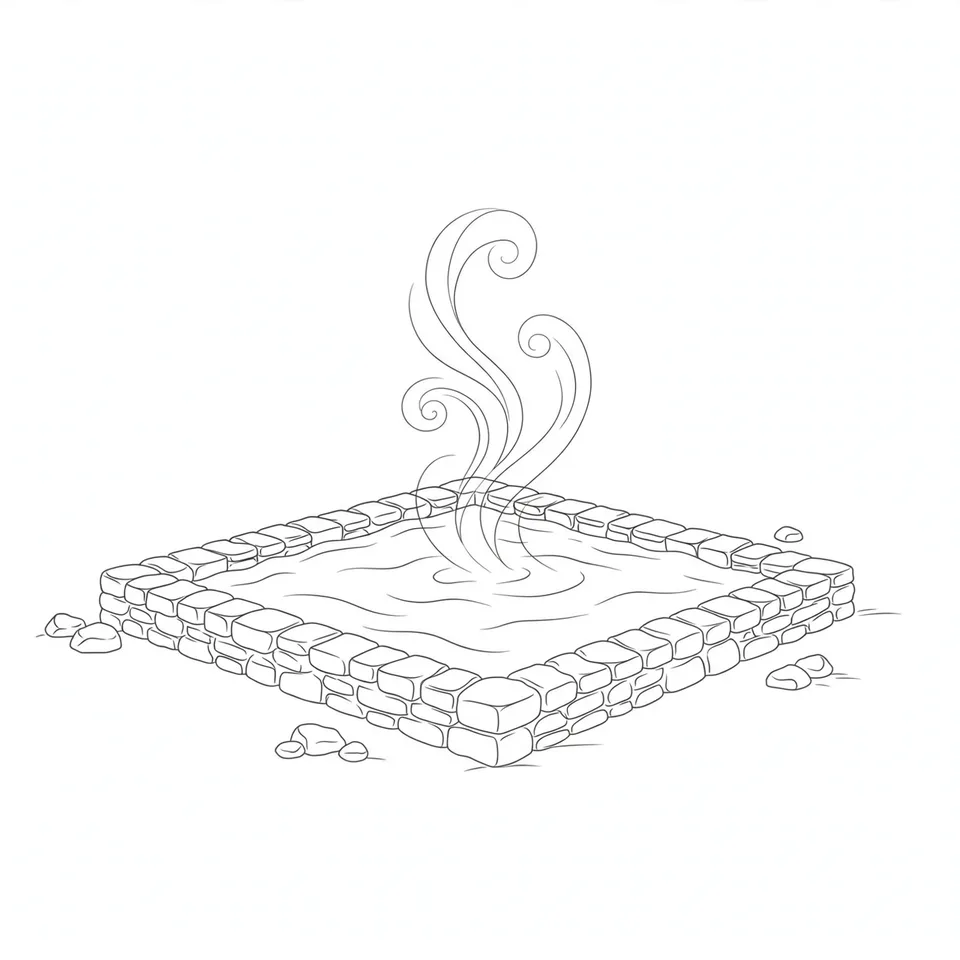
Japan sits on top of a volcano, and the whole country knows it. Hot water rises from the ground in almost every prefecture, and for more than a thousand years the Japanese have been getting into it, naked, together, and on purpose. An onsen is a natural hot spring bath, and it is not a bath you take to get clean. It is a ritual of hot water, strict manners, and doing nothing, and it is one of the most Japanese things there is.
Not a bath, a ritual
The first thing to understand is that you do not bathe in an onsen to get clean. The washing is done beforehand, at low showers along the wall, sitting on a small stool, scrubbing thoroughly and rinsing completely so that no soap ever reaches the spring water. Only then do you step into the bath, and only then do you soak. The water is for relaxing, not for washing, and that distinction is the whole point.
Japanese law defines an onsen precisely. Water counts as onsen if it emerges from the ground at 25 degrees Celsius or warmer, or if it carries a specified concentration of one of nineteen designated minerals, sulfur and iron among them. A sento, the everyday public bathhouse found in most Japanese cities, runs on ordinary heated water and keeps the same manners without the geology. The numbers are large. Japan has more than 27,000 hot spring sources and around 3,000 onsen towns, and the springs produce about 2.6 million liters of water every minute. Almost half of that water comes out hotter than 42 degrees.
A thousand years of soaking
The onsen goes back a long way. The earliest mention is in the Nihon Shoki, a chronicle written in the eighth century, which names three of Japan's oldest onsen: Dogo in Ehime, Shirahama in Wakayama, and Arima in Hyogo. All three are still open today. For centuries the onsen was mainly for the nobility and the warrior class, a luxury rather than a daily habit. It opened up to ordinary people when the railway network spread across Japan, and by the Edo period visiting hot springs had become common. A guidebook from 1810 introduced 292 onsen around the country, and by the late Edo period, onsen rankings printed like sumo tournament brackets were sold as souvenirs.
Most Japanese people still go for a bath at least once a day, and many go up to three times, before dinner, after dinner, and again in the morning. A trip to stay at an onsen ryokan, a traditional inn built around a spring, is called onsen ryokou, and it is one of the most common forms of domestic travel in Japan. You arrive, you bathe, you eat, you sleep, you bathe again.
The rules are the point
An onsen has a strict code, and first-time visitors are often surprised by how serious it is. You enter naked, no swimsuits, and men and women bathe separately, divided by noren curtains, women on the red side and men on the blue. Before entering, you wash at one of the low stations and rinse completely, then you pour a few scoops of the spring water over your shoulders, a custom called kakeyu, to meet the heat of the water. The small towel that comes with you is folded on your head or set on the stone edge, and it never goes into the water. You do not speak loudly, you do not swim or dive, you do not take photos, and you do not run, because the floor is wet and a fall is dangerous. You do not enter after drinking, because hot water makes you tipsy and taxes the heart. A soak of ten to twenty minutes is enough.
The rules sound strict, and they are, but they are not bureaucracy. They are what make the shared water work. A hundred strangers can sit in the same hot pool in silence, and it feels private, because everyone follows the same code. The manners are the reason the onsen feels calm rather than crowded.
There is one rule that still keeps some visitors out. Many shared onsen still ask guests with tattoos not to enter, a custom rooted in the association between tattoos and organized crime. A growing number of properties now allow tattoos or provide covers, and many ryokan offer a private bath for one party at any hour, which is the simplest workaround. If you have tattoos and you want to try an onsen, book a room with its own bath, or ask the inn in advance.
The outdoor bath
If you are offered a rotenburo, accept at once. A rotenburo is an outdoor bath, and it is the best part of the onsen. The indoor pool keeps its heat evenly and suits a short, deliberate soak, but the outdoor bath gives up its warmth to the air, which is why it comes into its own on a cold evening or in light snow, the steam lifting off the hot water into the cold. In autumn you sit in the water and watch the maple leaves turn red on the trees at the edge of the stone. In winter the snow covers everything while you are warm. There is also the ashiyu, a foot bath, where you sit on a bench and put just your feet in the water, which is the version for people in a hurry.
The famous onsen towns each have their own character. Beppu has the most hot spring sources in the country. Kusatsu is known for water so acidic it was once used to bleach cloth. Hakone sits in the mountains near Mount Fuji. Dogo, Shirahama, and Arima are the three named in the eighth century chronicle, and they are still going.
My take
What I like about the onsen is that it is a culture built around doing nothing, and doing it properly. There is no productivity in it, no goal, no score. You sit in hot water, you say nothing, you stay for ten minutes, and then you get out. The rules that look strict from the outside are really just a way of protecting that nothing, of making sure that a hundred strangers can share a small pool of hot water and each feel alone with their thoughts.
I think there is something wise in that. A lot of modern life is about adding things, more features, more speed, more noise. The onsen is the opposite. It is an old, simple thing, hot water and silence, and it has survived for more than a thousand years without needing to be improved. Some things do not need to be optimized. They just need to be kept, and the Japanese have kept this one very well.