The World's First Bullet Train
· 8 min read
In 1964, nine days before the Tokyo Olympics, Japan opened a train that went 210 kilometers an hour and had never been done before. Sixty years later, no passenger has ever died in a crash on it.
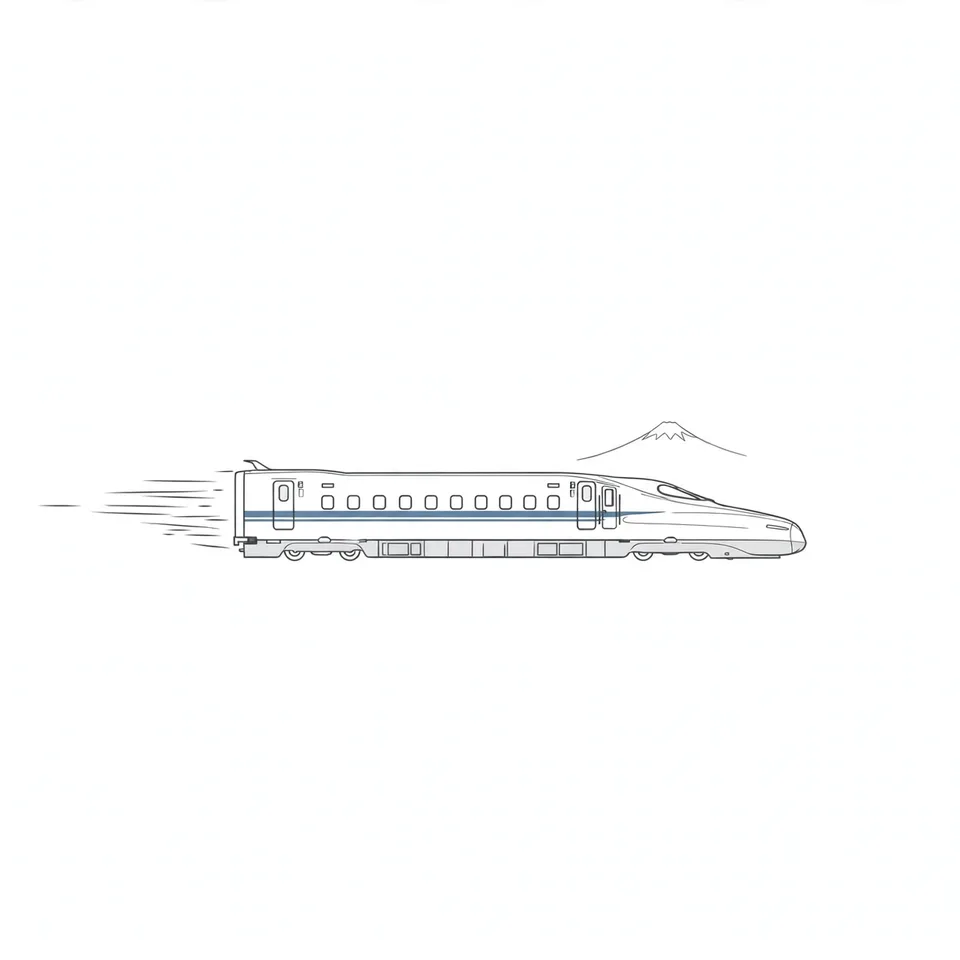
On October 1, 1964, nine days before the opening ceremony of the Tokyo Olympics, Japan launched a train that changed how the world thought about rail travel. It was called the Shinkansen, and it connected Tokyo and Osaka, 552 kilometers apart, in just over three hours. The fastest express train on the same route had taken more than six and a half hours. The new train went 210 kilometers an hour, it was sleek and white and blue, and the image of it flashing past Mount Fuji became one of the most famous pictures of the decade. The English-speaking world quickly gave it a nickname that stuck: the bullet train.
Nine days before the Olympics
The timing was not a coincidence. The 1964 Tokyo Olympics were the first Olympic Games ever held in Asia, and the first to be broadcast internationally, and Japan wanted the world to see a new country. The Shinkansen was the centerpiece of that message. It opened nine days before the Games began, so that the athletes, the journalists, and the tourists arriving for the Olympics would ride it, photograph it, and write about it. It worked. The train became the symbol of a Japan that had rebuilt itself after the war and was now building the future.
The line was called the Tokaido Shinkansen, and it was the world's first modern high-speed rail system. Plans for it had been conceived as early as the 1930s, but it took a particular kind of stubbornness to build it. In 1955, Shinji Sogo, the president of Japanese National Railways, promoted the idea of a dedicated high-speed railway, and he pushed it through the government despite strong opposition to its cost and scale. The line cost 380 billion yen to build, about one billion dollars at 1964 exchange rates, and part of the money came from the World Bank. It was an enormous bet for a country that was still rebuilding. I keep thinking about the confidence that took, to spend a billion dollars on a train that had never existed before, and to open it nine days before the whole world arrived to look at it. That is not caution. That is a country deciding what it wants to be, and then building it on a deadline.
The men who built it
The technical work was led by chief engineer Hideo Shima, a man who is now remembered as the father of the Shinkansen. Shima focused on three things: speed, safety, and comfort, and he designed the whole system around them rather than bolting them on afterward. The most important decision he made was that the Shinkansen would run on its own dedicated line, built from scratch, rather than sharing tracks with ordinary trains. That meant no level crossings, no freight trains, no slow local services getting in the way, and no possibility of a collision with another kind of traffic. It also meant the line could use standard gauge track, wider than the narrow gauge used by Japan's conventional railways, which made the trains more stable at speed.
The train itself was the 0 Series, and its most recognizable feature was the long, pointed nose. It was not styled that way to look fast. It was shaped in a wind tunnel, to cut through the air with as little resistance as possible, and the bullet shape is what gave the train its nickname. From the outset the line was fitted with an automatic train control system, which controlled the train's speed without lineside signals, so the driver could not accidentally run a red light, because there were no lights to run. The system was built to make the most dangerous mistakes impossible, rather than hoping that people would not make them. That is a design philosophy I admire, and it is the reason the safety record that follows is not luck.
Sixty years, zero deaths
The most extraordinary thing about the Shinkansen is not its speed. It is its safety record. Since the first Tokaido Shinkansen service in 1964, no passenger has ever been killed in a Shinkansen train accident, a derailment or a collision. That record has held for more than sixty years, across more than ten billion passenger journeys, in a country that experiences frequent earthquakes, typhoons, and heavy snow. No other high-speed rail system in the world has matched it.
The record needs to be stated carefully, because it has qualifications, and the qualifications make it more impressive rather than less. There have been deaths on Shinkansen platforms, including one in December 1995 when a young man was killed after being caught in a train door as it closed. And there has been one derailment, in 2004, when the Chuetsu earthquake shook a Joetsu Shinkansen train off the rails. The train remained upright, and no passengers were injured. After that earthquake, JR Central began installing derailment protection guards inside the running rails, so that a derailed train would be kept on the track rather than tipping over. The system learns from the one time it failed, and it changes.
The safety is built from layers. The dedicated line has no level crossings. The automatic train control governs speed. And there is an earthquake early warning system, called UrEDAS, with sensors placed along the tracks that detect seismic activity and automatically trigger emergency braking before the strongest shaking arrives. In a country where the ground moves, the train is designed to stop itself before the earthquake reaches it. That is not a single clever device. It is a whole system, built by people who assumed that things would go wrong and planned for it, and I think that is the real lesson of the Shinkansen. Safety is not a feature you add at the end. It is a decision you make at the beginning, about what you are willing to spend, and what you are willing to give up, to make sure that nobody dies.
The key dates
| Year | What happened |
|---|---|
| 1930s | Plans for a dedicated high-speed railway are first conceived |
| 1955 | Shinji Sogo promotes the high-speed railway and wins government approval |
| 1964 | The Tokaido Shinkansen opens on October 1, nine days before the Tokyo Olympics, at 210 km/h |
| 1965 | The Tokyo to Osaka journey is cut to 3 hours 10 minutes |
| 2004 | The Chuetsu earthquake derails a Shinkansen train, with no injuries |
| 2015 | The Hokuriku Shinkansen extends the network toward the Sea of Japan |
| Today | The fastest Shinkansen, the Hayabusa, runs at 320 km/h on the Tohoku line |
A train that is also a clock
The Shinkansen is famous for more than speed and safety. It is famous for being on time, to the second, and for being spotlessly clean. Each day nearly a quarter of a million passengers ride the Tokaido Shinkansen line, and at peak times a top-speed Nozomi train arrives up to every five minutes. The trains are cleaned and turned around in minutes, the seats face the direction of travel, and the conductors bow when they enter and leave each carriage. It is a system that treats punctuality as a form of respect, and the passengers return it by queuing neatly on the platform markings and boarding without pushing.
The network has grown far beyond the original Tokyo to Osaka line. It now stretches across the country, from Hakata in the south to Hokkaido in the north, and it carries people to hot spring towns, to ski resorts, to the cities where the festivals are. The fastest train in service today is the Hayabusa, which runs on the Tohoku line at up to 320 kilometers an hour. And the next step is already being built. JR Central is developing the L0 Series Maglev, a magnetic levitation train for the Chuo Shinkansen, which is designed to travel at 500 kilometers an hour, and JR East has said that driverless bullet trains could be introduced from the mid-2030s.
What I like about the Shinkansen is that it is not really about going fast. Going fast was the easy part, once the line was built. The hard part was everything around it: the decision to build a separate line, the willingness to spend a billion dollars, the wind tunnel, the automatic controls, the earthquake sensors, the cleaning crews, the bow of the conductor. A train that goes 210 kilometers an hour is an engineering achievement. A train that goes 210 kilometers an hour, on time, every five minutes, for sixty years, without killing anyone, is something else. It is a promise, kept so many times that people stop noticing it, and that is the highest compliment a piece of infrastructure can receive. It becomes invisible, not because it is unimportant, but because it works so well that you can forget it is there, and just get on, and go.