The Eruption That Changed the World
· 10 min read
In April 1815, a volcano on the Indonesian island of Sumbawa erupted so violently that it erased a kingdom, stole a summer from the entire Northern Hemisphere, and accidentally gave the world Frankenstein and the bicycle.
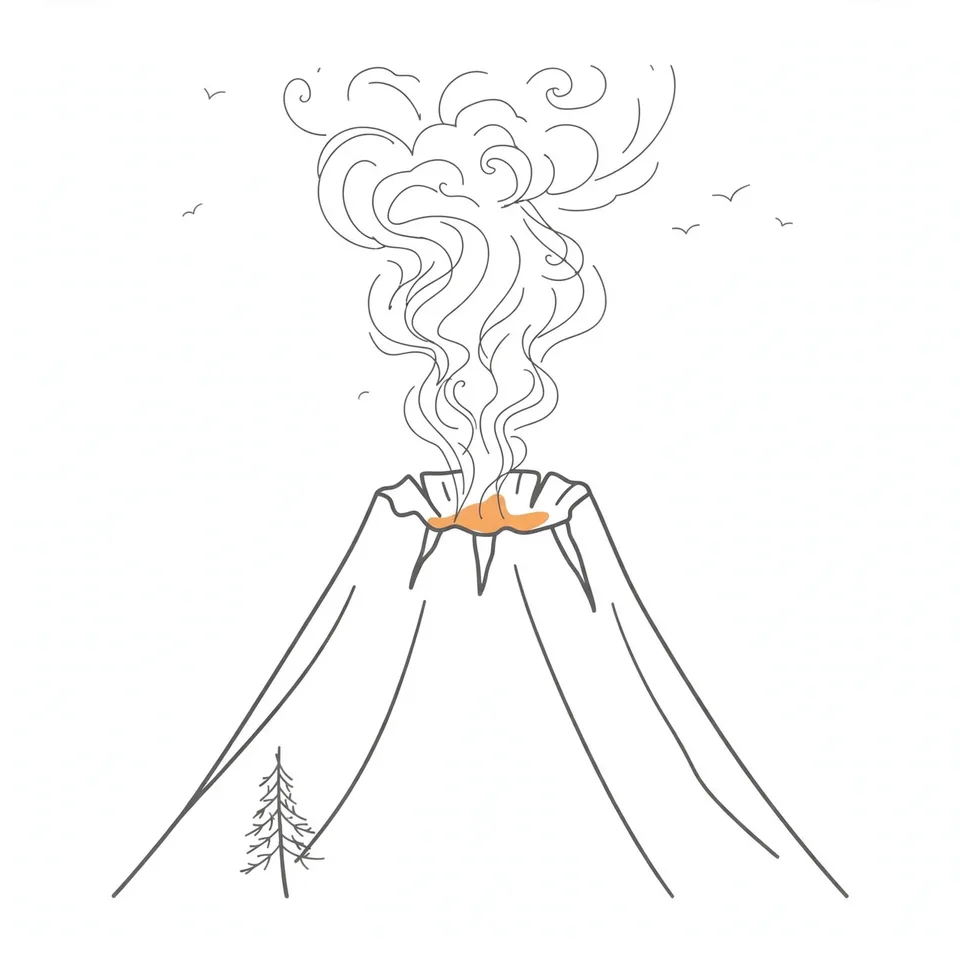
In April 1815, a mountain on the Indonesian island of Sumbawa exploded. It was the largest volcanic eruption in recorded human history, and it did not stay in Indonesia. The ash and gas it threw into the sky cooled the whole Northern Hemisphere, ruined harvests in Europe and North America, and turned 1816 into a year without a summer. In the cold and rain that followed, an eighteen-year-old named Mary Shelley wrote Frankenstein, and a German inventor named Karl Drais built the first bicycle. A volcano in Sumbawa changed the world, and most of the world never knew where it started.
The sound of cannon fire
Mount Tambora is a stratovolcano on the northern coast of Sumbawa, in what is now West Nusa Tenggara. Before 1815 it stood about 4,300 metres tall, one of the highest peaks in the Indonesian archipelago, and it had been quiet for roughly four hundred years. Signs of unrest appeared around 1812. Then, on 5 April 1815, the mountain exploded.
The sound carried across the archipelago. Thomas Stamford Raffles, the British lieutenant-governor of Java, heard it from 1,260 kilometres away and assumed it was cannon fire. He sent troops from Yogyakarta to find out who was fighting. At Makassar, 380 kilometres away, the commander of a British cruiser heard what he took for a naval engagement and sent a ship to investigate. On Ternate, 1,400 kilometres away, the British resident heard the same distant booming. The explosion was heard as far away as Sumatra, some 2,600 kilometres from the mountain. Nobody in those places knew yet that a mountain had come apart. Ash began falling in East Java the next day.
The first explosion was only a rehearsal. On the evening of 10 April, around seven o'clock, the mountain entered its climactic phase. Three colossal columns of ash and gas rose about 43 kilometres into the sky, and the summit collapsed inward. The eruption went on into 11 April and for days after, and the ash darkened large parts of the Indonesian archipelago for three days. When it was over, the mountain was 1,450 metres shorter than it had been. Where the peak used to be, there was a crater six kilometres wide.
A kingdom erased
The eruption is classified as VEI 7 on the Volcanic Explosivity Index, the highest rating ever recorded for an eruption in human history, and the most recent confirmed VEI 7 event on Earth. It threw around 150 cubic kilometres of ash, rock and pumice into the air, and around 60 million tonnes of sulfur dioxide into the stratosphere. It carried roughly four to ten times the energy of the Krakatoa eruption of 1883.
The human cost was the worst of any eruption on record. About 11,000 to 12,000 people died directly, killed by pyroclastic flows, tsunamis and roofs collapsing under the weight of ash. Then came famine and disease. Ash destroyed crops and poisoned water across Sumbawa, Lombok and Bali, and an estimated 49,000 to 80,000 more people died in the months that followed. The most cited total, from the volcanologist Clive Oppenheimer, is about 71,000 dead, though estimates range from 60,000 to more than 92,000.
The eruption did something no other eruption in recorded history has done. It erased a civilization. The kingdoms of Tambora and Pekat, on the slopes of the mountain, were obliterated. The kingdom of Tambora had about 10,000 people, and its ruler, Raja Abdul Gafur, was killed along with everyone who had not already fled. The people of Tambora spoke a language unlike any of their neighbours. It was a linguistic isolate, unrelated to Malay or to any other Austronesian language, and it may have been the last surviving pre-Austronesian language in central Indonesia. British officials who visited shortly before the eruption wrote down 48 words of it. That is all that survives.
The year without a summer
The sulfur dioxide Tambora put into the stratosphere turned into a thin veil of sulfate particles that circled the globe and reflected sunlight back into space. The Northern Hemisphere summer of 1816 cooled by about half a degree Celsius, which sounds small until you remember that a summer is built on small margins. It was the coldest European summer on record between 1766 and 2000.
In Switzerland it rained for 130 days between April and September, and Lake Geneva flooded. In New England, snow fell in June, and killing frosts came in June, July and August, ruining crops that farmers had already planted. Harvests failed across Europe and North America. Grain prices doubled, and in some places tripled. There were food riots, and people left their homes in search of food. Historians estimate 100,000 to 200,000 excess deaths in Europe alone from famine, typhus and disease in the two years that followed. Some researchers also link the climate disruption to the first cholera pandemic, which began in Bengal in 1817, though that connection is still debated.
Nobody in 1816 knew what had caused it. The link between a volcano in Indonesia and a cold summer in Europe was not understood for more than a century. People blamed sunspots, lightning rods, and the will of God. The world was hungry, and it had no idea why. I find that part almost as striking as the eruption itself. The largest volcanic event in recorded history happened on a small island, and the people suffering its consequences on the other side of the world had no way of knowing it existed.
A monster is born in Geneva
The summer of 1816 was supposed to be warm and social. Instead it was cold, dark and relentlessly wet, and a small group of writers found themselves trapped indoors on the shore of Lake Geneva in Switzerland. Lord Byron had rented the Villa Diodati. His physician, John Polidori, was with him. Nearby, Percy Bysshe Shelley had rented a cottage, travelling with his eighteen-year-old companion, Mary Godwin, who would become Mary Shelley.
Mary wrote to her half-sister on 1 June that an almost perpetual rain confined them principally to the house. To pass the time, Byron suggested that each of them write a ghost story. Mary thought about it for days, and then she had a nightmare about a pale student of unnatural arts kneeling beside the thing he had assembled, and the creature showing signs of life. She turned the nightmare into a novel. Frankenstein, or The Modern Prometheus, was published anonymously in 1818, and it has never gone out of print. Polidori, in the same house, started the story that became The Vampyre, the direct ancestor of every modern vampire tale. The painter J. M. W. Turner, meanwhile, was painting sunsets made lurid by the same volcanic dust that had ruined the summer.
There is a strange symmetry in it. A volcano destroyed a kingdom in Indonesia, and in the cold that followed, a teenager in Switzerland invented modern science fiction. The monster in Frankenstein is not really the point of the book. The point is the man who made it and then abandoned it, and the book is still read two hundred years later because that is a story about responsibility, and responsibility does not go out of date.
The bicycle
The same cold summer that kept Mary Shelley indoors was starving horses in Germany. The failed harvests of 1816 drove up the price of oats, the fuel of every horse, and horses died of hunger or were slaughtered for meat and hides. Karl von Drais, a German inventor and forestry official in the state of Baden, watched the shortages and began thinking about what could replace the horse for short journeys.
His answer was a wooden frame with two wheels in a line, a padded saddle, and a handlebar to steer the front wheel. There were no pedals, no chain, and no engine. The rider sat on it and pushed along the ground with their feet, like walking, only faster. Drais called it the Laufmaschine, the running machine. On 12 June 1817, he rode it from Mannheim to Schwetzingen and back, about 14 kilometres, in under an hour. He patented it the next year, and in France it became known as the velocipede. In England it was mocked as the dandy horse.
Historians are careful about this one. The evidence that Tambora caused Drais to invent the bicycle is circumstantial, not a letter in which he says so. But the historian Hans-Erhard Lessing, who has pieced together Drais's story, finds it persuasive, and the timing is hard to ignore. Drais had tried to replace the horse before, and given up. It was the brutal weather after Tambora, and the price of oats climbing to a new high, that brought him back to the idea. The bicycle, the machine that would eventually carry billions of people, may have been born because a volcano made it too expensive to feed a horse.
The key dates
| Year | What happened |
|---|---|
| 1812 | Tambora shows signs of unrest after about 400 quiet years |
| 5 Apr 1815 | First major explosion; the sound is heard 2,600 km away and mistaken for cannon fire |
| 10-11 Apr 1815 | Climactic eruption, VEI 7; the mountain loses 1,450 m of height and a 6 km crater forms |
| 1815-1816 | Famine and disease kill tens of thousands on Sumbawa, Lombok and Bali |
| 1816 | The Year Without a Summer; the coldest European summer on record |
| 1816 | Mary Shelley writes Frankenstein at the Villa Diodati on Lake Geneva |
| 12 Jun 1817 | Karl Drais rides the first Laufmaschine from Mannheim to Schwetzingen |
| 1818 | Frankenstein is published anonymously; Drais patents the velocipede |
| 1967 | Tambora erupts for the last time, a small VEI 0 event |
What is left
Mount Tambora is still there. It stands 2,850 metres tall now, and its crater is a place people hike to, a national park of more than 70,000 hectares. Its last eruption was in 1967, a small one. The mountain is quiet, and the island around it is green again.
What stays with me is how far the consequences travelled. A mountain in Sumbawa killed tens of thousands of people who lived near it, and then its ash crossed the sky and changed the weather for people who had never heard of Sumbawa. It wrote a novel, and it may have invented the bicycle. The same volcanic forces that did all of that also heat the water in Japan's hot springs, and they are so woven into daily life in Indonesia that people run marathons in their shadow. A volcano can destroy a kingdom and give the world a monster and a bicycle in the same breath, and two hundred years later we are still living with what it did. That is the part worth remembering. The eruption was not just a disaster in Indonesia. It was a moment when the whole world turned out to be connected, and it took a volcano to prove it.