The Dragons That Still Walk the Earth
· 8 min read
On a handful of small Indonesian islands lives the world's largest lizard: a three-metre, venomous predator that can smell a carcass from kilometres away, and females can have babies without a male.
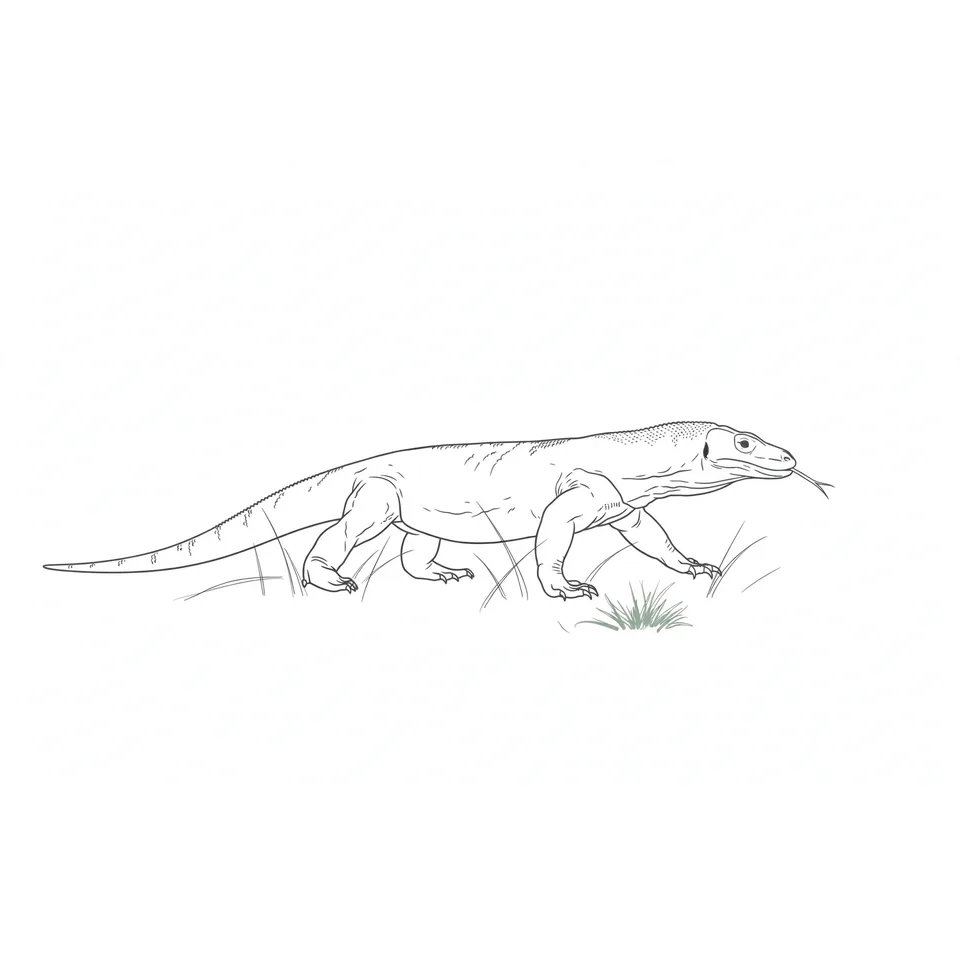
On a handful of small islands in eastern Indonesia, there lives an animal that sounds like it belongs in a storybook. It is three metres long, weighs as much as a person, hunts deer and wild pigs, and has a venomous bite. It is the largest lizard on Earth, and it lives nowhere else. Its name is the Komodo dragon.
The dragon is not a dinosaur, and it is not a myth. It is a monitor lizard, a cousin of the much smaller lizards that bask on rocks across Asia and Australia. But on a few dry, isolated islands, with no large predators to compete with, it grew enormous. It is one of the strangest animals in Indonesia, and one of the most surprising, because almost everything people think they know about how it kills is wrong.
The Largest Lizard on Earth
An adult male Komodo dragon is typically 2.5 to 3 metres long and weighs 70 to 90 kilograms. Females are smaller, usually under 2.5 metres. The largest verified specimen measured 3.13 metres and weighed 166 kilograms, a male given by the Sultan of Bima to an American zoologist in 1928. It is the heaviest lizard on the planet.
It lives wild on only five islands: Komodo, Rinca, Gili Motang, Nusa Kode, and parts of western and northern Flores, all in East Nusa Tenggara, the same island chain as Mount Tambora. It used to live on Padar too, but no dragon has been seen there since the 1970s. The islands are hot, dry, and covered in savanna and low forest, a landscape that suits a cold-blooded predator.
There are not many of them left. The IUCN, which tracks endangered species, estimates fewer than about 1,400 mature adults in the wild, and park counts put the total, including young dragons, at about 3,400. In 2021 the IUCN moved the species from Vulnerable to Endangered, citing habitat loss, rising seas, and pressure on the deer and pigs the dragons eat. A dragon can live about 30 years in the wild, but it takes around eight to nine years to reach full size, so every adult matters.
A Bite That Bleeds, Not a Dirty Mouth
For most of the twentieth century, everyone believed the Komodo dragon killed with a filthy mouth. The story went that its saliva was thick with deadly bacteria, so a single bite meant a slow death by infection. The prey, a deer or a pig, would weaken over days, and the dragon would follow its scent until it collapsed.
That story was wrong. In 2009, a team led by herpetologist Bryan Fry at the University of Queensland used MRI scans to look inside a Komodo dragon's skull, and found something no one had seen before: venom glands in the lower jaw. The venom is not injected like a snake's. It seeps from grooves between the teeth into the wound as the dragon bites and tears. It stops blood from clotting and drops blood pressure, so the wound keeps bleeding and the victim goes into shock. A 2007 study had already shown that the bacteria in a dragon's mouth are ordinary carnivore bacteria, no worse than those of any other large predator. The killing mechanism is venom. The bacteria are passengers.
The dragon's bite force is modest for an animal of its size. A crocodile of similar size bites far harder. The dragon instead relies on about 60 serrated teeth, a slashing bite, and patience. It is an ambush predator: it waits beside a trail, lunges, bites the legs or belly of its prey, and then lets the venom do its work. If the animal escapes, the dragon follows it by smell. Its forked tongue collects scent from the air and carries it to the Jacobson's organ in the roof of its mouth, and the two tips of the tongue tell it which direction the smell comes from. It can pick up the scent of a carcass from four kilometres or more downwind.
Its diet is whatever it can catch or find dead: Timor deer above all, then wild pigs, water buffalo, and goats. A dragon can eat up to 80 percent of its own body weight in a single meal, and it can run at up to 20 kilometres per hour in a short burst, which is faster than it looks.
The Young Live in Trees
A Komodo dragon's childhood is dangerous, and the danger comes from its own kind. Adults eat young dragons, and juveniles make up about 10 percent of an adult's diet. So a hatchling, about 40 centimetres long when it emerges from the egg, climbs straight into a tree and stays there. Young dragons spend their first years in the trees, eating insects, geckos, and birds' eggs, safe from the adults below. When they must come down to feed at a carcass, they roll in faeces and gut contents, which seems to put the adults off.
The females have one more surprise. In 2006, two female Komodo dragons in British zoos, Flora at Chester Zoo and Sungai at London Zoo, laid eggs despite never having been near a male. Genetic testing, published in the journal Nature, confirmed the eggs had only their mothers' DNA. The females had reproduced without a male, through a process called parthenogenesis, or virgin birth. Because of the way Komodo dragon sex chromosomes work, every viable offspring from parthenogenesis is male. A female alone can produce sons, and when those sons grow up, they can become her mates. It is a backup plan for an animal that lives on isolated islands, and it has been confirmed in zoos several times since, most recently in China in early 2026.
From Rumour to Science to King Kong
For a long time, the Komodo dragon was only a rumour. Local people on Flores knew about the giant lizards, but the outside world did not. That changed in 1910, when a Dutch colonial officer, Lieutenant Steyn van Hensbroek, heard tales of a "land crocodile" and led an expedition to Komodo Island. He caught a specimen about 2.1 metres long and sent it, with photographs, to Peter Ouwens, the director of the zoological museum in Bogor, Java. In 1912, Ouwens published the first scientific description and gave the animal its name: Varanus komodoensis. The Dutch government protected it in 1915.
The dragon then did something no other lizard has done: it inspired a Hollywood monster. In 1926, an American adventurer named W. Douglas Burden led an expedition to Komodo and brought back 12 preserved specimens and two live ones. He wrote a book about the journey, Dragon Lizards of Komodo, and the filmmaker Merian C. Cooper read it. Cooper's first idea was a film about a gorilla brought to Komodo to fight a dragon. The idea grew, the dragon was replaced by dinosaurs, and the film became King Kong, released in 1933. Three of Burden's specimens are still on display at the American Museum of Natural History in New York.
Indonesia created Komodo National Park in 1980 to protect the dragon and the sea around it. In 1991, UNESCO listed the park as a World Heritage Site, and the dragon was declared a national animal of Indonesia. In 2011, the park was named one of the New7Wonders of Nature.
| Year | What happened |
|---|---|
| 1910 | Hensbroek hears of giant lizards and visits Komodo |
| 1912 | Peter Ouwens describes the species as Varanus komodoensis |
| 1915 | The dragon is first protected by law |
| 1926 | Burden's expedition brings specimens to America, inspiring King Kong |
| 1980 | Komodo National Park is established |
| 1991 | UNESCO lists the park as a World Heritage Site |
| 2021 | The IUCN moves the species from Vulnerable to Endangered |
How to See One
The only way to see a Komodo dragon in the wild is to visit Komodo National Park, and the gateway is Labuan Bajo, a fishing town on the western tip of Flores. From there, boats run to Komodo and Rinca, where rangers lead short treks from the ranger stations. The dragons are often near the stations, basking in the sun, and the rangers keep visitors at a safe distance. They are wild animals, and they are fast when they want to be.
Indonesia has no shortage of reasons to visit, from the Borobudur Marathon in Central Java to the dragons of Komodo. But the dragons are different from a race or a temple. They are an endangered animal, and the park exists because Indonesia chose to protect it. The dragons have survived for millions of years on a few small islands, through isolation, through the loss of their habitat, and through a world that keeps getting warmer and more crowded. They are not dinosaurs, and they are not monsters. They are lizards that grew large because nothing else on their islands could stop them, and they are still here, walking the dry grass, flicking their forked tongues at the wind.
I think that is the real wonder of the Komodo dragon. It is not that it is big, or venomous, or that it inspired King Kong. It is that it exists at all, on five small islands in eastern Indonesia, and that you can still go and see it, in the wild, with a ranger beside you and a dragon a few metres away.