Why Japan Has a Vending Machine on Every Corner
· 7 min read
Japan has about 2.6 million vending machines, roughly one for every 48 people. They sell hot coffee in winter, free drinks in a disaster, and almost anything else you can imagine.
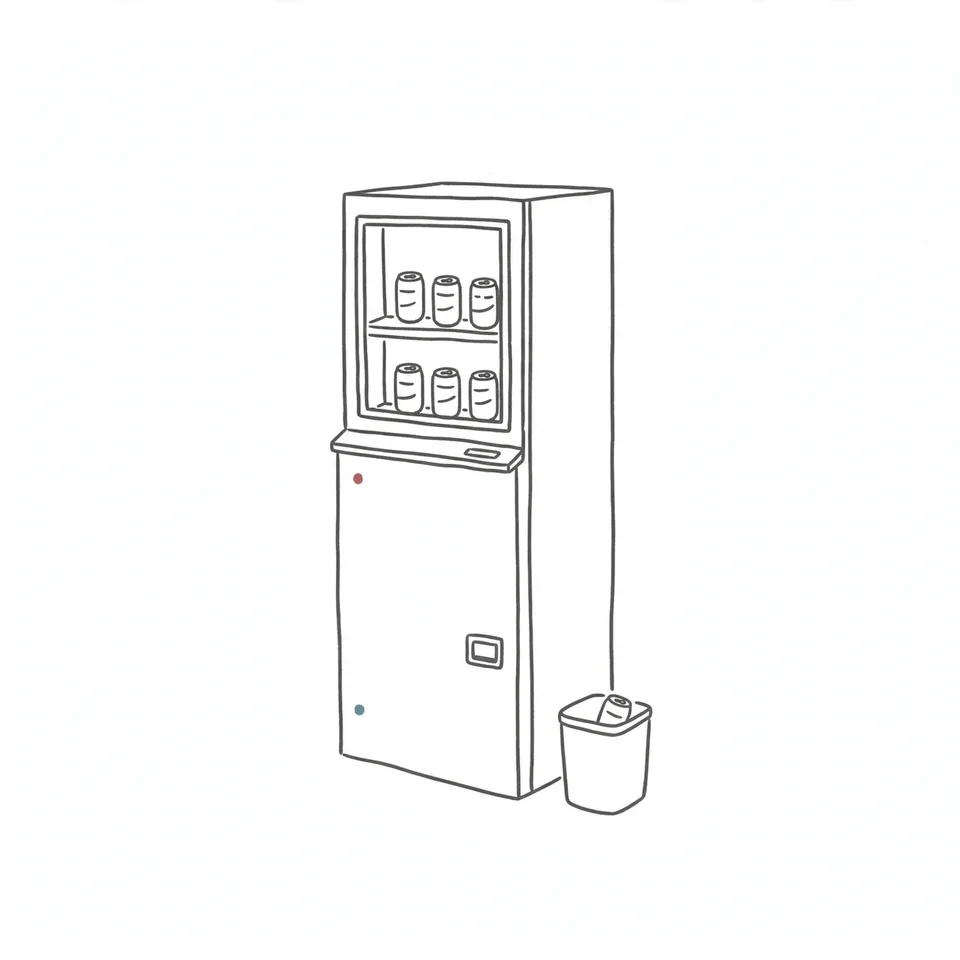
Walk down almost any street in Japan and you will pass a vending machine. Then another. Then another. They glow on dark residential streets, stand beside rice fields in the countryside, and wait at the top of mountain trails. Japan has about 2.6 million vending machines, roughly one for every 48 people, and most of them sell drinks around the clock.
They are easy to dismiss as a quirk, a photo opportunity for tourists. But they are more than that. They are infrastructure: a hot drink on a freezing morning, a cold bottle of water on a humid afternoon, and in a disaster, a source of free drinks when the shops are closed. The reason they work in Japan, and almost nowhere else at this scale, has less to do with technology than with trust.
How Many Machines Are There, Really
The number most people quote, "over five million," is out of date. According to the Japan Vending System Manufacturers Association, Japan had 2,585,200 vending machines at the end of 2025. Of those, 2,178,800 sold drinks, and 81,100 sold food. Add in automatic service machines like coin lockers and change machines, and the wider total reaches 3,881,700.
The total has been shrinking for years. It peaked at about 5.1 million in 2013, and the decline has two causes: Japan's population is falling, and convenience stores have spread into every neighbourhood. A konbini sells more, stays open just as late, and does not need a machine on every corner. Yet the vending machine survives, because it does something a shop cannot: it waits, silently, in places where a shop would never open.
The density is still unmatched. The United States has more machines in total, about 6.9 million, but spread across a far larger population. In Japan, there is roughly one vending machine for every 48 residents. In the US, the figure is closer to one for every 146 people.
It Started With Tobacco in 1888
The vending machine was not invented in Japan. The first one ever recorded stood in a temple in ancient Egypt around 215 BC, dispensing holy water. But Japan made the idea its own, and it started with tobacco.
In 1888, a furniture designer and inventor named Tawaraya Koshichi built a machine that sold cigarettes, and filed a patent for it the same year. He also built a wooden dispenser for stamps and postcards, using the mechanics of traditional karakuri dolls, the wind-up automatons of old Japan. That machine, built in 1904, was the first vending machine to actually go into service in Japan. The oldest surviving example still sits in the Postal Museum in Tokyo.
The modern boom came much later, and it came from America. Coca-Cola began the modern boom in 1962, installing its own machines by the tens of thousands and selling pre-bottled drinks instead of the old squirt of juice into a paper cup. Cans followed in the mid-1960s. Hot canned drinks arrived in 1972, and two years later came the machine that defines the Japanese vending machine today: one box that sells hot and cold drinks side by side.
| Year | What happened |
|---|---|
| 1888 | Tawaraya Koshichi patents a tobacco vending machine |
| 1904 | The first stamp and postcard dispenser goes into service |
| 1962 | Coca-Cola kicks off the modern vending boom |
| 1972 | Hot canned drinks arrive |
| 1974 | The first machine sells hot and cold drinks together |
| 2011 | Disaster-relief machines prove their worth after the Tohoku quake |
Hot and Cold in the Same Box
If you cannot read Japanese, you can still use a vending machine. Cold drinks carry a blue label. Hot drinks carry a red one. In winter, the same machine that sold iced tea in August will be full of hot coffee, hot green tea, and even hot corn soup. In summer, it switches back.
The prices are modest, usually 100 to 200 yen for a drink. Most machines take coins, IC cards, and QR code payments. The cans are small, the bottles are cold, and the machine is always on. It is a small thing, but on a winter morning in Shizuoka, when the wind comes off the mountains, a hot can of coffee from a machine on an empty street feels like a small kindness.
They Sell Almost Anything
Drinks are the main business, but the machines sell far more than drinks. Food machines number about 81,100, and they dispense instant noodles, frozen food, ice cream, and snacks. Step away from the standard drink machine and the range gets stranger: fresh eggs, bananas, bags of rice, flowers, umbrellas, toys, and even live crabs. There is a vending machine at the summit of Mount Fuji.
This is where the konbini comparison breaks down. A convenience store has a manager, a staff, and a closing time. A vending machine has none of those, so it can sit on a mountain, in a car park, or at the end of a country road, selling to whoever passes. The machines change their stock with the seasons, and the companies that run them, names like Coca-Cola, Suntory, Kirin, Asahi, and DyDo, treat each machine as a tiny shop of its own.
When Disaster Strikes, They Give Drinks Away
The most serious thing a vending machine does in Japan has nothing to do with selling. Some machines are built for disasters. When an earthquake of magnitude 5 or higher strikes, they switch into disaster mode and give their drinks away for free.
There are three ways this happens. Some machines receive an emergency release command over the network from the local government or the operating company. Some are unlocked with a special key by a designated local administrator. The newest models detect the shaking themselves, and switch to free mode on their own battery or a hand-cranked generator when the power goes out.
The idea took hold after the 2011 Tohoku earthquake and tsunami, which killed nearly 20,000 people. The drinks company DyDo DRINCO began building disaster-relief machines in earnest after that disaster, placing them in school grounds, coastal towns, and office districts. Coca-Cola distributed more than seven million bottles of drinks after the 2011 quake, including free drinks from its vending machines. Some machines also broadcast free Wi-Fi under the name 00000JAPAN, and display evacuation shelter locations on an electronic sign.
It is a strange thought: a machine built to take your coins, designed to give everything away the moment things go wrong. But that is the point. In a country where the next big earthquake is a matter of when, not if, a vending machine is also a piece of emergency infrastructure, waiting quietly on a street corner.
Why It Only Works in Japan
So why does Japan have a vending machine on every corner, and other countries do not? The machines are not the hard part. Any country can build a box that sells drinks. The hard part is leaving it alone.
A vending machine on a dark street is an invitation to steal from it, break it, or tip it over. In Japan, that almost never happens. The machines sit unguarded, full of cash, in places where nobody is watching, and they survive. That is not a technology story. It is a trust story, built on low crime and a long tradition of mujin hanbai, selling without a person present, that goes back to unmanned farm stands in the countryside.
There are practical touches too. Most drink machines have a recycling bin beside them for empty cans and bottles, because public rubbish bins are rare in Japan. The machines themselves have become far more efficient: a modern can and bottle machine uses about 725 kilowatt hours of electricity a year, and the industry says electricity use per machine has fallen by about 77 percent since 1991.
I think the vending machine is the most honest symbol of everyday Japan. It is not a temple or a bullet train. It is a small, glowing box that does one job, all day and all night, in heat and snow, and asks for nothing more than a coin. Most countries could build one. Very few could leave it alone on a dark street and expect it to still be there in the morning.