Ikigai, the Japanese Idea of a Reason to Live
· 8 min read
Ikigai is the Japanese idea of a reason to live, and it is not the four-circle diagram you have seen online. The real concept is smaller, older, and more useful than the viral version.
There is a Japanese word for the reason you get up in the morning. It is ikigai, and it has become one of the most shared ideas about Japan in the English-speaking world. You have probably seen it as a diagram: four overlapping circles labeled what you love, what you are good at, what the world needs, and what you can be paid for. There is only one problem with that diagram. It is not Japanese.
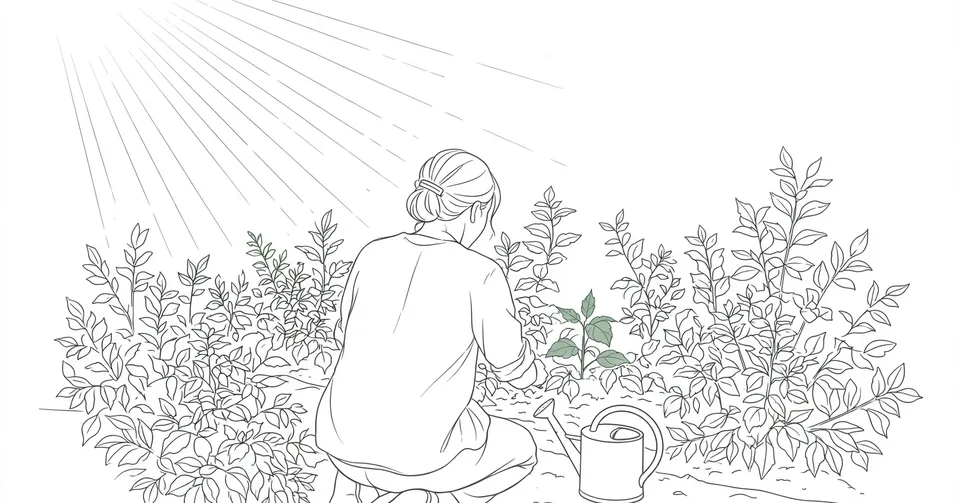
The real ikigai is older, smaller, and harder to draw. It is an everyday Japanese word, studied by a psychiatrist in the 1960s, and it describes something most Japanese people find in ordinary life: a garden, a grandchild, a morning cup of tea, a craft done well. It does not require a perfect career or a grand purpose. It requires only something that makes the day worth living.
What Ikigai Actually Means
Ikigai combines two Japanese words: iki, meaning life or alive, and gai, meaning worth or value. Put together, they mean roughly a reason for being, or that which makes life worth living. The Oxford English Dictionary defines it as a motivating force, something or someone that gives a person a sense of purpose or a reason for living.
The word is old and ordinary. It has been part of everyday Japanese for centuries, and it is not a formal philosophy with a canonical text. It is a folk concept, the kind of word people use without thinking about it, until someone asks what it means.
The person who gave the concept its depth was Mieko Kamiya, a psychiatrist who published a book called Ikigai ni tsuite, meaning On Ikigai, in 1966. Kamiya argued that it has two faces: the source of the value you find in life, and the feeling that your life has value because that source exists. The source can be a person, a craft, a role in a community, or a morning ritual. The feeling is the quiet sense that what you do matters. In 2022, the Japanese government described it in the same spirit, as that which brings value and joy to life, from people such as children or friends to activities including work and hobbies.
The Diagram That Is Not Japanese
The four-circle diagram is everywhere, and it is the reason most people outside Japan have heard of it. It looks authoritative, with its neat circles and its promise that your purpose sits where four things overlap. But the diagram did not come from Japan, and it does not describe what Japanese people mean by ikigai.
The diagram began as a purpose diagram by Andrés Zuzunaga, a Spanish astrologer, in 2011. In 2014, Marc Winn, a British blogger, adapted it and attached the word ikigai to it. The combination went viral, and a bestselling book by Héctor García and Francesc Miralles in 2016, Ikigai: The Japanese Secret to a Long and Happy Life, carried the four-circle version to millions of readers.
The problem is not that the diagram is useless. It is a decent career exercise. The problem is that it changes the concept. The diagram insists that your purpose must be something you can be paid for, which turns it into a test of whether your job is meaningful. The real thing has no such requirement. For many Japanese people, ikigai is a morning cup of tea, a garden, or time with grandchildren, not a perfectly aligned career. The diagram also makes it sound like a single grand calling you must discover. The real thing is usually small, daily, and particular.
Five Pillars, Not Four Circles
A better guide to ikigai comes from Ken Mogi, a Japanese neuroscientist who wrote The Little Book of Ikigai in 2017. Mogi is explicit that the four-circle diagram was created in 2014 by a Westerner and conflated with the Japanese word. Instead of circles, he offers five pillars, which he presents as a daily practice rather than a puzzle to solve.
The five pillars are starting small, releasing yourself, harmony and sustainability, the joy of little things, and being in the here and now. Starting small means beginning with the tiniest possible step, like getting up early to enjoy a quiet morning. Releasing yourself means letting go of ego and attachment to outcomes. Harmony and sustainability means it should fit your community and your environment, not extract from them. The joy of little things is the daily fuel: savored tea, a flower, a walk. Being in the here and now means it is a present-tense practice, not a future-tense goal.
Mogi stresses that the pillars are not mutually exclusive or exhaustive, and they have no particular order or hierarchy. Two activities in his book meet all five pillars: the traditional Japanese tea ceremony, and the act of becoming a sumo wrestler. Both are slow, detailed, communal, and fully present. That is the point. Ikigai is not something you find once. It is something you practice every day.
Ikigai and a Longer Life
Ikigai is often linked to longevity, and the link is real, though it needs care. Okinawa, in southern Japan, is one of the world's Blue Zones, regions where people live unusually long lives. The island has about 24.55 people over the age of 100 for every 100,000 inhabitants, far above the global average. Researchers who study Okinawa point to diet, community, and a sense of purpose together, not purpose alone.
The research on purpose and mortality is consistent. The Ohsaki Study followed more than 43,000 Japanese adults for seven years and found that those who reported no sense of ikigai had about 50 percent higher risk of dying during the study than those who did, after accounting for age, smoking, physical activity, and other factors. A meta-analysis pooling ten prospective studies with more than 136,000 participants found that a stronger sense of purpose was associated with about 17 percent lower risk of dying from any cause, and a similar reduction in major cardiovascular events. Another study found that having a sense of purpose was associated with a 31 percent lower risk of functional disability and a 36 percent lower risk of developing dementia over three years.
These numbers deserve honesty. They show association, not proof that purpose alone causes a longer life. The strongest studies on purpose used large populations outside Okinawa, and longevity in Okinawa comes from many things at once: diet, lifelong social groups called moai, daily activity, and a sense of purpose. Ikigai is a useful lens on why people live well, not the single explanation. But the pattern is hard to dismiss. People who feel their life has a point tend to live longer and stay sharper, and that is true whether the purpose is a garden or a grandchild.
Finding Your Own Ikigai
If ikigai can be small, then finding it is easier than the diagram suggests. It does not have to be a career, and it does not have to be impressive. The Japanese psychologist Michiko Kumano describes ikigai as wellbeing from small things and being alive. Research in the journal Frontiers in Psychology found that ikigai in Japanese people is most strongly associated with daily routine, relationships, and small pleasures, not achievement or recognition.
Start with what already gives your morning a shape. It might be a walk, a cup of tea, a plant you tend, or a person you look after. Like an onsen, it works best as a ritual you return to, not a goal you chase. Even a cold drink from a vending machine on a hot day can be the kind of small pleasure Mogi means, if you actually stop and enjoy it.
Ikigai changes across a lifetime. What gives a young person purpose is rarely what gives an older person purpose, and that is normal. The concept makes room for that. It does not ask you to find one thing and hold it forever. It asks you to notice what makes today worth living, and to do a little more of it tomorrow. That is a smaller ask than the diagram makes, and it is a kinder one. A purpose you can find in a garden is a purpose you can actually live with.
| Year | What happened |
|---|---|
| Heian period | The word ikigai is already in everyday Japanese use |
| 1966 | Psychiatrist Mieko Kamiya publishes Ikigai ni tsuite, the first academic study |
| 2008 | The Ohsaki Study links ikigai to lower mortality in 43,000 Japanese adults |
| 2011 | Spanish astrologer Andrés Zuzunaga creates a purpose diagram |
| 2014 | Blogger Marc Winn adapts the diagram and attaches the word ikigai |
| 2017 | Neuroscientist Ken Mogi publishes The Little Book of Ikigai with five pillars |
More in Culture & Society
Latest posts
- Cat Island Japan, Where Cats Outnumber People
- Why Rendang Was Named the World's Best Food
- The Dragons That Still Walk the Earth
- Why Japan Has a Vending Machine on Every Corner
- How Karaoke Conquered the World
- The World's First Bullet Train
- How a Bowl of Noodles Changed the World
- Why Japan's Hot Springs Are a Way of Life
- The QR Code Was Invented in Japan
- What It Really Costs to Live in Tokyo
- Japan's Autumn Leaves and Where to Find Them
- Chasing the Sunrise at the Borobudur Marathon
- Walang Kekek and the Woman Behind Indonesia's Keroncong
- No Na, Indonesia's First Global Girl Group