Chakubarai, the Japanese Way to Make the Receiver Pay for Delivery
· 7 min read
Chakubarai means the person receiving a parcel pays the shipping fee, not the sender. It is a normal option in Japan, and it is not the same as cash on delivery.
If you send a parcel in Japan, the person at the counter will ask you a question that has no exact equivalent in English. Do you want to pay now, or should the person receiving it pay? The second option has its own word: chakubarai. It means the recipient pays the shipping fee when the parcel arrives, and it is one of the most useful words a foreign resident in Japan can learn.
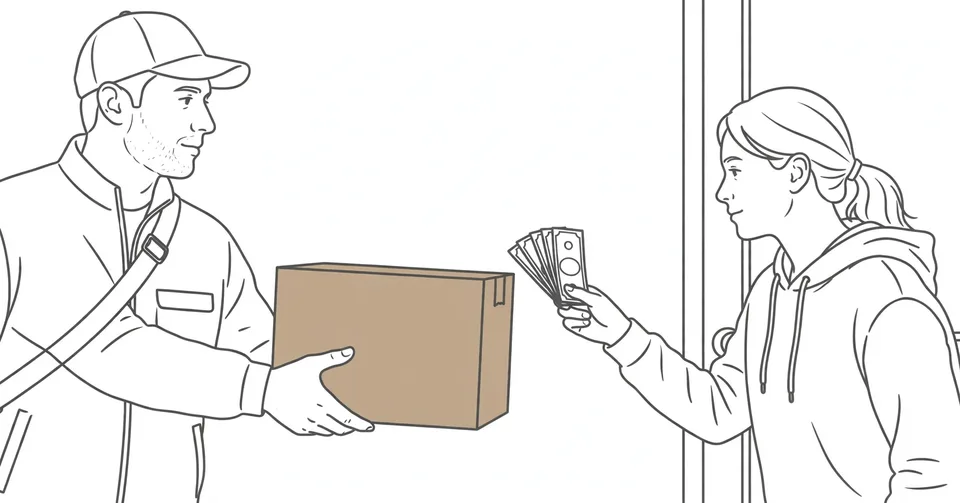
Chakubarai is not free shipping, and it is not cash on delivery. Those are the two mistakes people make with it. It is simply a choice about who pays the transport charge, and once you know the word, sending and receiving parcels in Japan becomes much easier.
What Chakubarai Means
Chakubarai is written 着払い. The first character, 着, means to arrive. The second part, 払い, means to pay. Put together, the word means the payment is made on arrival, by the person receiving the parcel. When you choose it, you hand over the parcel and pay nothing at the counter. The driver collects the shipping fee from the recipient at the door.
The opposite is motobarai, written 元払い and also written 発払い. It means the sender pays the shipping fee at the time of shipping. Motobarai is the default and the most common arrangement in Japan. Every standard waybill is a motobarai form unless you specifically ask for a chakubarai form instead. The two words are a pair, and you will see them on every parcel form in the country: 元払い for sender pays, 着払い for recipient pays.
The price of the parcel is the same either way. It depends on the size of the box, the total of its length, width, and height, and on the distance it travels. It changes only who pays, not how much the delivery costs.
Chakubarai Is Not Cash on Delivery
The confusion starts because it and cash on delivery both involve paying at the door. They are not the same thing. It only covers the shipping fee. Cash on delivery, called daibiki in Japanese, short for 代金引換, covers the price of the goods.
Daibiki means the carrier collects a specified payment for the sender when delivering the goods. The driver takes the money for the item itself and sends it to the seller. It means the driver collects only the transport charge. The item itself must already be paid for, or paid for separately.
Here is the difference in practice. Suppose you bought an item for 3,000 yen and agreed to pay 800 yen for shipping. With chakubarai, you pay the driver 800 yen, not another 3,000 yen. Your total is 3,800 yen. With daibiki, the driver would collect the price of the item as well, plus the service fees. Japan Post is clear on this distinction: daibiki cannot be made chakubarai, and the sender initially pays the postage for a daibiki parcel. If someone offers you a parcel and says the payment is chakubarai, they are talking about the delivery fee only. If they mean the price of the item, the word is daibiki.
How to Send a Parcel Chakubarai
Sending a parcel this way is almost the same as sending one the normal way, with one difference: you need the right form. Both Yamato Transport and Japan Post use a special dedicated chakubarai waybill, separate from the standard prepaid form. Ask for it at the counter, or say "chakubarai de onegai shimasu", which means please send it recipient-paid.
The waybill, called an okurijo or denpyo, asks for the recipient's postal code, address, name, and phone number first, then your own details as the sender. You can select a preferred delivery date and a time slot. At Yamato, you can also fill in the details in advance with their app and show a QR code at the store, which saves time at the counter. You can drop off a parcel at a post office, a carrier's office, or a convenience store, or book a pickup.
The main carriers all support it. Yamato Transport, known as Kuroneko for its black cat logo, runs TA-Q-BIN, the most widely used door-to-door service, for parcels from size 60 up to size 200, with a combined length, width, and height of up to 200 centimeters and a maximum weight of 30 kilograms. Japan Post's Yu-Pack accepts parcels up to 170 centimeters combined and 25 kilograms. Sagawa Express handles much of the business shipping in Japan, including many online orders. Chakubarai is available for Yu-Pack, Yu-Packet, and Yu-Mail at Japan Post, but ordinary letters cannot use it.
When to Use Chakubarai
Use chakubarai when the recipient has agreed to cover the cost. That agreement is the whole point, and Japan Post requires it. The most common cases are easy to recognize. A shop asks you to return a faulty item and pays the return shipping, so the shop sends you a chakubarai label. You buy something secondhand on Mercari and choose the option where the buyer pays the shipping. You send a parcel to someone who asked for it and offered to pay the delivery.
Never use it as a surprise. If the recipient refuses a chakubarai parcel and it is returned, the sender is charged the shipping fee. That rule exists because the system runs on trust: the sender assumes the recipient expects the parcel and expects to pay. A chakubarai parcel arriving unannounced is the delivery equivalent of sending someone a bill they never agreed to. If you are the sender, confirm the amount and the arrangement first. If you are the recipient, ask the sender for the shipping charge before the parcel arrives, so you can prepare the payment separately from anything you already paid for the item.
What It Costs the Receiver
The receiver pays the normal postage for the parcel, based on its size and the distance, plus any applicable handling fee. For Japan Post's Yu-Pack, there is no additional chakubarai handling fee on top of the postage itself. The postage still applies, and the usual discounts do not: parcels paid by the recipient get no discount, including the bring-in discount for dropping a parcel off yourself.
Payment is flexible. For a chakubarai Yu-Pack, postage stamps can be used to pay the shipping charge, and stamps and cash can be combined. The driver collects the money at the door. If you are out when the parcel arrives, the driver leaves a missed-delivery slip, called a fuzai renrakuhyo, and you can request redelivery, called saihaitatsu, online, by phone, or through the carrier's app, using the number on the slip.
| Option | Who pays | What is paid |
|---|---|---|
| Chakubarai (着払い) | Recipient, on arrival | Shipping fee and any handling fee |
| Motobarai (元払い) | Sender, at the counter | Shipping fee |
| Daibiki (代引き) | Recipient, on arrival | Price of the goods, plus fees |
Chakubarai is a small word, but it says something about how Japan works. The country runs on systems that are precise, polite, and built on agreement, from the way a parcel is labeled to the way a fee is collected at the door. Knowing the word does not just save you money at the counter. It lets you send things the way Japanese people send things, with the cost going to the person who agreed to pay it.
More in Life & Style
Latest posts
- Cat Island Japan, Where Cats Outnumber People
- Ikigai, the Japanese Idea of a Reason to Live
- Why Rendang Was Named the World's Best Food
- The Dragons That Still Walk the Earth
- The Eruption That Changed the World
- How Karaoke Conquered the World
- The World's First Bullet Train
- How a Bowl of Noodles Changed the World
- The QR Code Was Invented in Japan
- What It Really Costs to Live in Tokyo
- Why Japan's Convenience Stores Are a Destination
- Japan's Autumn Leaves and Where to Find Them
- Chasing the Sunrise at the Borobudur Marathon
- Walang Kekek and the Woman Behind Indonesia's Keroncong
- No Na, Indonesia's First Global Girl Group