A Kakejiku Turns a Blank Wall Into a Conversation
· 23 min read
A kakejiku is a Japanese hanging scroll that turns one bare wall into a place for a poem, a painting, or a single line of calligraphy, and it asks for nothing more than a quiet look.
A blank wall in a Japanese room is not an accident. It is a decision, and a kakejiku is often the reason the decision works. One vertical scroll, hung alone on pale plaster, can hold a whole room together. It gives the eye somewhere to rest, and it gives the people in the room something to talk about without saying a word first.
A kakejiku is a Japanese hanging scroll, a painting or a piece of calligraphy mounted on paper or silk so that it can be hung on a wall and rolled away for storage. The word is often used interchangeably with kakemono, which means a hanging thing, while kakejiku means a hung scroll. The difference is small, and in everyday use the two words point at the same object. What matters is what the scroll does. It turns a wall from a boundary into a meeting place.
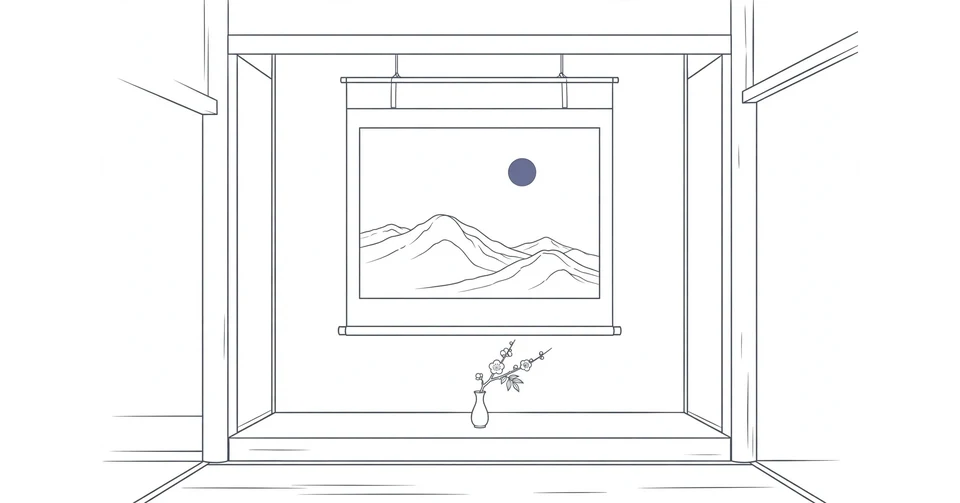
The scroll does its work quietly. It does not shout, it does not glow, and it does not compete with the furniture. A visitor notices it the way you notice a person who is listening carefully, not because they are loud but because they are fully present. That is the first lesson of the kakejiku. A room does not need more things in it. It needs one thing chosen with care.
What a kakejiku actually is
At its simplest, a kakejiku is a work of art with a built in frame and a built in way to disappear. The central panel, called the honshi, holds the painting or the calligraphy. Around it sits the mounting, a border of paper or cloth that frames the work and protects it. A wooden rod runs along the bottom, and a cord at the top lets the whole thing hang from a single hook. When the season changes, or the guests change, or the mood of the house changes, the owner rolls the kakejiku up, ties it, and puts it away in a wooden box. The wall goes blank again, and waits for the next scroll.
This roll away quality is easy to overlook, and it is the heart of the form. A framed picture on a Western wall tends to stay where it is put, year after year, until the people in the house stop seeing it. A kakejiku refuses that fate. It is hung for a time, looked at properly, and then stored. Its absence is part of its value. When it returns, months later, it feels fresh again, because the eye has had time to forget it. I think there is a gentle wisdom in that rhythm. We keep too many things on permanent display in our lives, and we wonder why they stop moving us. The kakejiku suggests a different habit. Put the beautiful thing away sometimes, so that meeting it again feels like a meeting.
The mounting itself is a craft, known as hyoso, and it has its own vocabulary. In the maruhyoso style, which is one of the best known forms, the top section is called the ten, meaning heaven, and the bottom section is called the chi, meaning earth. Pillars called hashira run down the sides. A narrow strip of fine cloth, often gold brocade, sits just above and below the central work, and it is called the ichimonji. At the bottom, a cylindrical wooden rod called the jikugi acts as the axis around which the scroll rolls, and the knobs at its ends, called jiku, serve as handles when the scroll is rolled and unrolled. Small decorative pieces with tassels, called fuchin, hang from the top rod. Each part has a job, and each part has a name, and the names remind you that nothing on a kakejiku is accidental.
Look closely at the proportions and you will see a small piece of thoughtfulness. In the maruhyoso style, the ten at the top is longer than the chi at the bottom. The reason is practical and human. Scrolls were traditionally viewed from a kneeling position, seated on tatami, and the longer upper section corrected the perspective so that the central work sat comfortably in view. A kakejiku is not only made to be looked at. It is made to be looked at by a person sitting on the floor, at ease, with time to spare. That detail tells you everything about the pace the object expects from you.
From a sutra to a living room wall
The story of the kakejiku begins long before it reached Japan. The mounting of painting and calligraphy is thought to date back to the Tang dynasty in China, and the hanging scroll may have developed out of the mounted sutra, a sacred text that used a cylindrical bar at the end around which the scroll was rolled for storage. The format made holy images portable, and portability mattered. A painting that could be rolled up could travel from temple to temple, from teacher to student, from one generation to the next, without needing a wall of its own.
The Japanese art dictionary JAANUS traces how this Chinese form arrived in Japan along with Esoteric Buddhism during the Heian period, which ran from 794 to 1185, and how it became more common in the Kamakura period, from 1185 to 1333. At first, the scrolls were objects of worship, hung in the central position of a Buddhist hall or on a partition wall in a temple room. A Buddhist kakejiku might show a buddha, a bodhisattva, or a religious founder such as Bodhidharma, and when it served as the main object of worship it could be called by names such as Gohonzon. The scroll was not decoration. It was the focus of the room, the thing the room was built around.
Change came in the Muromachi period, from 1336 to 1573, under the influence of Zen. The scroll moved out of the temple hall and into the reception room, and its meaning softened without losing its depth. According to JAANUS, the kakejiku became connected with the tea ceremony in this period, and scrolls began to be appreciated as works to be viewed for their aesthetic quality alone rather than purely as images of worship. That shift is one of the great quiet revolutions in Japanese art. A sacred object learned how to be beautiful in an ordinary room, and an ordinary room learned how to hold something sacred without turning into a temple.
The architecture followed the scroll. With the establishment of the shoin-zukuri style, the palatial residential style of the Muromachi period, the kakejiku came to be hung in the tokonoma, the small raised alcove that became the focal point of the Japanese reception room. The shapes complemented one another. The tall, narrow scroll fitted the tall, narrow alcove, and the alcove gave the scroll a home that was neither a temple nor a bare wall. The standard display in a tokonoma, as described in the bayu.id article on that alcove, is a hanging scroll and a flower arrangement, and the scroll sets the tone for everything else in the room. If you want to understand why the kakejiku matters, start there, in the tokonoma that turns one corner of a Japanese room into a shrine. The alcove is the stage, and the kakejiku is very often the actor on it.
Wikipedia notes that the origin of the kakejiku is said to date back to the Nara period, from 710 to 794, which is earlier than the Heian arrival described by JAANUS. The two accounts are not quite in conflict. They reflect different ways of drawing the line between a Buddhist scroll used in worship and the mounted hanging scroll as a distinct art form. The conservative reading, and the one I would trust, is that scrolls arrived with Buddhism and took centuries to become the domestic object we recognise today. Origins in Japan are often like that, layered rather than dated to a single year, and the kakejiku carries those layers in its very shape. It is a temple object, a Chinese import, a Zen teaching tool, and a piece of interior design, all rolled into one tube of paper and silk.
Reading the mount like a frame that speaks
Most visitors look straight at the painting or the calligraphy in the middle of a kakejiku, and that is natural. The centre is where the artist worked. But the mount around it is worth a slow look too, because it tells you how formal the occasion is, and how the owner wants you to read the work.
Japanese mounting recognises three broad modes, called shin, gyo, and so, which translate roughly as formal, semi-formal, and informal. Each mode can be divided further, and the choice of mode depends on the work itself and on the purpose for which it will be hung. A formal shin mounting, with rich brocade and a full set of elements, suits a formal reception or a religious image. A casual so mounting, simpler and lighter, suits a quiet tea gathering among friends. The scroll, in other words, dresses for the occasion, the way a host dresses for guests. You would not wear the same clothes to a wedding and to a morning walk, and a kakejiku does not wear the same mount to a formal ceremony and to a relaxed afternoon.
The parts of the mount reward attention. The ichimonji strips, in the best cloth, draw a clean line above and below the central work, like a pause before and after a sentence. The chuuberi, the cloth that runs alongside the work on all four sides, is usually a little plainer than the ichimonji, and the outer jouge sections are plainer still. Two long, narrow strips called fuutai hang from the upper crosspiece, their length matching the height of the upper mounting. On the back, a thin section of silk called the makiginu remains visible when the scroll is rolled, protecting the work and marking the roll as finished. None of this is ornament for its own sake. It is a system for giving the central image room to breathe, and for telling the viewer, before a single word is read, how seriously to take what follows.
There is also a practical lesson in the mount. A kakejiku is fragile by design. Paper and silk, ink and light colour, do not survive careless handling. The mount protects the edges, the rod keeps the roll tight, and the box keeps out dust and damp. A scroll that is looked after can outlive its owner by centuries, and many have. A scroll that is left hanging in direct sunlight, or unrolled on a damp floor, will fade and stain within a few years. The craft of mounting is therefore also a craft of care, a promise that the object will be handed on in good condition. I find that promise moving. In a world that treats most things as disposable, the kakejiku is built on the assumption that someone in the future will want to unroll it, and that we owe that person a scroll worth unrolling.
What hangs on a kakejiku
The subjects mounted as a kakejiku cover almost the whole range of Japanese art. Landscapes and bird-and-flower paintings are common, as are portraits of Buddhist figures, sketches made from life, and fragments of old documents and letters. Single line calligraphy is a subject in its own right. A single character, or a short phrase brushed in ink, can fill the whole central panel, and the empty space around the strokes does as much work as the ink itself. Old letters or poems by Zen monks, known as bokuseki, are especially prized, because the brushwork carries the personality of the writer in a way that a printed text never can.
Some scrolls stand alone, called doppuku. Others come in sets. A pair is called soufuku, a triptych is called sanpukutsui, and sets of four, six, eight, or twelve exist as well, for subjects such as the four seasons, the eight views of a landscape, or the twelve months. Certain subjects lend themselves to these formats. A tiger and a dragon make a natural pair, one fierce and one fluid, and the deity Kannon with a monkey and a crane makes a natural triptych. The set is hung together, and the wall becomes a small gallery with a single theme running through it.
The subject is rarely chosen at random. In a tea room, the scroll is chosen for the season, for the guests, and for the occasion, and the choice is a form of communication. A painting of plum blossom in late winter says that spring is near. A line of calligraphy about the moon says that tonight is for looking up rather than looking down at a phone. A Buddhist image says that this gathering has a reflective purpose. The host does not need to explain any of this. The scroll explains it, silently, to anyone who takes the time to look. That is why the title of this article calls the kakejiku a conversation. It does not speak out loud, but it starts one, and the people in the room finish it among themselves.
The seasonal habit is worth pausing on. A kakejiku is changed with the seasons, and sometimes with the occasion, so that the wall never grows stale. A scroll of cherry blossom hangs in spring, a cool waterfall in summer, red maple in autumn, and a bare branch or a line about snow in winter. The rhythm follows the year outside the window, and the room stays in step with the world beyond it. This is a small discipline, and it is easy to dismiss as fussiness, but I think it is the opposite. It is a way of paying attention to time passing, and of marking that passage with something beautiful rather than letting the months blur together. A house that changes its scroll with the seasons is a house that notices what season it is.
The kakejiku and the flower beside it
A kakejiku rarely hangs alone in a formal setting. In the tokonoma it is paired with ikebana, the Japanese art of flower arrangement, and the pairing is deliberate. The scroll gives words or images, the flowers give living nature, and the empty wall between them gives both room to breathe. The two objects balance one another. The scroll is flat, still, and made by human hands. The flowers are three dimensional, alive, and already beginning to fade. Together they form a tiny landscape, a mountain of ink above and a branch of the season below, and the viewer stands between them, part of the scene rather than outside it.
The discipline behind that pairing runs deep. If you want to understand the flower half of the arrangement, the bayu.id article on ikebana and the quiet discipline behind Japan's flower art is a good companion to this one. Ikebana is not flower decoration in the Western sense. It is a practice of choosing one stem, cutting it at the right angle, and placing it so that the empty space around it matters as much as the flower itself. The kakejiku works the same way. Both arts trust emptiness, and both arts ask the viewer to slow down.
The great tea master Sen no Rikyu, who shaped the tea ceremony in the sixteenth century, argued for an alcove of austere elegance, one scroll and one vase holding tea flowers, nothing more. His version of the alcove was a protest against display for its own sake, and it set the tone for the tea room for centuries after him. The lesson travels well beyond the tea room. A kakejiku and a single branch can say more than a wall full of objects, because the eye has somewhere to rest and the mind has somewhere to wander. Abundance is not the same as richness, and the scroll proves it every time it hangs alone.
How to hang, roll, and care for a kakejiku
Hanging a kakejiku looks simple, and it is, once you know the small rules. The cord at the top, called the kakehimo, goes over a hook or a nail, and the scroll hangs straight down, its bottom rod resting lightly against the wall. The scroll should hang flat, without curling at the edges, and it should sit at a height where a seated person can read it comfortably. In a tokonoma, the scroll hangs at the back of the alcove, centred, with the flower arrangement in front of it and to one side. Nothing else crowds it. The empty wall around it is part of the display.
Rolling the scroll away is the part that worries new owners, and the worry is understandable. Paper and silk feel fragile in the hands. The method is gentle and unhurried. Hold the top rod with one hand, guide the roll with the other, and roll from the bottom upward, keeping the tension even so that the scroll rolls straight. The jiku knobs at the ends of the bottom rod give you something to hold. Never press hard on the central painting, never fold the scroll, and never leave it unrolled on the floor where someone might step on it. When it is rolled, tie it loosely with its cord, slide it into its wooden box, and store the box flat in a dry place, away from direct light. A scroll that is rolled and stored properly will last. A scroll that is left hanging for months in a sunny room will fade, and fading cannot be undone.
There are a few honest warnings worth giving. A genuine antique kakejiku is not a cheap souvenir, and the market has its share of reproductions and damaged pieces sold as treasures. The price of an old scroll depends on the artist, the age, the condition, and the quality of the mounting, and a buyer who does not know these things should buy from a dealer they trust, or not buy at all. A modern reproduction, honestly sold as one, is a fine way to start. It lets you live with the form, learn how it changes a room, and decide whether the habit of changing a scroll with the seasons suits your life, before you spend serious money. There is no shame in starting with a copy. The shame would be in buying a fake at the price of a real one, or in hanging a beautiful old scroll in a bathroom where steam will ruin it within a year.
For a first scroll, the subject matters more than the price. Choose something you can live with and look at slowly. A single line of calligraphy that you half understand is better than a busy painting that tires the eye. A simple landscape with plenty of empty space is better than a crowded scene. A seasonal subject, plum or maple or moon, gives you a reason to change the scroll when the season turns, and that reason will teach you the habit. Hang it where you sit in the evening, not where guests glance at it on their way past. A kakejiku is for the people who live in the room, first and foremost, and guests are welcome to share in it.
A kakejiku in a modern home
It is fair to ask whether a kakejiku still has a place in a modern home, far from a tatami room and a tokonoma. The honest answer is yes, with a little translation. The scroll does not need an alcove to work. It needs a bare wall, a single hook, and a room that is willing to leave some space empty. A kakejiku hung in a modern living room, above a low table or beside a window, does the same job it does in a traditional house. It gives the room a focal point that is quiet rather than loud, and it gives the people in the room something worth looking at slowly.
The scroll also travels well across cultures, because its appeal is not tied to knowing Japanese. You do not need to read the calligraphy to feel the balance of the brushstrokes, and you do not need to know the name of the painter to feel the calm of a misty mountain. The kakejiku is one of those Japanese forms, like the tea bowl or the stone garden, that speaks before it is explained, and the explanation, when it comes, deepens the feeling rather than replacing it. That is a rare quality, and it is why the scroll has found homes far from Japan, in apartments and offices where no one has ever sat in seiza.
There is a practical side to this, too. A modern home is often full of screens, and screens demand attention in a way that a scroll never does. A television glows, a phone buzzes, a laptop waits with its tabs open. A kakejiku asks for the opposite kind of attention, the kind you give to a view from a window. You glance at it, you look away, and later you glance again, and each glance finds something slightly different, because the light has changed or your mood has changed. I keep coming back to this contrast, because it feels like the real argument for the scroll today. We do not need another object that competes for our attention. We need one object that rewards it, gently, without asking for anything in return.
If you do hang a kakejiku in a modern room, give it the same respect it gets in a traditional one. Hang it alone, not crowded between posters and shelves. Keep it out of direct sunlight, and away from radiators and damp walls. Change it when the season changes, even if the change is only to roll it away and leave the wall blank for a while. The blank wall is not a failure. It is the scroll resting, and the room resting with it. A home that can leave a wall blank for a month is a home that trusts its own quiet.
Why one scroll is enough
There is a temptation, when you first fall for the kakejiku, to collect them quickly, to fill every wall with scrolls, to turn the house into a gallery. Resist it, at least at first. The form works because it is singular. One scroll, one wall, one season, one conversation. Two scrolls on the same wall argue with one another. Three turn the room into a shop. The discipline of the kakejiku is the discipline of choosing, and choosing means leaving things out. The collector who owns twenty scrolls and hangs one at a time understands the form better than the collector who hangs all twenty at once.
This discipline extends beyond the wall. The kakejiku teaches a way of looking that applies to the rest of life. Look at one thing properly, rather than glancing at ten things quickly. Keep the beautiful thing for a season, then put it away and miss it a little. Let the empty space do some of the work. These are small habits, and they sound almost too simple to matter, but they add up to a different kind of attention, one that is patient rather than hungry. In a culture that rewards speed and volume, patience is a quiet form of resistance, and the scroll is one of its oldest teachers.
The scroll also teaches something about conversation itself. A kakejiku does not tell you what to think. A line of calligraphy might be a Zen phrase, a poem, or a single word such as dream, moon, or emptiness, and each visitor reads it differently. One person sees a hope, another sees a warning, and a third sees only beautiful ink. None of them is wrong. The scroll starts the conversation and then steps back, the way a good host starts a discussion and then listens. A wall full of explanations would leave nothing to talk about. A single scroll leaves everything to talk about, and that is why it turns a blank wall into a conversation rather than a lecture.
I think that is the deepest reason the kakejiku has survived for so many centuries, through changes of religion, architecture, and taste. It is not only a beautiful object. It is a beautiful habit, a way of arranging a room and a day around one quiet thing. The habit survived the move from temple to tea room, and from tea room to modern apartment, because the need it answers has not changed. People still want a place in the house where the eye can rest, and where a guest can be greeted without words. The scroll provides that place, and it asks for very little in return. A hook, a bare wall, and a few minutes of attention now and then. That is a fair trade, and it is one that more homes could afford to make.
A quiet wall, a longer look
A kakejiku will not change your life on its own. It will not make a small room large, or a busy household calm, or a difficult winter easy. What it will do, if you let it, is give one wall in your home a purpose beyond holding up the roof. It will give you a reason to notice the season, a reason to sit down for a few minutes without a screen, and a reason to ask a guest what they see in a line of ink or a painted mountain. Those are small reasons, and they are enough.
Hang the scroll, step back, and look at it the way its makers intended, slowly, from a seated position, with nothing else competing for your eye. Notice the mount, the proportions, the space around the strokes, and the way the bottom rod holds the whole thing steady. Then roll it away when the season turns, and leave the wall blank for a while. The blankness is part of the work. When the next scroll goes up, you will see it with fresh eyes, and the conversation will start again, in a different season, with different guests, and with a slightly different you. That is the whole art of the kakejiku, and it has been enough for a thousand years.
More in Culture & Society
- A Shoji Lets the Daylight In While Keeping the World Out
- A Tokonoma Turns One Corner of a Japanese Room Into a Shrine
- Fusuma Turn a Room Into Whatever Japan Needs Next
- Wearing a Happi Means You Belong to the Matsuri
- Washi Paper and the Thousand-Year Craft Behind Japan's Toughest Sheets
- Chusonji Is the Mountain Temple That Outlasted Its Golden Age
Latest posts
- Japanese Video Games and How a Small Island Rewired Play
- A Sudare Turns Harsh Sunlight Into a Cool Breeze
- Himeji Castle, Japan's White Heron That Survived War and Fire
- A Genkan Is Where Japan Leaves the Outside World at the Door
- A Ranma Lets a Japanese Room Breathe Over the Top of Its Walls
- Japanese Breakfast and the Morning Meal That Starts with Rice and Soup
- A Yuzamashi Cools the Water Before the Tea Begins
- Tencha Is the Shade-Grown Leaf Matcha Is Made From
- Taiko Drums and the Thunder That Shook Japanese Festivals
- A Kyusu Is the Small Teapot Behind Every Good Cup of Sencha
- Shincha Is the First Flush Japan Waits All Winter For
- Gyokuro Earns Its Price One Shade-Grown Leaf at a Time
- Sencha Is the Green Tea Japan Drinks Every Single Day
- Mugicha Is the Barley Tea Japan Pours All Summer Long
- Bancha Is the Everyday Tea Japan Drinks Without Thinking