Washi Paper and the Thousand-Year Craft Behind Japan's Toughest Sheets
· 13 min read
Washi paper has carried Japanese writing, light, and art for more than 1,300 years, and the handmade sheets still outlast most modern paper.
A sheet of washi paper looks too fragile to trust. Hold it up to the light and you can see the fibres, long and loose, like a net that was never quite finished. Yet this is the paper that has carried Japanese writing for more than 1,300 years, and the oldest datable sheet still survives from the year 702. Washi paper is not delicate in the way it seems. It is tough in a quiet way, the kind of toughness that comes from long fibres, cold water, and hands that refuse to hurry.
The short answer is that washi paper is traditional Japanese paper made by hand from the inner bark of three plants, the paper mulberry called kozo, the mitsumata shrub, and the gampi tree. UNESCO inscribed the craftsmanship of washi paper on its Representative List of the Intangible Cultural Heritage of Humanity in 2014, and extended the listing in December 2025. That recognition covers three named traditions and the communities that keep them alive, not every sheet sold under the name. Still, the craft itself is easy to admire: a sheet of washi paper can last a thousand years, it filters light instead of blocking it, and it is still made one sheet at a time.
I first met washi paper the way most visitors do, without noticing it. It was the sliding screen in a ryokan, glowing softly in the morning, and the lantern swaying over a restaurant doorway. Only later did I learn that the same material was also behind the calligraphy scrolls in museums, the prints of old Tokyo, and the repairs holding together damaged paintings in the Louvre. Washi paper hides in plain sight, and that is part of its charm.
What Washi Paper Actually Is
The word washi simply means Japanese paper. It came into common use in the late nineteenth century, when Western style paper, called yoshi, arrived in Japan and people needed a word to tell the two apart. But the material itself is far older than the name. Washi paper is formed from bast fibres, the useful tissue that sits just inside the bark of a plant, rather than from the wood itself. That difference is the whole story. Wood pulp paper is ground into short, uniform bits. Washi paper keeps its fibres long, and long fibres tangle into a sheet that bends instead of breaking.
The three fibres most often named are kozo, mitsumata, and gampi. Kozo, the paper mulberry, gives the strongest and most common sheets. Mitsumata gives a softer, finer surface that takes ink beautifully, which is why it has long been used for banknotes. Gampi gives a smooth, slightly glossy sheet that resists insects and water, and it was once the paper of choice for fine writing. A papermaker may use one fibre or blend them, and each region has its own recipe, passed down through families and workshops.
Washi paper is not one product. It is an umbrella term for dozens of local papers, each with its own weight, colour, and character. Some sheets are thick enough to patch a wall. Some are so thin you can read through them. What they share is the method, and the method is what UNESCO chose to protect. If you want the full reference entry, the Wikipedia article on washi paper lays out the fibres, the history, and the three UNESCO listed traditions in one place.
How Washi Paper Reached Japan
According to the Nihon Shoki, the chronicle of Japan compiled in 720, papermaking reached Japan from China in 610, brought by Buddhist monks travelling through the Korean Peninsula. At first the paper served religion. It carried sutras as Buddhism took root, and that was enough to make it precious. The oldest datable sheet of washi paper is a census document from 702, kept in the Shosoin, the imperial storehouse in Nara.
Japanese papermakers did not simply copy the Chinese method. Around 805 to 809 they developed a technique called nagashi-suki, a way of forming sheets by dipping a bamboo screen into a vat of fibres suspended in water thickened with a plant mucilage called neri, then shaking the screen until the fibres settled into an even layer. The mucilage slows the water down, so the fibres have time to spread and tangle. The result is a sheet that is stronger, thinner, and more even than the older method could produce.
Over the centuries, washi paper spread from the court to the samurai and then to ordinary people. In the Heian period, from 794 to 1185, it was the paper of the nobility. From the Kamakura period onward, as power shifted to the samurai, its use spread with them. By the Edo period, from 1603 to 1868, washi paper was everywhere: in homes, in shops, in schools, in temples. Until Japan modernised in the Meiji era, it was simply what paper meant.
How a Sheet of Washi Paper Is Made
Making washi paper is slow work, and the slowness is deliberate. It begins in the fields, where kozo branches are cut, steamed, and stripped of their bark. The outer bark is scraped away and only the white inner bark is kept. That bark is boiled, washed in clear running water, and beaten by hand until the fibres separate into soft strands. Nothing here is ground or shredded. The fibres stay long, because their length is the point.
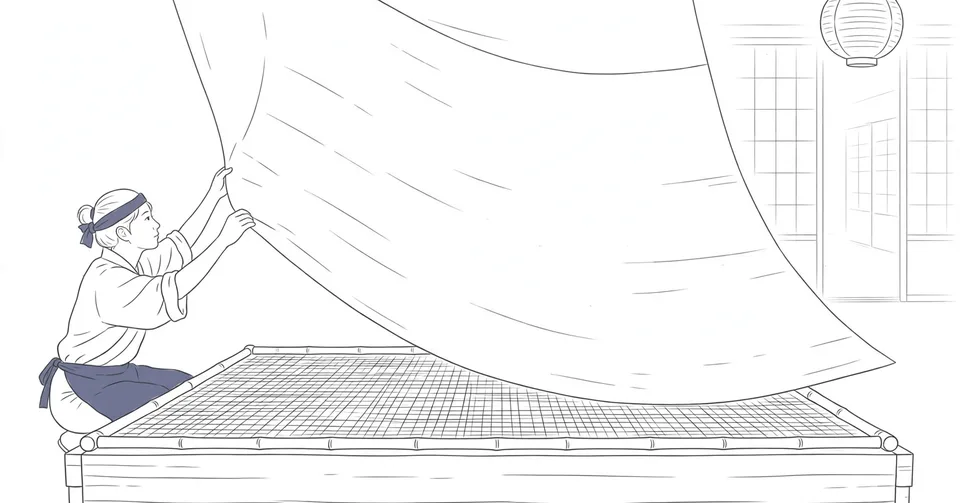
The forming itself usually happens in winter, after the farming year ends. Cold water keeps the organic material fresh and makes the fibres contract into a stronger sheet, so the cold season is not a hardship for the papermaker but a tool. The papermaker dips a bamboo screen into the vat, lifts it, and shakes it in a flowing motion, back and forth, until a thin layer of fibres covers the screen. This is nagashi-suki, and it takes years to learn the rhythm. Too fast and the sheet is uneven. Too slow and it is too thick.
Each sheet is laid on top of the last, pressed to squeeze out the water, and then dried, often on wooden boards in the sun. A skilled papermaker can make hundreds of sheets in a day, but every sheet is still made by hand, one dip at a time. The purest form of Mino paper, called honminoshi, uses only three ingredients: kozo, water, and neri. In 2021, only eight artisans in Mino were qualified to make it, which says something about how exacting the standard is.
There is a lesson in the process that I keep thinking about. Modern paper is made fast, in enormous rolls, and it yellows and crumbles within decades. Washi paper is made slowly, one sheet at a time, and it can outlive the building it is stored in. Speed is not always the smarter trade.
Why Washi Paper Outlives Other Paper
The durability of washi paper is not a legend. It comes from chemistry and structure, and both are easy to explain. Western paper made from wood pulp contains lignin and acids that slowly eat the sheet from the inside, which is why old newspapers turn yellow and brittle. Washi paper is made from long bast fibres with very low impurities, so there is far less inside it that can rot. The long fibres also tangle tightly, which makes the sheet flexible instead of stiff. A stiff sheet cracks when it is folded. A flexible sheet bends and survives.
That is why museums and libraries around the world use washi paper to repair damaged books, paintings, and documents. The Louvre and the Vatican Museums both rely on it. A thin sheet of washi paper can back a torn painting, because it is strong for its weight, and it can be removed cleanly with moisture later if a better repair comes along. A repair that can be undone is a rare thing in conservation, and conservators value it highly.
The Shosoin documents prove the point in the plainest way. Sheets made more than 1,300 years ago are still legible, not because they were kept in perfect conditions, but because the material itself resists decay. Washi paper does not promise forever. It promises a very long time, and it keeps that promise more often than any other paper humans have made.
The Three Papers UNESCO Recognised
UNESCO did not certify every sheet sold as washi paper. The 2014 inscription covers the craftsmanship of three specific traditions, each tied to a community that still practises it by hand. The listing was extended in December 2025, at the twentieth session of the intergovernmental committee in New Delhi, to cover the craft more broadly across Japan.
| Tradition | Where it is made | Main fibre |
|---|---|---|
| Sekishu-banshi | Misumi, Hamada City, Shimane Prefecture | Kozo |
| Hon-minoshi | Mino City, Gifu Prefecture | Kozo |
| Hosokawa-shi | Ogawa Town and Higashichichibu Village, Saitama Prefecture | Kozo |
Each of these papers has its own character. Sekishu-banshi is known for its strength. Hon-minoshi is the purest form, made entirely by hand from kozo, water, and neri. Hosokawa-shi is a sturdy paper with a long history in the hills northwest of Tokyo. The people in these communities take pride in the tradition and regard it as a symbol of their cultural identity, in the words UNESCO used when it inscribed the craft. That pride matters, because a craft like this survives only if the next generation wants to learn it.
Mino, in Gifu Prefecture, has been making paper for about 1,300 years, drawing its water from the Nagara River. Each October the town glows during the Washi Akari Art Festival, when lanterns made from local paper light the old merchant quarter. Echizen, in Fukui Prefecture, is another centre, and its hosho and torinoko papers are designated Important Cultural Properties. These towns are not museums. They are working places where paper is still made, sold, and used.
Where Washi Paper Shows Up in Daily Life
The most familiar home for washi paper is the shoji screen, the translucent sliding panel that divides rooms and softens the light. A shoji screen does not block the day the way a wall does. It filters it, and a room with shoji feels larger and calmer than the same room with solid doors. Fusuma, the opaque sliding partitions, use a heavier sheet of the same material. Paper lanterns, chochin, are washi paper stretched over a bamboo frame, and they have lit Japanese streets and festivals for centuries.
Washi paper is also the surface behind some of Japan's best known arts. Origami folds it, Japanese calligraphy writes on it, and ukiyo-e printers used it to carry colour in layers that wood pulp paper could never hold. The Japanese tea ceremony uses it too, in the small details of the tearoom, where a sheet of paper can be a wrapper, a decoration, or a quiet part of the setting. Each of these arts asks something different from the sheet, and washi paper answers because it is not one fixed product but a family of papers.
Beyond the arts, washi paper has practical jobs that surprise most people. It has been used for banknotes, because mitsumata fibre makes a sheet that is hard to copy and pleasant to handle. It has been used for clothes, household goods, and toys, and for the vestments of Shinto priests and the statues of Buddhas. During the Nebuta Matsuri in Aomori, the great lantern floats that parade through the streets were for much of their 300 year history covered in washi paper made from the paper mulberry plant, a story National Geographic tells in its portrait of Japan's perfect paper. The material is ordinary and sacred at the same time, and Japan has never seemed to see a contradiction in that.
There is also an environmental side that feels modern, though it is really very old. Making washi paper uses only new branches cut from the trees, not the whole tree, so the plant keeps growing. The process uses water, plant fibre, and sunlight, and almost nothing else. It is not a perfect industry, and the handmade share of the market is small, but the basic idea, that a useful material can come from a plant without destroying it, is one the modern world is still trying to relearn.
Visiting the Washi Towns
If you want to understand washi paper, the best way is to watch it being made. Mino City in Gifu Prefecture is the easiest place to start. The Mino Washi Museum lets visitors try forming a sheet themselves, and the old merchant quarter, Udatsu, is one of the best preserved Edo period streets in Japan. Come in October for the lantern festival, when the whole town seems to be made of light.
Echizen, in Fukui Prefecture, is the other great centre. Its papermakers have worked there for more than 1,500 years by local tradition, and the town has a museum and workshops where visitors can make their own postcards and lampshades. Ogawa Town in Saitama Prefecture, home of Hosokawa-shi, is closer to Tokyo, about an hour by train, and its paper experience centre offers hands on sessions in the same hills where the UNESCO listed craft is still practised.
A practical note for visitors: most workshops welcome beginners, and the sessions usually last one to two hours. You will get wet, your first sheet will probably be uneven, and that is the point. The papermaker next to you has done this thousands of times, and the difference between your sheet and theirs is visible in about ten seconds. It is a humbling and oddly cheerful way to spend an afternoon.
A Sheet Worth Slowing Down For
I think the reason washi paper has lasted is not only the fibre or the water. It is the attitude behind it. The craft assumes that some things are worth doing slowly, that a material made with care will repay that care, and that a sheet of paper can be both useful and beautiful without trying to be either. That attitude runs through a lot of Japanese craft, from pottery to gardens to the tea ceremony, but washi paper makes it visible in the plainest way. You can hold the result in one hand.
There is also something quietly hopeful about it. The handmade paper industry is small, the artisans are ageing, and the cheap alternative is everywhere. Yet the craft was inscribed by UNESCO, the lantern festival in Mino still draws crowds, and conservators in Paris and Rome still reach for a Japanese sheet when something precious tears. Washi paper survives because people keep finding new reasons to need it, from museum repairs to festival lanterns to a visitor's first uneven sheet in a workshop in Gifu.
The next time you slide open a shoji screen or pick up a paper lantern, look at the sheet itself. The fibres are long, the surface is uneven, and the light comes through in a way no factory paper manages. That is more than 1,300 years of practice, held up to the light, and it is still being made, one dip of the screen at a time.
More in Culture & Society
- Chusonji Is the Mountain Temple That Outlasted Its Golden Age
- A Pure Land Garden Is a Paradise You Can Walk Through
- Sagemono Are the Hanging Treasures Samurai Wore at the Waist
- Oshu Fujiwara Built a Golden Capital in the North
- Fujiwara no Kiyohira Turned War Into Gold
- Motsu-ji Keeps Hiraizumi's Pure Land Garden Alive
Latest posts
- Mugicha Is the Barley Tea Japan Pours All Summer Long
- Bancha Is the Everyday Tea Japan Drinks Without Thinking
- Hojicha Is the Roasted Tea Japan Reaches for After Dinner
- Kakigori and the Thousand-Year History of Japan's Shaved Ice
- Genmaicha Turns Roasted Rice Into Japan's Nuttiest Green Tea
- Harajuku and the Tokyo Streets Where Fashion Refuses to Sit Still
- Hiramaki-e Keeps the Gold Flat and Lets the Picture Speak
- Chuson-ji Is the Mountain Temple That Guarded the Golden Hall
- Urushi Kabure Is the Rash Lacquer Apprentices Learn to Live With
- Konjikido Is the Golden Hall That Outlived a Fallen Capital
- Hidehira-Nuri Keeps Hiraizumi's Golden Age in Lacquer
- Urushiol Is the Itch Behind Japan's Most Beautiful Lacquer
- Wajima-nuri Is the Lacquer That Survives Being Dropped
- Tsugaru-nuri Hides Four Seasons of Colour Under the Lacquer
- Shunkei-nuri Lets the Wood Grain Shine Through the Lacquer