Gyokuro Earns Its Price One Shade-Grown Leaf at a Time
· 11 min read
Gyokuro is Japan's shaded, umami-rich premium green tea, grown under cover for about 20 days before harvest and brewed cool and slow for a small, intensely savory cup.
The first time I tasted gyokuro, I thought someone had made a mistake. The cup in front of me was small, the liquid was a pale green, and the flavor was closer to warm broth than to anything I had ever called tea. It was not grassy, not bitter, and not refreshing in the usual sense. It was rich, savory, and oddly filling, as if a small meal had been folded into a few sips. That first cup also came with a price tag that made me pause, and the pause is the point of this story. A tea that costs this much should be able to explain itself, and gyokuro can, one shade-grown leaf at a time.
The short answer is shade. Gyokuro is a Japanese green tea grown under cover for about 20 days before harvest, and sometimes for as long as 30, while the bushes are shielded from most of the sun. Farmers cover the plants with reed screens, straw, or black netting, and the cover is often added in stages, blocking about 70 percent of the sunlight at first and rising to 80 or 90 percent before harvest. The plant responds by holding on to theanine, the amino acid behind umami, instead of turning it into the bitter catechins it would make in full sun. The result is a leaf with deep savory sweetness, very little astringency, and a dark green color that looks almost unreal. The name gives the game away. Gyokuro means jade dew, or jewel dew, a name that suits a tea served in such small and precious cups.
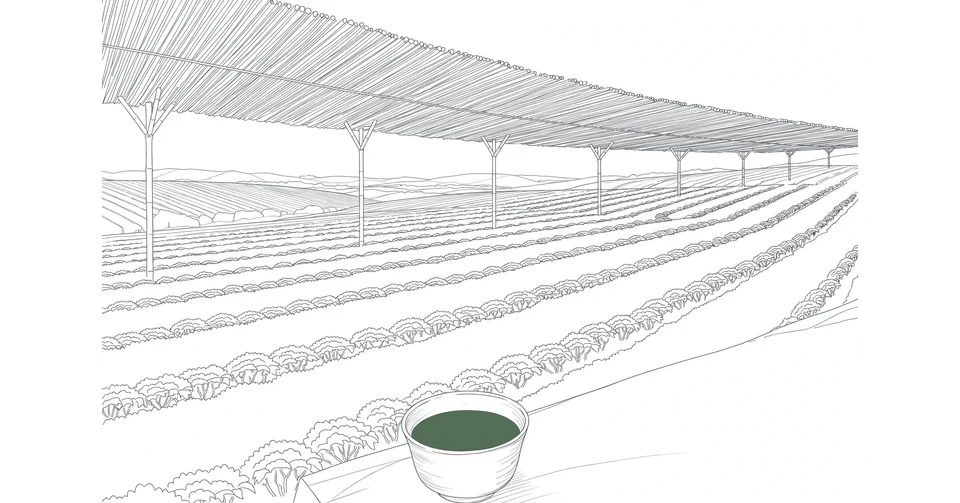
That is the whole of it, really. Everything else about gyokuro, the price, the ceremony, the small cups, the careful brewing, follows from those three weeks in the dark. A farmer who shades a field is betting that the extra work will show up in the cup, and a drinker who pays for the result is betting that their palate can tell the difference. Both bets usually pay off, which is why this tea has survived nearly two centuries as a luxury rather than fading into a curiosity. In the rest of this article I will explain how the shading works, where the tea comes from, how it was invented by accident, and how to brew it at home without wasting a single gram.
Why gyokuro tastes like broth, not grass
The chemistry is simple enough to explain in one paragraph, and strange enough to be worth the telling. In full sunlight, a tea plant converts theanine into catechins, the compounds that give green tea its bite and its astringency. Catechins also act as a kind of sunscreen, protecting the leaf from ultraviolet light. Take the sun away and the conversion slows to a crawl. Theanine stays in the leaf, catechins stay low, and the plant makes more chlorophyll to catch what little light gets through, which is why shaded leaves turn such a deep and glossy green. The same stress that keeps the theanine in place also pushes caffeine levels up, so gyokuro carries more caffeine than sencha, even though it tastes far gentler. Theanine gives the lift a calmer feel, which is one reason people describe the tea as focused rather than jittery, though that is a matter of personal experience, not a medical claim.
The numbers behind that flavor are striking. One guide to Japanese tea, citing Japanese tea industry data, puts the theanine in gyokuro at roughly 2,650 milligrams per 100 grams of leaf, about twice the level found in ordinary sencha. I treat that figure as a useful comparison rather than a laboratory certainty, since theanine varies by cultivar, field, and season, but the direction is not in doubt. Theanine was first identified in gyokuro itself, by the researcher Yajiro Sakato in 1949, which feels fitting. The compound that defines the tea was found in the tea first, and only later understood as the reason it tastes the way it does.
Taste is where the science becomes dinner. The first sip of a well brewed gyokuro reminds many drinkers of dashi, the clear Japanese stock, or of steamed greens with a drop of soy sauce. There is a marine note in there too, something close to nori seaweed, and a sweetness that sits at the back of the tongue long after the cup is empty. My own view is that this is the tea for people who think they do not like green tea, because the thing they dislike is usually bitterness, and bitterness is exactly what shading takes away. What remains is the savory core of the leaf, served neat.
The accident that invented gyokuro
Gyokuro was not planned. It was noticed. In 1835, Kahei Yamamoto VI, the sixth head of the Edo tea house Yamamotoyama, visited the Uji area near Kyoto and watched workers steam and dry shaded tencha leaves at a local roastery. The leaves were covered to protect them from frost, not to make a new tea, but Yamamoto tried rolling the soft shaded leaves into small balls shaped like drops of dew. The result tasted remarkably sweet and rich, and Yamamotoyama began selling it under the name gyokuro. Later makers refined the rolling into the fine needle shape that defines the tea today, and the method spread from Uji to other regions. The full story, including the 1835 date and the Yamamotoyama connection, is set out on the Wikipedia page for gyokuro, which is a good place to check the history against the summary here.
There is a lesson in that accident that goes beyond tea. Yamamoto was not looking for a luxury product. He was watching ordinary workers do ordinary work, and he paid attention to a side effect that everyone else had walked past. The shading had been a practical trick, a way to keep frost off young leaves, and it turned out to change the flavor completely. I find that encouraging, because it suggests that craft advances as much by noticing as by planning. The farmers who covered their plants were solving a small problem. The merchant who watched them turned the solution into a tea that is still prized nearly two centuries later.
Where the best gyokuro comes from
Three regions define premium gyokuro, and each brings its own character to the cup. Yame, in Fukuoka Prefecture, is the largest producer by a wide margin, with more than 40 percent of Japan's gyokuro coming from its fields, and its tea is known for a rich and full-bodied style that leans hard into umami. Uji, in Kyoto Prefecture, is the historic home of shaded tea, where the craft began, and its gyokuro tends toward a more refined and balanced character. Asahina, in the Okabe area of Shizuoka Prefecture, is small but prestigious, known for traditional hand-picked lots. Most gyokuro in Japan is grown in Fukuoka, Kyoto, and Mie prefectures, and the same grade can taste noticeably different from one region to another, which is half the fun of comparing them.
If you are choosing a first bag, the region matters less than the freshness and the seller. A mid-range Yame or Uji gyokuro from a reputable tea shop is the safest introduction, and the differences between regions only become clear after you have tasted a few. I would start with Yame for the fullest umami, then try Uji when you want to see what restraint tastes like. Shizuoka readers may be pleased to know their own prefecture is in the conversation, since Asahina sits in the same hills that grow so much of Japan's everyday sencha. Terroir is real in tea, just as it is in wine, but it rewards a drinker who has a baseline first.
How to brew gyokuro without ruining it
Brewing is where most people go wrong, and the mistake is almost always the same. They use water that is far too hot. Gyokuro needs water at 50 to 60 degrees Celsius, much cooler than the 70 to 80 degrees used for sencha, because cool water draws out the sweet theanine while leaving most of the bitter catechins behind. Push the temperature above 70 degrees and the balance flips, the astringency arrives, and the umami recedes. Boil fresh water, then let it cool in a yuzamashi, a small cooling vessel, or simply pour it back and forth between two cups a few times. Each transfer drops the temperature by roughly 5 to 10 degrees, and the water should feel warm to the touch, not hot.
The leaf ratio is the second surprise. Gyokuro is brewed strong, with far more leaf and far less water than an everyday cup. A widely used guide puts the ratio at about 5 grams of leaves for 150 milliliters of water, while richer traditional recipes use around 10 grams for just 100 milliliters, so the exact amount depends on the school and the leaf. I start with the lighter ratio and only go richer once I know the tea. Steep the first infusion for about two minutes without stirring, then pour every last drop into the cups, a little at a time into each, so every cup ends up the same strength. A good leaf can be re-infused three or four more times for 20 to 30 seconds each, with slightly warmer water and a shorter wait each round. The flavor shifts as you go, from deep umami to something brighter and lighter, and the spent leaves are tender enough to eat with a little ponzu or soy sauce, a small final treat that tea regions in Japan have long enjoyed. The full brewing method, with exact temperatures and times, is laid out in Food in Japan's guide to gyokuro, which I checked while writing this article.
The equipment can stay simple. A small kyusu teapot with a fine mesh filter is ideal, and a houhin, a small handleless pot, works beautifully too, because gyokuro is usually brewed for one or two cups at a time. Warm the pot and the cups first, then discard that water, so the cool brewing water does not lose more heat to cold ceramic. Then slow down. This is a tea that punishes haste and rewards patience, and the two minutes of waiting are part of the pleasure, not a delay before it.
What gyokuro costs and when it is worth it
Gyokuro is the most expensive leaf tea in Japan, and the price is easy to explain once you have seen the work behind it. Standard grades run roughly 1,000 to 3,000 yen per 100 grams, and competition-grade and hand-picked lots climb far higher. The shading has to be built and tended, the tender leaves are often picked by hand, the yields are small, and only uniform high-grade leaves reach the final product. None of that is marketing. It is labor, and the labor is visible in the cup.
Whether it is worth it depends on what you want from a cup. For an everyday drink, it is not, and Japan knows this. That is why bancha, the everyday tea Japan drinks without thinking exists, brewed by the pot and poured without ceremony, and why hojicha, the roasted tea Japan reaches for after dinner fills the evenings. Gyokuro is for the opposite moment, the quiet cup after a long day, the tea served to a guest you want to honor, the small luxury you choose on purpose. Drink it when you can give it your attention, and save your money the rest of the time. That, to me, is the honest way to enjoy an expensive tea.
The quiet pleasure of a small cup
I keep coming back to the size of the cup. Gyokuro is served in small pours, and that smallness is the whole philosophy. You cannot gulp it while scrolling through your phone. You have to sit with it, notice the broth-like depth, and let the sweetness arrive slowly. In a world that sells tea by the liter and flavor by the bucket, there is something quietly brave about a drink that asks for less water, less haste, and more attention, and then gives more back. Try it once, brewed properly, and you will understand the price. You may not buy it every week. You may not need to. But you will know what those three weeks of shade were for.
More in Food & Travel
- A Kyusu Is the Small Teapot Behind Every Good Cup of Sencha
- Shincha Is the First Flush Japan Waits All Winter For
- Sencha Is the Green Tea Japan Drinks Every Single Day
- Mugicha Is the Barley Tea Japan Pours All Summer Long
- Bancha Is the Everyday Tea Japan Drinks Without Thinking
- Hojicha Is the Roasted Tea Japan Reaches for After Dinner
Latest posts
- Washi Paper and the Thousand-Year Craft Behind Japan's Toughest Sheets
- Chusonji Is the Mountain Temple That Outlasted Its Golden Age
- Kakigori and the Thousand-Year History of Japan's Shaved Ice
- A Pure Land Garden Is a Paradise You Can Walk Through
- Genmaicha Turns Roasted Rice Into Japan's Nuttiest Green Tea
- Sagemono Are the Hanging Treasures Samurai Wore at the Waist
- Oshu Fujiwara Built a Golden Capital in the North
- Harajuku and the Tokyo Streets Where Fashion Refuses to Sit Still
- Fujiwara no Kiyohira Turned War Into Gold
- Motsu-ji Keeps Hiraizumi's Pure Land Garden Alive
- Hiramaki-e Keeps the Gold Flat and Lets the Picture Speak
- Chuson-ji Is the Mountain Temple That Guarded the Golden Hall
- Urushi Kabure Is the Rash Lacquer Apprentices Learn to Live With
- Konjikido Is the Golden Hall That Outlived a Fallen Capital
- Hidehira-Nuri Keeps Hiraizumi's Golden Age in Lacquer