A Yuzamashi Cools the Water Before the Tea Begins
· 18 min read
A yuzamashi is the small Japanese cooling bowl that brings freshly boiled water down to the gentle temperature sencha and gyokuro need, one calm pour at a time.
The first time I saw a yuzamashi on a tea table, I mistook it for a serving bowl. It was wide, shallow, and empty, with a small lip on one side and no lid, no handle, and no strainer. Then the host poured boiling water into it, waited, and poured the water onward into the teapot, and the empty bowl suddenly made sense. It was not there to hold tea. It was there to hold the heat back for a moment, so the leaves would meet water at the temperature they deserved.
A yuzamashi is a small vessel used to cool freshly boiled water before it touches Japanese green tea leaves. The water goes from the kettle into the yuzamashi first, loses heat through the wide open surface and the cool ceramic, and only then moves on to the teapot. It is a simple idea, and that simplicity is the whole point. There is no dial, no battery, and no display. You pour, you wait, you feel the warmth of the bowl in your hand, and you pour again.
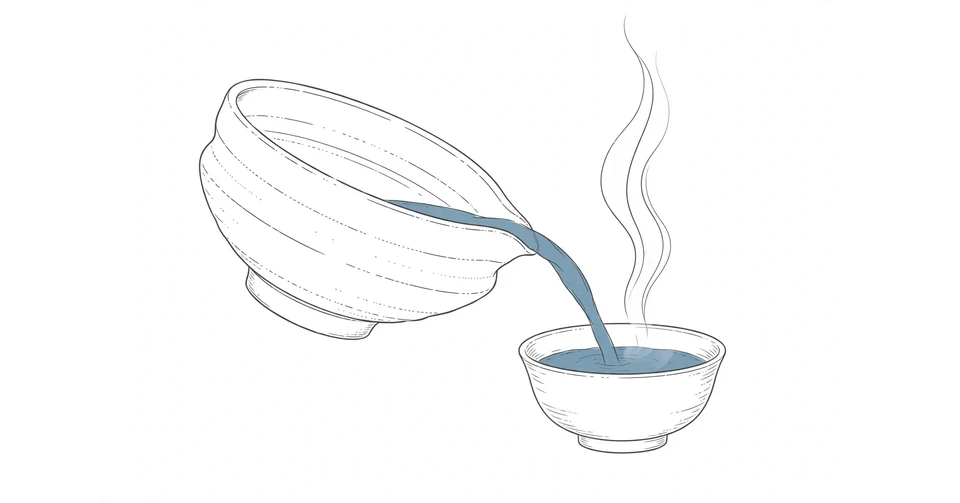
If you have ever brewed a good sencha with water straight off the boil and wondered why it tasted sharp and drying, a yuzamashi is the answer to that small mystery. Japanese green teas are brewed far below boiling point, and the gap between boiling water and brewing water is exactly the job this bowl was made to close.
What a yuzamashi is, and what the name means
The word yuzamashi translates literally as hot water cooler. It is a wide, shallow ceramic bowl or pitcher with an open mouth and a pouring lip or small spout, made to cool water quickly by giving it a large surface area. When you pour boiling water into a yuzamashi, the heat escapes from the open surface, the ceramic itself absorbs some of the heat, and the water settles at a lower temperature in a minute or two. The shape is the method. A narrow jug would hold the heat in. A wide bowl lets it go.
Most yuzamashi are made of ceramic, either porcelain or stoneware, and many come from pottery towns in Japan that have made teaware for generations. Tokoname in Aichi Prefecture is one of the best known, and its unglazed reddish clay, called shudei, is a familiar sight in tea shops. A yuzamashi from Tokoname feels slightly rough and warm in the hand, and the clay itself takes up heat from the water, which is part of how the cooling works. Porcelain versions are smoother and often thinner walled, and they tend to cool the water a little faster because the thin walls pass heat outward more quickly.
The size is modest. A typical yuzamashi holds about 200 to 300 millilitres, enough for one or two small cups of tea, and the size should match the teapot you brew in. A bowl much larger than your teapot leaves you guessing how much water you have cooled, while a bowl much smaller forces you to cool the water in two rounds. Some larger pieces carry small marks inside the bowl, for example at 100 and 200 millilitres, so you can measure by eye. The lip matters more than it looks. A good lip lets the water leave in a thin, steady stream instead of a sudden rush.
A yuzamashi holds water only. It does not hold brewed tea in the classic sequence, and it does not hold leaves. That is worth saying clearly, because the bowl looks so much like a serving pitcher that a beginner is tempted to pour the finished tea into it. The order is always the same. Kettle to yuzamashi, yuzamashi to teapot, teapot to cups.
Why water temperature changes the taste
Green tea is sensitive to heat in a way that surprises people who are used to black tea. Pour boiling water over sencha leaves and the cup turns bitter within seconds, not because the leaves are bad but because hot water pulls the bitter compounds out of the leaf faster than the sweet ones. Cool the water by twenty or thirty degrees and the same leaves give you a different drink entirely, softer, sweeter, and easier to sit with.
Three groups of compounds do most of the work in the cup. Theanine is the amino acid behind the sweet, savory depth that tea drinkers call umami, and it dissolves readily even in cooler water. Catechins are the compounds behind the brisk, astringent bite of green tea, and they extract best at higher temperatures, above roughly 75 to 80 degrees Celsius. Caffeine sits with the catechins, extracting more eagerly when the water is hotter and giving a mild bitter edge of its own. Temperature is the lever that decides which compounds arrive first and in what proportion, and a yuzamashi is the tool that lets you pull that lever by hand.
Gyokuro shows the effect most clearly. The tea is shade grown, which keeps its theanine high and its catechins low, and it is brewed with water at only 50 to 60 degrees Celsius, far cooler than most people expect. At that temperature the theanine comes out and the catechins mostly stay in the leaf, so the cup tastes like warm broth, rich and savory, with almost no bite. Brew the same leaves at 80 degrees and the balance flips. The astringency arrives, the sweetness recedes, and the tea that justified its price tastes ordinary. Our article on gyokuro puts it plainly, in a line that first sent me looking for a yuzamashi of my own: "Boil fresh water, then let it cool in a yuzamashi, a small cooling vessel, or simply pour it back and forth between two cups a few times." The sentence is practical rather than poetic, and it is honest about the alternative too. You can cool water without a yuzamashi. The bowl simply makes it easier and steadier.
Sencha is more forgiving than gyokuro, but it still rewards cooler water. The everyday Japanese green tea is usually brewed at 70 to 80 degrees Celsius, a range that keeps its fresh, grassy brightness while holding the bitterness in check. Sencha is the tea Japan drinks every single day, and the temperature window is part of why a cup made at home can taste so much better than a cup made with water straight from a boiling kettle. Go hotter than 80 degrees and the cup turns sharp. Go cooler than 70 and it can taste flat and underdrawn, as if the leaves never quite woke up.
The reason to cool the water is flavor, not health. Catechins are the antioxidants people praise in green tea, and their total yield generally keeps rising as the water gets hotter, so a boiling brew is not an empty cup. It is simply a harsher one. The yuzamashi is a flavor tool first, and that is enough. A cup that tastes sweet and calm will be drunk slowly and enjoyed fully, and that matters more than any number on a label.
How much cooler each pour makes the water
The rule of thumb you will hear most often is that each transfer between vessels drops the temperature by about 10 degrees Celsius. Pour boiling water at 100 degrees into a yuzamashi and you land near 90. Pour it onward into the teapot and you land near 80, which is the right range for sencha. Pour it into cups and back again, and each extra move takes off roughly another 10 degrees, bringing you down toward the 60 to 70 degree range that gyokuro wants. This is the method described by Hibiki-An, the Kyoto tea merchant, which gives the same sequence in concrete numbers: water poured straight into the teapot sits near 90 degrees, one pour through a cooling vessel brings it to about 80, two pours bring it to about 70, and three bring it to about 60.
The honest caveat is that 10 degrees is a rough guide, not a law of nature. The real drop varies with the size and material of the vessel, the volume of water, the temperature of the room, how long the water rests, and whether the bowl was already warm from a previous round. Our gyokuro article gives the more cautious version, saying each transfer drops the temperature by roughly 5 to 10 degrees, and that range is the one I trust most. A small volume of water in a wide porcelain yuzamashi on a cold morning will cool faster than a full bowl in thick stoneware on a warm afternoon.
That uncertainty is not a flaw in the method. It is the reason the yuzamashi asks you to pay attention, and the bowl teaches you to read the water with your senses, the sound of the pour, the thinning steam, and the warmth against your palm. After a few weeks of daily brewing, your hand knows the temperature, and that knowledge stays with you in a way a reading on a screen does not.
The table below gathers the target ranges from the tea guides I read while writing this article. Treat them as starting points, and adjust to your own taste from there.
| Tea | Water temperature | Steep time | Cooling pours from boiling |
|---|---|---|---|
| Gyokuro | 50 to 60 degrees Celsius | 90 to 120 seconds | 3 to 4 transfers |
| Sencha | 70 to 80 degrees Celsius | 60 to 90 seconds | 1 to 2 transfers |
| Genmaicha | 80 to 85 degrees Celsius | 60 to 90 seconds | 1 transfer |
| Hojicha | 90 to 100 degrees Celsius | 30 to 60 seconds | None, boiling water is fine |
Notice that hojicha, the roasted green tea, needs no cooling at all, and genmaicha needs only a single transfer. The yuzamashi earns its keep with the delicate teas, the shaded and lightly steamed leaves that suffer most from heat.
How to use a yuzamashi step by step
Using a yuzamashi is a short sequence, and the pleasure of it is that nothing in the sequence is difficult. The steps below follow the method in the Senbird Tea guide to brewing with a yuzamashi, which I read in full while preparing this article, and they match the practice described by Hibiki-An as well. Both guides agree that the water should be boiled fully first, then cooled, never the other way around.
- Set out your tea set before you boil the water. Place the yuzamashi, the kyusu teapot with its leaves already measured inside, and the cups on a stable surface. Use about 4 to 5 grams of sencha leaves per 150 to 200 millilitres of water, and a little more for gyokuro, about 6 to 8 grams per serving, because the shaded tea is brewed in a more concentrated style.
- Bring fresh, filtered water to a full boil. Boiling matters even though you are about to cool the water down again, because a rolling boil drives off chlorine and other sharp notes from tap water, and it gives you a known starting point of 100 degrees to count your cooling pours from.
- Pour the boiling water into the yuzamashi and let it rest for one to two minutes. The ceramic absorbs heat quickly, the wide surface sheds it into the air, and the steam above the bowl begins to thin. For sencha, aim for roughly 70 to 80 degrees. For gyokuro, cool further, either by resting the water longer in the bowl or by pouring it into cups and back again, each extra transfer taking off roughly another 5 to 10 degrees.
- Pour the cooled water gently from the yuzamashi over the leaves in the kyusu, in a slow, even stream, and let the leaves open on their own. Do not stir or shake the pot. Steep for 60 to 90 seconds for sencha, or 90 to 120 seconds for gyokuro, and keep the lid on while the tea brews.
- Pour the tea out into the cups in small, alternating portions, a little into each cup in turn and then back again, so every cup ends up the same strength. Pour until the last drop, because the final drops hold the most concentrated flavor, and leaving tea in the pot lets the leaves keep steeping and turn bitter. Good leaves can be brewed a second and third time, with a slightly shorter steep for the second infusion and slightly hotter water for the third.
The whole sequence takes only a few minutes longer than brewing with a kettle alone, and most of that time is waiting, not working. While the water rests in the yuzamashi, you can measure the leaves or warm the cups, or simply stand still for a moment. I have come to think of the pause as part of the recipe. A tea made in a hurry tastes hurried.
Materials and shapes, and what each one does
Porcelain is the cleanest and most predictable choice. A porcelain yuzamashi is glazed inside and out, so it does not absorb flavors, and it is easy to rinse clean. Its thin walls pass heat outward quickly, so the water cools a little faster than in thick stoneware, and the smooth white interior shows the color of the water clearly. If you brew many different teas and want a vessel that adds nothing of its own to any of them, porcelain is the honest pick, and it tends to be the least expensive way to start.
Unglazed clay is the traditional choice, and it behaves differently. Tokoname clay, especially the reddish shudei clay rich in iron, is said to soften the water slightly as it interacts with the tannins in green tea, giving a mellower cup. Whether you can taste that effect is a matter of palate and practice, and I would not promise a transformation. What is certain is that unglazed clay absorbs heat and gives a slower, steadier cooling curve, and that the rough texture feels warm and grounded in the hand. A clay yuzamashi also darkens slightly with use, and many owners come to love that quiet record of mornings past.
Glass is the third option. A glass yuzamashi lets you watch the water as it cools, which is genuinely useful when you are still learning, because you can see the steam fade and the surface settle. Glass cools differently from ceramic, though, and it does not offer the same warmth in the hand. The Senbird guide advises against metal and glass for exactly this reason, saying they transfer heat differently and do not give the same tactile feedback as ceramic. Glass works, and a glass bowl you already own is better than no cooling vessel at all, but if you are buying one piece to keep for years, ceramic is the safer bet.
Shape matters as much as material. The classic yuzamashi is a wide, low bowl with a single pouring lip. The wide mouth is what does the cooling, so a bowl that is tall and narrow defeats its own purpose. The lip should be smooth and slightly upturned, so the water leaves in a controlled stream instead of dribbling down the side. Some pieces are shaped more like a small pitcher, taller and with a definite spout, and these pour even more neatly, at the cost of a little surface area. Either shape works well, and the choice comes down to how you pour.
Choosing the right size for your table
Start by looking at your teapot. A yuzamashi should hold about the same amount of water as your kyusu, or a little more, so that one cooling pour fills one brew without measuring twice. Most guides suggest a capacity of 200 to 300 millilitres, which suits the small teapots that Japanese green tea is usually brewed in, and which serves one or two people comfortably. A set that looks balanced is a set you will reach for more often, and a bowl that is twice the size of everything else on the tray will sit in the cupboard, where it cools no water at all.
Price is the last thing to consider, and it is a pleasant surprise. A good porcelain yuzamashi costs little more than a decent teapot, and even a handmade clay piece from a known kiln is modest beside the price of the tea it serves. Gyokuro is expensive by the gram, and a single ruined brew can waste more money than a yuzamashi costs. Seen that way, the bowl is not an indulgence. It is insurance for the leaves.
Care and cleaning for a long life
A yuzamashi asks for very little care, and the little it asks for is worth giving. Rinse it with hot water after each use, and let it air dry upside down on a cloth or a rack so no moisture sits inside the bowl. If you use an unglazed clay piece, avoid soap where you can, because the porous clay can hold on to the scent of detergent and pass it to the next brew. A rinse and a soft cloth are usually enough.
Handle the bowl with the same care you would give any handmade ceramic. Do not pour boiling water into a bowl that is ice cold from a winter cupboard without warming it first with a splash of hot water, because a sudden shock can crack even good clay. Do not stack heavy pots on top of it, and do not leave it soaking in a sink full of dishes, where a careless knock can chip the lip. The lip is the most fragile part and the most important, since a chipped lip dribbles instead of pouring.
Keep the yuzamashi on the tea tray or on a shelf where you can see it, not buried at the back of a cupboard. A tool that is visible gets used, and mine sits beside the teapot on an open shelf, a quiet reminder on mornings when I am tempted to pour straight from the kettle.
When you do not own one yet
You do not need to own a yuzamashi to brew good Japanese green tea, and it would be wrong to suggest otherwise. The bowl is a convenience, not a gate, and the cooling it does can be done with pieces you already have in your kitchen. The classic substitute is the pair of cups. Pour boiling water into two yunomi cups, wait until the sides feel warm rather than hot, and then pour the water from the cups into the teapot. Hibiki-An describes exactly this method, and it works because each transfer takes roughly the same 5 to 10 degrees off the water. A wide rice bowl does the same job, and a small measuring jug will do it too.
A temperature controlled kettle is the modern alternative, and it has an obvious advantage. You set the number, the kettle holds it, and the water is ready without counting pours. It is precise, repeatable, and fast, and for a busy household it may be the most sensible choice of all. What it does not offer is the pause. I own a kettle with temperature settings, and I still reach for the yuzamashi on slow mornings, because the tea tastes the same either way and the morning feels different. That is a matter of taste, not of fact, and I offer it as such.
If you are deciding whether to buy one, borrow the method before you buy the object. Brew your sencha for a week using two cups to cool the water, counting one transfer for sencha and two or three for gyokuro, and notice whether the tea tastes better and whether you enjoy the extra step. If the answer to both is yes, a yuzamashi will make a practice you already like a little smoother and a little steadier. If the answer is no, you have lost nothing. The best tea tool is the one that fits the brewer, not the one that looks best in a photograph.
Why such a simple vessel earns its place
There is a temptation, when writing about a small bowl, to make it sound more important than it is. A yuzamashi will not make bad leaves taste good, and it will not rescue tea that has been stored badly or brewed carelessly. It does one thing, it cools water, and it does it with a grace that a thermometer and a kettle cannot quite match. But that one thing sits at the center of Japanese green tea, because temperature decides whether a cup tastes sweet or bitter, calm or sharp, and a tool that controls temperature by hand, without fuss, earns its place on any table where green tea is brewed with care.
A yuzamashi is a small, quiet object, and it does not ask to be admired. It asks only to be used, once or twice a day, in the short space between the kettle and the teapot. If you brew sencha or gyokuro at home, give it that space. Boil the water fully, pour it into the bowl, wait for the steam to thin, and pour it onward at the temperature the leaves deserve. The tea will answer you in its own language, sweet where it was bitter, soft where it was sharp.
More in Food & Travel
- Japanese Breakfast and the Morning Meal That Starts with Rice and Soup
- Tencha Is the Shade-Grown Leaf Matcha Is Made From
- A Kyusu Is the Small Teapot Behind Every Good Cup of Sencha
- Shincha Is the First Flush Japan Waits All Winter For
- Gyokuro Earns Its Price One Shade-Grown Leaf at a Time
- Sencha Is the Green Tea Japan Drinks Every Single Day
Latest posts
- Fusuma Turn a Room Into Whatever Japan Needs Next
- Wearing a Happi Means You Belong to the Matsuri
- Taiko Drums and the Thunder That Shook Japanese Festivals
- Washi Paper and the Thousand-Year Craft Behind Japan's Toughest Sheets
- Mugicha Is the Barley Tea Japan Pours All Summer Long
- Bancha Is the Everyday Tea Japan Drinks Without Thinking
- Chusonji Is the Mountain Temple That Outlasted Its Golden Age
- Hojicha Is the Roasted Tea Japan Reaches for After Dinner
- Kakigori and the Thousand-Year History of Japan's Shaved Ice
- A Pure Land Garden Is a Paradise You Can Walk Through
- Genmaicha Turns Roasted Rice Into Japan's Nuttiest Green Tea
- Sagemono Are the Hanging Treasures Samurai Wore at the Waist
- Oshu Fujiwara Built a Golden Capital in the North
- Harajuku and the Tokyo Streets Where Fashion Refuses to Sit Still
- Fujiwara no Kiyohira Turned War Into Gold