Tencha Is the Shade-Grown Leaf Matcha Is Made From
· 23 min read
Tencha is the shade-grown Japanese green tea leaf that is steamed, dried without rolling, and stone-ground into matcha. This article follows it from the shaded fields of Uji to the mill, and explains how to buy, store, and even brew it.
Every bowl of matcha begins with a leaf that almost nobody sees. Long before the bright green powder meets the whisk, the leaf has already lived a careful life under shade cloth in a tea field, and it has been steamed, dried, and picked apart without ever being rolled into the shape you would recognize as tea. That leaf has a name of its own, and it deserves one. Tencha is the shade-grown leaf that matcha is made from, and understanding it changes the way a bowl of matcha tastes.
The word itself gives the game away. Tencha, written with the characters for grinding and tea, means tea for grinding, and the character at its heart refers to grinding with a mill. It is not a finished drink in the usual sense. It is a material, prepared for one purpose, and everything about the way it is grown and processed serves that purpose. The finest matcha in the world starts here, in a pile of flat, vivid green flakes that look almost unfinished.
That unfinished look is the point. A tencha leaf is deliberately left flat and open, never rolled into the needle shape of sencha, because rolling would work against the mill. Its stems and veins have been removed, its blades cut small, and its flavor built up under weeks of shade. What follows is the story of that leaf, from the shaded fields to the stone mill, and a guide to buying, storing, and even brewing the rare leaf tea that most of the world never meets.
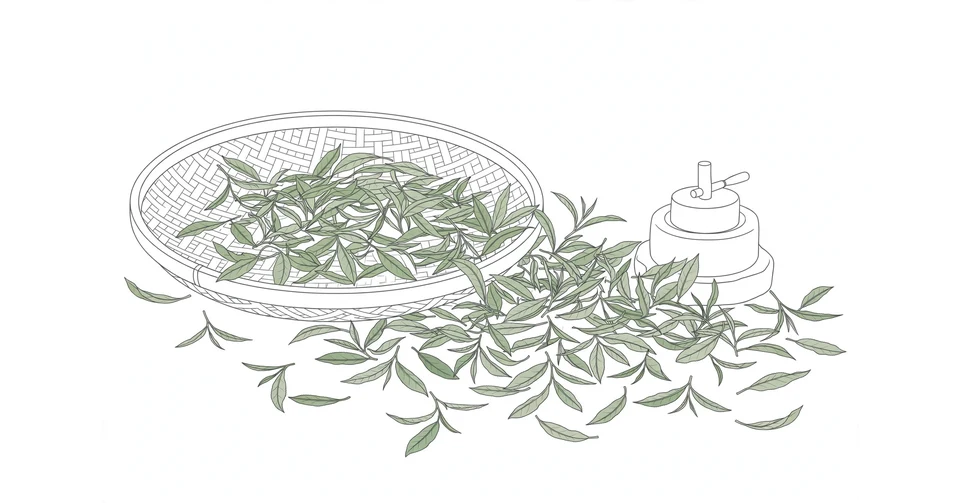
I first understood tencha properly not in a tea shop but in a sentence in our bancha article, which notes that a single harvest can take several different paths: "It becomes premium sencha, gyokuro, and tencha, the raw material for matcha." One plant, one harvest, and the path the leaves take after picking decides what they become. It is the path that leads to the mill, and it is the most demanding of the three.
What tencha actually is
Under the Green Tea Labeling Standards of the Japan Tea Central Public Interest Incorporated Association, tencha is defined as tea made from leaves harvested from a covered tea garden. Before harvesting, the garden is covered for approximately two to three weeks using overhead frames and materials such as reed screens, straw mats, or synthetic fabric. The harvested leaves are steamed and dried without rolling in a dryer built for the purpose or similar apparatus. That definition, plain as it sounds, draws the line that matters most. It is not simply green tea that someone decided to grind. It is a tea grown and processed for grinding from the start.
The distinction is strict enough that it has a legal edge. Tencha itself is not powdered. Matcha is produced by grinding the finished leaf into a fine powder, and under the same labeling standards, powder made by grinding tea other than tencha is classified as funmatsucha, powdered tea, rather than matcha. Grind sencha and you get powdered sencha. Grind gyokuro and you get powdered gyokuro. Only the ground leaf is matcha, and the difference is not a matter of marketing. It is written into the way the leaf was grown and handled, and you can read the full definition in the entry on Wikipedia.
This is why the familiar description of matcha as powdered green tea always feels incomplete to me. It is true in the way that calling a violin a wooden box with strings is true. The powder is only the final form. The real story is the leaf, and the leaf was already special before it ever touched a mill. Our matcha article follows the finished powder from the bowl backward, while this article stays with the leaf itself, because the leaf is where the quality of the powder is decided.
Tencha is also a useful reminder that Japanese tea is a family of processes rather than a list of separate plants. Sencha, gyokuro, and kabusecha can all begin with the same species, Camellia sinensis, and often with the same cultivar in the same field. What separates them is a series of decisions made by the grower: how much shade, how long, how the leaf is handled after picking, and what the leaf is meant to become. Tencha is the answer to the question of what a leaf must become if its destiny is the mill.
Why the leaves spend weeks in the shade
Shading is the first and most important of those decisions. During the growth of the new shoots, the tea garden is covered to reduce the amount of sunlight reaching the leaves, and the change in the leaf is chemical as well as visible. Shading causes the leaves to become thinner and increases their chlorophyll content, producing a deeper green color. It also promotes the accumulation of free amino acids, particularly theanine, while suppressing the formation of catechins associated with bitterness and astringency. The result is the umami and sweetness, the green color, and the characteristic aroma of shade-grown tea known as oika, the covering aroma.
In the traditional method practiced in Uji, a framework of wood or bamboo is constructed over the tea plants. Reed screens are spread over the framework and covered with rice straw. This method is known as honzu. Modern tea gardens commonly use steel pipe frames and synthetic fiber covering materials instead, which are cheaper to build and easier to move, though many growers and drinkers still insist that the old reed and straw covers produce a gentler shade and a finer aroma. For high grade leaf, tea bushes may be allowed to grow in a relatively natural form, and the young shoots are harvested by hand. To produce larger quantities, particularly for food processing use, tea bushes may be trained into curved hedges and harvested mechanically.
The length of shading varies with the grade. The labeling standards speak of approximately two to three weeks, while growers aiming for the highest quality may shade for thirty to forty days. That range is worth remembering when a seller makes claims about shading, because a longer shade is not automatically better. Too much shade can weaken the plant, and the balance between sweetness and body is something a grower judges field by field. I have come to think of shading less as a trick and more as a negotiation between the plant and the grower, where the grower trades sunlight for sweetness and accepts a smaller, more delicate harvest in return.
The chemistry behind the flavor is well documented. A study comparing commercially produced crude leaf with teas entered in competitions found significant positive correlations between sensory evaluation scores and the concentrations of total nitrogen and free amino acids. In plain terms, the compounds that shading builds up are the same compounds that judges reward in the cup. One of the principal compounds associated with the covering aroma is dimethyl sulfide, which is generated from a precursor in the leaves during heating, while ionone related aroma compounds are also formed during processing from carotenoids that have accumulated in the shaded leaves. None of this is visible when you look at the leaf, which is part of the pleasure of knowing it. The vivid green flake in your hand is a record of weeks of darkness.
From harvest to tencha aracha
Once the shaded shoots are harvested, the work moves quickly. Freshly harvested leaves are steamed to deactivate the enzymes responsible for oxidation. Steaming also softens the leaves and reduces their raw, grassy odor. The leaves are generally treated with steam at approximately 100 to 105 degrees Celsius for 10 to 15 seconds, a short and precise step that stops the leaf from browning while keeping its green color and fresh character intact.
After steaming, the leaves are blown upward in a cooling and spreading machine. This rapidly cools them, removes surface moisture, and separates leaves that have folded or adhered to one another. The opened leaves are then distributed over a wire mesh conveyor and passed through a tencha dryer. A tencha dryer, or tencha ro, contains a tunnel shaped drying chamber, and a dryer generally contains three to five vertically arranged conveyor levels. The leaves are dried by radiant heat, conducted heat, and hot air as they pass through the chamber, with stronger heat applied during the initial stage to remove moisture rapidly, then lower temperatures and longer heating as drying progresses.
The crucial fact is what does not happen in that dryer. The leaves are dried without rolling. Stems and larger veins are subsequently separated, and the material is dried again to produce tencha aracha, or crude leaf. Because no rolling is performed, the leaves remain as flat, irregular pieces rather than being formed into the needle like shape characteristic of sencha. Primary processing is generally carried out by tea growers, while finishing and grinding are commonly performed by tea wholesalers or manufacturers, so the leaf passes through several hands before it becomes powder.
The history of this shaded cultivation runs deep in Uji. A technical review published in 2015 stated that shaded cultivation had become established in the Uji region by the middle of the 16th century. A soil study published in 2019 examined the Okunoyama tea plantation, the only surviving plantation traditionally counted among the Seven Famous Tea Gardens of Uji, and estimated that the traditional system of shading tea plants with reed screens and rice straw had been established there by the first half of the 15th century, approximately 150 years earlier than the date previously inferred from historical documents. The two dates do not quite agree, and the honest thing is to say so. The soil evidence points earlier than the documents, and the documents are the more cautious source. Either way, the shaded fields of Uji have been producing this leaf for centuries, and the method changed slowly until mechanization arrived from the Taisho era through the early Showa era, when specialized dryers replaced much of the earlier manual drying over traditional roasting tables.
The quiet work of finishing
Crude tencha is not yet ready for the mill. During finishing, foreign material is removed from the crude leaf, and the leaf blades are cut into pieces suitable for grinding. The harder veins are removed, and the leaf material is generally cut into pieces approximately 5 millimeters square. A final drying process is then used to adjust the flavor and aroma. This is unglamorous work, and it is where much of the quality of the finished matcha is actually made.
The reason for all this cutting and sorting is practical. Matcha is expected to become an extremely fine powder, and coarse stems and larger veins are less suitable for producing the smooth, fine texture associated with matcha. Removing them during refinement helps create a more uniform material for grinding and a smoother finished tea. A mill cannot fix a leaf that was badly finished. It can only reveal, flake by flake, what the finishing left behind. The Yunomi guide to how matcha is made from this leaf puts it plainly: tencha is the tea material used to make matcha, the material itself has already been prepared specifically to become powder, and grinding ordinary tea leaves will never produce the same result.
There is a patience in this stage that I admire. Nothing about finishing looks impressive. It is sorting, cutting, drying, and checking, repeated until the leaf is uniform enough for a stone to do its slow work. The best leaf I have seen looks almost boring in the hand, a pile of small, flat, evenly green flakes with nothing to show off. That uniformity is the achievement. It means someone took the time to remove everything that did not belong, and the mill will reward that care with a powder that whisking turns into a smooth, even bowl.
Some producers add one more quiet step. Tencha can be aged for a few months before grinding, which allows some of the bitterness to soften and produces a sweeter matcha. The inventory is often kept as leaf until it is ordered, and the grinding happens close to the time of sale, because freshly ground matcha holds its aroma better than powder that has sat on a shelf. This is one of the reasons that good matcha is often ground to order, and why the leaf form is a better way to store the tea than the powder.
Tencha and gyokuro share a shade but not a fate
Gyokuro is the tea most often confused with this leaf, and the confusion is understandable. Gyokuro is also produced from shade-grown leaves, and both teas are known for sweetness, umami, and a deep green color. The difference is what happens after harvest. Gyokuro is rolled and dried using a process similar to that employed for sencha, whereas this leaf is dried without rolling, leaving the leaf pieces flat and open. Gyokuro is finished as a leaf tea, designed to be steeped in water and then removed. It is finished as a material for grinding.
That single difference in handling changes everything about the tea. If finished gyokuro is ground into powder, it becomes powdered gyokuro, not matcha, because the leaf was shaped for steeping rather than for the mill. Rolling breaks the cell walls in a way that suits extraction in hot water, and it gives gyokuro its thin needle shape and its broth like cup. This leaf keeps its cells largely intact, which is part of why matcha tastes the way it does. The two teas are siblings raised under the same shade, sent down different roads, and the road is the whole story.
Our gyokuro article reaches back to Uji in 1835, when workers steamed and dried shaded tencha leaves by hand, long before the dryers of the modern era existed. Reading that history next to the modern process is a useful exercise, because almost nothing about the intention has changed. The tools are faster and the dryers are mechanized, but the grower is still shading the plants, steaming the leaves, and refusing to roll them, for the same reason. The leaf is being prepared for the mill, and every step serves that one purpose.
I think this is why tencha is a good teacher for anyone who loves Japanese tea. It shows that a tea is not defined by the plant alone, or by the region alone, or even by the shade alone. It is defined by the chain of decisions that runs from the field to the cup, and a single decision, to roll or not to roll, can create two completely different teas from the same shaded leaves. Once you see that, the rest of Japanese tea starts to make sense as a set of paths rather than a set of names.
The stone mill is where tencha stops being tencha
Finished tencha is ground in a stone mill or another fine grinder to make matcha. Grinding is therefore not part of the leaf's production itself, but the subsequent process by which tencha is converted into matcha. The distinction matters, because it means the mill is not making the tea. It is only revealing what the field and the finishing already made.
A traditional stone mill, called an ishisu, is a pair of granite stones about 33 centimeters across. The lower stone is fixed and the upper stone turns at about 40 to 60 turns a minute, and the grooves cut into both faces carry the leaf outward through a gap of less than a millimeter. One mill makes only about 30 to 40 grams of matcha an hour, which is enough for roughly fifteen bowls of thin tea. The low output is a rate chosen for quality rather than a limit of the machine, because grinding any faster would create friction heat, and heat would damage the color and aroma that the shading worked so hard to build.
That slowness is the reason stone ground matcha costs what it does, and it is also the reason the leaf matters more than the mill. A poor grade leaf will produce a poor matcha no matter how slowly it is ground, while a premium tencha yields excellent results even when ground by machine. Modern production can use other fine grinding methods, and for culinary matcha that is entirely reasonable, but the ceremonial grades still tend to pass through stone, one slow gram at a time. When I hold a tin of good matcha now, I think less about the powder and more about the hours behind it, the weeks of shade, the seconds of steam, the sorting and cutting, and then the mill turning sixty times a minute for an hour to make a small pile of green dust.
How tencha is graded and priced
Not all tencha is equal, and the grades reflect the care taken at every stage. At the top end, the bushes are allowed to grow in a relatively natural form, the young shoots are handpicked, and the shading uses traditional materials. Competition grade leaf is grown and picked with extraordinary care, sometimes only a few kilograms of the very best young leaves from a field, and then carefully processed and stone ground. At the other end, tea bushes are trained into curved hedges and harvested mechanically, which lowers the quality a little but makes the tea affordable for everyday use and for cooking.
The labeling standards also recognize a category called food processing tencha. This includes autumn tencha and other tea leaves dried without rolling in a tencha dryer and intended primarily for use as ingredients in processed foods. This is the leaf that ends up in sweets, noodles, and lattes, and there is nothing wrong with it for that purpose. It is simply not the same material as the spring leaf that becomes ceremonial matcha, and the price tells you so. Knowing which kind of tencha you are buying is part of knowing what you are paying for.
The numbers behind the current matcha boom are striking. Japanese production of this leaf has expanded in response to increased demand for matcha. National production reached 6,278 tonnes in 2025, approximately 3.2 times its 2014 level, and it accounted for 8.6 percent of the total crude tea output of Japan. In 2025, Kagoshima Prefecture ranked first in tencha production, followed by Kyoto and Shizuoka prefectures. The average crude tea price of tencha in 2025 was 8,562 yen per kilogram, compared with 1,746 yen per kilogram for sencha, so tencha was worth approximately 4.9 times as much as sencha at the farm gate.
Those figures explain a quiet shift that tea drinkers in Japan have already noticed. As the leaf has become more valuable, some producers have shifted more attention and production toward tea for matcha, and that affects the balance of Japanese tea production as a whole. The Yunomi writer who documented how matcha is made from this leaf noticed the same thing from the other side, finding the ordinary sencha they drink every day becoming more expensive as demand for matcha pulled growers toward tencha. I feel the same mixed feeling. I am glad the world has discovered matcha, and I am sorry that the discovery makes the everyday teas a little harder to afford. The leaf that used to be a specialist material is now a major crop, and the whole tea landscape is adjusting to that fact.
Buying tencha and keeping it fresh
Tencha is traditionally regarded as mere raw material for matcha, which explains why it is hard to find, even in Japan. Most of it never reaches a shop shelf in leaf form. It goes from the grower to the wholesaler, from the wholesaler to the mill, and from the mill to the customer as powder. The leaf that does reach the retail market is usually sold by specialist tea shops, often online, and often in small quantities.
When you do find it, a few things are worth checking. Good tencha is vivid green, flat, and flaky, with small and fairly uniform pieces and no stems or coarse veins visible. The origin matters, and Uji in Kyoto, Kagoshima, and Shizuoka are the three names to know, since they lead national production. The harvest matters too. Spring tencha, from the first flush, is generally the finest, while later harvests and autumn tencha are better suited to everyday drinking or cooking. A seller who names the cultivar, the region, and the harvest is usually a seller who knows the leaf, and a seller who only says premium matcha leaf is usually selling a story rather than a tea.
Storage is simpler than it looks, and the leaf form is forgiving. Keep it cool, dark, and airtight, away from strong odors, and use it within a few months of opening. The leaf keeps its freshness longer than ground matcha, which oxidizes and loses aroma more quickly once it is powdered, and that is one more reason producers hold their stock as tencha and grind it only when it is ordered. Buy a small amount, keep it sealed, and treat it the way you would treat any fine green tea. My own habit is to buy the smallest bag a shop will sell and to finish it before opening another, because a half used bag sitting in a cupboard is a small waste of all the work that went into the leaf.
One caution is worth stating plainly. Cheap tencha sold for cooking is not a bargain version of ceremonial leaf. It is a different grade, grown and processed for a different purpose, and it will not brew or grind into the tea you might hope for. That does not make it a bad product. It makes it a product with a job, and the job is in the kitchen rather than the tea bowl. Buy the grade that matches what you plan to do with it, and the leaf will do its work well.
Brewing tencha as a leaf tea
Most people encounter tencha only indirectly, through matcha, and very few people brew the leaf as a cup of tea. That is a pity, because brewed tencha is a genuine experience, and brewing it is standard practice in professional quality evaluation. At the National Tea Competition in Japan, tencha is assessed by steeping, and the evaluation criteria include the appearance, aroma, liquor color, flavor, and, uniquely among the categories, the color of the brewed leaves. The judges brew it because brewing is the honest way to judge what the mill will later turn into powder.
Brewing tencha takes a little adjustment. The unrolled leaves are large, flat, and light, about half the weight of gyokuro leaves, and they tend to float while being steeped. Use a generous amount, around 5 to 8 grams per 200 milliliters of water, at around 70 to 80 degrees Celsius, for about two minutes, and press the floating leaves down under the water if you can. The liquor will be lighter in color than most Japanese teas, clear and pale green, with a mellow sweetness and less intensity than matcha, because only what dissolves into the water is consumed. With matcha you drink the whole leaf, while with brewed tencha you drink only the extraction, and the difference in strength is exactly the difference between eating a fruit and drinking its juice.
A few practical notes will help. A small teapot or a cup with a strainer works well, and the leaves can be re-steeped once or twice, with a slightly longer second infusion. Tencha can also be cold brewed, which suits its gentle character, and it pairs well with delicate Japanese sweets, since the sweetness of the leaf and the sweetness of the cake meet in the middle. One thing to know is that tencha is not considered a ceremonial tea, so drinking it is not part of the rules of the tea ceremony. That is, if anything, more reason to try it. It is a tea for the kitchen table rather than the tearoom, and it rewards curiosity without demanding ceremony.
I brewed my first cup of tencha expecting a weak matcha, and I was wrong in a useful way. It was not a weak version of anything. It was a quiet, clear, gently sweet green tea with a soft vegetal note and a clean finish, and it tasted like the field it came from rather than the mill it was headed for. Drinking it felt like meeting someone you only knew from photographs. The powder is the famous version, but the leaf is the person, and the leaf has its own character worth knowing.
Why tencha matters beyond the bowl
Tencha matters because it is where matcha is made, not at the mill but in the field and in the finishing room. The mill only reveals what is already there. The shade builds the sweetness, the steaming keeps the color, the drying without rolling keeps the leaf open, and the finishing removes everything that would spoil the powder. By the time the leaf reaches the stone, the quality of the matcha has already been decided, and the mill is simply the last, slowest step in a long chain of care.
That chain is also why the matcha boom has consequences beyond the price of a tin. When a specialist material becomes a major crop, growing from a small share of production to 8.6 percent of the national crude tea output in a little over a decade, the whole industry tilts toward it. Fields are shaded that were once left in the sun, growers invest in tencha dryers, and the everyday teas quietly lose ground. None of that is a reason to stop drinking matcha. It is a reason to understand what you are drinking, and to respect the leaf that makes it possible.
The next time you whisk a bowl of matcha, it is worth pausing for a moment before the first sip and thinking about the leaf behind the powder. Somewhere in Kagoshima, Kyoto, or Shizuoka, a field spent weeks under shade cloth, a grower steamed the harvest for a few seconds, a dryer carried the flat leaves through its chambers, and a pair of granite stones turned slowly for an hour to make a small pile of green dust. All of that work lives in the bowl. Tencha is the leaf that carries it, and it is worth knowing by name.
More in Food & Travel
- Japanese Breakfast and the Morning Meal That Starts with Rice and Soup
- A Yuzamashi Cools the Water Before the Tea Begins
- A Kyusu Is the Small Teapot Behind Every Good Cup of Sencha
- Shincha Is the First Flush Japan Waits All Winter For
- Gyokuro Earns Its Price One Shade-Grown Leaf at a Time
- Sencha Is the Green Tea Japan Drinks Every Single Day
Latest posts
- Fusuma Turn a Room Into Whatever Japan Needs Next
- Wearing a Happi Means You Belong to the Matsuri
- Taiko Drums and the Thunder That Shook Japanese Festivals
- Washi Paper and the Thousand-Year Craft Behind Japan's Toughest Sheets
- Mugicha Is the Barley Tea Japan Pours All Summer Long
- Bancha Is the Everyday Tea Japan Drinks Without Thinking
- Chusonji Is the Mountain Temple That Outlasted Its Golden Age
- Hojicha Is the Roasted Tea Japan Reaches for After Dinner
- Kakigori and the Thousand-Year History of Japan's Shaved Ice
- A Pure Land Garden Is a Paradise You Can Walk Through
- Genmaicha Turns Roasted Rice Into Japan's Nuttiest Green Tea
- Sagemono Are the Hanging Treasures Samurai Wore at the Waist
- Oshu Fujiwara Built a Golden Capital in the North
- Harajuku and the Tokyo Streets Where Fashion Refuses to Sit Still
- Fujiwara no Kiyohira Turned War Into Gold