A Kyusu Is the Small Teapot Behind Every Good Cup of Sencha
· 22 min read
A kyusu is the small Japanese teapot built for green tea, with a side handle and a built in strainer that keeps fine leaves out of the cup. Here is how it works, where its clay comes from, and how to choose one.
Pour a cup of sencha in Japan and the teapot doing the work is almost always a kyusu. It is small, usually holding no more than a couple of cups, with a handle sticking out of its side and a strainer built into the wall of the pot. It looks modest next to the big teapots of other tea cultures, and that modesty is the point. A kyusu is built around the way Japanese green tea is actually brewed: a small amount of leaf, a short steep, and a second and third pour from the same leaves.
The word kyusu simply means teapot in Japanese, though in everyday use it usually means the side handled form that most people picture when they hear the word. A traditional Japanese teapot, a kyusu, helps because its built in strainer holds back the fine leaf pieces that deep steamed sencha sheds, and that single detail explains why the pot looks the way it does. Everything about its shape follows from the tea it serves.
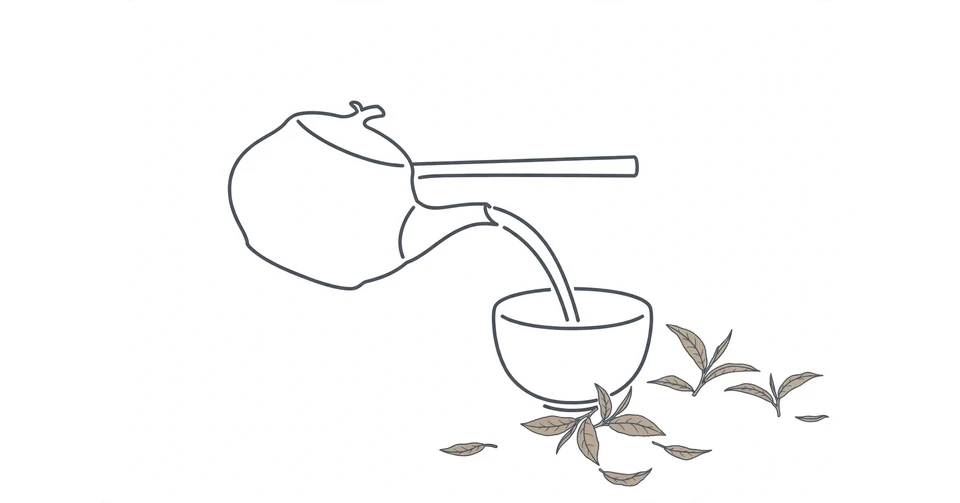
That is the honest starting point for understanding this pot. It is not a ceremonial object, and it is not a piece of decoration for a shelf. It is a working tool, refined over two centuries of daily use, and its design decisions are practical ones. The handle is on the side so the pour can be controlled with one hand. The strainer is built in so the leaves stay in the pot. The clay is unglazed so the tea comes out a little softer. None of this is accidental, and all of it is worth knowing before buying one.
What a kyusu actually is
A kyusu is a traditional Japanese teapot made mainly for brewing green tea. That is the plain definition, and it is worth holding on to, because the word itself carries no promise about shape. As the Kyusu entry on Wikipedia explains, the common idea that a kyusu always has a side handle is a misconception: the word merely means teapot, even though in common usage it usually does refer to a teapot with a side handle.
In practice, three forms cover almost everything a buyer will meet. The most common is the yokode no kyusu, the side handle teapot, with the handle set at a right angle to the spout. Then there is the ushirode kyusu, the back handle teapot, with the handle opposite the spout, much like teapots in other parts of the world. Finally there is the uwade kyusu, the top handle teapot, with a handle arched over the lid. The side handled form is the standard, and when a shop in Japan lists a kyusu without further detail, it is almost certainly a yokode.
Size is part of the definition too. A kyusu is a small pot, commonly holding somewhere between 200 and 350 millilitres, and most everyday pots sit in the 200 to 300 millilitre range. That is enough for one or two small cups, and deliberately so. Japanese green tea is brewed in small amounts and steeped again, so a pot that holds a litre would be the wrong tool. The small volume is not a limitation. It is the design.
I think the size is the first thing that surprises people who meet a kyusu for the first time outside Japan. A Western teapot is built to serve a table, so it is large and generous. A kyusu is built to serve one or two people, several times in a row, from the same leaves. It asks the drinker to slow down and pay attention to each pour rather than filling a big pot once and forgetting about it. That is a small difference in the hand and a large difference in how the tea is experienced.
Why the handle sticks out of the side
The side handle is the feature that makes a kyusu instantly recognisable, and it exists for a very practical reason. The handle sits at ninety degrees to the spout, so the whole pour can happen with one hand. The fingers wrap around the handle, the thumb settles on the lid to keep it in place, and the wrist makes a short, clean turn. The last drops come out with a gentle shake of the wrist, and the lid stays put.
That one handed pour matters because green tea is poured in a particular way. The pot is emptied completely at the end of each steep, down to the last drop, so that the leaves do not keep steeping in leftover water and turn bitter. The brewer pours back and forth between small cups, a little into each, then a little more, so that every cup ends up the same strength. Doing that with a heavy two handed pot would be clumsy. Doing it with a small side handled kyusu is natural, and after a few sessions it becomes automatic.
The history of the form is older than most people expect, and it did not begin with tea at all. The word kyusu comes from a Chinese term for a small vessel used at sudden need, which in Ming era China warmed sake rather than tea. Japan borrowed the object and the word, and repurposed it when steeped leaf tea arrived. The Obaku Zen monk Ingen brought Ming style tea drinking to Nagasaki in 1654, and the monk Baisao, who lived from 1675 to 1763, sold steeped tea from a portable stand in Kyoto and made it fashionable. In the Bunka-Bunsei years, from 1804 to 1830, the sencha boom put a small clay teapot into ordinary households, and the side handled form became the default. Japan is the only tea culture where this form became standard, and once you have poured with one, the reason is obvious.
There is also a quiet piece of craftsmanship in the lid that most owners never notice until someone points it out. In the smaller Tokoname pots, some lids are crafted so precisely that they will not fall off because of water adhesion when the pot is tilted. The spout, too, has to be made with an angle that stops drops from leaking back while pouring. These are small details, and they are exactly the details that separate a good kyusu from a cheap imitation. A pot that drips down its side after every pour is a pot that was not made with care.
The strainer hidden inside the pot
If the handle is the most visible feature of a kyusu, the strainer is the most important one. Built in filtration is half the reason this pot exists, and it is what connects the kyusu to the tea it serves. Japanese sencha is steamed, rolled, and dried into fine needles, and deep steamed sencha breaks into even smaller, powdery pieces. Without a strainer, those pieces would end up in the cup, and the last sip would be gritty and bitter.
The classic solution is the sasame, a fan of fine holes formed directly into the wall of the pot, from the same clay, in front of the spout. It is part of the pot itself rather than a separate piece, which means there is nothing to lose and nothing to clean separately. It keeps the pour honest for most teas, though it can clog with very fine or deep steamed leaf, and then the pour slows to a thin stream. That is the trade off of the traditional design, and it is worth knowing before choosing one.
The modern alternative is stainless steel mesh, and it comes in several forms. The obi-ami is a band of mesh running around the inner wall of the pot, a Tokoname development that gives the tea a much larger filtering area than the sasame. There are also flat meshes fitted at the spout and removable basket inserts that lift out for cleaning. Deep steamed sencha, with its broken leaf, wants mesh. Standard sencha and gyokuro are happy with ceramic. Handleless pots such as the hohin and the shiboridashi strain in the simplest way of all, through slits or holes formed at the lip of the spout, and they work because the leaves they brew are whole and large.
Choosing between ceramic and mesh is less a question of right and wrong than a question of which tea is poured most often. A drinker who brews mostly deep steamed sencha will be happier with a mesh strainer and will spend less time unclogging it. A drinker who brews standard sencha or gyokuro may prefer the sasame, which is traditional, elegant, and perfectly adequate for whole leaf. I lean toward mesh for everyday use, because a slow pour on a busy morning is the kind of small frustration that turns a good habit into a chore, and the kyusu is supposed to make tea easier, not harder.
Tokoname, the town that made the kyusu famous
No name is more closely tied to the kyusu than Tokoname. The town sits on the Chita Peninsula south of Nagoya, in Aichi Prefecture, and it is the oldest of Japan's Six Ancient Kilns, with pottery history going back roughly a thousand years to the late Heian period. For most of that time the town made storage jars and pipes, not teapots. The kyusu is a recent chapter in a very old story.
That chapter began in the late Edo period, when a Tokoname potter copied teapot forms from an imported illustrated book. Then Sugie Jumon developed the red clay kyusu that became the modern prototype in the early 1860s. A few years later came a direct transfer from China: in 1878 the potter and entrepreneur Koie Hoju invited the Chinese literatus Jin Shiheng to Tokoname, where he taught Yixing slab building and engraving techniques to local potters. The Japanese side handle standard and Chinese Yixing methods have been intertwined ever since. Today Tokoname is Japan's largest kyusu producer, and in 1998 Yamada Jozan III became the only kyusu maker ever named a Living National Treasure.
The signature material of Tokoname is shudei, which literally means vermilion mud. It is a clay unusually rich in iron, and when it is fired in an oxidising kiln the iron converts to hematite and turns the pot its familiar red brown. The piece stays unglazed, inside and out, and that unglazed surface is part of how the pot works. There are variants worth knowing. Kurodei is shudei re-fired wrapped in rice husks for a black surface. Mogake is a technique credited to Ina Choza in the 1830s, where eelgrass wrapped around the body scorches scarlet marks into the surface during firing. There is also the flat hira shape, a low, wide pot made for gyokuro.
A real Tokoname pot can be recognised by a few honest signals. The maker is named, the pot often carries a stamped or incised mark, usually on the underside or the lid rim, and better pieces come with a signed wooden box called a tomobako. The interior is unglazed, and running a finger along the inner wall is a simple test: a glazed interior on a pot sold as shudei is a tell that something is wrong. None of these signals guarantees quality on its own, and a small workshop in a lesser known region can produce a better pot than a famous name, but they are a useful starting point for a first purchase.
Banko clay and the purple alternative
If Tokoname is the first name a buyer meets, Banko is usually the second. Banko ware comes from Yokkaichi in Mie Prefecture, and its story begins with the merchant and tea devotee Nunami Rozan, who around 1736 to 1740 stamped his pieces with the words banko fueki, meaning unchanging for eternity, which gave the ware its name. Today the Banko association's own numbers put the region at over 80 percent of Japan's donabe clay pot production, though that figure belongs to the cooking pots rather than the teapots, and it is often misquoted as a share of teapot production.
The Banko teapot material is shidei, purple clay. The base is the same idea as Tokoname's: an iron rich clay left unglazed. The difference is not the mineral deposit but the atmosphere of the kiln. Tokoname fires in oxidation, and the iron becomes red hematite. Banko fires in reduction, with the kiln starved of oxygen, and the same iron converts to dark magnetite type oxides instead, giving a purple brown colour that darkens and gains lustre with use. One clay family, two atmospheres, two colours.
In practice, Banko pots are a natural home for hojicha, roasted teas, and everyday sencha, and many drinkers also reach for them with Chinese teas. That is a preference rather than a law, and the measurable behaviour of the two clays in the cup is close. Banko clay is also known for good heat resistance, and its pots often feel lighter in the hand than people expect. For a buyer choosing between the two, the honest advice is that either will brew a good cup, and the choice can safely come down to which colour and which feel is more pleasing in the hand. A kyusu is used every day, after all, and a pot that is pleasant to hold will be used more often than a pot that is merely correct.
What the clay actually does to the tea
The claim that an unglazed iron clay pot makes green tea taste smoother is old shop wisdom, and it has been repeated so often that it is easy to dismiss as folklore. Unusually, it has been tested, twice, in Japan, with instruments rather than opinions. A detailed guide to Japanese teapots and their kilns reports both studies, and the numbers are worth looking at closely.
A 2022 study in the Journal of Cookery Science of Japan brewed identical sencha, two grams of leaf per 100 millilitres of water at 85 degrees Celsius for 90 seconds, in six different vessels and measured the result. Tannin, the astringent fraction of the tea, came out at 73.2 milligrams per 100 millilitres from a Tokoname shudei pot, against 88.9 milligrams from Arita porcelain, which is roughly 18 percent less astringency from the same leaf. The umami amino acids stayed essentially unchanged across the ceramics. An earlier study from Mie Prefecture's research institute ran thirteen pot materials across a taste sensor and found the same ordering, with porcelain and glass at the astringent end and porous iron rich stoneware at the mild end, with a gap large enough for most people to taste.
The mechanism is thought to be physical: catechins adsorb into the pores of the unglazed surface and bind to iron compounds in the clay. The studies stop short of proving the exact chemistry, but the effect itself is not folklore. Two smaller points from the same work are also worth noting. At the standard three to five minute steep, stoneware holds the ideal 70 to 80 degree window slightly better than porcelain. And the colour of the infusion brewed in porcelain came out palest and dullest of all the vessels tested, which is a reminder that white porcelain flatters tea in the cup, not in the pot.
None of this means a clay kyusu is the only honest way to brew green tea. Porcelain has its own virtue, which is neutrality. Its water absorption is 0.00 percent, so the fired body takes up nothing and gives up nothing, and a porcelain kyusu shows the tea exactly as it is. That is why tasters use porcelain when they want the pot's opinion removed. But for a daily drinker who wants the cup to be a little rounder and a little less sharp, the clay pot earns its place. I find the difference real but modest, which is the right size for it. A good pot does not rescue bad leaf, and it does not transform good leaf into something else. It simply takes the edge off, cup after cup, quietly.
How to choose a kyusu
Choosing a kyusu is simpler than the catalogues make it look, because the decision comes down to three questions: how much tea is brewed at once, which tea is brewed most often, and whose hand will hold the pot.
Size comes first. An unglazed Tokoname or Banko clay kyusu of 200 to 300 millilitres is the standard choice for everyday sencha, and it is the right default for almost everyone. A pot in that range serves one or two small cups per steep and empties completely in one pour, which is exactly how sencha is meant to be served. Gyokuro and other shaded teas want something smaller, usually a hohin, a shiboridashi, or a flat hira kyusu of 80 to 150 millilitres, because the leaf is brewed with very little water at a low temperature. Hojicha and other roasted teas are happy in a larger pot of 300 millilitres or more, brewed hotter. The rule that survives every regional argument is to match the pot to the leaf actually drunk most often, and to keep the volume small enough that the pot is emptied in one pour.
Handle style comes second. The yokode, the side handle, is the right default for anyone starting with a Japanese clay teapot, and it suits standard green teas such as sencha, genmaicha, and hojicha. The ushirode, the back handle, feels familiar to anyone used to a Western teapot, and it is stable when the pot is full, which is why it appears often on porcelain kyusu and on pots made for hojicha. The uwade, the top handle, arches over the pot and suits larger volumes, which is why it is the restaurant and ryokan standard. Handleless pots, the hohin and the shiboridashi, are for low temperature brewing, where the water never gets hot enough to burn the hand.
Strainer comes third, and the choice follows the tea. Fukamushi sencha, the deep steamed style with its broken leaf, wants a mesh strainer, ideally the obi-ami band that runs around the inner wall. Standard sencha and gyokuro are happy with a ceramic sasame. A buyer who drinks only one tea can choose freely. A buyer who drinks several should choose the strainer that suits the finest leaf on the shelf, because a clogged pour is the one flaw that ruins a pot in daily use.
Price deserves an honest word. A functional clay kyusu can be bought for a modest sum, and a handmade pot from a named maker can cost many times more. The expensive pot is usually better finished, with a lid that fits perfectly and a spout that pours cleanly, but the difference in the cup is small. I would rather see a beginner buy a simple, well made Tokoname pot and spend the rest of the budget on good leaf than buy a beautiful pot and fill it with stale tea. The leaf matters more than the vessel, and the vessel matters more than the price tag suggests.
Brewing sencha and gyokuro in a kyusu
A kyusu earns its keep in the brewing itself, and the method is simple once the water temperature is understood. Sencha is sensitive to heat in a way that surprises first time drinkers. Water straight off the boil pulls bitter compounds out of the leaf faster than it pulls the sweet and savoury ones, so the cup turns harsh. The fix is to let the water cool. Most guides put sencha at 70 to 80 degrees Celsius, and the sencha article on this site recommends 70 degrees for the first steep, with 5 grams of leaf to 150 millilitres of water and a steep of about one minute. For a deep steamed sencha, 45 seconds is enough.
The routine is the same every time. Warm the kyusu and the cups with a little hot water, then discard it. Add the leaf, pour in the water at the right temperature, and wait. When the time is up, pour the tea out completely, moving between the cups a little at a time so each cup ends up the same strength, and shake the last drops out with a turn of the wrist. That final shake is where the side handle shows its value, and it is also where the quality of the strainer is tested.
The second steep is different. The leaves are already open, so the water can be a little hotter, around 75 degrees, and the steep much shorter, about 20 to 30 seconds. A third steep is possible, though by then the flavour is thinner and mostly a pleasant green echo of the first cup. The point is not to follow a recipe with laboratory precision. It is to understand the direction: cooler water for sweetness, hotter water for strength, and short steeps to keep the bitter side quiet.
Gyokuro asks for more patience, and it rewards the smaller pots. The gyokuro article on this site explains why this shaded tea commands its price, and the brewing follows from the same logic. The water is cooler still, around 50 to 60 degrees, the leaf to water ratio is higher, and the steep is longer, often two minutes. A small hohin or a flat hira kyusu suits it best, because the volume is tiny and the pot must be easy to handle when the water is barely warm. Pouring gyokuro from a large pot would be like serving a fine wine from a jug. It works, but it misses the point.
One habit matters more than any single recipe, and it is the habit of emptying the pot. A kyusu left half full between steeps keeps extracting, and the next cup comes out bitter and flat. Pouring everything out, down to the last drop, keeps each steep clean. It is a small discipline, and it is the difference between a pot that produces good tea and a pot that produces tea that tastes somehow tired.
How to care for a kyusu
An unglazed clay kyusu wants almost nothing, and that is part of its charm. Rinse it with hot water after use, and never use soap. The porous body absorbs detergent as readily as it absorbs tea, and a soapy pot will lend a chemical note to the next few brews that no amount of rinsing fully removes. Dry it fully with the lid off before storing, so no moisture is trapped inside. Porcelain tolerates anything, but clay asks for this one courtesy, and it is not a difficult one.
If a sasame strainer clogs, a soft brush under running water clears it. Never use a hard object, because the ceramic teeth are the most fragile part of the pot, and a chipped strainer cannot be repaired. If the pot is used daily, it will slowly change colour inside as tea oils settle into the clay. That is normal, and in Japan it is considered a virtue rather than a stain. The pot records the tea it has brewed, and over years that record deepens the colour and, many drinkers believe, softens the cup further.
There is one more habit worth keeping, and it is the simplest of all: use the pot for one tea, or at least for one family of teas. A clay kyusu that brews sencha every day will carry a faint memory of sencha into later brews, which is pleasant. A clay kyusu that brews sencha on Monday, hojicha on Tuesday, and a flavoured tea on Wednesday will carry a confused memory, which is less pleasant. Porcelain has no memory at all, which is why it is the honest all rounder for a drinker who rotates through many teas. But for the drinker who has one daily tea, a dedicated clay kyusu is a small pleasure that grows with time.
I keep one Tokoname pot for sencha and nothing else, and it has become one of the most used objects in my kitchen. It is not the most beautiful thing I own, and it is certainly not the most expensive, but it is the one I reach for without thinking. That is the real test of a kyusu. It is not whether it impresses a guest, but whether it disappears into the routine and makes the routine better.
A small pot worth slowing down for
A kyusu will never be the most dramatic object in the kitchen. It has no ceremony attached to it, no seasonal ritual, and no correct way to hold it beyond the way that works. What it has is something quieter: a shape refined by two centuries of daily use, a clay that softens the cup a little, and a strainer that keeps the leaves where they belong.
That modesty is easy to miss, and I missed it myself for a long time, treating the small teapot on the shelf as background rather than as something worth noticing. But a country does not brew its everyday tea in a pot like this by accident. It brews it in a kyusu because the volume is right, because the handle fits the hand, because the strainer does its job, and because a pot of it fits the shape of an ordinary day.
The next time a cup of sencha arrives, it is worth taking a slow sip and noticing the pot it came from. A kyusu is a small thing, and it does a small job, and it does that job well enough that the tea itself gets to be the point. For a tool that costs little and lasts for years, that is a good bargain, and a good reason to keep one on the shelf.
More in Food & Travel
- Shincha Is the First Flush Japan Waits All Winter For
- Gyokuro Earns Its Price One Shade-Grown Leaf at a Time
- Sencha Is the Green Tea Japan Drinks Every Single Day
- Mugicha Is the Barley Tea Japan Pours All Summer Long
- Bancha Is the Everyday Tea Japan Drinks Without Thinking
- Hojicha Is the Roasted Tea Japan Reaches for After Dinner
Latest posts
- Taiko Drums and the Thunder That Shook Japanese Festivals
- Washi Paper and the Thousand-Year Craft Behind Japan's Toughest Sheets
- Chusonji Is the Mountain Temple That Outlasted Its Golden Age
- Kakigori and the Thousand-Year History of Japan's Shaved Ice
- A Pure Land Garden Is a Paradise You Can Walk Through
- Genmaicha Turns Roasted Rice Into Japan's Nuttiest Green Tea
- Sagemono Are the Hanging Treasures Samurai Wore at the Waist
- Oshu Fujiwara Built a Golden Capital in the North
- Harajuku and the Tokyo Streets Where Fashion Refuses to Sit Still
- Fujiwara no Kiyohira Turned War Into Gold
- Motsu-ji Keeps Hiraizumi's Pure Land Garden Alive
- Hiramaki-e Keeps the Gold Flat and Lets the Picture Speak
- Chuson-ji Is the Mountain Temple That Guarded the Golden Hall
- Urushi Kabure Is the Rash Lacquer Apprentices Learn to Live With
- Konjikido Is the Golden Hall That Outlived a Fallen Capital