A Shoji Lets the Daylight In While Keeping the World Out
· 18 min read
A shoji is a paper screen on a wooden lattice that turns harsh daylight into a soft glow, and this article looks at how it is made, how it differs from a fusuma, and how to care for it.
Stand in a Japanese tatami room on a bright morning and you will notice something odd about the light. It does not arrive through a window in one hard rectangle. It comes through the whole wall at once, soft and even, as if the sun itself had been asked to lower its voice. The wall doing that work is a shoji, a screen of translucent paper stretched over a wooden lattice, and it is one of the quietest inventions in Japanese architecture.
A shoji does not try to impress anyone. It has no colour worth photographing and no carving worth framing, yet it changes everything about a room. It lets the daylight in while keeping the world out, and that simple trade is the reason it has survived for centuries in houses, temples, tea rooms, and inns across Japan. The screen is light enough to lift off its track with one hand and fragile enough to tear with a fingernail, and still it is trusted to guard the boundary between a home and the street.
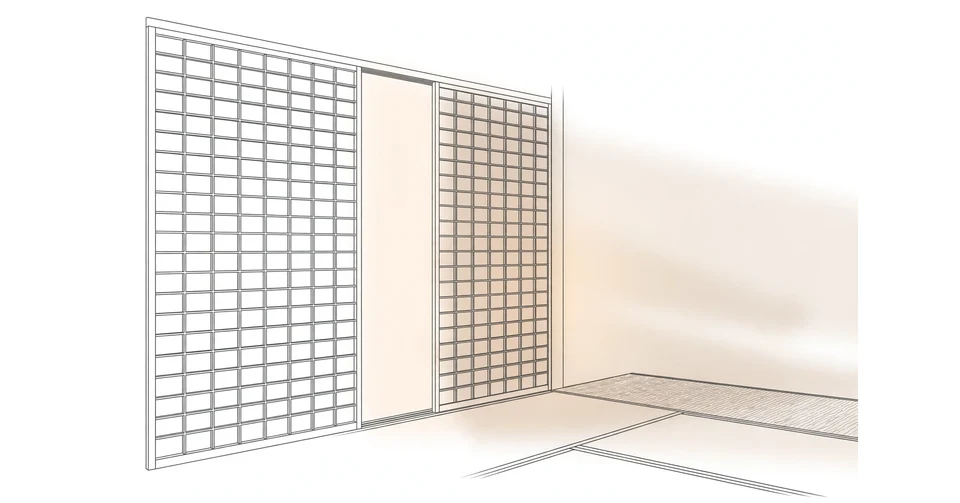
This article looks at the shoji on its own terms. Not as a decoration, and not as a cheaper cousin of the fusuma, but as a working piece of a house with a history, a craft, and a job that no glass window does quite the same way. We will look at where it came from, how it is made, how it differs from its opaque neighbour, and how to live with one, including the once a year ritual of giving it fresh paper. If you have ever sat in a room like this and felt oddly calm without knowing why, the answer may be hanging in front of you in a wooden frame.
A screen that once meant every kind of partition
The word shoji is far older than the paper screen we picture today. The Japanese Architecture and Art Net Users System, known as JAANUS, notes that the word appears as early as the year 780, in a record of materials for the Saidaiji temple. Back then it was a broad word, closer to our word partition than to one particular object. During the Heian period it could mean an opaque panel, a latticed door, a plank door, or a free standing screen, and only over time did it settle into the meaning we use now, a translucent screen that passes light.
The turning point came near the end of the twelfth century and the start of the thirteenth, when a form called akarishoji appeared. These were removable partitions covered on one side only with a translucent material, often thin silk or paper, so that light could pass through in a softened form while wind and glare were kept out. The growing skill of Japanese papermakers helped this form spread, because better washi made a better screen, and the screen in turn gave papermakers a steady reason to keep improving their craft.
The shoji rose to prominence as part of shoin-zukuri, the restrained style of residential architecture that developed in the Kamakura period, when aristocrats with shrinking incomes built smaller and simpler houses. The style was simplified further in the teahouse influenced sukiya-zukuri tradition, and during the Edo period the screen spread from the homes of the wealthy into the homes of ordinary people. Since then, the shoji has been largely unchanged, which is a rare thing to say about any piece of housebuilding that is still in daily use.
What strikes me about the history of the shoji is how little of it was driven by fashion. The shoji did not spread because it looked elegant, though it does, but because it solved a real problem in a wooden house with deep eaves and no glass. It let a family have daylight and fresh air without giving up privacy, and it did so with materials any village could supply, wood and paper and glue. That is the kind of design that survives, not because people are sentimental about it, but because it keeps working.
How a shoji is put together
A shoji looks simple, and that simplicity is deceptive. The frame is a panel called a koshi, a lattice assembled from interlocking laths of wood or bamboo called kumiko. The laths meet in halved joints that alternate in direction, so they weave together, and the interweaving is structural. Traditionally no metal fasteners hold the frame together, though rice glue can be used in the joints, and the paper, once it is tensioned by spraying it with water, strengthens the finished panel further. Coniferous wood is preferred for its fine, straight grain, and a screen made with split bamboo instead of wood is called a take-shoji.
The lattice itself is a small work of geometry. About two hundred traditional patterns are used, each with its own symbolism drawn from the natural pattern it represents, and patterns can be combined. The standard pattern in most homes is the mabarasan, with large squarish openings that are quick to assemble. Patterns with rectangles longer in the horizontal direction are more common in the east of Japan, while patterns with rectangles longer in the vertical direction are more common in the west. The foundations of these patterns, the jigumi grid, may be square, diamond shaped, or hexagonal. A visitor will not notice these details at first, but once you have seen a fine kumiko lattice up close, with its joints cut so precisely that they seem to grow out of each other, an ordinary window frame starts to look clumsy.
Paper covers one face of the frame only, and that is the detail that makes a shoji a shoji. The paper is washi, a specialised paper that diffuses light particularly well and excludes wind. It is traditionally made from kozo mulberry bark, mitsumata, or gampi fibre, or from hemp, and it is sold in a broad range of types. Bright white paper is the most popular choice in Japan, while darker colours are avoided for the obvious reason that they would not transmit light. A common misunderstanding outside Japan is that this paper is rice paper, the edible kind used in cooking. It is not, and the confusion probably survives only because the phrase sounds right.
The lowest part of the screen often gets a different treatment. The bottom section, which is the most likely to get wet or kicked, may be filled with a solid wood panel called a koshi dado, and a screen built this way is called a koshizuke shoji. When shoji were still exposed to rain under shallow eaves, these panels were tall, but today the screen usually sits behind glass, so the panel in common use is much lower. It is a small, practical adaptation, and it tells you something about the craft: the people who make these screens adjust the design to the weather, not to a picture in a catalogue.
One more small part deserves a mention, the hikite, or door pull. A smooth sheet of paper is hard to grip, so a single square in the frame may be papered on the opposite side only, or a groove may be cut into the outside of the frame, giving your fingers somewhere to catch. It is a tiny detail, easy to miss, and it is the kind of detail that separates a tool made by people who use it every day from one made only to be looked at.
Shoji and fusuma do opposite jobs
Visitors mix up shoji and fusuma constantly, and the confusion is understandable. Both slide in wooden grooves, both are made of wood and paper, and both belong to the same room. But they do opposite jobs, and once you know the difference you will never mix them up again. A shoji is a translucent paper screen on a wooden lattice, papered on one face only, built to pass light. A fusuma is papered on both faces and lets almost no light through. The short version, as the earlier article on fusuma puts it, is that fusuma shape space and shoji shape light.
Position follows the job. A shoji sits near windows or along the veranda side of a room, where daylight comes through it softened and spread evenly across the floor. A fusuma sits between rooms, where darkness is acceptable and privacy matters more than brightness. In a typical Japanese style room the two work as a pair, the shoji on the outer edge facing the garden and the fusuma on the inner edge facing the next room, and together they make a room that is bright, private, and easy to rearrange. If you want the full story of the opaque half of that pair, the article on how a fusuma turns a room into whatever Japan needs next walks through its history and its own craft in detail.
Sound is the one point where the two screens are alike, and not in a good way. Neither one is soundproof. A fusuma muffles sound a little better because it is thicker and papered on both sides, but a conversation in the next room still comes through as a murmur, and footsteps on tatami are easy to hear. A shoji gives visual privacy, like a curtain, but it does not block sound at all. That is worth knowing before you book a room in a traditional inn and expect silence. Japanese houses have always accepted that trade, and in a way the acceptance is part of the design: the screens are even thought to encourage the people inside to speak and move softly, calmly, and gracefully, which fits the ethos of the sukiya-zukuri style.
The two screens also share a limit that matters for anyone thinking of installing them. Neither belongs on an exterior wall, where weather calls for storm shutters or glass. In modern construction the shoji usually sits inside a sliding glass door or window, which takes the weather while the screen takes the light. That pairing, glass outside and paper inside, is how an old idea survives in a modern house without pretending the climate has changed.
The light is the point
Everything about a shoji comes back to light, and it is worth slowing down to notice what kind of light it makes. Glass lets the sun in as it is, bright in one place and dark in another, with hard shadows that move across the floor through the day. A shoji takes that same sunlight and spreads it. The paper scatters the rays in every direction, so the whole wall glows and the room fills with an even, gentle brightness that has no hot spot and no glare. On a cloudy day the effect is even stronger, because the screen turns a grey sky into a large, soft lamp.
That softness is why a shoji changes how a room feels to sit in. Shadows of trees outside show through the paper as slow moving silhouettes, and the sound of frogs or rain reaches you without the sight of the street that made it. The screen does not set a sharp barrier between inside and outside, and that is the point: you are sheltered, but you are not sealed off. I think this is the real reason the shoji has lasted so long. It is not only a practical device for light and privacy. It is a way of living with the weather and the garden instead of shutting them out, and that attitude runs through a great deal of Japanese architecture.
The screen does more than manage light. While washi blocks wind, it still allows air to diffuse through, which mattered a great deal when buildings were heated with charcoal and damp rose from the ground under a raised wooden floor. Fresh air had to move through the house, and a paper screen that breathes a little was part of that system rather than a flaw in it. Above the sliding panels, the ranma transom panel often has openings of its own to encourage breezes to pass through the building, and the way a ranma lets a Japanese room breathe over the top of its walls is the natural companion to what the shoji does at eye level. The two pieces work together, one handling light and the other handling air, and the room stays comfortable without a machine doing the work.
There is also a quieter effect that is harder to measure. A room lit by a shoji asks less of your eyes. There is no bright window to squint against and no dark corner to strain into, so reading, sewing, or simply sitting feels easier for longer. People who work in rooms like this often describe the light as restful, and I believe them, because the difference between scattered light and direct light is something your body notices before your mind names it. Modern lighting designers spend a great deal of money chasing the same effect with diffusers and indirect fixtures, and a sheet of paper on a wooden frame has been doing it for centuries.
Paper that is meant to be replaced
A shoji is not a screen you buy once and forget. Its paper is a consumable, and that is not a weakness but part of the design. Traditionally the paper is renewed once a year, in late December, so the house goes into the new year with fresh, bright screens. The old paper is soaked along the glue lines and peeled away, sometimes coming off in a single piece if it is peeled carefully, and the remains are washed from the frame. New paper is pasted on with rice glue, which is water soluble, and after the glue has dried, which takes about six hours, the paper is sprayed lightly with water so that it tightens and any small wrinkles disappear.
Anyone who has done this once learns two things. The first is that the job is simpler than it looks, and the second is that it is harder to do well than it first appears. The paper must lie flat without bubbles, the glue must be even, and the frame must be handled gently while it is bare, because the thin kumiko laths break easily when the screen is stripped and stepped on. It is a small annual ceremony, and I suspect that is part of its value. A house that asks you to renew a part of it every year keeps you in a relationship with it, instead of letting you forget it exists until something breaks.
Small tears do not always mean a full replacement for a shoji. Paper is decoratively patched when it is torn, and a patched shoji can be more charming than a perfect one, with the patch treated as part of the screen rather than a shameful repair. That attitude, of repairing visibly and living with the repair, is one of the things I admire most about the craft. It treats the screen as a living part of the house, not a disposable product, and it asks the owner to take part in keeping it beautiful.
Modern materials have added choices that the old makers did not have. Laminated papers, coated in vinyl, last longer and are sufficiently waterproof to be wiped clean, though the thicker the plastic film the harder the paper is to install, and laminated paper cannot be sprayed with water to tighten it. Rigid light diffusing panels of acrylic or polycarbonate are also used, and these are waterproof enough for places where paper would fail. Plastic sheets and synthetic fibres first entered washi production in the 1960s, and a small proportion of synthetic fibre is now sometimes used to increase tear strength. None of these replaces the traditional screen entirely, and that is fine. They are options for particular rooms, and the paper original remains the standard against which they are judged.
Seasonal variations show the same practical spirit. In summer, some screens are swapped for sudare-shoji, filled with reed, cat tail stalks, pampas grass, or fine bamboo held together with thread. These give more shade and ventilation than paper, and they are sometimes called summer shoji. In Kyoto, both paper shoji and fusuma are removed and replaced with these reed screens and bamboo blinds, usually toward the end of June, before the rainy season ends and the Gion Festival begins. Other named forms include the yukimi shoji, a snow viewing screen with a glass pane that lets you watch the garden in cold weather, and the tsukimi shoji, favoured for moon viewing. A screen that can be swapped with the season is not a fixed wall. It is a piece of clothing for the house, changed when the weather changes.
Shoji in modern homes and ryokan
The shoji has not retired to museums. It is still used in traditional style Japanese houses and in Western style housing, especially in the washitsu, the traditional Japanese style room that many modern homes still include. In a new apartment the screen often sits behind glass, taking the light while the glass takes the weather, and in a renovated house it may divide a living room from a study, giving privacy without darkness. The screen has adapted to modern life by accepting a junior role beside glass, and it still does the one job glass cannot do, which is to soften the light.
The place most visitors meet a shoji is a ryokan, the traditional inn, and that is probably the best introduction. You slide the screen open in the morning and the garden is there, framed by the lattice and lit by the same soft light that fills your room. In the evening you slide it closed and the room becomes a paper lantern, glowing gently from within. The screen is part of the reason a night in a ryokan feels so different from a night in a hotel, even when the bed is just as comfortable. A hotel room is lit by lamps. A ryokan room is lit by the house itself.
Architects outside Japan have borrowed the idea widely, and the borrowing is a compliment, though it sometimes loses the craft. A plastic panel with a printed wood grain pattern is not a shoji, even if it looks like one from across the room. The real thing is light, removable, and repairable, and it asks the people who live with it to handle it gently. That fragility is often listed as a disadvantage, and it is true that a screen can be torn by a child, a pet, or a careless elbow. But fragility is also information: a house that can be damaged by a touch teaches the people inside it to move with care, and moving with care is not a bad habit for a home to teach.
Living with a shoji
If you live with a shoji, a few habits will keep it in good shape. Slide it by the frame, not by the paper, and use the hikite where one is fitted. Keep the wooden grooves clean, because grit in the track is what makes a screen stick and jump, and a jumping screen is what tears paper. Keep the screen dry, since even laminated paper suffers when water bleeds in from the edges, and never put a shoji where it will get wet, such as a bathroom. Repair small tears promptly with a patch, before a small tear becomes a large one, and plan the annual re-papering as a household task rather than a chore to postpone until the paper is grey.
Most of all, live with the light it makes rather than fighting it. A shoji will never give you a sharp view of the street, and it will never block the sound of the house next door. Those are not failures. They are the terms of the trade, daylight in exchange for a little less privacy than a wall, and a little more contact with the world outside than glass. Accept those terms and the screen will repay you every morning, when the whole wall lights up at once and the room feels larger than it is.
A shoji is a small thing, a frame and a sheet of paper, and it does a small thing, it lets the daylight in while keeping the world out. But small things done well have a way of outlasting grand ones. The screen has survived eight centuries of change in Japanese houses because it answers a need that has not changed: people want light in their rooms, privacy from the street, and a home that feels connected to the garden outside. A sheet of washi on a lattice of wood still does that better than almost anything else, and on a bright morning in a tatami room, with the whole wall glowing softly, it is hard to argue with the result.
More in Culture & Society
- A Tokonoma Turns One Corner of a Japanese Room Into a Shrine
- Fusuma Turn a Room Into Whatever Japan Needs Next
- Wearing a Happi Means You Belong to the Matsuri
- Washi Paper and the Thousand-Year Craft Behind Japan's Toughest Sheets
- Chusonji Is the Mountain Temple That Outlasted Its Golden Age
- A Pure Land Garden Is a Paradise You Can Walk Through
Latest posts
- Himeji Castle, Japan's White Heron That Survived War and Fire
- A Genkan Is Where Japan Leaves the Outside World at the Door
- A Ranma Lets a Japanese Room Breathe Over the Top of Its Walls
- Japanese Breakfast and the Morning Meal That Starts with Rice and Soup
- A Yuzamashi Cools the Water Before the Tea Begins
- Tencha Is the Shade-Grown Leaf Matcha Is Made From
- Taiko Drums and the Thunder That Shook Japanese Festivals
- A Kyusu Is the Small Teapot Behind Every Good Cup of Sencha
- Shincha Is the First Flush Japan Waits All Winter For
- Gyokuro Earns Its Price One Shade-Grown Leaf at a Time
- Sencha Is the Green Tea Japan Drinks Every Single Day
- Mugicha Is the Barley Tea Japan Pours All Summer Long
- Bancha Is the Everyday Tea Japan Drinks Without Thinking
- Hojicha Is the Roasted Tea Japan Reaches for After Dinner
- Kakigori and the Thousand-Year History of Japan's Shaved Ice