Ikebana and the Quiet Discipline Behind Japan's Flower Art
· 13 min read
Ikebana is the Japanese art of flower arrangement, built on a few stems, empty space, and five centuries of discipline. Here is how it began in a Kyoto temple and why it still matters.
Ikebana is the Japanese art of arranging cut flowers, branches, and leaves so that a few stems say more than a full bouquet ever could. Where a Western florist fills a vase, an ikebana practitioner leaves most of the vase empty on purpose, because the space between the stems is part of the arrangement. The word itself comes from ikeru, to arrange or to give life, and hana, flower, and that second meaning matters: the point is not to decorate a room but to give a cut branch a second life in a new place.
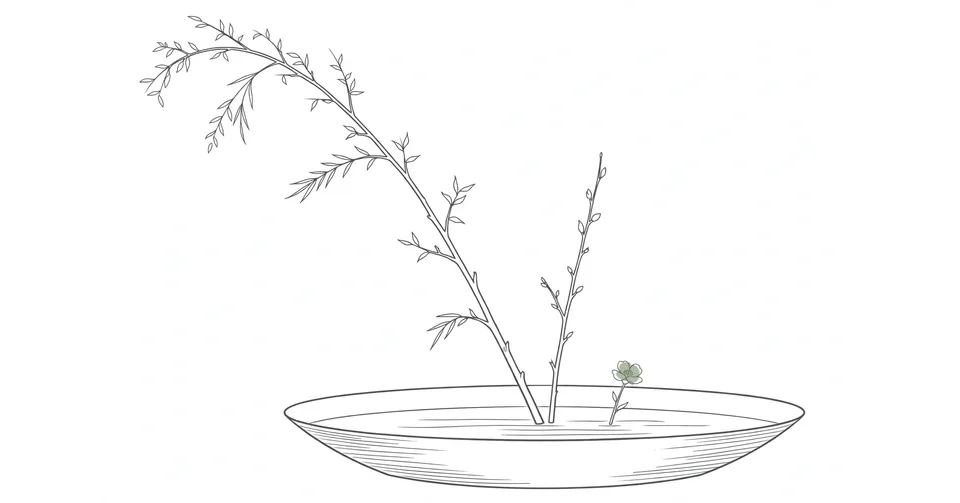
A single ikebana arrangement can take an hour to build and a lifetime to understand, yet a beginner can make a first one in ten minutes with three stems and a shallow bowl. That contrast is the whole appeal. Ikebana looks simple from across the room and turns out to be strict up close, with rules about angles, heights, and the direction each stem leans. The discipline is the art, and the flowers are only the material it works on.
What ikebana actually is
At its core, ikebana arranges plant material in a vessel so that it looks as it might grow outdoors, only more deliberate. A traditional arrangement uses three main stems of unequal length, set at angles that suggest heaven, earth, and humanity, or in the Sogetsu school, shin, soe, and hikae. The tallest stem sets the height of the whole piece, the second gives it width, and the shortest anchors it near the water line. Everything else, extra flowers, leaves, a twist of bare branch, is optional, and often left out.
The empty space is not an accident. In ikebana, the gaps between stems are called ma, and they are treated as a material just like the flowers. A stem that stands alone against white wall space draws the eye to its curve in a way a crowded vase never could. This is the same instinct that shapes a Japanese garden, where a single stone can hold a whole corner of gravel, and it is no coincidence that the two arts grew up side by side. If you have ever stood in a garden like the ones in Japanese gardens and the quiet art of borrowed scenery, you have already met ikebana's way of thinking, only outdoors and at a larger scale.
Ikebana is also called kado, the way of flowers, which puts it in the same family as the tea ceremony and the martial arts: a practice with a path, not just a skill. A student studies under a teacher, works through set forms before improvising, and is graded through a system of licenses that can take decades to complete. That structure is one reason ikebana survived for more than 550 years while fashions in flower arranging came and went.
A history that starts in a Kyoto temple
Ikebana began with flowers placed before the Buddha. Buddhism reached Japan in the sixth century, and with it came the custom of offering flowers on temple altars. The Ikenobo school, the oldest school of ikebana, traces the art to three roots: flowers enjoyed for their beauty, branches raised as yorishiro, objects that call down divine spirits, and those Buddhist altar offerings. For centuries the arranging stayed inside temples, done by priests.
The first written record comes from 1462. In that year, the diary Hekizan Nichiroku, kept by a Zen monk at Tofukuji temple, noted that Senkei Ikenobo, a priest of the Rokkakudo temple in Kyoto, had arranged flowers for a warrior, and that the people of Kyoto praised the result. Ikenobo still counts its history from that entry and celebrated its 550th anniversary in 2012. The Rokkakudo itself, formally Shiunzan Chohoji, is a six-sided temple in central Kyoto that tradition says Prince Shotoku founded in 587, and it remains the home of the Ikenobo school today.
From the temple, ikebana moved into the homes of warriors and then merchants. The Muromachi period produced rikka, the oldest formal style, a tall arrangement built like a miniature landscape in a deep vase. The tea ceremony, which was taking shape in the same centuries, pulled the art in the opposite direction, toward chabana, a single flower in a simple vessel for the tea room. Readers who know the tea ceremony from the Japanese tea ceremony and the art of slowing down will recognise the shared taste: restraint, seasonality, and a preference for one perfect thing over many good ones.
By the Edo period, ikebana had become a standard accomplishment for women of good families, taught in schools with hereditary headmasters called iemoto. The system survives today. Each school is led by an iemoto, students pay for lessons and licenses, and the schools guard their styles the way a family guards a recipe. It is a structure outsiders sometimes find rigid, but it is also why the knowledge survived intact: the forms were written down, taught step by step, and handed from one headmaster to the next without interruption.
Rikka, shoka, nageire, and moribana
Most ikebana falls into a handful of styles, and knowing them is the fastest way to read an arrangement. Each style answers the same question differently: how much should the flowers imitate nature, and how much should they obey geometry.
| Style | What it looks like | Typical vessel | Where you meet it |
|---|---|---|---|
| Rikka | A whole landscape in one tall vase, built from seven or nine main branches | Deep bowls and tall vases | Ikenobo, temples and formal rooms |
| Shoka | One to three kinds of material in an uneven triangle, rising from one point at the water line | Cylinders and shallow bowls | Ikenobo and many Edo-era schools |
| Nageire | Stems thrown into a tall vase and left to lean as they will, held by the vase mouth or a forked twig | Tall, narrow vases | Tea rooms and casual settings |
| Moribana | Low, wide piles of flowers in a shallow dish, stems fixed on a spiked holder | Suiban, a wide shallow basin | Ohara, and beginner classes everywhere |
| Jiyuka | Free style, any material and any container, including metal, glass, and stone | Anything | Sogetsu and modern schools |
Rikka is the oldest and the most formal. Its seven or nine main branches, called yakueda, each have a role and a prescribed angle, and a full rikka can take hours to build. Shoka, also read seika, strips the idea down to three lines, shin, soe, and tai in Ikenobo teaching, arranged as an uneven triangle that suggests a plant rising from a single point. Nageire, literally thrown in, looks casual but is not: the stems are placed so that they hold each other up, and the apparent accident is the whole point. Moribana, meaning piled-up flowers, is the style most beginners meet first, because the spiked holder under the water does the hard work of keeping stems upright.
That holder is the kenzan, also sold outside Japan as a flower frog. It is a heavy metal base set with needle-like prongs, and its name means sword mountain. Kenzan were made in large quantities from the early twentieth century, after advances in metalworking, with well-known makers in Tsubame and Sanjo in Niigata Prefecture. A kenzan is the first tool a teacher tells a student to buy, along with a pair of flower scissors called hanabasami. The rest of the kit is small: a shallow basin called a suiban, water, and whatever the season offers.
The three schools that still teach ikebana
Three schools dominate ikebana today, and their differences are a good map of the art itself. Ikenobo is the oldest, first recorded in 1462, and the most classical. It teaches rikka, shoka, and free style, and it keeps the strictest link to the temple tradition. Its headmaster today is Sen'ei Ikenobo, the 45th headmaster of the school, and in a piece of news that made headlines in Japan in October 2026, the Council for Cultural Affairs recommended designating rikka an Important Intangible Cultural Property and recognising Sen'ei Ikenobo as its holder, a Living National Treasure. For an art that is more than five and a half centuries old, it was a long overdue honour.
Ohara is the school of the shallow bowl. Its founder, Unshin Ohara, lived from 1861 to 1916, trained in the Ikenobo tradition, and watched Western flowers arrive in Japan during the Meiji period. The tall vases of rikka did not suit the new flowers, so he designed low, wide dishes and a new style to go with them: moribana. The Ohara school dates its founding to 1895, when moribana was first presented, and it says it was the first to create the form most people now picture when they hear the word ikebana, a shallow suiban with a pin holder inside. Ohara is also known for landscape moribana, which draws a natural scene inside the bowl, with hills, water, and distance suggested by a few stems.
Sogetsu is the youngest and the freest of the three. Sofu Teshigahara, born in 1900, parted ways with his father, the ikebana artist Hisaji Teshigahara, and founded Sogetsu in Tokyo in 1927, at a time when everybody believed ikebana meant following inherited forms. His slogan was anytime, anywhere, by anyone, and the school teaches its students to arrange with any material, including scrap metal, plastic, and stone, in any container. Sogetsu marks its centenary in 2027, a hundred years after a twenty-seven-year-old decided that flower arranging should be a creative art rather than a set of rules. The school is now one of the largest in Japan, and its teachers work in cities around the world.
The three schools disagree about plenty, but they agree on the basics: three main stems, respect for the season, and the idea that the arrangement should look alive. A student who learns one school can usually read the work of the others, the way a speaker of one dialect can follow another. The Japan Ikebana Art Association lists 232 member schools and 3,250 members as of the end of 2025, which gives a sense of how large the world behind those three famous names really is.
Why the season decides everything
Ikebana follows the calendar more strictly than almost any other art. A branch of cherry blossom belongs in spring, a maple leaf in autumn, and a bare twig in winter is not a failure but a subject. Teachers tell students to use what is growing now, and to use it while it is at its best, which means an arrangement made in November looks nothing like one made in May. This is the same seasonal thinking that runs through Japanese cooking and through the tea ceremony, and it is one of the reasons ikebana never feels dated: the material changes every few weeks, so the art has to keep moving.
The seasons also decide the mood. Spring arrangements lean upward and open, summer arrangements are lush and wide, autumn arrangements carry seed pods and coloured leaves, and winter arrangements are sparse, with evergreen branches and a single camellia if you are lucky. A practitioner in Shizuoka once told me that the hardest month to arrange in is February, when almost nothing is in flower, and that the month teaches the most, because it forces you to find beauty in a bare branch and the shape of empty space. That sounds like a small lesson, and it is, but it is the kind of small lesson that stays with you outside the classroom.
There is a practical side too. Ikebana is cheap to start and hard to master, which is a rare combination. A kenzan, a shallow bowl, and a pair of scissors cost less than a dinner out, and the flowers can come from a garden, a park, or a roadside. The expensive part is the time: weekly lessons, practice at home, and the slow accumulation of an eye for line and balance. It is the opposite of most hobbies that ask for money up front and attention later, and I think that is part of why it keeps its students for decades.
How to try ikebana at home
You do not need a teacher for a first arrangement, only three stems and a shallow bowl. Pick one tall branch, one medium stem, and one short flower, and cut them to different lengths. Place the tallest stem first, leaning slightly to the left, and fix it on the kenzan or wedge it against the rim of the vase. Add the second stem at a lower angle to the right, then the shortest near the water line, pointing toward the viewer. Step back. If the three stems make an uneven triangle with air between them, you have an arrangement. If they crowd together, take one out. Removing a stem is the most common correction in ikebana, and the most useful one: beginners almost always add too much, and the art is mostly about knowing when to stop.
A few practical rules help. Cut stems underwater or under running water so air does not block the stem. Change the water every day, and recut the stem ends every two days, and an arrangement that would last three days can last a week. Keep the work out of direct sun and away from fruit bowls, since ripening fruit releases ethylene gas that ages flowers fast. And use the season: a single branch of plum blossom in February beats a dozen imported roses in any month, because it belongs to the moment you are living in.
If you want a teacher, Ikebana International, founded in 1956, has nearly 140 chapters in 44 countries and areas, under the motto Friendship through Flowers. Most chapters welcome beginners, and a first class usually costs no more than a few thousand yen, or the local equivalent. The schools also publish textbooks in English, and the Sogetsu school in particular teaches its basic upright and slanting styles in a form that a beginner can follow from a book. For a deeper account of the history and the schools, the guides at Japan Rituals and Thursd are both careful and readable, and they agree on the dates and names used here.
The same discipline of attention turns up in other Japanese arts. Bonsai and the thousand-year art of tiny trees trains a tree over decades with the same patience, and kintsugi, the Japanese art of repairing broken things finds beauty in damage rather than hiding it. Ikebana sits comfortably between them: smaller than a tree, quieter than a repair, and just as concerned with what is left out as with what is put in.
Ikebana will not make a room look full, and that is the point. It asks for a few stems, a little water, and the patience to look at what is not there. In a world that keeps adding more of everything, an art built on leaving things out feels less like nostalgia and more like a skill worth keeping. The flowers will wilt in a week, the water will be changed, and the bowl will be empty again, and that is fine. The arrangement was never meant to last. What lasts is the eye it trains, and the habit of noticing that a bare branch, set at the right angle, is already enough.
More in Culture & Society
- Seppuku Was the Ritual a Samurai Chose Over Disgrace
- Saya Is the Lacquered Sheath That Guards the Katana
- Daisho Was the Pair of Swords That Marked a Samurai
- Hamon Is the Wavy Line That Proves a Katana Is Real
- The Wakizashi Was the Short Sword a Samurai Never Left Behind
- The Tsuba Turned a Sword Guard Into a Small Work of Art
Latest posts
- Omiyage and the Japanese Art of Bringing Something Back
- How the Katana Became the Soul of the Samurai
- The Menpo Gave the Samurai a Face Worth Fearing
- Japan Goes Maple Hunting Every Autumn and Calls It Momijigari
- Kabuto Gave the Samurai a Helmet Worthy of His Sword
- Christmas in Japan and the Fried Chicken Dinner That Started It All
- Kiso Yoshinaka Rode Out of the Mountains and Nearly Took Japan
- Sakayaki Gave the Samurai His Signature Hairline
- The Archer on the Tower Was Hangaku Gozen
- Koyo Turns Japan Into a Country That Forecasts Leaves
- Inside Japan's 100 Yen Shops, Where Everything Costs a Coin
- Tomoe Gozen Rode Into Battle When Women Were Told to Stay Home
- A Chonmage Is the Knot Every Sumo Wrestler Wears Before the Fan
- Onna-Bugeisha Held the Castle While the Men Were Away
- Momiji-Gari Is Japan's Autumn Answer to Hanami