Taiko Drums and the Thunder That Shook Japanese Festivals
· 11 min read
Taiko drums began as shrine instruments in the 6th century and became a global stage art after 1951. Here is how the drums, the players, and the sound work.
You feel taiko drums before you hear them. The first strike lands in your chest like a door closing somewhere deep inside the building, and only a moment later does your ear catch up. That physical jolt is the whole point. Taiko drums are not background music. They are a sound you stand inside.
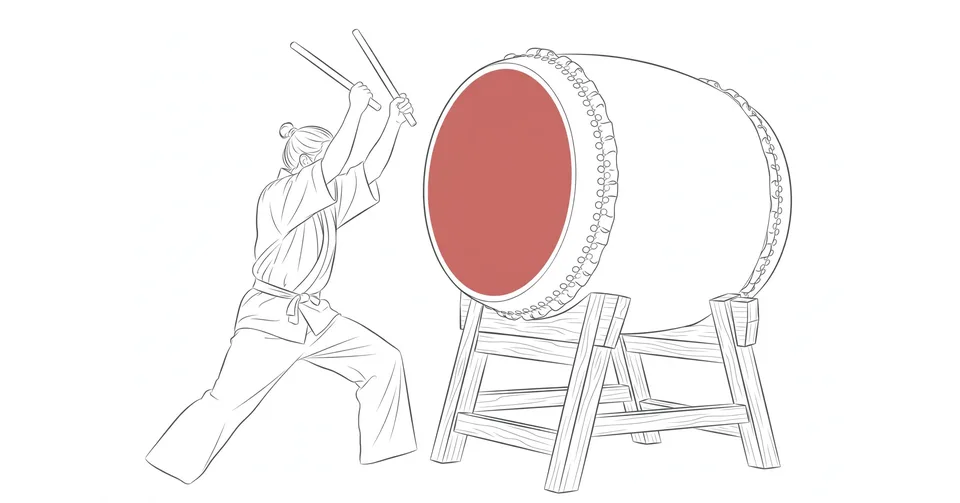
Taiko drums are the broad family of Japanese percussion instruments known in Japanese as wadaiko, which simply means Japanese drums. The word taiko itself can mean any drum, but outside Japan it usually means these barrel shaped instruments with cowhide heads, and the ensemble style called kumi-daiko, a group of players on drums of different sizes. What most people picture when they hear the phrase taiko drums is the modern stage version, a line of players in matching happi coats moving in unison around drums the size of bathtubs. That image is real, but it is only about seventy years old. The drums themselves are more than fourteen centuries older, and their story runs from shrine courtyards and battlefields to a jazz drummer in Nagano who rebuilt the whole tradition from a single old score.
Taiko Drums Did Not Start on a Stage
Archaeological evidence places taiko drums on the Japanese archipelago as early as the 6th century, in the latter part of the Kofun period. Clay haniwa figures from that era depict drums, and historical records suggest the instruments arrived through Chinese and Korean cultural influence, carried along with Buddhism. The Nihon Shoki, the second oldest book of Japanese classical history, even gives taiko drums a mythological origin story, which tells you how deeply the sound had already settled into the culture by the time anyone wrote it down.
For most of their history, taiko drums were working instruments rather than concert instruments. In villages they marked time, called people together, and drove the rhythm of festivals. In temples and shrines they accompanied ritual. In court music they kept the pulse of gagaku. In the theatre they sat in the hayashi ensemble behind Noh and kabuki, the small high pitched shime-daiko cutting through flute and chant to hold the whole performance together. The drums also went to war, where their sound carried orders across distances that a voice could never cross. If you watch kabuki today, you can still hear that old job in the music, the drum telling the actors and the audience exactly where the scene is going, as I wrote about in my piece on Japanese kabuki and the theatre that paints its actors.
What taiko drums were not, for over a thousand years, was a show in themselves. Nobody bought a ticket to watch drummers. The drums served something else, a festival, a ritual, a play. That changed in 1951, and the change came from an unlikely place.
The Family of Taiko Drums
Not all taiko drums are the same instrument. A kumi-daiko ensemble is really a small orchestra of drums, each with a job, and the names tell you what each one does. The table below covers the four types you will see most often.
| Drum | Typical size | Sound and role |
|---|---|---|
| Nagado-daiko | 45 to 90 cm across | Warm and full bodied, the backbone of the ensemble |
| O-daiko | 90 cm to more than 180 cm across | Deep and earth shaking, the climactic centerpiece |
| Shime-daiko | About 30 cm across | High and cutting, keeps time like a snare drum |
| Okedo-daiko | 33 to 66 cm across | Bright and resonant, light enough to carry in parades |
The nagado-daiko, the long bodied drum, is the one you will see most. It is carved from a single log, often zelkova, with cowhide heads tacked directly to the shell, so it cannot be tuned. The o-daiko is simply a nagado-daiko grown enormous, a drum more than a metre across that is usually played by two people at once, or by one player with oversized sticks, and the largest examples weigh around three tons and cost hundreds of thousands of dollars. They live permanently in shrines and temples because moving them is a project in itself.
The shime-daiko works the opposite way. It is small, roughly snare drum sized, with heads sewn onto iron rings and laced to the body with rope, which means it can be tuned, and its sharp crack is what the rest of the ensemble locks onto. The okedo-daiko sits in between, a stave built drum with rope tensioned heads that is light enough to sling over a shoulder, which is why it shows up in street festivals and parades.
Drummers measure taiko drums in the old Japanese units of shaku and sun. One shaku is about 30 centimetres, and one sun is about 3 centimetres. The sticks, called bachi, change with the drum. Hard oak bachi suit the nagado-daiko, larger softwood bachi suit the o-daiko, and smaller lighter bachi suit the shime-daiko. A player who picks up the wrong pair finds out quickly, because taiko drums punish bad technique. The heads are stretched tight, the sticks are heavy, and a full performance is a workout that leaves even fit players sweating through their shirts.
The Jazz Drummer Who Reinvented Taiko Drums
The modern taiko drums stage was invented by Daihachi Oguchi, a jazz drummer from Okaya in Nagano Prefecture. Around 1950, Oguchi took on an old score for the kagura drumming of Suwa Grand Shrine and set out to revive it. Instead of restoring the old form exactly, he rebuilt it the way a jazz drummer thinks about a drum set. In his ensemble, which he called Osuwa Daiko and founded in 1951, each player took a different drum with a different role. The high pitched shime-daiko set the basic rhythm the way a snare drum does. The growling nagado-daiko added accents the way a bass drum does. Several players, several drums, one composed piece that builds, breaks, and resolves.
Nobody had arranged taiko drums like that before. Within a decade the idea had spread. Ondekoza formed on Sado Island in 1969 and took the ensemble on the road with a famously punishing training regime. Kodo, which grew out of Ondekoza, debuted in West Berlin in 1981 and has toured the world ever since. The taiko drums performance at the Tokyo Olympics in 1964 had already lit the fuse, and the decades that followed turned a local festival sound into an international art form. The Nippon Taiko Foundation was formed in 1979 to keep the growing movement connected, and Oguchi himself went on to help form nearly 200 taiko groups in Japan, Singapore, Canada, and the United States before his death in 2008.
There is something quietly radical in that history. Oguchi did not preserve taiko drums by freezing them. He preserved them by changing them, by letting a jazz drummer's ear hear a drum set inside a shrine tradition. The purists of his day must have been horrified, and they would have been wrong. Without his reinvention, taiko drums might have survived as a museum sound, played at a handful of festivals by a shrinking circle of keepers. Instead the drums now have thousands of groups around the world, and the tradition is louder than it has ever been.
What a Taiko Drums Performance Feels Like
A kumi-daiko concert is closer to a sporting event than a recital. Players strike from wide stances, arms raised high, and the choreography matters as much as the rhythm. Between strikes they shout kiai, sharp cries that punctuate the beat and keep the group breathing together. The sound builds in layers. The shime-daiko ticks out a fast pattern, the nagado-daiko answers with deep rolling phrases, and then the o-daiko enters and the whole room seems to lean backwards.
The comparison that comes to mind is not another Japanese art but the gamelan orchestras of Indonesia, where many players each carry one small part of a large interlocking pattern. I wrote about gamelan as the sound of Java and Bali, and the listening experience is similar. No single player carries the melody. The music exists only in the space between the players, in how precisely they land together. Miss by a fraction and the whole pattern wobbles. Land together and the sound feels much bigger than the sum of its drums.
That precision is why taiko drums are so watchable even for people who know nothing about Japanese music. You do not need a programme note to understand a room full of people hitting enormous drums in perfect time. Your body understands it first. The sound is low enough to feel in the floor, and the visual rhythm of raised arms and falling sticks gives your eyes something to follow. Children in the audience usually start bouncing in their seats within a minute, and adults are not far behind.
If you ever get the chance to try taiko drums yourself, take it. Most community groups welcome beginners, and the first lesson is humbling in the best way. Holding the bachi correctly, finding the stance, and landing a clean single strike turns out to be a skill, not a given. After an hour your arms ache, your timing drifts, and you gain a new respect for the players who make it look effortless. There is a lesson in that, one that applies well beyond music. The things that look simplest from the audience are usually the ones that took the longest to learn.
Where to Hear Taiko Drums in Japan
The easiest place to hear taiko drums is a summer matsuri. Almost every local festival in Japan has a taiko drums group somewhere in the programme, often playing from a yagura tower in the middle of the street while dancers circle below. The sound is free, the crowd is part of the show, and the drums do the job they have done for centuries, pulling a whole neighbourhood into the same rhythm at the same time. If you are planning a summer trip, check the festival calendar for wherever you are staying, and look for the word taiko in the schedule. My guide to the Tanabata festival and the star crossed lovers behind the bamboo wishes gives a sense of how these summer festivals feel when a whole town turns out after dark.
For the full stage experience, Kodo is the group to see. The ensemble is based on Sado Island in Niigata Prefecture, and every August it hosts the Earth Celebration, a three day festival of taiko drums, music, and workshops on the island. Kodo also tours Japan and the world for much of the year, and its concerts are the closest thing taiko drums have to a definitive performance. Tickets sell out, so book early, and sit close enough to feel the o-daiko in your ribs.
Beyond the big names, the real heart of taiko drums is local. Nearly every city in Japan has at least one community group, and many rehearse in public halls where visitors can watch or even join a trial session. The Nippon Taiko Foundation lists groups across the country, and a quick search for the city name plus taiko usually turns up a practice schedule. Some groups perform at shrine festivals, some at school events, and some simply gather every week because they love the sound. That is the part of the tradition Oguchi would probably recognise with the most pleasure, ordinary people making an enormous noise together for no reason other than joy.
Taiko drums began as a way to mark time, to call a village, and to honour a god. A jazz drummer turned them into a concert art. The drums survived the change because the change was honest, it kept the sound and the sweat and the shared pulse, and only changed the room. When you hear them live, you are hearing fourteen centuries of that pulse at once, and the oldest part of it is the simplest. One person hits a drum. Another person answers. Everyone in earshot falls into step.
More in Music & Entertainment
Latest posts
- A Kyusu Is the Small Teapot Behind Every Good Cup of Sencha
- Shincha Is the First Flush Japan Waits All Winter For
- Gyokuro Earns Its Price One Shade-Grown Leaf at a Time
- Sencha Is the Green Tea Japan Drinks Every Single Day
- Washi Paper and the Thousand-Year Craft Behind Japan's Toughest Sheets
- Mugicha Is the Barley Tea Japan Pours All Summer Long
- Bancha Is the Everyday Tea Japan Drinks Without Thinking
- Chusonji Is the Mountain Temple That Outlasted Its Golden Age
- Hojicha Is the Roasted Tea Japan Reaches for After Dinner
- Kakigori and the Thousand-Year History of Japan's Shaved Ice
- A Pure Land Garden Is a Paradise You Can Walk Through
- Genmaicha Turns Roasted Rice Into Japan's Nuttiest Green Tea
- Sagemono Are the Hanging Treasures Samurai Wore at the Waist
- Oshu Fujiwara Built a Golden Capital in the North
- Harajuku and the Tokyo Streets Where Fashion Refuses to Sit Still