A Genkan Is Where Japan Leaves the Outside World at the Door
· 17 min read
The genkan is the small entryway inside the front door of a Japanese home, where shoes come off and the outside world stays behind. This is how it works, and why it has lasted for more than a thousand years.
Every home in Japan has a small space that is not quite a room. You step into it from the street, and within a few seconds you are expected to understand the whole house. The genkan is that place, a shallow entryway just inside the front door, where the outside world stops and the home begins.
The rule is simple and absolute. Shoes come off here, and they come off only here. Nobody walks further into the house in outdoor shoes, not the owner, not a guest, not a delivery driver in a hurry. The genkan makes the rule easy to follow, because the floor itself tells you where to stop.
I learned the habit the clumsy way, on my first evening in a Japanese home, when I stepped out of my shoes and straight onto the wrong floor in my socks, and my host laughed kindly and pointed down. The lesson stayed with me longer than any guidebook rule, because the genkan teaches with architecture instead of words. You do not need to be told twice when the floor changes under your feet.
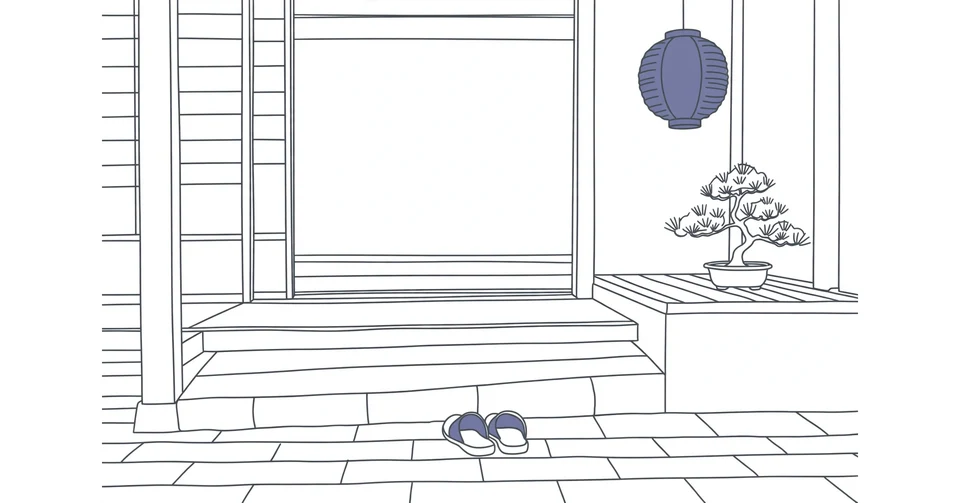
Once you notice this small entryway, you start seeing it everywhere, in old farmhouses and new tower apartments, in schools and public baths, in temples and in the tiniest rented rooms. The genkan is one of the few features that survived the Westernisation of the Japanese home almost unchanged, and it survives because it works. It keeps dirt out, it slows people down, and it gives every arrival a small ceremony.
What a genkan actually is
A genkan is a traditional Japanese entryway, a combination of a porch and a doormat, usually located inside the building directly in front of the door. Its primary function is the removal of shoes before anyone enters the main part of the house or building. That sounds modest, and it is, but the simplicity is the point. The whole house is organised around the idea that the floor inside is clean and the ground outside is not, and the genkan is the place where the two meet and are kept apart.
The floor of the genkan is called the tataki, a hard surface of tile or concrete that sits lower than the floor of the house. After removing shoes, a person must avoid stepping on the tataki in socks or with bare feet, because that would carry dirt into the house. Instead, you step up from the tataki onto the raised wooden floor, usually changing into uwabaki, the slippers or indoor shoes kept for wear inside. The step up is small, but it marks a real change. Below it, the street. Above it, the home.
The genkan is normally recessed into the floor, so any dirt tracked in from outside stays contained, much like a mud room in a Western house. The height of the step varies a great deal, from very low, around 5 to 10 centimetres, to shin level or knee level in older houses. In some houses the step is a single broad piece of timber. In others it is a deep drop that forces you to sit for a moment and swing your legs around, which is its own quiet piece of design. You cannot rush a deep step. You arrive, you pause, and then you enter.
Shoes in a private home are usually turned to face the door, so they can be slipped on easily when leaving. It is a small courtesy that also happens to be practical. A guest who turns their own shoes toward the door is showing that they know the house, and a host who turns a guest's shoes for them is showing care. I think this detail matters more than it seems. The genkan is full of these tiny courtesies, none of them written down in the house rules, all of them learned by watching.
The step that divides two worlds
The raised threshold between the genkan and the rest of the house has its own name, the agarikamachi, written with the characters for rising and frame. It is the wooden edge you step over, and it is the clearest line in the whole house. Everything on one side of it belongs to the outside. Everything on the other side belongs to the inside. Children learn the line before they learn to read, and visitors learn it the first time they are invited in.
The step works because it is physical, not verbal. No sign asks you to remove your shoes. The floor drops, the material changes from tile to wood, and your body understands before your mind catches up. I have come to think that this is why the custom has lasted so long. Rules that live in the building outlast rules that live only in conversation. A host can forget to mention the shoes, a guest can be too shy to ask, and the genkan still does its job, quietly, every single time.
In apartments, the genkan is usually much smaller than in a house, and it may have no difference in elevation from the rest of the floor at all. Sometimes it is only a patch of different flooring material, a strip of tile or vinyl at the door that marks the entryway without a step. The rule does not change with the size. Shoes still come off in that small patch of floor, and the home still begins where the tile ends. A small flat can hold a whole philosophy in less than a square metre, and I find that rather moving. The idea is stronger than the architecture, and the architecture bends to fit whatever space is available.
A thousand years of taking shoes off
The custom of removing shoes before entering the house is believed to go back more than one thousand years, to the prehistoric era of elevated floor structures. It continued to the present day even after the Westernisation of the Japanese home, which began in the Meiji period from 1868 to 1912. Tatami mats, wooden floors, and low tables came and went, and Western style rooms with chairs and beds moved in beside them, but the genkan stayed. A house can change almost everything about itself and still keep its entrance.
The word itself has a longer and grander history than the small space in an ordinary house suggests. According to JAANUS, the Japanese architecture dictionary, the earliest known basic layout of a genkan appears on a fourteenth century plan of Kenchoji, a Zen temple in Kanagawa prefecture. There it took the form of a gateway across the final bays of a gallery on the central axis of the temple plan. By the sixteenth century, the term was applied to a tiled gallery projecting from the front of the high priest's living quarters, a formal guest entrance that opened onto the garden in front and backed onto an entrance court closed off with plastered wall panels. It sometimes ran straight and sometimes ended in an L shape, and it could carry a gabled roof or an undulating bargeboard, with a doorway fitted with panelled pivoted doors.
From the early decades of the seventeenth century, the term came to be applied to a porch-like projection from the guard house or retainers room in the residences of leading warriors and shoguns. This functioned as an entrance porch and a place for carriages to draw up, and it was sometimes called a carriage porch genkan. It had solid flanking walls, a paved floor, and a flight of steps at the far end giving access to the room beyond. By the 1630s it was equipped with a low broad timber step called the shikidai, upon which a visitor could alight from a palanquin. One or two steps above the shikidai, the interface with the room beyond typically consisted of two pairs of sliding panels.
What began as a porch for retainers was transformed, by the early seventeenth century, into a formal entrance known as the onari genkan, a symbol of high social status that was restricted by legislation to members of the warrior class, the aristocracy, and leading religious figures. The entrance had become a statement. The size of your genkan said something about who you were, and the law made sure nobody could fake it. There is something honest about a status symbol that is also a functional space. It did not sit on a shelf. It worked for a living, every day, with every visitor.
In the latter half of the Edo period, an abbreviated version of this grand entrance appeared in middle ranking warrior residences, sometimes projecting no further than the width of a veranda, but usually a complete platform for boarding and alighting from a palanquin. It often had a decorative gable, and it served as the formal entrance to the guest reception suite. Apart from formal guests, its use was normally restricted to the master of the house, while other family members used another less elaborate entrance constructed nearby. Possession of a genkan was prohibited in ordinary vernacular houses during the Edo period, but by the eighteenth century the houses of leading merchants and village headmen, as well as feudal lords' lodgings, were increasingly permitted to build them as part of formal guest reception suites. They were also permitted on the houses of doctors and officials in charge of important shrines. In town houses, an internal genkan with a shikidai was often constructed within the earth floored area called the doma, to provide a formal point of entry to the raised living area.
From around the end of the Edo period, a simpler type of genkan became the main entrance to the houses of lower ranking warriors and foot soldiers. It often included an internal earth floored area for removing shoes, but it lacked a shikidai. JAANUS describes this type as the forerunner of the genkan used in the average modern Japanese house. That is the part of the history I like best. The grand formal entrance of shoguns and priests was slowly simplified, handed down the social ladder, and finally given to everyone. The status symbol became a household habit, and the household habit is what survived.
The etiquette of the genkan
The etiquette of the genkan is easy to learn and easy to get wrong in small ways. Shoes come off facing the door, as I have said, and the change into indoor slippers happens on the raised floor, never on the tataki. You step out of your shoes onto the tataki, turn, sit or crouch if the step is high, and step up in your socks onto the wood. The slippers wait there, lined up or tucked by the edge. When you leave, the process runs in reverse. You step down from the raised floor into your shoes, which are already facing the door, and you are outside again without ever having let the dirt follow you in.
Guests receive a little extra care. A host will often provide guest slippers, kept separate from the family's own, and will sometimes turn the guest's shoes to face the door while the guest is still stepping inside. It is a gesture that says you are welcome and you will be looked after. I have always thought that the genkan is where Japanese hospitality begins, before the tea is made and before anyone sits down. The welcome is in the floor, in the slippers, in the shoes turned the right way.
The genkan also has a secondary function that is easy to miss. It is a place for brief visits without being invited across the step into the house proper. Where a pizza delivery driver in an English speaking country would normally stand on the porch and conduct business through the open front door, in Japan a food delivery would traditionally have taken place across the genkan step. The visitor stands on the tataki, the resident stands on the raised floor, and the business is done between them. Nobody is rude, nobody is turned away, and nobody crosses the line unless they are invited. The step is a polite distance made out of wood and tile.
This is a useful arrangement in a crowded country where neighbours, salespeople, and delivery workers come to the door often. In rural areas especially, the genkan was traditionally considered open to the public, and neighbours and salespeople alike would enter this space and call out to the residents within. The house had a threshold that was not quite outside and not quite inside, and the community knew how to use it. The front door could be open, the genkan could receive people, and the home itself could stay private behind the step.
What lives in a genkan
A genkan is small, but it holds a surprising amount of daily life. The most obvious resident is the shoe cupboard, the getabako, a cabinet with compartments for outdoor shoes. Schools and public baths have large getabako with a compartment for each person, and a school corridor full of them is a sight in itself, rows of small doors holding hundreds of pairs of shoes. In private residences the getabako may be absent, and shoes simply wait in a neat row on the tataki, but the larger the household, the more likely there is a cabinet to keep the entrance from turning into a shoe shop.
Next to the shoes, almost always, stands the umbrella stand. Japan is a country of sudden rain, and the umbrella stand is the genkan's answer to it. Wet umbrellas drip onto the tataki, where the water does no harm, instead of onto the wooden floor, where it would. A good umbrella stand holds the long umbrellas upright and gives the folding ones a tray, and on a rainy evening it fills up fast. I have a soft spot for this object. It is the most honest piece of furniture in the house, because it exists only to deal with the weather as it actually is, not as anyone wishes it to be.
The geta, the traditional wooden sandals, also belong here, along with the everyday shoes of the season: rain boots in June, snow boots in the mountains in February, sandals in August. The genkan stores the footwear of the year, and looking at what is lined up there tells you something about the household. Children's shoes in a row by size, work boots by the door, a pair of geta kept for festivals. The entrance is a small museum of the family's daily movements, and it changes with the weather and the calendar.
The genkan is also where cleaning ends, not where it begins. In the year end cleaning called osouji, the house is worked from the back toward the door, top to bottom and dry before wet, and the entrance is finished last, so the house is left the way a guest will meet it. The osouji article on this site describes that order in detail, and it is worth reading if you want to understand why the Japanese clean the way they do. When the genkan is swept and the shoes are put in order, the work is done, and the year can end. A clean entrance is the last thing the old year sees.
Look up when you stand in a genkan and you may find one more thing. The ranma, the carved wooden transom, is sometimes placed above the main entrance of a structure, letting air and a little light pass over the top of the walls. The article on ranma on this site explains how that open panel works, and why a room with one feels different from a room without. The genkan and the ranma make a good pair. One guards the bottom of the doorway, where feet and dirt are managed, and the other opens the top, where air and light are allowed through. Between them, the entrance is doing two jobs at once.
The genkan in a modern apartment
In a modern apartment, the genkan is often barely more than a doormat sized patch of tile. There may be no step at all, no getabako, and no room to line up more than two pairs of shoes. The umbrella stand might be a single hook, and the guest slippers might live in a basket on top of the shoe cabinet. Everything is compressed, and yet the custom survives the compression without complaint. The rule does not need space. It needs a line, and a line can be drawn with a change of flooring as easily as with a step.
I think this is the real test of the genkan, and it passes. A tradition that needs a grand house to survive is a fragile thing. A tradition that fits into a one room apartment, in a tower block, in a city of millions, is a strong one. The genkan adapted to apartments the way it adapted to the Westernisation of the home a century earlier, by keeping the idea and letting the form change. The step became a strip of tile. The shikidai became a small wooden edge, or nothing at all. The shoes still come off.
There are practical reasons for this, of course. Japanese apartments are small, floors are often wood or tatami, and outdoor shoes would ruin them quickly. But there is also a cultural reason, and it matters more. People keep the genkan because they like what it does to the feeling of coming home. The small act of removing shoes marks the end of the working day and the start of private life. It is a ritual so short that it barely counts as one, and so regular that it becomes invisible, which is exactly how the best rituals work.
Why the genkan still matters
A genkan is a small thing, a patch of tile and a step, and it would be easy to call it a quaint survival, a leftover from a time when houses were built differently. I do not think that is right. The genkan survives because it answers a question that every home has to answer, which is where the outside ends and the inside begins. Most houses answer that question with a door. Japanese houses answer it with a room, a floor, a step, and a habit, and the answer is clearer for it.
The genkan asks very little of the people who use it. Take your shoes off here. Do not step on the lower floor in your socks. Turn your shoes toward the door when you leave. In return, it keeps the house clean, it gives guests a dignified place to be received, and it gives everyone who comes home a moment to arrive properly, instead of walking in still half outside. That seems like a fair exchange, and it has seemed fair for more than a thousand years.
Stand in a genkan for a minute before you step up, and you can feel the house waiting on the other side of the step. The shoes are lined up, the slippers are ready, the umbrella stand is full or empty according to the weather. Everything is in its place, and the place is small enough to hold in a single glance. Then you step up, and you are home.
More in Life & Style
- A Ranma Lets a Japanese Room Breathe Over the Top of Its Walls
- Harajuku and the Tokyo Streets Where Fashion Refuses to Sit Still
- Tenugui Is the Thin Cotton Cloth Japan Uses for Everything
- Japanese Stationery and the Small Tools Japan Takes Seriously
- Osouji Is the Cleaning Japan Does Before the Gods Arrive
- Inside Japan's 100 Yen Shops, Where Everything Costs a Coin
Latest posts
- Himeji Castle, Japan's White Heron That Survived War and Fire
- A Shoji Lets the Daylight In While Keeping the World Out
- A Tokonoma Turns One Corner of a Japanese Room Into a Shrine
- Japanese Breakfast and the Morning Meal That Starts with Rice and Soup
- Fusuma Turn a Room Into Whatever Japan Needs Next
- Wearing a Happi Means You Belong to the Matsuri
- A Yuzamashi Cools the Water Before the Tea Begins
- Tencha Is the Shade-Grown Leaf Matcha Is Made From
- Taiko Drums and the Thunder That Shook Japanese Festivals
- A Kyusu Is the Small Teapot Behind Every Good Cup of Sencha
- Shincha Is the First Flush Japan Waits All Winter For
- Gyokuro Earns Its Price One Shade-Grown Leaf at a Time
- Sencha Is the Green Tea Japan Drinks Every Single Day
- Washi Paper and the Thousand-Year Craft Behind Japan's Toughest Sheets
- Mugicha Is the Barley Tea Japan Pours All Summer Long