Chusonji Is the Mountain Temple That Outlasted Its Golden Age
· 13 min read
Chusonji began as a mountain temple in 850, became the spiritual heart of the Fujiwara golden age, survived fire and the fall of its patrons, and still stands above Hiraizumi today.
Most visitors climb Mount Kanzan for one thing, a small hall covered in gold. They are not wrong to want to see it. Yet the gold is only the brightest room in a much older and quieter story, and Chusonji rewards the people who slow down long enough to hear the rest of it.
Chusonji is a Tendai Buddhist temple in Hiraizumi, a small town in Iwate Prefecture in the north of Honshu. Temple records say it was founded in 850 by the monk Ennin, known as Jikaku Daishi, more than two centuries before the Fujiwara lords made Hiraizumi famous. It stands on a hill called Kanzan, which is why it is often called Kanzan Chusonji, and it has watched a golden capital rise, burn, and fade while the temple itself kept going.
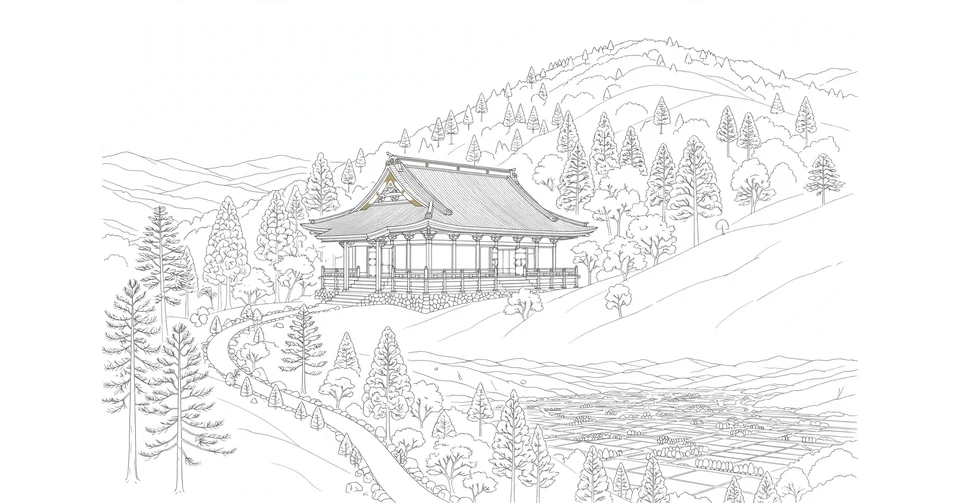
That long view is the point of this article. The golden hall matters, and we will come to it, but Chusonji is better understood as a whole place, a mountain temple that began as a monk's foundation, became the spiritual heart of a northern capital, lost almost everything to fire, and still stands today as part of a UNESCO World Heritage site. To walk its slope is to walk through nine centuries of Japanese history in about an hour.
A temple founded on a mountain long before the gold
Ennin was no ordinary monk. He was the third head abbot of the Tendai sect, based at the great monastery of Enryakuji on Mount Hiei near Kyoto, and he is remembered for the record of his travels and study in China, a journey some scholars count among the great travel writings of the world. According to the temple's own records, it was Ennin who founded Chusonji in 850, planting a Tendai temple on a forested hill in the far north, a long way from the capital and its politics.
Honesty requires a small note here. Some modern scholars argue that the temple was really founded by the Fujiwara lord Kiyohira around the start of the twelfth century, and that no firm record of Buddhist activity on the hill survives from before 1100. The temple itself holds to the older account, and the National Diet Library repeats the 850 founding in its own guide to the site. Either way, the important fact is the same. Long before gold leaf and world heritage plaques, Chusonji was a mountain temple, a place of prayer set apart from the world below.
That setting still shapes the visit. Chusonji sits on top of Kanzan, and the climb is part of the experience. The air is cooler under the trees, the sounds of the town fall away, and the temple reveals itself slowly, hall by hall, rather than all at once. A temple built on a mountain makes a quiet argument that some things are worth walking uphill for, and Chusonji has been making that argument for centuries.
Kiyohira turned Chusonji into a prayer for peace
The temple's great transformation came in the early twelfth century, when Fujiwara no Kiyohira, the first lord of the Oshu Fujiwara, began building a massive temple complex on the hill. According to the Azuma kagami, the official history of the Kamakura shogunate, the finished complex held more than 40 halls and pagodas, along with over 300 monks' residences. What had been a mountain temple became the spiritual centre of a capital.
Kiyohira's reasons were not only about power. He had lived through the bitter wars that dominated the Tohoku region in the late eleventh century, the Former Nine Years War and the Latter Three Years War, and he intended Chusonji to placate the spirits of all who had died in those conflicts, friend and foe alike. In his dedication pledge for the temple, known as the Ganmon, he wrote that all travellers, regardless of status, would be greeted affectionately by the Buddhas and receive their blessings without fail. The merits of Chusonji were to be shared evenly and universally, with no one left out.
There is something quietly radical in that. A warlord who had won his position by force chose to build his great temple not as a monument to his own victory, but as a prayer for the dead on both sides, and as a promise that a stranger of any rank would be welcomed. The full story of the clan that raised Hiraizumi is told in Oshu Fujiwara Built a Golden Capital in the North, and Chusonji is where that story turns from politics into prayer.
Kiyohira's son Motohira inherited the vision and built his own great temple, Motsuji, which his son Hidehira completed. Hidehira in turn commissioned Muryokoin Temple. For nearly one hundred years Hiraizumi flourished in peace and prosperity, and the city grew so rich and so confident that UNESCO would later describe it as a place that rivalled Kyoto, politically and commercially. Chusonji stood at the heart of that golden age, not as a palace but as its conscience.
The golden hall is only one room in a larger story
The most famous building at Chusonji is the Konjikido, the Golden Hall, completed in 1124. It is a small hall dedicated to Amida Nyorai, the Buddha of Infinite Light, and apart from its roof it is covered in gold leaf, inside and out. It is the only twelfth century structure to survive at Chusonji in its original form, and it was the first structure ever designated a National Treasure of Japan. The mummified bodies of Kiyohira and his heirs were laid to rest inside it, which makes the hall both a work of art and a family tomb.
The hall deserves its fame, and it has its own full story in Konjikido Is the Golden Hall That Outlived a Fallen Capital. But a visitor who treats the Golden Hall as the whole of Chusonji misses most of the temple. The hall is small, it is viewed from behind glass, and the visit lasts only a few minutes. The temple around it is large, open, and made for slow walking.
The main hall, the Hondo, is the working heart of Chusonji, where services and rituals are still conducted by the twenty or so monks who live and work here, supported by seventeen subsidiary halls. The Hondo was most recently rebuilt in 1909, and its principal image is Shaka Nyorai, the historical Buddha. On either side of the image stand the temple's eternal lights, lit with flame from Enryakuji, where the flame is said to have burned since the time of the Tendai founder Saicho. That detail matters. It ties this northern mountain temple back to the monastery where its founder trained, a thread of fire carried across centuries and across Japan.
The treasure house, the Sankozo, opened in 2000 to protect the temple's collection for future generations. Most of the more than 3,000 National Treasures and Important Cultural Properties that survive at Chusonji are housed there now, including Buddhist statues, sutras, and the burial goods of the Oshu Fujiwara lords. The collection matters because it is not a random pile of old objects. It brings together lacquer work, woodwork, metalwork, dyeing, and calligraphy, and it represents the peak of Heian period Buddhist art in eastern Japan. The gold gets the attention, but the quiet rooms of the Sankozo show the full range of what this temple once made and kept.
Fire, silence, and the centuries after the Fujiwara fell
Golden ages end, and Hiraizumi's ended violently. When Minamoto no Yoshitsune, the younger brother and former general of Minamoto no Yoritomo, fell out with his elder sibling, he fled north to Hiraizumi. Soon after he arrived, his protector Hidehira fell ill and died. Hidehira's heir Yasuhira, unable or unwilling to stand up to Yoritomo's pressure, attacked the fugitive general in early 1189 and forced him into suicide. It was not enough. Yoritomo attacked Yasuhira himself and brought the curtain down on the century long Oshu Fujiwara dynasty.
The poet Matsuo Basho visited Hiraizumi in 1689, five hundred years later, and wrote that three generations of glory had vanished in the space of a dream. He was standing in a place that had once rivalled Kyoto, looking at grass and ruins, and the line has haunted the town ever since. UNESCO quotes it in the official account of the site, and it is easy to see why. Hiraizumi is a reminder that wealth and power are not permanent, no matter how golden they look while they last.
Chusonji's own fortunes changed sharply in the centuries that followed. In 1337, fire consumed many of the temple's halls, pagodas, and treasures. The great complex of more than 40 halls that Kiyohira had built was reduced to a handful of survivors, chief among them the Konjikido. Yet the loss was not total. More than 3,000 treasures survived the fire, and the temple endured, smaller and poorer, but still a living place of worship rather than a ruin.
The centuries after the fire were quiet ones. In the Tokugawa period, the Date clan of Sendai ruled this region, and it was the Date who planted the great cryptomeria trees that still line the main approach to Chusonji, the slope called Tsukimizaka, or Moon Viewing Slope. Those trees are now three to four centuries old. They are a reminder that the temple's history did not stop with the Fujiwara. New patrons came, planted trees, repaired halls, and kept the lamps lit. Chusonji survived because generation after generation of people decided, without fanfare, that it was worth keeping.
What a visitor sees at Chusonji today
The visit begins at the foot of Tsukimizaka, the long slope that climbs to the temple through a tunnel of cedar trees. The Date clan's cryptomeria trees stand on either side of the path, tall and dark, and the walk itself does the work of slowing a visitor down. By the time the halls come into view, the town below feels far away, which is exactly the point of a mountain temple.
At the top, the Hondo main hall anchors the precinct, with its subsidiary halls spread through the trees around it. The Konjikido sits nearby, protected inside its concrete shelter and viewed from behind glass, a necessary compromise that keeps the gold safe while letting visitors stand close to it. Photography is not allowed inside, which is a small mercy. It forces people to look with their eyes instead of through a screen, and the hall is better for it.
The Sankozo museum completes the visit, and it is worth the time. The statues and sutras there show what the Fujiwara court could commission at its height, and the burial goods of the lords bring the history down to a human scale. These were real people, with real possessions, who believed that beauty and prayer belonged together. The temple's own English guide describes the precinct in full, including hours and admission, and it is the best place to check practical details before a visit, on the official Chusonji temple website. A typical visit takes one to two hours, and the standard adult admission covering the Konjikido and the Sankozo is 1,000 yen.
In 2011, Hiraizumi was inscribed on the UNESCO World Heritage List as "Hiraizumi, Temples, Gardens and Archaeological Sites Representing the Buddhist Pure Land". The listing covers five component sites, including Chusonji, Motsuji, and the sacred mountain of Mount Kinkeisan, and it recognises the temples and gardens under criteria (ii) and (vi), for their fusion of Pure Land Buddhism with Japan's indigenous nature worship. The National Diet Library's guide to the temple records the same facts plainly: founded in 850, rebuilt by Kiyohira in the early twelfth century, and registered as a World Heritage site in 2011, with the Konjikido as a National Treasure. The full entry is on the National Diet Library page for Chusonji Temple.
The listing changed how the world sees Hiraizumi, but it did not change what Chusonji is. It is still a working temple, with monks, rituals, and eternal lights. The World Heritage plaque is at the gate. The prayer is inside.
The lotus that waited eight centuries
One of the strangest and most moving stories at Chusonji does not involve gold at all. It involves a flower. In 1950, when the mummified remains in the Konjikido were examined, researchers found 100 lotus seeds inside the container that held the head of Yasuhira, the last Fujiwara lord. The seeds had rested there for some eight hundred years.
The seeds were given to Ichiro Oga, one of Japan's leading lotus experts. He tried to make them grow and failed during his own lifetime. Decades later, one of his pupils, Toshiko Nagashima, succeeded, and a seed that had slept since the twelfth century finally flowered in the late 1990s. The flower is now known as the Chusonji lotus, and it blooms in a pond in the temple grounds, at its best on summer mornings from mid-July to mid-August.
I find this story more hopeful than the gold. Gold survives because it does not decay, and that is impressive in its own way. But a seed survives because life is stubborn, and because someone patient enough finally gave it water and warmth. The lotus is a small, living answer to the fire of 1337 and the fall of 1189. Empires end, halls burn, and still, eight centuries later, a flower opens. Chusonji keeps that flower the way it keeps its eternal flame, as proof that some things are carried forward by care rather than by force.
Why Chusonji still matters
Chusonji matters because it outlasted the age that made it famous. The Oshu Fujiwara are gone. Their capital is grass and archaeology. The halls they built, with one golden exception, are ash. Yet the temple they rebuilt is still here, still tended, still prayed in, and still welcoming travellers of any status, just as Kiyohira's pledge promised.
That is the lesson the mountain teaches, and it is a gentle one. Greatness is not the same as permanence. The Fujiwara built for eternity and got about a century. The monks who tend Chusonji build nothing so grand, and they have kept the place alive for more than eleven centuries by doing the small things, sweeping the approach, trimming the lamps, planting a cedar, watering a seed. The gold draws the eye, and it should, but the temple keeps its meaning in the quiet work that happens around the gold.
Go for the Golden Hall, by all means. Stay for the cedar slope, the main hall, the museum, and the lotus pond. Chusonji is not a single treasure. It is a whole mountain that learned how to survive, and it is still teaching that lesson to anyone willing to climb it.
More in Culture & Society
- A Pure Land Garden Is a Paradise You Can Walk Through
- Sagemono Are the Hanging Treasures Samurai Wore at the Waist
- Oshu Fujiwara Built a Golden Capital in the North
- Fujiwara no Kiyohira Turned War Into Gold
- Motsu-ji Keeps Hiraizumi's Pure Land Garden Alive
- Hiramaki-e Keeps the Gold Flat and Lets the Picture Speak
Latest posts
- Mugicha Is the Barley Tea Japan Pours All Summer Long
- Bancha Is the Everyday Tea Japan Drinks Without Thinking
- Hojicha Is the Roasted Tea Japan Reaches for After Dinner
- Kakigori and the Thousand-Year History of Japan's Shaved Ice
- Genmaicha Turns Roasted Rice Into Japan's Nuttiest Green Tea
- Harajuku and the Tokyo Streets Where Fashion Refuses to Sit Still
- Chuson-ji Is the Mountain Temple That Guarded the Golden Hall
- Urushi Kabure Is the Rash Lacquer Apprentices Learn to Live With
- Konjikido Is the Golden Hall That Outlived a Fallen Capital
- Hidehira-Nuri Keeps Hiraizumi's Golden Age in Lacquer
- Urushiol Is the Itch Behind Japan's Most Beautiful Lacquer
- Wajima-nuri Is the Lacquer That Survives Being Dropped
- Tsugaru-nuri Hides Four Seasons of Colour Under the Lacquer
- Shunkei-nuri Lets the Wood Grain Shine Through the Lacquer
- Takamaki-e Raises Gold Off the Lacquer Until You Can Feel It