Sencha Is the Green Tea Japan Drinks Every Single Day
· 14 min read
Sencha is the steamed green tea behind most cups poured in Japan, from family breakfasts to office meetings. Here is how sencha is made, where it grows, and how to brew it well at home.
Walk into almost any home, office, or restaurant in Japan and the tea in the cup is almost certainly sencha. It is the green tea Japan drinks every single day, the default cup that needs no occasion and no ceremony, and the quiet background to millions of ordinary moments.
Sencha accounts for roughly four fifths of the tea Japan produces, according to a detailed guide to Japanese green tea that puts its share at over 80 percent of national production. Other estimates land a little lower, closer to 70 percent, so the honest figure is a range rather than a single number. Either way, no other Japanese tea comes close. When a Japanese person says they are having tea, this is usually the tea they mean.
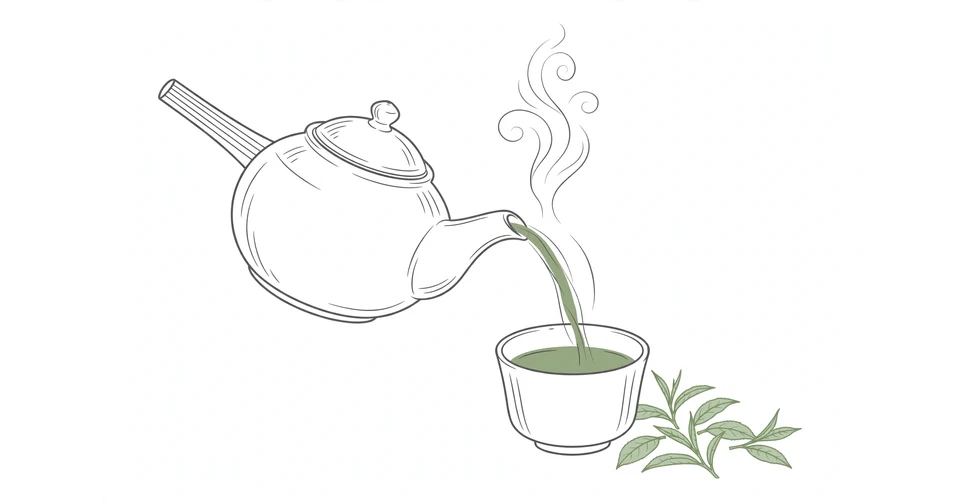
That ordinariness is exactly what makes this tea worth a closer look. It is not a rare tea for special guests or a powdered tea for ceremony. It is the working tea of a whole country, brewed in dented office teapots, poured from plastic bottles on summer trains, and served free with lunch in small restaurants from Hokkaido to Okinawa. Understanding it means understanding something about how Japan actually lives, not just how it performs tradition.
What sencha actually is
The name gives the first clue. Sencha literally means a decoction of tea, a tea made by steeping leaves in hot water. That sounds plain, and in a way it is the point. Unlike matcha, which is ground into powder and whisked, sencha is whole leaves infused in a teapot and then poured. The leaves stay in the pot, the liquor comes out clear and green, and the same leaves can be steeped again.
Every batch begins the same way. Fresh leaves are picked, then quickly heated to stop them from oxidizing. In Japan that heating is done with steam, and the choice of steam over fire is the single most important fact about this tea. Chinese green teas are usually pan fired in hot woks, which gives them a flatter leaf and a warm, nutty character. Japanese producers steam their leaves instead, and the steam keeps the leaf greener, brighter, and more vegetal. One comparison of the two traditions notes that steaming preserves the leaf's amino acids better than direct pan firing, and keeps the colour vividly green.
After steaming, the leaves are rolled into thin, needle like shapes and dried. The rolling locks flavour inside the leaf until hot water releases it, and it gives sencha its distinctive look in the bag: dark green needles that unfurl slightly as they steep. The finished tea brews into a liquor that ranges from pale yellow green to deep, almost cloudy green, depending on how long the leaves were steamed.
How steaming shapes the taste of sencha
Steam is not one setting. Producers vary the length of steaming from about 20 seconds to as long as 160 seconds, and that single choice changes the whole cup. A regular sencha is steamed for roughly 30 to 40 seconds. A deep steamed sencha, called fukamushi, is steamed for 40 to 60 seconds or longer. The longer the steam, the stronger and less astringent the taste becomes, the weaker the aroma grows, and the darker and cloudier the liquor turns. The leaves also break into smaller, more powdery pieces, which is why a deep steamed cup can look almost opaque.
The flavour itself is green in a way that has no real parallel in Chinese tea. A good cup tastes of steamed vegetables, of seaweed and baby spinach and edamame, with a savoury depth that tea drinkers call umami. A useful way to think about it is to imagine the difference between vegetables that have been steamed and vegetables fried in a pan with a little oil. The steamed ones stay bright and green and taste of themselves. That is what the steaming does for sencha, and it is why the tea can taste startlingly fresh even when it is served in a paper cup at a train station kiosk.
I find that freshness is also what makes this tea forgiving in a way that fancier teas are not. A premium gyokuro demands cool water and careful timing, and a good matcha demands a whisk and a bowl. Sencha tolerates a busy kitchen. It rewards care, certainly, but it does not punish a rushed morning. That tolerance is part of its design as an everyday drink, and I think it is one reason Japanese households keep coming back to it instead of treating it as a weekend project.
The first flush and the arrival of shincha
Not all of it is equal, and the difference starts with when the leaves are picked. Through the winter, tea bushes store nutrients in their roots. When spring arrives, the new shoots are tender, bright green, and packed with flavour. The first harvest of the year produces the most prized leaves, and the tea made from them is called shincha, or sometimes ichibancha, the first tea.
The live bancha article on this site notes that the prized first flush has already been gathered for sencha and gyokuro before the later pickings are turned into everyday bancha, and the same article observes that the first flush in spring produces the most tender leaves, which become premium sencha, gyokuro, and tencha. That ordering matters. It gets the first and best pick of the year, and the teas made from later harvests are, by definition, what remains.
Japanese tradition marks the moment. The first day of spring falls on 4 February in the old calendar, and the 88th day after it is traditionally the first day of plucking. People who drink the tea harvested on that first day are said to enjoy good health for the rest of the year. The custom sounds like folklore, and in part it is, but it also records a practical truth: the first leaves really are the sweetest, and the first weeks of the harvest really are the best time to buy.
Shincha reaches the shops in late spring, and for a few weeks it is everywhere: in supermarkets, in department store basements, and in the small tea shops that still line shopping streets in tea country. It is brighter, fresher, and more fragrant than the sencha sold the rest of the year, and it usually costs more. Then it is gone, and the regular sencha of the year takes its place. That seasonality is one of the quiet pleasures of drinking Japanese tea. The tea changes through the year, and paying attention to it is a small way of paying attention to the seasons themselves.
Where sencha grows
Tea grows in around 40 of Japan's 47 prefectures, but production is heavily concentrated. The three main growing regions are Shizuoka, Kagoshima, and Mie, and together the three account for roughly 80 percent of domestic production, according to figures from the Ministry of Agriculture, Forestry and Fisheries. Shizuoka, between Mount Fuji and the Pacific coast west of Tokyo, was for decades the largest producer, at times accounting for more than 40 percent of national output. Kagoshima, in warm southern Kyushu, has caught up fast and overtook Shizuoka in crude tea output in 2024, helped by a mild climate that brings an early harvest and by large scale mechanized farming.
The rivalry between the two prefectures is friendly but real, and it shows up in the cup. Shizuoka sencha is the classic everyday style: balanced, accessible, and broad in character, the tea most Japanese people grew up drinking. Kagoshima sencha tends to be a little bolder and slightly more astringent, a reflection of the warmer south and different cultivation practices. Uji, in Kyoto, is the most prestigious of the old tea regions, and its name still carries weight, but in volume terms the everyday tea of Japan now comes overwhelmingly from Shizuoka and Kagoshima.
One cultivar dominates the fields. Yabukita, found in Shizuoka in 1908 by a planter named Suzuki, became the most widely planted tea bush in Japan because it tastes good and resists disease. Its name comes from the bamboo bush, or yabu, north of which, or kita, it was found. Other cultivars exist, among them Yutaka Midori, Okumidori, Sae Midori, and Asatsuyu, each with its own character, and connoisseurs enjoy telling them apart. For most drinkers, though, the label that matters is the prefecture and the harvest, not the cultivar.
Living in Shizuoka, I see the tea fields almost every day, long green rows running up the hillsides between houses and factories. It is easy to forget, seeing them so often, that the crop they produce is the backbone of the whole Japanese tea world. Then I remember that the tea in the office pot, the tea in the bottle from the convenience store, and the tea served with lunch all trace back to fields like these, and the ordinary landscape starts to look like something more deliberate.
How to brew sencha at home
It is simple to brew, but it is sensitive to heat in a way that surprises first time drinkers. Water straight off the boil pulls bitter compounds out of the leaf faster than it pulls the sweet and savoury ones, so the cup turns harsh. The fix is to let the water cool. Most guides put sencha at 70 to 80 degrees Celsius, and a detailed brewing comparison recommends 70 degrees for the first steep, with 5 grams of leaf to 150 millilitres of water and a steep of about one minute. For a deep steamed sencha, 45 seconds is enough.
The second steep is different. The leaves are already open, so the water can be a little hotter, around 75 degrees, and the steep much shorter, about 20 to 30 seconds. A third steep is possible, though by then the flavour is thinner and mostly a pleasant green echo of the first cup. The point is not to follow a recipe with laboratory precision. It is to understand the direction: cooler water for sweetness, hotter water for strength, and short steeps to keep the bitter side quiet.
A traditional Japanese teapot, a kyusu, helps because its built in strainer holds back the fine leaf pieces that deep steamed sencha sheds. But a small teapot of any kind, or even a cup with a strainer, works fine. What matters most is the water temperature and the freshness of the leaf. This tea fades faster than roasted teas, losing aroma within a couple of months of opening, so buy small bags, keep them sealed and away from light and heat, and use them up rather than saving them for a special occasion. The special occasion, for this tea, is today.
Sencha in daily Japanese life
What makes it different from other famous Japanese teas is not quality but role. Matcha belongs to ceremony and to dessert menus. Gyokuro belongs to quiet appreciation and high prices. Sencha belongs to everything else. It is the tea of the office meeting, the family breakfast, the lunch set, and the long afternoon of work. Restaurants serve it free with the meal. Offices keep a pot warm all day. Convenience stores sell it hot in winter and cold in summer, and the bottles are as common as water.
That everyday presence is why sencha sits at the centre of a family of Japanese teas that share its leaves and its methods. Bancha, made from later harvests and coarser leaves, is the humbler sibling, the tea for big pots and long evenings, and the bancha article on this site describes it as the tea Japan drinks without thinking. Genmaicha takes it as its base and adds roasted rice, which turns the same green tea into something nutty and toasty, and the genmaicha article on this site explains how that roasted rice changes the whole character of the cup. Reading those two alongside this one gives a fuller picture: one plant, one steaming method, and a whole shelf of different teas.
Sencha also anchors the Japanese habit of drinking tea without ceremony and without fuss. There is no special equipment required, no seasonal ritual, no correct way to hold the cup. A mug works. A paper cup works. The tea does not mind. I think that lack of ceremony is a feature, not a failure. Japan has ceremonial teas for ceremonial moments, and it has this tea for all the other moments, which are most of life.
Caffeine and the calm alert feeling of sencha
It contains a moderate amount of caffeine, and one detailed comparison puts a serving at about 62 milligrams, a little more than a comparable serving of Chinese dragonwell green tea. That is still well below a cup of coffee, and the number varies a lot with the amount of leaf, the water temperature, and the length of the steep, so it is better treated as a rough guide than a promise. Shaded varieties, which grow under cover before harvest, tend to carry more caffeine, while roasted teas carry less.
What tea drinkers notice more than the caffeine itself is how it feels. Tea contains l-theanine, an amino acid that is believed to soften some of the sharper effects of caffeine, and people often describe the result as a calm alertness rather than the jolt of coffee. Sencha is said to contain higher levels of l-theanine than pan fired green teas, because steaming preserves amino acids better than direct firing. The science here is suggestive rather than settled, and no single cup proves anything, but the description matches the experience of many drinkers, myself included. A cup of sencha in the afternoon sharpens the mind without making the hands shake, and that is a useful thing in a working day.
How to choose a bag of sencha
Buying sencha is straightforward once a few rules are clear. First, look for the harvest. Shincha, the first flush of spring, is the freshest and most fragrant, and it is worth buying when it appears. Second, look for the region. Shizuoka and Kagoshima dominate production, and either is a safe choice for an everyday cup. Uji carries prestige and a higher price, and it is a good choice for a gift. Third, buy a small quantity. A 100 gram bag is plenty for a household, and it will stay fresh longer than a large bag left open for months.
Price is a useful but imperfect guide. Very cheap sencha is usually made from later harvests and tastes flat and astringent. Very expensive sencha is usually a first flush or a single cultivar lot, and it rewards careful brewing. The middle of the range, the ordinary sencha sold in most tea shops, is where the value sits. It is the tea that Japanese families actually drink, and it is good enough that a careful cup at home can rival anything poured in a restaurant.
Storage matters more than most buyers realise. Tea absorbs smells, moisture, and light, so keep it in a sealed bag or tin, away from the kitchen spices and the sunny windowsill. A cool cupboard is ideal, and the refrigerator is a bad idea unless the bag is truly airtight, because condensation does more harm than the cold does good. Freshness is the whole game with sencha, and a bag bought last spring will not taste like a bag bought this spring, no matter how carefully it was stored.
A cup worth slowing down for
Sencha will never be the most dramatic tea in the cupboard. It does not have the ceremony of matcha, the luxury of gyokuro, or the theatre of a rare first flush sold at auction prices. What it has is something quieter and, I think, more valuable: it is the tea that shows up every day, in every kitchen and office in Japan, and does its job without asking to be admired.
That reliability is easy to miss, and I missed it myself for a long time, treating the free tea with lunch as background rather than as something worth noticing. But a country does not drink a tea four fifths of the time by accident. It drinks it because the steaming is right, because the flavour suits food, because the price is fair, and because a pot of it fits the shape of an ordinary day. The next time a cup of sencha arrives without ceremony, it is worth taking a slow sip and noticing what is actually in it: spring leaves, steam, and a small green habit that holds a whole country together.
More in Food & Travel
- A Kyusu Is the Small Teapot Behind Every Good Cup of Sencha
- Shincha Is the First Flush Japan Waits All Winter For
- Gyokuro Earns Its Price One Shade-Grown Leaf at a Time
- Mugicha Is the Barley Tea Japan Pours All Summer Long
- Bancha Is the Everyday Tea Japan Drinks Without Thinking
- Hojicha Is the Roasted Tea Japan Reaches for After Dinner
Latest posts
- Washi Paper and the Thousand-Year Craft Behind Japan's Toughest Sheets
- Chusonji Is the Mountain Temple That Outlasted Its Golden Age
- Kakigori and the Thousand-Year History of Japan's Shaved Ice
- A Pure Land Garden Is a Paradise You Can Walk Through
- Genmaicha Turns Roasted Rice Into Japan's Nuttiest Green Tea
- Sagemono Are the Hanging Treasures Samurai Wore at the Waist
- Oshu Fujiwara Built a Golden Capital in the North
- Harajuku and the Tokyo Streets Where Fashion Refuses to Sit Still
- Fujiwara no Kiyohira Turned War Into Gold
- Motsu-ji Keeps Hiraizumi's Pure Land Garden Alive
- Hiramaki-e Keeps the Gold Flat and Lets the Picture Speak
- Chuson-ji Is the Mountain Temple That Guarded the Golden Hall
- Urushi Kabure Is the Rash Lacquer Apprentices Learn to Live With
- Konjikido Is the Golden Hall That Outlived a Fallen Capital
- Hidehira-Nuri Keeps Hiraizumi's Golden Age in Lacquer