A Tokonoma Turns One Corner of a Japanese Room Into a Shrine
· 14 min read
A tokonoma is the small raised alcove in a Japanese room where a scroll, a flower and a quiet object turn one corner into a place of respect.
Walk into a traditional Japanese room and your eye goes straight to one corner. The tatami is plain, the walls are bare, the sliding doors are shut, and then there is a shallow recess in the wall, raised a hand above the floor, holding a hanging scroll, a single branch in a vase, and nothing else. That recess is a tokonoma, and it is the most important square metre in the house.
A tokonoma is not a shelf and it is not decoration in the usual sense. Nothing in it is useful. You cannot sit in it, store things in it, or lean on it. Its whole job is to hold beauty still for a while, and to remind everyone in the room that some corners of life are set apart. In a culture that often hides its feelings behind politeness, the alcove says out loud what the host cannot: you are welcome here, and this meeting matters.
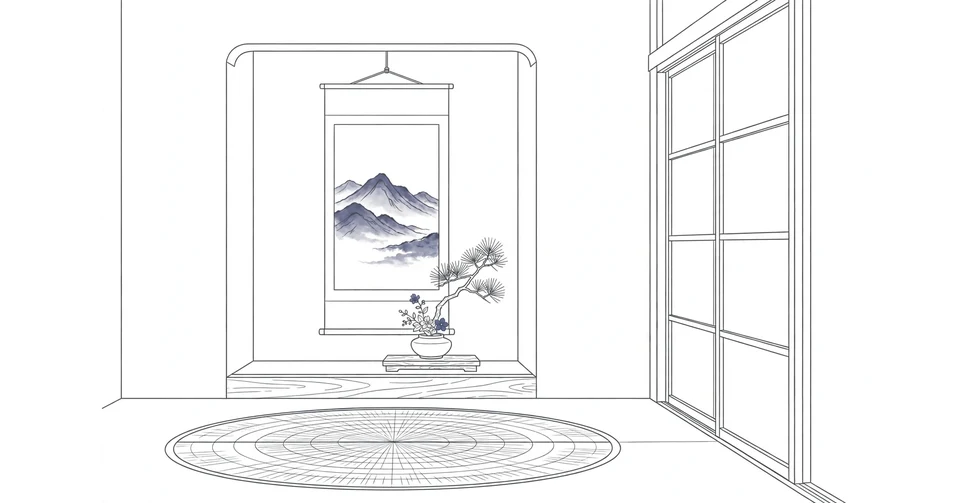
The word itself is plain. Toko means floor, and ma means space or room, so the word is literally a floor space, a small piece of raised floor cut out of the ordinary room. That plainness is the point. It does not impress with size or gold leaf. It impresses with restraint, with the decision to leave most of the room empty so that one quiet corner can speak.
Where the tokonoma came from
Nobody agrees exactly where the alcove came from, and that disagreement is part of its charm. There are two main theories, and both of them lead back to rooms where people prayed.
The first theory traces the tokonoma to the shinden-zukuri style of the Heian period, which ran from 794 to 1185. These were the sprawling wooden mansions of the aristocracy, built around open halls and gardens, and the alcove is thought to have grown out of a display space in those great rooms. The style declined in the Muromachi period, from 1336 to 1573, but the idea of a special corner survived it.
The second theory looks to Zen Buddhist monasteries of the Kamakura period, from 1185 to 1333. In a monastery room there was a board called an oshiita, a low altar board that held candlesticks, incense burners and vases for Buddhist ritual. Behind it hung a scroll with a Buddhist theme. According to this theory, the oshiita and the wall behind it slowly developed into the alcove of the shoin-zukuri style, the residential architecture that took shape in the Muromachi period.
What is certain is that by the Muromachi period the alcove had become a feature of the reception room, and its role was already social as much as spiritual. In a shoin-zukuri house, the owner sat in front of the tokonoma to receive guests. For an especially honoured visitor, the host would give up that seat and place the guest in front of the alcove instead. The alcove was never only about the objects inside it. It was about who was allowed to sit near it, and what that seating said about respect.
I find that history quietly moving, because it shows how a religious object becomes a social one without losing its gravity. The scrolls that once faced monks now face dinner guests, and the room still behaves as if something sacred is present. Japan has a talent for this kind of translation, keeping the form while letting the meaning soften into everyday life. It is a temple corner that learned how to live in a house.
What sits in a tokonoma, and why so little
A classical tokonoma holds very few things, and the short list is the whole lesson. The standard display is a hanging scroll, called a kakemono or kakejiku, and a flower arrangement, ikebana. Sometimes a third object joins them, a small sculpture called an okimono, a bonsai, or a ceramic piece. That is usually all. Three things at most, and often only two.
The scroll hangs at the back and sets the tone. It may carry a line of calligraphy, a Zen phrase, or a painting of a mountain, a bird, or the moon. The flowers stand in front of it, usually a single stem or a small branch in a simple vase, chosen for the season. Together they form a tiny landscape: words above, living nature below, and a stretch of empty wall between them that does as much work as either object.
The restraint is deliberate, and it has a history. The great tea master Sen no Rikyu, who shaped the tea ceremony in the sixteenth century, argued for an alcove of austere elegance: one scroll and one flower vase holding tea flowers, nothing more. His version of the alcove was a protest against display for its own sake. In his hands, the tokonoma became a place where less meant more, and where the host showed taste by what was left out.
The architecture of the alcove reinforces the same message. Its floor is raised slightly above the tatami, a step up that marks the space as different from the room around it. One side is framed by a pillar called the toko-bashira, usually a piece of wood prepared specially for the purpose. It can be a nearly raw trunk with the bark still on it, or a square piece of heartwood with very straight grain, and the choice of pillar sets the level of formality for the whole alcove. A rough, natural pillar suggests a rustic tea house. A polished, perfect one suggests a formal reception room.
There is a temptation, when you first see a tokonoma, to think of it as empty. A Western living room fills its focal wall with a television, shelves, photographs, and souvenirs. The alcove does the opposite. It takes the most honoured spot in the room and leaves most of it blank. The blankness is not a failure to decorate. It is the decoration, and it asks the viewer to slow down enough to notice one branch, one line of ink, one small object, as if each of them were the only thing in the world.
The tokonoma greets your guests before you do
The most beautiful idea attached to the alcove is that its display is a greeting. The host chooses the scroll and the flowers for a specific guest, a specific season, and a specific occasion, and the arrangement speaks before the host says a word. A plum branch in late winter says that spring is coming. A scroll with a phrase about the moon says that tonight is for looking up. The guest reads the alcove the way you might read a face.
In the tea ceremony this greeting becomes a ritual. When guests enter a tea room, they bow in front of the alcove before anything else happens, greeting the scroll and the flowers as if they were hosts themselves. The objects are treated as a presence, not as furniture. Writers on the tea ceremony describe the scroll and the flowers as two forms of illumination, each one offering its own quiet guidance: the words on the scroll carry warmth and meaning, and the flowers carry the passing season. Both are temporary, and both are gone by the next gathering. That is the point, and it is tied to the idea of ichi-go ichi-e, one time, one meeting, the understanding that this exact gathering will never happen again.
The alcove also changes through the day. In a formal tea room there is often no window in the alcove itself, and at night the host brings light to it. A small hand lamp called a teshoku, a candle on a short stand, is placed in the tokonoma, and in the symbolism of the tea room the alcove is identified with the east, the direction of the rising sun. The host carries the lamp in, the guests handle the fire, and the little flame turns the recess into a sunrise in miniature. The illumination of the tokonoma at night shows how much thought the tea world has poured into this one corner, down to the oil in the lamp and the direction each person faces.
It strikes me that the alcove is the opposite of the modern welcome. Today we greet guests with noise, with music playing, a television murmuring, and a phone buzzing on the table. The tokonoma greets with silence and one branch. It assumes the guest is capable of paying attention, and it rewards that attention with something worth looking at. There is a generosity in that assumption. A host who leaves a room quiet is trusting you to fill it with your own thoughts.
How the alcove orders the whole room
A tokonoma does not only decorate a room. It organises it. Every seat in a Japanese style room is measured against the alcove, and the hierarchy is simple to read once you know the rule.
The most honoured guest sits closest to the alcove, in the seat called the kamiza, the upper seat. It is the spot furthest from the entrance, and therefore the safest and most protected place in the room, the place where a guest can sit without anyone passing behind them. The host sits lower down, nearer the door, where they can come and go and serve. In a formal meeting, nobody has to be told where to sit. The alcove has already decided.
The rules around the alcove are strict, and they underline how seriously Japan takes this small space. Stepping inside the alcove is forbidden, except when someone must change the display, and even then a strict etiquette is followed. You do not put your feet where the scroll hangs. You do not lean on the toko-bashira. You do not use the raised floor as a step or a shelf. Children in traditional houses learn this the way children elsewhere learn not to touch a stove: early, and without much discussion.
That discipline extends to the room itself. A Japanese reception room is a flexible space, and its sliding fusuma panels let one room become two, or two rooms become one, depending on the occasion. The tokonoma is the one fixed point in all that flexibility. Walls move, tables appear and disappear, and the number of guests changes, but the alcove stays where it is, and the room arranges itself around it like iron filings around a magnet.
I think there is a practical wisdom here that goes beyond etiquette. Every shared space needs a fixed point, something that does not move when everything else does. In many modern homes that fixed point is a television, and the room arranges itself around a screen that demands attention. In a traditional Japanese room, the fixed point is a tokonoma, and the room arranges itself around a silence that invites attention. The difference between those two centres says a lot about what a household values.
The tokonoma in a modern Japanese home
Walk through a modern Japanese apartment today and you will probably not find an alcove. Most new homes are built Western style, with a living room, a dining table, and no tatami at all. The traditional Japanese room, the washitsu, survives mainly as a single guest room, if it survives at all, and many families use that room for storage or as a bedroom. The tokonoma, which needs a tatami room to make sense, has quietly followed the washitsu into retreat.
But the alcove has not disappeared. It survives where Japanese tradition is performed rather than simply lived: in ryokan inns, in restaurants that serve kaiseki cuisine, in temples and tea houses, in the reception rooms of old houses that are kept as museums, and in the homes of people who still care about the old forms. Step into a ryokan in Kyoto or Kanazawa and the first thing you will see in your room, after the low table and the tatami, is the tokonoma, holding a scroll for the season and a flower for the day. The innkeeper has chosen those objects for you, a stranger, with the same care a host would show a friend.
The tokonoma has also travelled further than most Japanese ideas. The American architect Frank Lloyd Wright was deeply influenced by Japanese architecture, and he translated the meaning of the tokonoma into its Western counterpart: the fireplace. Like the alcove, the fireplace is the ceremonial heart of the room, the place the furniture faces and the family gathers around. Wright understood that every home needs a centre that is not a screen and not a table, and he borrowed the Japanese answer. The history of the tokonoma records this borrowing as one of the alcove's strangest afterlives, a Japanese shrine corner reborn as an American hearth.
What interests me is that the tokonoma survives in translation even when it fails at home. In Japan it is fading from daily life because houses have changed. Abroad it survives as an idea, because the need it answers has not changed: a room needs a place where nothing is sold, nothing is switched on, and nothing is asked of you. The fireplace answers that need with fire. The alcove answers it with a flower. Either way, the room is better for having a corner that exists only to be looked at.
What a tokonoma teaches about living with less
There is one more role the tokonoma plays, and it appears every year at New Year. A household's most precious seasonal objects spend the holidays in the alcove, because the tokonoma is where the family puts the things it wants the gods and the guests to notice. A hamaya, the sacred arrow bought at a shrine, is displayed on the household altar, in the tokonoma alcove, at the entrance, or in the living room. A kagami mochi, the stacked rice cake that gives the New Year god a place to rest, waits in the tokonoma alcove of the main room through the holiday. The phrase is the same in both customs, in the tokonoma alcove, and it tells you exactly how Japanese families think about this corner. When something matters enough to be honoured, it goes to the tokonoma.
That New Year habit explains why the kagami mochi is never cut with a knife but broken by hand, a custom that belongs to the same world of quiet respect. You can read about why kagami mochi is never cut with a knife and see how the same spirit runs through it: some objects are treated as guests, not as things, and guests are not cut open. The tokonoma is where that attitude lives in the architecture of the house. It is the room's way of saying that some things are not for use.
The deeper lesson of the tokonoma is about attention. The alcove works because it is small. One scroll and one flower can be truly seen, in a way that a wall of objects cannot. The tokonoma trusts that a single branch, changed with the season, can carry the whole weight of hospitality. That trust is increasingly rare. Modern life fills every surface, every wall, and every spare minute, on the theory that more is better. The tokonoma argues the opposite, and it has argued it for six hundred years: choose one beautiful thing, give it an empty corner, and let it be enough.
It is worth asking what your own home's tokonoma would be. Not a replica of a Japanese alcove, but the equivalent of it: one corner deliberately left for beauty, one shelf that holds a single object instead of ten, one windowsill with a flower instead of a stack of mail. Most of us do not need more decoration. We need one place in the house where decoration is allowed to be the whole point, and where nothing else is allowed to compete with it.
A tokonoma turns one corner of a Japanese room into a shrine, and in doing so it quietly reorganises the whole house around respect. The guest sits in the best seat, the host sits lower, the scroll speaks first, and the flower marks the season. Nothing in the room is expensive, and nothing in it is loud. Yet visitors remember that corner long after they have forgotten the rest of the house. Beauty does not need much space. It needs a little space that is protected, and a household willing to keep it empty for anything except the one thing that belongs there.
More in Culture & Society
- A Shoji Lets the Daylight In While Keeping the World Out
- Fusuma Turn a Room Into Whatever Japan Needs Next
- Wearing a Happi Means You Belong to the Matsuri
- Washi Paper and the Thousand-Year Craft Behind Japan's Toughest Sheets
- Chusonji Is the Mountain Temple That Outlasted Its Golden Age
- A Pure Land Garden Is a Paradise You Can Walk Through
Latest posts
- Himeji Castle, Japan's White Heron That Survived War and Fire
- A Genkan Is Where Japan Leaves the Outside World at the Door
- A Ranma Lets a Japanese Room Breathe Over the Top of Its Walls
- Japanese Breakfast and the Morning Meal That Starts with Rice and Soup
- A Yuzamashi Cools the Water Before the Tea Begins
- Tencha Is the Shade-Grown Leaf Matcha Is Made From
- Taiko Drums and the Thunder That Shook Japanese Festivals
- A Kyusu Is the Small Teapot Behind Every Good Cup of Sencha
- Shincha Is the First Flush Japan Waits All Winter For
- Gyokuro Earns Its Price One Shade-Grown Leaf at a Time
- Sencha Is the Green Tea Japan Drinks Every Single Day
- Mugicha Is the Barley Tea Japan Pours All Summer Long
- Bancha Is the Everyday Tea Japan Drinks Without Thinking
- Hojicha Is the Roasted Tea Japan Reaches for After Dinner
- Kakigori and the Thousand-Year History of Japan's Shaved Ice