Wearing a Happi Means You Belong to the Matsuri
· 14 min read
A happi is a light cotton coat worn as a uniform at Japanese festivals, and the crest and group name printed on its back tell everyone which team you belong to.
At a Japanese matsuri, the crowd is a blur of colour and noise, but the people who belong to the festival are easy to spot. They wear matching coats, and the coat does the talking. A happi is a light festival coat, usually worn as a uniform, and putting one on is the simplest way to say you are part of the team.
The message is printed on the back, literally. A happi usually carries the name of the festival or the group on its back, sometimes with the kanji for matsuri, and smaller marks on the lapels. Strangers read it at a glance, and that is the whole point. The coat is not really about fashion. It is about belonging, and it has worked that way since the Edo period.
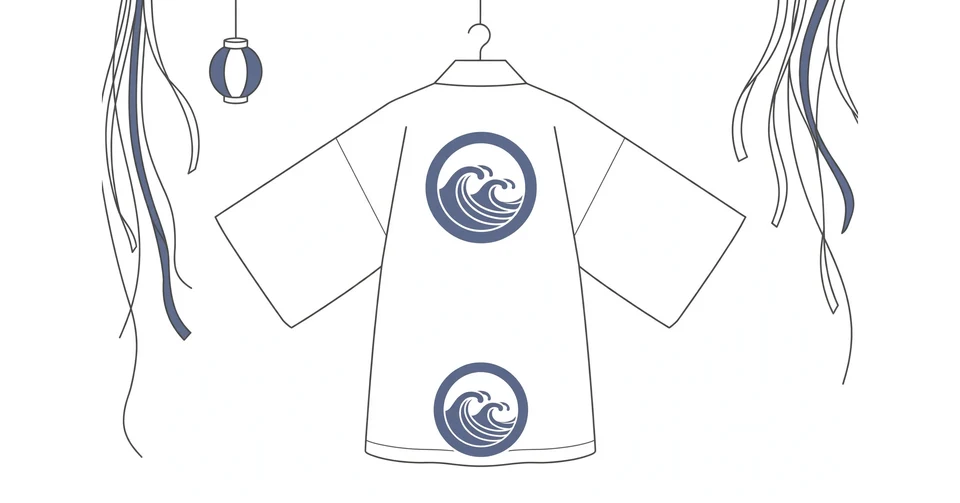
What I like most about this coat is how honest it is. Other traditional garments ask you to read subtle signals, a lining glimpsed at the cuff, a crest so small you have to lean in. A happi does the opposite. It shouts the group name across a crowded street, and it invites you to join in rather than admire from a distance.
What a happi actually is
A happi is a traditional Japanese coat with tube shaped sleeves, a loose fit, and an open front. It is usually made of cotton, though modern versions also come in polyester and other fabrics. The sleeves are wide and often fall about three quarters of the way down the arm, and the front is left open to be secured with a sash or a narrow obi belt. The coat is short, ending around the hip, and it is meant to be worn over ordinary clothes rather than over a kimono.
The classic happi is blue, with designs in red, black, and white, but modern versions come in almost every colour. The fabric is light and breathable, which matters because matsuri take place outdoors in warm weather, and the people wearing them are walking, carrying, dancing, and shouting for hours. A heavy coat would be a burden. A happi is built for movement, and you can feel that in the cut the moment you put one on.
The most distinctive feature of the coat is not the cut, though. It is the decoration. Bold graphics, symbols, or text sit on the lapels, and a much larger design covers the back. That back design is usually the name of the festival or the participating association, and the kanji for festival, matsuri, may appear as well. Traditional motifs also show up, cherry blossoms, waves, cranes, and dragons among them. The designs are applied by screen printing, embroidery, or applique, and some high end or traditional coats carry hand painted designs or intricate embroidery.
It is therefore a simple garment with a clear job. It keeps you cool, it lets you move, and it tells everyone around you who you are with. If you have ever stood at the edge of a festival crowd and wondered which people were participants and which were spectators, the happi is your answer. The participants are the ones in matching coats, and the coats match because the group matters more than the individual on that day.
From servants and firefighters to festival streets
The happi traces its origins to the Edo period, which ran from 1603 to 1868. Sources do not agree on the exact year it first appeared, so the honest version is that it emerged during that long stretch of peace and urban growth, when Edo, now Tokyo, filled with merchants, craftsmen, and neighbourhood organisations that needed a way to mark their people.
At first, the happi was a working uniform rather than festival wear. House servants wore it to display the mon, the family emblem of the household they served. A servant in a happi was instantly recognisable as belonging to a particular house, and the crest on the coat did the work of an introduction. Merchants and craftsmen used it the same way, with the crest or name of their shop or guild on the back.
The most famous early wearers were the firefighters of Edo. They wore a happi with their brigade crest on the back, so that one gang could be told apart from another at the scene of a fire. This was a practical matter, not decoration. In the Edo period, firefighters were paid not only for putting out fires but also for promptness and presence at the scene, so being seen mattered. They wore conspicuous happi and even danced on intact roofs near fires carrying matoi, the tall standards of their brigade. Their happi was distinct from another firefighter garment, the hikeshi sashiko banten, a heavily quilted cotton jacket designed to hold a large quantity of water and protect the wearer from heat. One coat was for being recognised, the other was for getting close to the flames.
Over time, the happi moved from the workplace to the festival street. The same logic applied. A matsuri is organised by neighbourhood groups, shrine associations, and teams, and each of them needs to be visible in a crowd. Matching happi turned a loose crowd of neighbours into a visible team, and that tradition has held ever since. Today you will see a happi on people carrying a mikoshi, a portable shrine, on parade participants, and on performers, and the coat still does what it did for servants and firefighters centuries ago. It says, this person belongs to us.
You can read the full background in the Wikipedia entry on the happi, which covers the Edo period origins, the firefighter connection, and the distinction from the quilted firefighter jacket.
Reading the back of a happi
If you want to understand a happi, start at the back. That is where the coat speaks loudest. The back usually carries one large design, and learning to read it turns a colourful jacket into a small piece of local history.
Most often, the back shows the name of the festival or the name of the group taking part, written in large kanji. The kanji for matsuri may sit beside it. Some coats carry the mon, the family or group crest, instead of or alongside the name. The lapels, known as heri, often carry a contrasting colour and may repeat the name of the festival, the group, or the event in smaller lettering. Together, the back and the lapels form a kind of uniform, and regulars at a festival learn to read them the way sports fans read team shirts.
The designs are not random. A neighbourhood team might choose waves, which suggest resilience, or cranes, which suggest longevity. Cherry blossoms and dragons appear often, and some coats carry the symbol of a local shrine or a landmark. The point is never just to look good, though a well designed happi certainly does. The point is to be recognised at a distance, in a crowd, in the heat, by people who need to know which team is which.
There are also several recognised types of happi, and each one fits a different role at a festival. A matsuri happi is the standard festival coat, often with the kanji for matsuri on the back. A taiko happi is often sleeveless, worn by taiko drummers who need their arms completely free. A yosakoi happi is a longer version, sometimes reaching the knees, worn by dancers in the Yosakoi festival. A corporate happi carries a company logo or name and is worn by company representatives at trade fairs or promotional events. Younger wearers have added anime and manga inspired happi, worn by cosplay enthusiasts and fans, which shows that the form is flexible enough to carry new meanings without losing the old one.
To me, this variety is the sign of a healthy tradition. A garment that could only ever mean one thing would have died out long ago. The coat survives because the same basic shape can carry a shrine name, a company logo, or a cartoon character, and in every case the wearer is still saying the same thing. I am with these people, and we are here together.
Happi, haori, hanten, and yukata: how to tell them apart
Japanese jackets can look similar to an unfamiliar eye, but each one has a different job, and the happi is the easiest to place once you know what to look for. The quick test is to ask three questions. Is it padded? Is it worn over a kimono? And is the decoration meant to identify a group?
A haori is the most formal of the group. It is a jacket worn over a kimono, usually thin or lightly lined, sometimes in silk, and it adds a finished, dignified layer without the full formality of a ceremonial outfit. Older haori often hide intricate patterns on the inner lining, and a formal haori may carry a family crest. Where a happi shouts the group name on its back, a haori keeps its elegance quiet. The difference is one of manners. A haori is about personal style and status, while a happi is about outward identification, and you can read more about that quieter jacket in the article about a haori, the jacket that turns a kimono formal.
A hanten is the warm one. It is a short, cotton padded winter coat, cut to about mid thigh, with a black sateen collar, and it was the everyday jacket of merchants, artisans, and labourers. Unlike the haori, which was once restricted to certain social classes, a hanten could be worn by anyone. The padding is the giveaway. If the jacket is thick and warm, it is a hanten. A happi is never padded, because it was never designed to fight the cold. It was designed to be seen, and to be worn in warm festival weather.
A yukata is different again, because it is not really a jacket at all. It is a light cotton robe, worn on its own after a bath or at a summer festival, and it is the robe Japan reaches for when the day is done and comfort matters more than ceremony. The yukata wraps the whole body, while a happi is an open layer worn on top of other clothes. If you want the full picture of the robe itself, the article on the yukata, the robe Japan reaches for after the bath explains how it fits into daily life.
So the family sorts itself out neatly. Formality belongs to the haori, warmth belongs to the hanten, comfort belongs to the yukata, and identity belongs to the happi. The happi is the only one of the four whose main job is to say who you are with, and that is why it is the one you see in crowds, on teams, and on festival streets.
How to wear a happi at a matsuri
Wearing one is straightforward, but a few small details make the difference between looking like a participant and looking like someone who borrowed a costume. The coat is meant to be worn over other clothing, so for a festival that usually means a T-shirt with shorts or light trousers underneath. The open front is secured with the sash or obi that comes with the coat, and the bow should sit at your waist. Do not tie it too tightly. The coat is meant to be comfortable and to allow a full range of motion, and a sash pulled hard enough to restrict your arms defeats the purpose.
The sleeves should fall about midway between your elbow and wrist. If they feel long, you can roll them up slightly, which is common among people carrying a mikoshi or playing taiko, where free arms matter more than a neat line. A hachimaki headband is the usual companion, and tabi socks with sandals complete the festival look, though plenty of participants today wear trainers and nobody minds. The Japan Experience guide to happi coats gives the same practical advice, and it is worth reading before your first festival if you want to get the details right.
There is also an unspoken rule worth knowing. A happi with a specific group name on the back belongs to that group, and wearing it is a claim of membership. Generic happi with only the kanji for matsuri, or a plain festival design, are the safe choice for visitors and first timers. If a team hands you their happi, that is an invitation, and it is a generous one. Accept it in that spirit, wear it for the day, and hand it back with thanks. The coat is light, but the trust it represents is not.
My own view is that this is the happi at its best. A lot of traditional clothing asks the wearer to be careful, to sit a certain way, to avoid creasing the silk. A happi asks the opposite. It asks you to move, to sweat, to carry something heavy with your neighbours, and to be seen doing it. That is a rare thing in a wardrobe, a garment whose whole purpose is participation, and I think that is why it has outlasted so many more delicate pieces of traditional dress.
Buying a happi and looking after it
If you want your own, Japan makes it easy. Traditional craft shops in cities like Kyoto and Tokyo sell them, and many festivals sell happi as souvenirs at the event itself, which is the best way to get one with a real local design. Online, marketplaces such as Rakuten and Amazon Japan carry a wide selection, and there are specialty online stores that focus on Japanese traditional clothing and ship internationally. Second hand shops in Japan, including well known chains such as Kinji and Chicago, often have vintage or second hand happi at lower prices, and a worn happi with a faded crest has a character that a brand new one cannot fake.
When you buy, pay attention to three things. First, the size. Many happi are one size fits all, so check the measurements rather than assuming. Second, the material. Cotton is the classic choice, breathable and comfortable, while polyester blends are lighter and dry faster but can feel less substantial. Third, the design. Make sure you know what the kanji on the back actually says, especially if you plan to wear it at a festival, because a coat with a real group name carries a meaning you may not want to claim by accident.
Looking after a happi is simple, and the rules are the same ones that apply to most cotton festival wear. Most coats can be machine washed on a gentle cycle with cold water, but always check the care label first. Air dry by hanging the coat in the shade, and avoid direct sunlight, which fades the colours. If ironing is needed, use a low setting, and iron printed designs on the reverse side to protect the graphics. Store the coat folded or on a wide hanger, in a cool, dry place away from direct sunlight, and treat stains promptly with a gentle stain remover suitable for the fabric. With that kind of care, a happi lasts for years, and a well kept one becomes a reminder of the festivals it has been to rather than just a piece of clothing.
Why a happi still matters
The happi could have faded into a museum piece. It began as a servant uniform, it served firefighters in an age before modern fire engines, and its world of neighbourhood guilds and Edo period streets is long gone. Instead, it is still on the streets every summer, still matching, still shouting group names across crowds, and still being reinvented by taiko drummers, yosakoi dancers, companies, and anime fans. That is not an accident. It survived because its job never went away. People still need a way to say, I belong to this group, and I am here with them.
It is a simple coat, and that simplicity is the point. It does not need silk, padding, or ceremony to matter. It needs a group, a festival, and a back large enough to carry a name. Put it on, tie the sash, and the street knows where you stand. That is what wearing a happi means, and it is a meaning worth keeping.
More in Culture & Society
- Fusuma Turn a Room Into Whatever Japan Needs Next
- Washi Paper and the Thousand-Year Craft Behind Japan's Toughest Sheets
- Chusonji Is the Mountain Temple That Outlasted Its Golden Age
- A Pure Land Garden Is a Paradise You Can Walk Through
- Sagemono Are the Hanging Treasures Samurai Wore at the Waist
- Oshu Fujiwara Built a Golden Capital in the North
Latest posts
- Japanese Breakfast and the Morning Meal That Starts with Rice and Soup
- A Yuzamashi Cools the Water Before the Tea Begins
- Tencha Is the Shade-Grown Leaf Matcha Is Made From
- Taiko Drums and the Thunder That Shook Japanese Festivals
- A Kyusu Is the Small Teapot Behind Every Good Cup of Sencha
- Shincha Is the First Flush Japan Waits All Winter For
- Gyokuro Earns Its Price One Shade-Grown Leaf at a Time
- Sencha Is the Green Tea Japan Drinks Every Single Day
- Mugicha Is the Barley Tea Japan Pours All Summer Long
- Bancha Is the Everyday Tea Japan Drinks Without Thinking
- Hojicha Is the Roasted Tea Japan Reaches for After Dinner
- Kakigori and the Thousand-Year History of Japan's Shaved Ice
- Genmaicha Turns Roasted Rice Into Japan's Nuttiest Green Tea
- Harajuku and the Tokyo Streets Where Fashion Refuses to Sit Still
- Fujiwara no Kiyohira Turned War Into Gold