A Sudare Turns Harsh Sunlight Into a Cool Breeze
· 15 min read
A sudare is a traditional Japanese blind of bamboo or reed that softens harsh sunlight while letting the breeze through, and it still cools Japanese homes today.
On a hot afternoon in Japan, the sun does not ask permission. It pours through the open side of a house, heats the tatami until the floor feels warm under bare feet, and turns a quiet room into a place nobody wants to sit in. The old answer to that problem is not a machine and not a thick curtain. It is a thin blind of bamboo or reed, hung where the wall would be, that lets the air in and keeps the glare out. A sudare does exactly that, and it has been doing it for more than a thousand years.
The blind is a screen made of slender horizontal slats of bamboo, wood, or other natural material, woven together with string or colored yarn. The gaps between the slats are the whole point. Sunlight is broken into soft stripes, insects and prying eyes are kept outside, and the breeze passes straight through. From the bright side it looks nearly solid, while from the dim side of the room you can still see out. That one-way quality is what makes the blind feel almost like magic the first time you stand behind one.
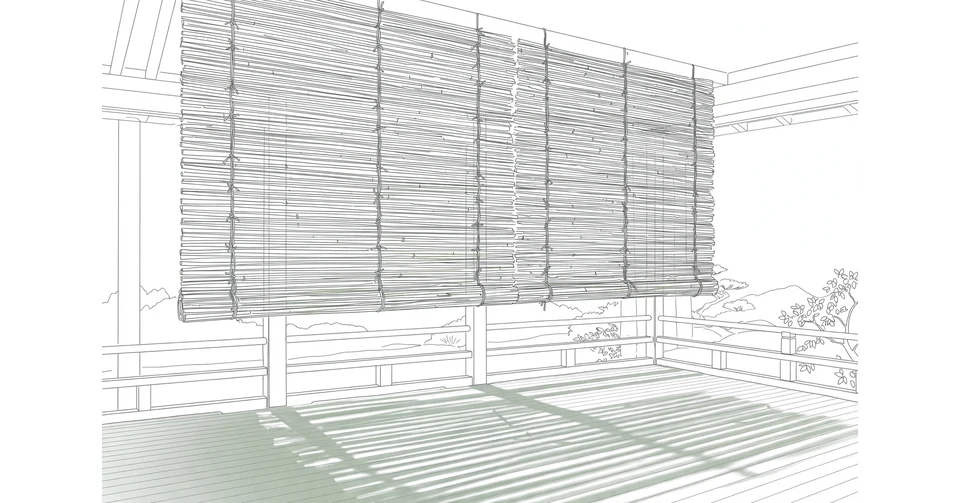
The idea grew out of the same tradition as the paper screens that divide Japanese rooms. In the shoji article I wrote about how paper lets daylight in while keeping the world out, and the sudare is the summer cousin of that idea. In fact, some shoji screens are fitted with reed or bamboo instead of paper for the hot months, a version called sudare-shoji, or summer shoji. The house does not fight the season. It changes its skin, and this blind is the skin it wears when the sun is at its strongest. That simple seasonal swap says a lot about how Japanese homes were built to work with the weather rather than against it.
What a sudare actually is
The word sudare, written with the characters for a bamboo blind, describes a hanging screen of thin stems held together by cord. According to the Japanese Architecture and Art Net Users System, the blind is made from solid stems of bamboo, the horsetail plant, ditch reed, or bush clover, bound or plaited together with cord so that light and air can pass through easily and so the blind can be rolled up when stored. The same source notes that some blinds have a decorative brocade binding and silk tassels hanging from the top, a reminder that even a practical object can be made beautiful.
Wikipedia describes sudare in similar terms, as traditional Japanese screens or blinds made of horizontal slats of decorative wood, bamboo, or other natural material, woven together with simple string, colored yarn, or other decorative material to make nearly solid blinds. It can be rolled or folded up out of the way when it is not needed. When the blind carries a green fabric hem, it is sometimes called misu, a more formal name that points to its history in palaces and fine houses. A different form, called yoshizu, stands upright instead of hanging and is made of vertical reed slats, more like a freestanding screen than a blind.
The materials are deliberately ordinary. Bamboo, reed, and grass grow quickly, cost little, and are easy to replace. That is part of the charm of the blind. It is not a luxury object that demands to be preserved forever. It is a working part of the house, made from what the land provides, and when it wears out after a few summers it can be replaced without ceremony. There is a quiet honesty in a thing that does its job well and does not pretend to be permanent.
Why a sudare cools a room without blocking the breeze
The cooling power of the blind comes from shade plus airflow, and the combination matters more than either one alone. A solid shutter would block the sun but also block the wind, and a hot room with no moving air stays hot. A sheet of glass would keep the wind out too, while letting the heat of the sun straight through. A sudare solves both problems at once because it is mostly gaps. It cuts the direct glare, which is the part of sunlight that heats a floor and stings the skin, while leaving the air free to move.
Anyone who has sat behind one of these blinds on a humid afternoon knows the feeling. The light in the room turns soft and striped. The floor stops radiating heat. A breeze that would have been stopped by a curtain finds its way through the slats and across the room. The house feels cooler not because the air itself is colder, but because the sun is no longer working directly on everything inside. It is a small difference in temperature and a large difference in comfort.
This is why these blinds are normally put up in spring and taken down again in autumn. They belong to the warm half of the year, when the house needs shade more than it needs insulation. In winter the same opening would be closed with solid shutters or paper screens that hold the warmth in. The rhythm of putting the sudare up and taking it down again is part of living with the seasons rather than ignoring them. It is a small household ritual, and it marks the year as clearly as the first plum blossom or the first autumn leaf.
Modern life has found new places for the same trick. These blinds still hang on the verandahs of old houses, but they also appear on train windows, where the slats soften the glare for passengers, and outside small shops and restaurants, where they shade the entrance and signal that the place is open for the summer. The principle has not changed. Wherever harsh sunlight meets a space where people want to sit comfortably, a sudare is a reasonable answer.
A sudare in the Heian court and The Tale of Genji
A sudare was never only a sunshade. In the Heian period, which ran from 794 to 1185, the blind became a social boundary as well as a physical one. Court ladies would sit concealed behind a sudare when speaking with a man outside their immediate family. She could peep through the slats and see the person she was talking to, but he had to remain at a distance, so he could not see her. Only with her permission might he step closer, and only she would ever raise the screen. An unwarranted move on his part was seen as a grave breach of etiquette and a threat against her honour.
The same one-way quality that cools a room gave a woman privacy in a world where her face was not for public view. The sudare let her observe without being observed, and that small power mattered. The blind appears prominently in The Tale of Genji, the great court novel of the period, where scenes play out on either side of its woven slats. Illustrations from the tale show the blind as a constant presence, a woven wall between the inner world of the court and the outer world beyond it.
The imperial court used the blind for an even more formal purpose. Because looking directly at the emperor was forbidden, he would sit hidden behind a screen in the throne hall, with only his shoes showing below the hem. The blind turned the ruler into a presence rather than a person, someone whose voice could be heard but whose face could not be seen. The practice faded as imperial power declined, but it shows how far a simple woven blind could reach, from shading a farmhouse verandah to veiling the most powerful person in the land.
The finer blinds of palaces and villas were far from plain. They used high-quality bamboo, with expensive silk and gold embroidery worked in, and sometimes paintings on the inside. These were objects of craft as much as utility, and they announced the status of the household that hung them. The plain reed blind of a common home and the embroidered screen of a palace were the same idea at different prices, which is often how the best Japanese objects work. One good design serves everyone, and the rich simply buy the finer version.
A sudare inside a shoji frame
The closest relative of the blind is the shoji screen, and the two are often found in the same house, doing different jobs in different seasons. A shoji is a sliding frame filled with translucent paper. It divides rooms, softens light, and gives privacy while still letting daylight through. I described that gentle glow in the article about how a shoji lets the daylight in while keeping the world out, and the sudare works on the same principle with a different material. Where paper diffuses light, reed and bamboo filter it. Where paper blocks the breeze, the gaps in a sudare invite it in.
That is why some shoji screens are made with sudare panels instead of paper for the summer. The Japanese Architecture and Art Net Users System explains that blinds are sometimes used in place of translucent paper on sliding screens, and these are known as sudare-shoji or summer shoji because they are used during the warm months. The panel can be set vertically or horizontally into the sliding frame. When the heat passes, the paper version returns, and the house is dressed for winter again.
The fusuma, the opaque sliding door that turns one large room into two smaller ones, plays a different role again. Where a fusuma closes a space off entirely, as I wrote in the article about how fusuma turn a room into whatever Japan needs next, the blind never fully closes anything. It filters rather than blocks. Together, the three fittings give a Japanese house a kind of wardrobe: paper for soft light, solid panels for privacy, and woven reed for summer shade and air. The house is not a fixed box. It is a set of choices that change with the season and the hour.
How a sudare is made, from reed to loom
Making one is patient work, and the steps have changed less than most crafts. The stems are cut, dried, and sorted by thickness and length. Then they are laid side by side and bound with cord, either by hand or on a loom. The cord passes over and under the stems in a regular pattern, holding them evenly spaced so the blind hangs straight and the gaps stay uniform. If the spacing is uneven, the blind sags or the light falls in ragged stripes. If the cord is too tight, the blind will not roll. The maker has to judge all of this by feel.
The Edo period, from 1603 to 1867, and the Meiji period that followed it, from 1868 to 1911, saw the production of sudare go into decline as a large industry and settle into the status of a traditional handicraft. Wikipedia notes that the blinds are still sold and shipped abroad by various companies, and that they are typically woven on looms today. The handwork did not disappear. It moved into smaller workshops where the skill is passed from one maker to the next, and where a buyer can still order a blind made to fit a particular window.
There is also a museum for the craft. A museum in Amano-cho, Kawachinagano, in Osaka traces the history of the sudare, displaying the tools and machines used to manufacture them as well as blinds from other countries. It is a small, focused place, the kind of museum that exists because someone believed an everyday object deserved to be remembered properly. The existence of a museum for a window blind tells you something about how Japan treats its crafts. Nothing useful is too humble to be kept.
The finest ones are still made by hand, and the difference is visible. A machine-woven blind is regular and even, which is exactly what most buyers want. A hand-bound one has a slight unevenness that catches the light differently, the way a handmade basket differs from a factory one. Both work. The choice between them is the same choice Japan has made again and again with its crafts: keep the machines for everyday use, and keep the hands for the things that deserve a little more care.
Living with a sudare today
A sudare is not a museum piece. It is still for sale in home stores across Japan, and it still hangs in ordinary houses, especially in older neighbourhoods where the verandah faces the afternoon sun. The buyer measures the opening, chooses bamboo or reed, picks a plain binding or a coloured one, and hangs the blind from hooks under the eaves. When a typhoon is coming, the blind comes down and goes inside. When the first hot week of June arrives, it goes back up. The routine is simple enough that a child can learn it.
The blind has also found work in places its makers never imagined. Commuter trains in Japan carry sudare on their windows, a detail that surprises visitors who expect plastic blinds. The slats soften the glare without blocking the view of the passing fields, and the woven texture gives the carriage a warmer feeling than a metal shutter would. Restaurants hang a sudare across an open doorway to shade the entrance while keeping it visibly open. The message is gentle: come in, but know that inside it is cool.
There is also a quiet environmental argument for a sudare. It needs no electricity, contains no plastic in its traditional form, and is made from plants that regrow in a season. It does not cool a room as much as an air conditioner, and nobody should pretend otherwise. But it reduces the need for cooling, and it does so with a material that can be composted when it finally wears out. In a world that is learning to be suspicious of solutions that consume power to fix problems caused by power, that simplicity is worth noticing. The old answer was not perfect, but it was honest about what it cost.
For a traveller, the sudare is also a useful sign. When you see one hanging outside a house or a shop, you are looking at a place that is lived in through the summer, not sealed against it. The blind says that the people inside prefer moving air to cold air, and soft light to darkness. It is a small thing to notice, but travelling is mostly noticing small things, and the sudare is one of the most Japanese small things there is.
What a sudare teaches about comfort
I think the reason a sudare still matters has little to do with temperature and a lot to do with attitude. The modern instinct is to seal a room and control it, to close the windows, draw the blinds, and let a machine decide what comfortable means. A sudare does the opposite. It accepts that the outside world is hot and bright, and it negotiates with it instead of shutting it out. It takes the edge off the sun, keeps the insects away, and lets the wind do the rest. Comfort, in this version, is not a number on a thermostat. It is a balance that you can feel on your skin.
That attitude runs through a lot of Japanese design, and it is worth borrowing even if you never hang a blind. The best solutions are often the ones that work with a problem rather than overpowering it. A sudare does not pretend summer is not happening. It lets you live inside summer more comfortably, and there is a kind of wisdom in that, a willingness to adapt instead of insisting that the world adapt to you.
There is also something to be said for the way a sudare marks time. Putting it up in spring and taking it down in autumn is a small ceremony that reminds the household the year is turning. Modern life hides the seasons behind glass and air conditioning, and it is easy to forget which month it is when every room feels the same. The blind on the verandah does not let you forget. It is there when the heat arrives and gone when it leaves, and its presence is a calendar you can touch.
If you ever find yourself in a Japanese house on a hot day, sit behind the sudare for a while before you reach for any switch. Watch the striped light move slowly across the floor as the sun travels. Feel the breeze come through the slats and across your arms. Notice how the street outside is still visible, softened but not hidden, and how the room feels private without feeling closed. That is what a thousand years of craft adds up to: not a gadget, but a way of sitting comfortably inside a summer afternoon. A sudare turns harsh sunlight into a cool breeze, and it does it with nothing more than reed, string, and a good idea about how a house should breathe.
More in Life & Style
- A Genkan Is Where Japan Leaves the Outside World at the Door
- A Ranma Lets a Japanese Room Breathe Over the Top of Its Walls
- Harajuku and the Tokyo Streets Where Fashion Refuses to Sit Still
- Tenugui Is the Thin Cotton Cloth Japan Uses for Everything
- Japanese Stationery and the Small Tools Japan Takes Seriously
- Osouji Is the Cleaning Japan Does Before the Gods Arrive
Latest posts
- Japanese Video Games and How a Small Island Rewired Play
- A Kakejiku Turns a Blank Wall Into a Conversation
- Himeji Castle, Japan's White Heron That Survived War and Fire
- A Shoji Lets the Daylight In While Keeping the World Out
- A Tokonoma Turns One Corner of a Japanese Room Into a Shrine
- Japanese Breakfast and the Morning Meal That Starts with Rice and Soup
- Fusuma Turn a Room Into Whatever Japan Needs Next
- Wearing a Happi Means You Belong to the Matsuri
- A Yuzamashi Cools the Water Before the Tea Begins
- Tencha Is the Shade-Grown Leaf Matcha Is Made From
- Taiko Drums and the Thunder That Shook Japanese Festivals
- A Kyusu Is the Small Teapot Behind Every Good Cup of Sencha
- Shincha Is the First Flush Japan Waits All Winter For
- Gyokuro Earns Its Price One Shade-Grown Leaf at a Time
- Sencha Is the Green Tea Japan Drinks Every Single Day