Himeji Castle, Japan's White Heron That Survived War and Fire
· 13 min read
Himeji Castle is Japan's largest surviving original castle keep, a white wooden fortress completed in 1609 that outlasted war, earthquake, and five centuries of weather.
Most of the castles you can visit in Japan are concrete reconstructions, built in the twentieth century to look like the originals. Himeji Castle is the exception that makes the rule worth knowing. Its main keep is real seventeenth century timber, finished in 1609, and it has never burned down. That single fact changes the whole visit. You are not looking at a picture of history. You are walking through it, up steep wooden stairs that have carried feet for more than four hundred years.
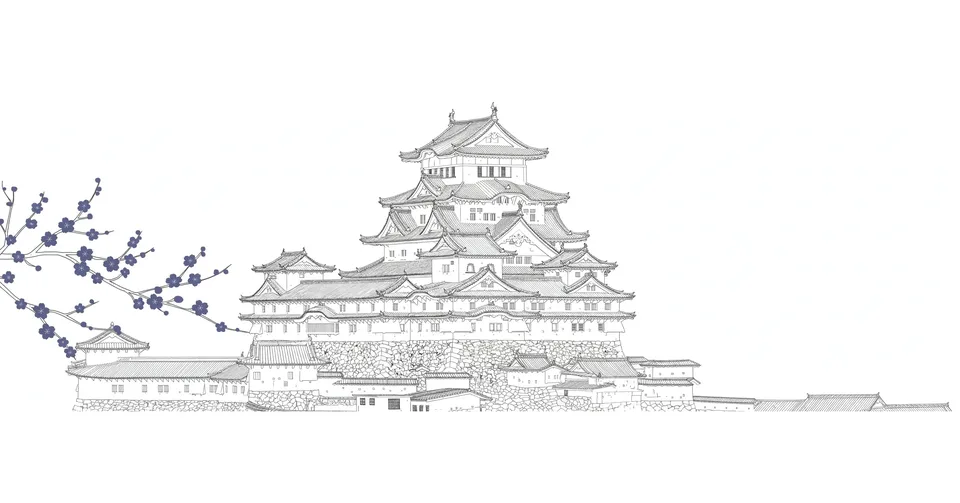
The short answer is that Himeji Castle is the largest and best preserved of the twelve original castle keeps left in Japan. It stands on a low hill at the end of a straight avenue from Himeji Station, white plaster walls rising over dark stone, and it was inscribed by UNESCO in December 1993 as one of the first World Heritage sites in Japan. Himeji Castle survived the firebombing of its own city in 1945, the Great Hanshin earthquake of 1995, and centuries of rain. It is worth the trip from Osaka or Kyoto, and it is worth going inside, not just photographing from the street.
I went to Himeji Castle on a clear winter morning, expecting a famous view and a crowded keep. What stayed with me was quieter than that. Inside the keep, the wooden floors are worn smooth and the staircases are so steep they feel like ladders. The windows frame the city below in small, deliberate slices. The castle was built to be defended, and you can feel that in your legs. It is also beautiful in a way that has nothing to do with defence, which is the contradiction at the heart of the place. A fortress that looks like a bird about to take flight.
Why Himeji Castle Is Not a Reconstruction
Japan once had thousands of castles. Most were torn down in the Meiji period, when the new government ordered the old fortresses dismantled, or burned in war. Of the keeps that remain, only twelve are original wooden structures. Himeji Castle is the largest of them, and the most complete, with 83 buildings surviving in the complex. The main keep, three smaller keeps, and the corridors that join them are designated National Treasures. Another 74 structures are Important Cultural Properties. Nothing else in Japan comes close to this level of survival.
The distinction matters because a reconstruction can show you the shape of a castle but not the substance. At Himeji Castle, the beams are the beams. The plaster is renewed by hand, but the frame it covers has stood since the early 1600s. When UNESCO listed the castle in 1993, alongside Horyu-ji in Nara, it was recognising exactly this quality. Himeji Castle is not a copy of a feudal castle. It is one.
Himeji Castle's roots reach back to a fourteenth century fort on the same hill. Toyotomi Hideyoshi built a castle here in 1581. The Himeji Castle you see today was built by Ikeda Terumasa, who received Himeji from the shogun Tokugawa Ieyasu after the Battle of Sekigahara. Terumasa's builders worked from 1601 to 1609, raising the main keep and the defensive walls. In 1618, Honda Tadamasa extended the castle again, adding the West Bailey as a residence for his daughter-in-law, Princess Sen. The result is a complex that took two generations to finish and has never needed to be rebuilt.
The White Heron and Its White Walls
The castle's nickname is Shirasagi-jo, the White Heron Castle. Stand on Otemae-dori, the broad avenue from the station, and the name makes sense at once. The white plaster walls and grey tiled roofs rise over the stone base like a heron with its wings half spread. The effect is deliberate. The plaster is not paint. It is a traditional mixture of lime, hemp fibre, and seaweed paste, applied by hand over the wooden walls, and it has to be renewed regularly because it weathers to grey.
The most recent renewal was a major project. In 2009 the castle began its first large scale restoration in fifty years, and the main keep spent years under scaffolding and a protective cover. The work finished in March 2015, when the castle reopened on 27 March, its walls newly white. The project cost 2.33 billion yen and involved about 33,000 workers. Visitors who came in 2015 found the white almost startling, and it has softened since into the warm tone you see today. The next major repair of the keep is not expected for about fifty years, which is one reason the castle feels so permanent. It is maintained on a timescale that outlasts a human working life.
There is a practical side to the whiteness too. The thin black lines that run down the white walls are drip courses, small channels that carry rainwater away from the wood underneath. Without them, a century of rain from the Harima region would have eaten the beams. Beauty and engineering share the same surface here, and the people who restored Himeji Castle in 2015 spent years getting both right.
A Maze Built to Slow an Army
Himeji Castle was never attacked, so its defences were never tested in battle. That is a strange piece of luck, and it means the defences survive intact for visitors to get lost in. The path from the outer gate to the main keep winds, doubles back, and narrows through a series of gates, walls, and courtyards. The route is designed to confuse and slow an attacker, forcing a column of soldiers into single file under loopholes where defenders could shoot or drop stones. Modern visitors walk the same route, and they still get turned around.
The keep itself is six storeys tall, rising 46.4 metres above a stone base 14.85 metres high. Inside, the floors are open and spare, with displays of armour and weapons on some levels. The staircases are steep and the steps are uneven, worn by centuries of use. There is no lift, and the climb is part of the experience. At the top floor, a small shrine sits in the keep, and the windows look out over the city and the hills beyond. On a clear day you can see the Inland Sea in the distance.
Look closely at the stone walls on the way up and you will find something unexpected. Some of the stones carry carved marks, the crests of the lords and the work gangs who built the walls. The stones were cut and hauled by hand, and the marks were a way of keeping count. The castle is full of details like this, small and practical, and they are easy to miss if you hurry to the top. My own advice is simple. Take the slow route, read the signs, and look at the stonework. The keep is the destination, but the walls are the story.
The Night the City Burned
The most remarkable chapter in the history of Himeji Castle is the night it should have burned. Himeji was heavily bombed near the end of the Second World War, and on the night of 3 July 1945 most of the city around the castle burned to the ground. The keep had been draped in black camouflage netting to hide it from the air, and an incendiary bomb that struck the top floor failed to explode. When the smoke cleared, the White Heron was still standing, almost untouched, above a city that had been largely destroyed.
It is worth pausing on that image. A wooden castle, more than three hundred years old, survived a firestorm that levelled the town around it. The camouflage helped, and luck helped, but the survival also says something about the building itself. The thick plaster, the stone base, and the separation between the keep and the town all played their part. Fifty years later, the Great Hanshin earthquake of 1995 shook the region severely, and the keep stood again, its flexible timber frame absorbing what rigid stone could not.
Himeji Castle was repaired after the war, in a Showa era restoration that ran from 1956 to 1964, when the keep was taken apart, repaired, and reassembled. That work, and the Heisei restoration that followed it, is why the castle looks the way it does today. Each generation has paid for the next one to see the building intact. That is the quiet contract behind every World Heritage site, and Himeji Castle makes it visible.
There is also a ghost story, as there is at almost every old Japanese castle. The well in the castle grounds is tied to the legend of Okiku, a servant in the tale of Bancho Sarayashiki, who was said to have been thrown down a well after breaking a precious plate. Guides mention it briefly, and visitors peer into the well with a mixture of curiosity and respect. It is a reminder that the castle is not only a monument. It is a place where people lived, worked, and told stories, and some of those stories are dark.
What a Visit Costs in 2026
Prices at Himeji Castle changed in 2026, and the new system catches many visitors by surprise. Since 1 March 2026, adult admission for people who do not live in Himeji City is 2,500 yen. Visitors under 18 enter free, through the first 31 March after their eighteenth birthday. The combined ticket for the castle and the neighbouring Koko-en garden is 2,600 yen, only 100 yen more than the castle alone, and for most adults it is the better choice. Residents of Himeji City pay 1,000 yen. The old adult price of 1,000 yen for everyone ended on 28 February 2026.
The price rise was introduced to fund the ongoing preservation of the wooden keep, and it made Himeji Castle the most expensive castle in Japan to visit. That is worth knowing before you go, so the ticket price does not spoil the day. Buy the combined ticket if you have three hours, because Koko-en is a set of nine small traditional gardens built in 1992, and it is a calm counterpoint to the climb through the keep. One date is free for everyone. On 11 December, the anniversary of the World Heritage listing, the castle and nearby facilities open without charge, and no tickets are sold that day. Expect crowds.
There is one more practical point for 2026. Preservation work is taking place around the main keep, including repairs to the Ni-no-yagura turret and the Mizu-no-ichi-mon and Mizu-no-ni-mon gates. The castle stays open, but scaffolding and narrowed passages should be expected until around late July 2027. The work does not remove the central experience, but a few close range views may be interrupted. Check the official Himeji Castle site before you travel for the latest notice, and check the city page on the revised admission fees if you want the prices in writing.
Planning the Day Trip
Himeji Castle is an easy day trip, and the journey is part of the pleasure. The Shinkansen from Shin-Osaka takes about 28 minutes, which is why so many visitors pair the castle with an Osaka base. The castle is about a fifteen minute walk from the north exit of Himeji Station, straight down Otemae-dori, and the keep is visible from the station, growing larger with every step. If you want the full history of the train that gets you there, the story of the bullet train explains how Japan built the world's first high speed railway, and Himeji is one of the places where that story still pays off.
Arrive early. The main keep admits at most 1,000 people an hour, and on busy days the real wait is not at the ticket gate but at the door of the keep itself. Morning is quieter, and the light on the white walls is at its best before noon. Give the castle at least two and a half hours, and three if you add Koko-en. The outer Sannomaru grounds and the distant views of the keep are free, so even a short stop rewards you, but the interior is where the castle stops being a photograph and becomes a building.
The seasons change the visit without changing Himeji Castle. In spring the grounds fill with cherry blossom, and the white walls against pale pink are the classic image of Himeji Castle. If you want to time a spring trip well, the guide to Japan's cherry blossoms covers the timing across the country. In autumn the maples in Koko-en turn red and gold, and the garden becomes the main event. If you are planning around the leaves, the guide to Japan's autumn leaves will help you pick the week. Winter has its own reward. The crowds thin, the air clears, and the white heron stands out against a grey sky.
There is one more thing to know before you climb the keep. The stairs are steep, the floors are bare wood, and there is nowhere to sit inside. Wear shoes you can walk in, leave large bags at the station lockers, and bring water in summer. The castle was built for soldiers, not for comfort, and it has not apologised for that in four hundred years.
The Castle That Refused to Fall
Himeji Castle endures because it was built well, repaired on time, and lucky on the one night when luck mattered most. That combination is rare. Most old buildings lose one of the three, and then they are gone. Himeji Castle also endures because people keep choosing to pay for it, from the lords who raised the keep to the city that raised the ticket price in 2026 to fund the next round of repairs. Preservation is not a single decision. It is a habit, repeated every fifty years, and Himeji Castle is the proof that the habit works.
If you visit only one castle in Japan, make it this one. Not because it is the prettiest, although it is, and not because it is the most famous, although it is that too. Visit it because it is real. The keep you climb is the keep that Ikeda Terumasa finished in 1609, the keep that survived the night of 3 July 1945, and the keep that a city replastered by hand in 2015 so that it would still be white when you arrived. Standing at the top, looking out over a city that was rebuilt around it, you understand what four hundred years actually means. It means a building that outlived its builders, its wars, and its earthquakes, and is still standing, waiting for the next visitor to climb its stairs.
More in Food & Travel
- Japanese Breakfast and the Morning Meal That Starts with Rice and Soup
- A Yuzamashi Cools the Water Before the Tea Begins
- Tencha Is the Shade-Grown Leaf Matcha Is Made From
- A Kyusu Is the Small Teapot Behind Every Good Cup of Sencha
- Shincha Is the First Flush Japan Waits All Winter For
- Gyokuro Earns Its Price One Shade-Grown Leaf at a Time
Latest posts
- A Genkan Is Where Japan Leaves the Outside World at the Door
- A Shoji Lets the Daylight In While Keeping the World Out
- A Ranma Lets a Japanese Room Breathe Over the Top of Its Walls
- A Tokonoma Turns One Corner of a Japanese Room Into a Shrine
- Fusuma Turn a Room Into Whatever Japan Needs Next
- Wearing a Happi Means You Belong to the Matsuri
- Taiko Drums and the Thunder That Shook Japanese Festivals
- Sencha Is the Green Tea Japan Drinks Every Single Day
- Washi Paper and the Thousand-Year Craft Behind Japan's Toughest Sheets
- Mugicha Is the Barley Tea Japan Pours All Summer Long
- Bancha Is the Everyday Tea Japan Drinks Without Thinking
- Chusonji Is the Mountain Temple That Outlasted Its Golden Age
- Hojicha Is the Roasted Tea Japan Reaches for After Dinner
- Kakigori and the Thousand-Year History of Japan's Shaved Ice
- A Pure Land Garden Is a Paradise You Can Walk Through