Japanese Breakfast and the Morning Meal That Starts with Rice and Soup
· 13 min read
A Japanese breakfast is a full savory meal built on rice, miso soup, grilled fish and small sides. Here is what is on the tray, where the pattern comes from, and how to order one as a visitor.
A Japanese breakfast is not a quick bowl of cereal before the day starts. It is a complete savory meal: steamed rice, miso soup, a piece of grilled fish, an egg, and a few small sides, all arranged on one tray. The same structure that shapes a formal Japanese dinner shows up at the breakfast table, in miniature, before nine in the morning.
The pattern has a name, ichiju-sansai, which means one soup and three dishes. Rice sits at the center, miso soup warms the meal, and the small dishes exist to flavor the rice rather than to fill you up on their own. Once you understand that logic, the tray stops looking like a random collection of bowls and starts looking like a small, well planned system.
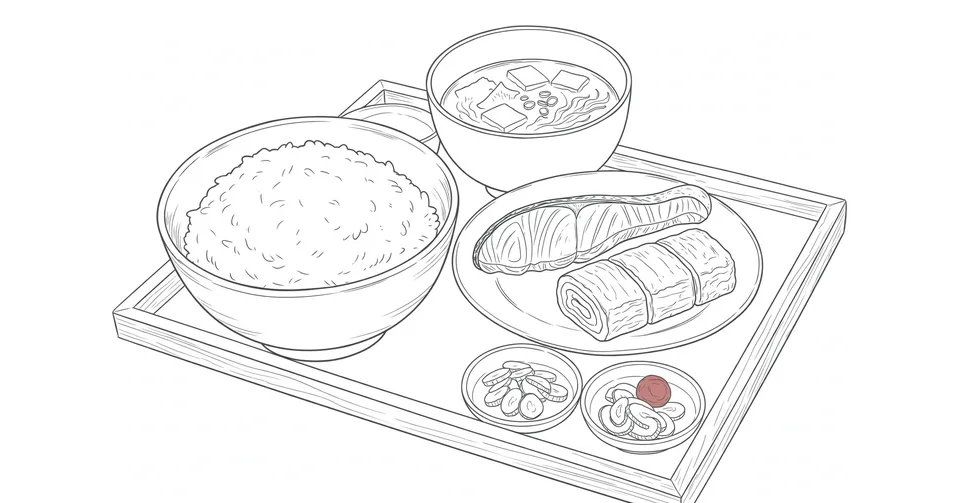
A Japanese breakfast rewards the traveler who slows down for it. The first time I sat in front of a full tray at a ryokan, I treated it like a buffet and finished the rice before touching the fish. A Japanese friend laughed and told me to pace myself: the rice is the main event, the fish and pickles are its supporting cast, and the soup is sipped all the way through, not finished first. That small correction changed how I eat breakfast in Japan, and it is the kind of detail no menu ever explains.
What a traditional Japanese breakfast looks like
A traditional Japanese breakfast arrives as a set, not as a single plate. The tray holds a bowl of steamed white rice, a bowl of miso soup, a main dish, and two or three small sides. The arrangement follows a fixed geography that has barely changed in centuries: the rice bowl goes at the lower left, the soup bowl at the lower right, and the small dishes fill the upper part of the tray. Chopsticks rest on the right, and a cup of green tea stands nearby.
The structure comes from ichiju-sansai, the one soup, three dishes framework that organizes formal Japanese cooking. The name counts only the soup and the three dishes. It does not count the rice or the pickles, which are treated as givens. The three counted dishes have their own hierarchy: a main dish, usually protein, plus two supporting dishes prepared by different methods, classically one simmered, one vinegared or raw, and one grilled.
Breakfast is where most Japanese people meet this structure every day, often without ever naming it. A weekday version may shrink to one soup and two sides, or even one side, but the center never moves. Rice and soup stay. When UNESCO registered washoku, traditional Japanese food culture, as Intangible Cultural Heritage in 2013, ichiju-sansai was cited as one of the principles that give the cuisine its character. A guide to the classic Japanese breakfast set lists the same components on the tray: rice, miso soup, grilled fish, egg, pickles, nori, and often natto. The breakfast tray is that principle at its most everyday.
The cast of the tray
Rice, or gohan, is the anchor of a Japanese breakfast. It is short grain rice, steamed until just sticky, served in a lacquered bowl that is held in the left hand while eating. A serving is modest, roughly 150 to 180 grams cooked, because the rice is meant to be flavored bite by bite by everything around it, not eaten plain in large amounts.
Miso soup, or misoshiru, is the one soup in ichiju-sansai. It is made from dashi stock, fermented soybean paste, and simple additions such as tofu, wakame seaweed, and green onion. The miso itself is regional: white and sweet in Kyoto, red and darker in eastern Japan. The garnish changes with the day and the season. The soup is sipped alongside the rice throughout the meal, never treated as a starter to be finished first.
Grilled fish is the classic main dish. Salted salmon, known as shiozake, is the most common choice in modern homes, with mackerel and horse mackerel close behind. The fish is salted lightly, rested for a few minutes, and grilled at high heat until the skin crisps. The portion is small by design, around 30 to 50 grams, because it exists to season the rice. Coastal towns serve whatever was landed that morning, and in the north, hokke, or Atka mackerel, takes the same role.
The egg shows up in several forms. Tamagoyaki, the rolled omelet, is the most photogenic. Tamago kake gohan, a raw egg cracked over hot rice with a splash of soy sauce, is the fastest version and a favorite of people who eat at home. An onsen egg, slow cooked in its shell until the white is barely set, appears on fancier trays. Each version does the same job: a soft, rich counterpoint to the rice.
The small sides complete the tray. Tsukemono pickles add crunch and salt, nori seaweed is torn over rice or eaten as a wrap, and natto, the sticky fermented soybeans, divides the table like nothing else in Japanese food. The natto article on this site explains why visitors either love it or leave it untouched, but at a Japanese breakfast it is simply one more small dish doing its job. Simmered vegetables, known as nimono, and ohitashi, blanched greens in dashi, round out the rotation. Nothing on the tray is there by accident.
Where the pattern comes from
Ichiju-sansai reaches back to the Heian period, from 794 to 1185, when court cuisine and meals for Buddhist monks first established the pattern of rice accompanied by soup and several small dishes. The formal version hardened during the Muromachi period, from 1336 to 1573, as honzen-ryori, the ceremonial banquet style that fixed the placement of each bowl on the tray. What began as court etiquette slowly became home cooking, and home cooking made it the default shape of a Japanese morning.
That history explains why a Japanese breakfast feels so composed. It is not a collection of leftovers or a quick assembly of whatever is in the fridge. It is a scaled down version of a formal meal, built on the same rules. The seasoning is gentle, the portions are small, and the flavors are meant to be balanced across the tray rather than concentrated in one dish.
The pattern also explains the Japanese attitude toward breakfast as a real meal rather than fuel. In many countries, breakfast is the meal people skip or shrink. In Japan, the traditional breakfast treats the morning as worthy of a full kitchen effort, even if the weekday version is assembled in fifteen minutes from a rice cooker left on warm overnight, a packet of instant miso soup, and pickles from a jar.
The weekday shortcut
Most Japanese households do not build the full tray every morning. The working day version is a shorter form of the same idea: rice from the cooker, miso soup from a packet or a quick dashi, one protein such as grilled fish or tamagoyaki, and pickles straight from the jar. Five minutes of active work if the rice is already warm, twenty five if the fish needs grilling.
The rice cooker is the quiet hero of the Japanese breakfast. Left on its warm setting overnight, it holds rice at the right temperature until morning, so the hardest part of the meal is already done when the cook wakes up. Instant miso soup, sold as a paste or a freeze dried block, dissolves in hot water in seconds and tastes close enough to the homemade version that few people apologize for using it. A guide to what a traditional morning meal looks like describes the same weekday reality: warm rice, a simple miso soup with tofu and wakame, grilled fish or tamagoyaki, and pickles, assembled in minutes rather than cooked from scratch.
Tamago kake gohan deserves its own mention because it is the simplest honest Japanese breakfast there is: hot rice, one raw egg, a splash of soy sauce. It takes two minutes, costs almost nothing, and follows the same logic as the full tray, since the egg exists to flavor the rice. It is the meal students eat before an exam and office workers eat before a long day.
The convenience store plays a role too. An onigiri from a konbini, bought on the way to the station, is the portable version of the same breakfast, rice and a savory filling wrapped in nori. It is not a traditional Japanese breakfast in the formal sense, but it carries the same DNA: rice first, everything else in service of the rice.
The other Japanese breakfast
Not every Japanese breakfast is the traditional set. Bread has a real place at the morning table, especially among younger people and in cities. A common home breakfast is thick sliced shokupan toast with butter and jam, a boiled egg, and coffee or milk. Hotels almost always offer a choice between the Japanese set and a Western set, and many Japanese guests pick the Western one on weekdays and the Japanese one on weekends, when there is time to enjoy it.
The kissaten, the old style Japanese coffee shop, invented its own morning ritual. In Nagoya, coffee shops began serving toast and a boiled egg free with a morning coffee in the postwar decades, a deal called morning service that spread across the region and became a point of local pride. The toast is thick, the egg is soft boiled, and the coffee is strong and dark. It is a Japanese breakfast in spirit, if not in form, because it follows the same rule as the traditional tray: a small, complete meal that starts the day properly.
School lunches follow the same logic from the other direction. Kyushoku, the Japanese school lunch system, serves children a structured meal of rice or bread, soup, a main dish, and milk, teaching the ichiju-sansai balance from childhood. A child who grows up on kyushoku already knows how a Japanese breakfast tray is supposed to work before ever cooking one.
Three ways to eat breakfast in Japan
Visitors meet Japanese breakfast in three main settings, and each one shows a different face of the same meal. The table below compares them at a glance.
| Setting | What you get | When to choose it |
|---|---|---|
| Ryokan or hotel Japanese set | Full tray: rice, miso soup, grilled fish, egg, pickles, tea | When you want the complete traditional Japanese breakfast |
| Kissaten morning service | Coffee with toast and a boiled egg | When you want a cheap, local start in Nagoya or a smaller city |
| Konbini onigiri and tea | Rice ball, bottled tea, maybe a boiled egg | When you are catching an early train |
The ryokan set is the one to plan for. Most ryokan include breakfast in the room rate, and the tray is prepared for the number of guests, so it cannot be ordered casually at the last minute. Hotel Japanese breakfast service usually runs from around 7:00 to 10:00 in the morning, and the set is often the most expensive breakfast option on the menu, which is fair, because it is also the most complete.
The kissaten version is the best value and the most local. Morning service typically runs until around 11:00, and the deal is simple: order a coffee and the toast and egg come with it. In Nagoya, some shops add red bean paste or a small salad, and regulars have strong opinions about which shop does it best. It is a good first Japanese breakfast for a traveler who finds the full fish and natto tray intimidating.
The konbini version is the fallback that still counts. A salmon onigiri, a bottle of green tea, and a boiled egg from the shelf make a respectable Japanese breakfast for under 500 yen, eaten on a train platform or a park bench. It lacks the soup and the ceremony, but it keeps the rice at the center, and that is the point.
How to order one as a visitor
Ordering a Japanese breakfast as a visitor is easier than it looks, because the meal is usually a set rather than a list of choices. At a ryokan, breakfast is served in the dining room or in the room itself, and the tray arrives as the kitchen prepared it. At a hotel, ask for the washoku set, which means the Japanese style breakfast, as opposed to the yoshoku, or Western style, set. Most hotel restaurants serve both, and the staff will understand either word.
A few practical notes make the experience smoother. The fish comes with small bones, so eat it slowly and pick the flesh off with chopsticks rather than cutting it. The natto arrives in a small container with a packet of mustard and soy sauce; stir it vigorously until it turns pale and stringy, then eat it over rice. The pickles are eaten between bites to reset the palate, not as a separate course. And the soup is sipped from the bowl with both hands, chopsticks used to fish out the tofu and seaweed.
If the full tray feels like too much at seven in the morning, that is a reasonable feeling and a common one, even among Japanese people. A smaller version is still a Japanese breakfast: rice, soup, and one good side will do. The meal is not a test. It is a structure, and like any good structure, it works even when you simplify it.
Why the tray matters
A Japanese breakfast matters because it shows how Japanese food thinks. The meal is built on balance rather than abundance, on a small number of ingredients prepared simply, on the idea that a morning deserves the same care as an evening. The tray is the most ordinary expression of washoku, and it is served every day in millions of homes without ceremony or comment.
My own opinion, after many mornings in Japan, is that the Japanese breakfast is the most underrated meal in the country. Visitors plan their dinners and photograph their lunches, but breakfast is where Japanese food is at its most honest: no spectacle, no special occasion, just rice, soup, and a few small dishes done well. The Japanese tea ceremony gets the attention, and it deserves it, but the breakfast tray is the ceremony most people actually live with.
So the next time you wake up in Japan, skip the hotel buffet for one morning and ask for the washoku set. Eat the rice first, sip the soup through the meal, and let the small dishes do their work one bite at a time. It is a quiet way to start the day, and it is the one meal that will tell you more about how Japan eats than any restaurant dinner.
More in Food & Travel
- A Yuzamashi Cools the Water Before the Tea Begins
- Tencha Is the Shade-Grown Leaf Matcha Is Made From
- A Kyusu Is the Small Teapot Behind Every Good Cup of Sencha
- Shincha Is the First Flush Japan Waits All Winter For
- Gyokuro Earns Its Price One Shade-Grown Leaf at a Time
- Sencha Is the Green Tea Japan Drinks Every Single Day
Latest posts
- Fusuma Turn a Room Into Whatever Japan Needs Next
- Wearing a Happi Means You Belong to the Matsuri
- Taiko Drums and the Thunder That Shook Japanese Festivals
- Washi Paper and the Thousand-Year Craft Behind Japan's Toughest Sheets
- Mugicha Is the Barley Tea Japan Pours All Summer Long
- Bancha Is the Everyday Tea Japan Drinks Without Thinking
- Chusonji Is the Mountain Temple That Outlasted Its Golden Age
- Hojicha Is the Roasted Tea Japan Reaches for After Dinner
- Kakigori and the Thousand-Year History of Japan's Shaved Ice
- A Pure Land Garden Is a Paradise You Can Walk Through
- Genmaicha Turns Roasted Rice Into Japan's Nuttiest Green Tea
- Sagemono Are the Hanging Treasures Samurai Wore at the Waist
- Oshu Fujiwara Built a Golden Capital in the North
- Harajuku and the Tokyo Streets Where Fashion Refuses to Sit Still
- Fujiwara no Kiyohira Turned War Into Gold