Sagemono Are the Hanging Treasures Samurai Wore at the Waist
· 23 min read
Sagemono are the hanging containers Japanese men once wore at the waist, a pocket made of cord, toggle and lacquered box that turned a missing pocket into an art form.
A man walking through Edo period Japan carried his whole day at his waist. His seal, his medicine, his tobacco, his pipe, his money and his writing brush all hung from a cord at his hip, swinging gently as he walked, held up by a single carved toggle tucked over his sash. The kimono he wore had no pockets, so he wore his pockets on the outside, and the Japanese name for that hanging collection was sagemono.
The word sagemono means simply hanging things, and it covers the whole system rather than any one object. The lacquered inro box, the drawstring kinchaku bag, the tobacco pouch, the pipe case and the portable writing set were all sagemono, different containers that shared one cord, one toggle and one idea. Each was made for a single purpose, yet together they worked as a man's portable desk, pharmacy and purse, and they turned a practical problem into one of the most admired crafts Japan ever produced.
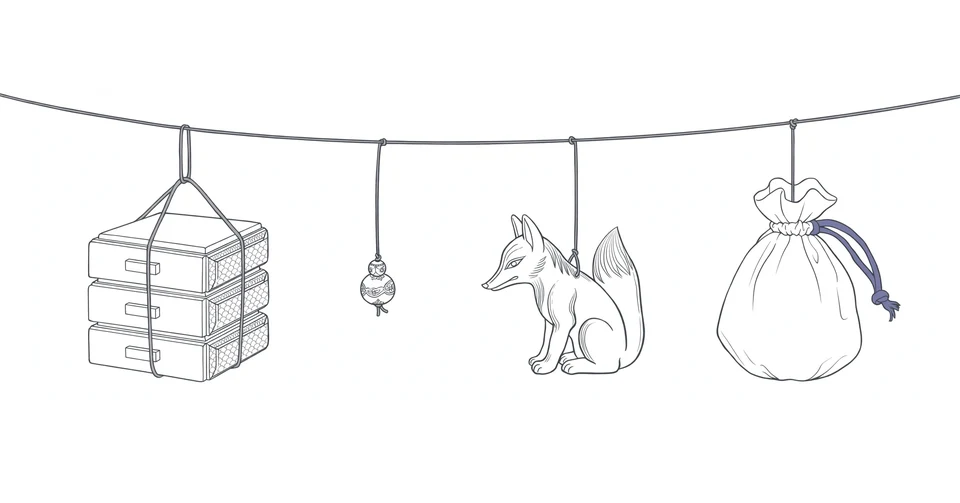
What makes a sagemono worth a whole article is that it is not really about the objects at all. A sagemono is about a solution. A garment without pockets forced its wearers to invent a way of carrying things, and the answer they found, the sagemono, was so elegant, so carefully made and so deeply tied to rank and taste, that it outlived its usefulness by more than a century. Long after the last man stopped wearing one to work, collectors and museums were still chasing the finest sagemono, and the little hanging treasures still teach a lesson about how a constraint can make a thing beautiful.
Why the kimono needed a pocket that hung outside
The kimono is a simple garment, a T-shaped robe wrapped around the body and held in place with a wide sash called an obi, and for centuries it was worn by Japanese people of all classes. It has no pockets in the Western sense. The wide sleeves of the kimono could hold small flat things, and women sometimes tucked objects into the fold of the sash, but a man who needed to carry a seal, a pipe, a pouch of coins and a few remedies had nowhere to put them inside his clothes.
The answer was to hang them outside, in a sagemono. A cord was looped through the container, passed over the top of the obi, and held in place by a toggle that sat above the sash while the container hung below it. Wikipedia defines the arrangement plainly, calling sagemono a hanging object attached to a sash, and noting that because traditional Japanese dress lacked pockets, objects were often carried by hanging them from the obi in containers known as sagemono. The Wikipedia article on inro gives the full account of the system, including how most sagemono were created for specialized contents such as tobacco, pipes, writing brush and ink, and how the inro was created in the Sengoku period as a portable identity seal and medicine container for travel.
The sagemono system was already old by the time it reached its peak. Containers for seals and medicine were being carried at the waist in the Sengoku period, from 1467 to 1615, when Japan was divided by civil war and men traveled with what they needed on their person. As the country settled into the long peace of the Edo period, from 1603 to 1868, the sagemono changed from a traveler's tool into a man's accessory, and by the middle of the Edo period it was one of the most visible marks of taste a man could carry. The inro article on this site tells that story through the lacquered box itself, and the box was only one member of the sagemono family.
There is a temptation to see the missing pocket as a flaw in the kimono, and to wonder why no one simply sewed a pocket into the robe. That misses the point. The kimono is cut from straight lengths of cloth with almost no shaping, and a pocket sewn into it would have spoiled the clean fall of the fabric and the line of the sash. The hanging system kept the robe simple and moved the complexity to the sagemono themselves, which could be made, repaired, replaced and admired separately. It was a division of labor between the garment and the sagemono, and it worked so well that it lasted for more than two centuries.
How a sagemono hangs together
Every sagemono, whatever its shape, hangs the same way, and the mechanics are worth understanding because they explain why a sagemono looks the way it does. Four parts work together, and each one has its own craft. At the bottom hangs the container, the box or pouch that holds the contents. Above it sits a small sliding bead called an ojime. Above the bead sits the toggle called a netsuke. Running through all of them is the cord, usually braided silk, that ties the set together.
The cord is threaded through a channel on one side of the container, through two small holes in the netsuke, called himotoshi, then down the other side of the container, and knotted on the underside. The wearer slips the netsuke under his obi from below and lets it sit on top of the sash while the container hangs a few inches beneath it, between waist and hip. The weight of the container pulls the cord taut, the netsuke stops the whole sagemono from sliding to the floor, and the ojime, pushed down toward the container, holds everything shut. To open a sagemono, the wearer slides the ojime up toward the netsuke, and the container can be lifted free and opened. It is a sagemono lock with no metal, no hinge and no clasp, and it worked a dozen times a day for more than two hundred years.
The bead deserves more attention than it usually gets, and I wrote about it in detail in Ojime Is the Tiny Bead That Keeps a Netsuke From Slipping Away. The ojime grips by friction alone. Its holes are only just wide enough for the cord, so it slides when pushed with a fingertip and holds when left alone, and a bead with holes too wide would let the case open on a crowded street while one with holes too narrow would jam and fray the cord. Getting that fit right was part of the maker's skill, and it is one reason an old bead that still slides smoothly is prized.
The netsuke, the toggle at the top of a sagemono, is the part that became famous, because carvers turned it into miniature sculpture. Monkeys, rats, gods, demons, fishermen, crabs and gods in every posture appear as toggles, carved in wood and ivory, and the best of them are small masterpieces. But the toggle was only the anchor. It held up the sagemono, the container, and that container was the point. The netsuke got the exhibitions, the inro got the lacquer, and the cord and the bead did the quiet work in between. A sagemono set only makes sense as a whole, and collectors who chase a single piece without the rest of the sagemono are collecting a fragment of a sentence.
A sagemono set had to be balanced. A container that was too heavy would drag the cord down and pull the toggle out from under the sash. A toggle that was too light would slip. A cord that was too rough would wear the lacquer. The makers tuned all of that by hand, in objects that had to survive being bumped against door frames, jostled in crowds and opened and closed dozens of times a day. The grace of the system is that none of that effort shows. To a passerby, a man simply wore a small beautiful sagemono at his waist, and the engineering stayed invisible.
The five kinds of sagemono a man might carry
Not every sagemono held the same thing, and the different containers show how completely the sagemono covered a man's day. Most types of sagemono were created for specialized contents, and the five below were the ones a visitor to Edo would have seen most often.
The inro was the most famous sagemono, a stack of small nested compartments held together by the cord, first used for seals and later mostly for medicine. The name joins two kanji, in, meaning a seal or stamp, and ro, meaning a basket or container, so the name itself says seal case. The compartments, usually two to seven of them, were made for different remedies so they would not mix, and the stack was so precisely fitted that the seams almost disappeared when it was closed. A detailed account of the box, its makers and its decoration is told in Inro Is the Little Lacquered Box That Carried a Samurai's Day, and the box deserves that attention, because it was the most elaborate member of the family and the one that best shows how a practical container became art.
The kinchaku was the soft cousin of the inro, a sagemono of cloth rather than lacquer, a small drawstring bag of cloth or leather, closed by pulling the cord tight. It carried coins, small personal items and whatever did not need a hard case, and the same ojime bead slid on its drawstring to hold it shut. The kinchaku was the everyday workhorse of the set, less precious than the lacquered box and more forgiving, and it shows how the same hanging logic served a bag as well as a box.
The tabako-ire was the tobacco pouch, a sagemono for smokers, and it belonged to the smoking culture of Edo Japan. Tobacco was introduced to Japan by the Portuguese in the middle of the 16th century, and by the Edo period smoking had become a common habit, though one the authorities watched with suspicion, since towns were built of crowded wooden houses and fire was a constant fear. The pouch held shredded tobacco, and it hung beside its partner, the pipe case.
The kiseruzutsu was that pipe case, a sagemono in the shape of a tube, a long slim tube that protected a smoking pipe called a kiseru. The kiseru itself was a slender metal pipe with a small bowl, very different from a Western pipe, and its name is said to come from the Portuguese phrase que sorver, meaning to breathe in. The tube was often made of bamboo, lacquered wood or leather, and it hung vertically at the waist, a thin line beside the rounder shapes of the pouch and the box. A man who smoked carried pouch and pipe case together, a matched pair within the larger sagemono.
The yatate was the portable writing set, the most surprising sagemono of all. The name means arrow stand, because early samurai kept ink stones inside their arrow stands, and the first yatate were long boxes with the ink compartment in the axis of the pen. Later designs gave the yatate the shape of a smoking pipe to hold more ink, and in the late Edo period another design appeared in which the ink box was attached to the pen shaft by a chain, with the ink box itself serving as the netsuke that fixed the set to the belt. A writing set that hangs at the waist sounds impractical until you remember that a samurai or an official might need to write a note, sign a document or record an order at any moment, and there was no desk to walk to. The yatate put the desk in his sash, a sagemono for writing.
There were other, rarer members of the sagemono family. Small purses for coins, cases for spectacles, containers for incense, and sheaths for small knives all hung the same way, and each one was shaped to its contents. The point is not the list of sagemono but the principle. Once the Japanese had solved the problem of carrying things without pockets, they solved it again and again for every new need, and each new sagemono took the same form, a container, a cord, a bead and a toggle.
What sagemono were made of
The materials of sagemono tell the story of Edo Japan itself, because the makers used almost anything they could shape, and the choice of material said as much about the owner as the carving did. Wood was the everyday material, honest and warm, and about 80 percent of surviving antique netsuke were carved in various types of native Japanese wood, including cypress, cherry, black persimmon, yew, camphor, zelkova and camellia, according to the Metropolitan Museum. Boxwood was favored for its fine grain and durability, and wood shows the carver's hand most directly, because it hides nothing.
Lacquer was the material of the inro, the best known sagemono, and it was also used to decorate containers made of other materials. A lacquered surface could be black and deep enough to see your face in, dusted with gold powder in the maki-e technique, inlaid with mother of pearl in the raden technique, or finished inside with nashiji, a golden pear skin pattern. The lacquer work was slow, layer after layer, with drying and sanding between coats, and the hardest part was the fit, because each compartment had to slide into the next tightly yet smoothly, with the joint invisible all the way around.
Ivory was the luxury material, smooth and creamy, able to hold fine detail, and it came to Japan mostly through trade with China and India. It was used for toggles, beads and small containers, and for centuries it was one of the most popular materials for netsuke carvers. That history has a harder side that should be said plainly. International trade restrictions on elephant ivory were put in place in 1989, and old ivory carries an ethical weight today that it did not carry when it was carved. A collector now has to think about provenance, about whether a piece left Japan legally, and about whether owning it does any good. My own view is that the old pieces in museums are best left where they are, studied and admired, and that a new collector can learn everything from wood, glass, lacquer and metal without touching ivory at all. The art is in the carving, not in the tusk.
Other materials filled out the sagemono range. Coral gave a deep red accent that stood out against black lacquer and indigo silk. Metal beads and fittings in gold, silver, copper and brass could be engraved, inlaid and enamelled. Porcelain carried painted scenes in miniature. Glass brought color and shine at a lower price. Bamboo, leather, horn, tortoiseshell and even stone appear in old pieces, sometimes combined in a single object, and makers were so skilled at imitating materials in lacquer that a surface could look like wood grain or woven cloth until you touched it.
The materials also decided how a sagemono set would age. Wood gains a soft shine from handling, ivory mellows to a warm tint, and both develop a quality the Japanese call aji, the agreeable feel of a thing that has been touched often and well. A piece that has never been handled feels dead in the hand, however pretty it looks in a case. The good ones ask to be picked up, and that is a rare quality in an object this small. The makers of sagemono understood that their work would be held, turned, opened and closed every day, and they finished the hidden surfaces, the inside of a compartment, the underside of a lid, the back of a toggle, to the same standard as the front.
Who wore sagemono, and what they said without words
Sagemono began as the equipment of men of the warrior class, but they did not stay there. By the middle of the Edo period, wealthy merchants were the great patrons of sagemono, and the reason was the law. Under the strict social order of the Edo period, merchants stood at the bottom, below warriors, farmers and artisans, and sumptuary laws told them what houses they could build, what fabrics they could wear and what they could display. A rich merchant could not wear silk brocade or build a grand gate, but the laws said nothing about the small box on a cord at his waist.
An inro lacquered in black and gold, made by a famous workshop, cost more than the netsuke that held it up, and everyone on the street understood what it meant. A sagemono set was shown the way a watch is shown today, slipped out from the sash, turned in the palm, handed over for a friend to admire, and then tucked away again. It was social, portable and personal, all at once, and because it was small, a collector could own dozens without needing a storehouse. The finest sets were matched, with the toggle, the bead and the container telling one story, perhaps a monkey on the toggle and a peach on the bead, or the same flower repeated in lacquer, wood and coral, and assembling a matched set took time, money and taste.
The makers who served this market were organized in workshops with long histories. Two families dominated the making of fine inro. The Koma family served the shogun's court from the 15th century onward, and the Kajikawa family served the Tokugawa shoguns for generations. Both were lacquerers first and inro makers second, and their names on a piece were a guarantee the way a swordsmith's signature was. Later makers built their own reputations, and the best of them are still collected by name. The most famous of all is Shibata Zeshin, who lived from 1807 to 1891 and worked through the end of the Edo period into Meiji, and whose inro are among the most sought after in the world.
Most of what we know about the Edo period carvers who made sagemono comes from a single book, the Soken Kisho, published in Osaka in 1781 by Inaba Tsuryu, which lists more than 50 famous masters, most from Kyoto and Osaka. It was a book about sword fittings that happened to include carvers, which tells you how the craft was seen at the time, as part of the sword world as much as an art of its own. The names in that book are still the names collectors chase, and the workshops those men founded made beads and containers as well as toggles, because a customer who ordered a set wanted every part of it from the same hand.
There was also a quieter side to who wore a sagemono. A sagemono set kept its contents private by design. It hung at the waist in plain sight and revealed nothing, and the outside was for everyone while the inside was for the owner alone. A man might carry a charm, a folded paper, a tiny altar or a pinch of incense, the things he wanted close but did not want seen. That privacy appealed to men who lived under watchful eyes, and it is part of why the little hanging box survived as a symbol of standing long after its practical use had faded. Even today, among sumo referees, the gyoji, only those of the higher ranks are allowed to wear an inro, a small survival of the old idea that the little box marks a man's standing.
I find something quietly honest in the way these objects handled status. The sumptuary laws were meant to keep people in their place, and the merchants answered not by breaking the law but by finding the one place the law had not looked, a box the size of a matchbox at the waist. It was not a protest and it was not a fraud. It was a small, beautiful refusal to accept that taste belonged only to the people at the top, and it worked because the work itself was genuinely good. A law can forbid a fabric, but it cannot forbid a craftsman from doing his best work in a space no bigger than a palm.
How sagemono faded with the kimono
Everything changed when Japan opened its ports to foreign trade in 1854. Western suits and uniforms arrived, the kimono retreated into private life, and the sagemono stopped being a daily necessity. Demand for the container collapsed, but demand for the object exploded. Foreigners living in Japan bought the little carvings as souvenirs, small enough to fit in a palm, exotic enough to show at home, and cheap enough at first to collect by the dozen. Compact and portable by design, they were exported in large numbers, and some of the greatest collections ended up outside Japan.
The Metropolitan Museum of Art acquired one hundred inro from the collection of John H. Webster of Cleveland in the early 20th century, and the gift of Mrs. Russell Sage added thousands of netsuke alongside them, presented in 1910. The flow worried people in Japan, and with reason, because the finest pieces were leaving and few were left to see at home. The Russian jeweler Peter Carl Faberge, known for his Faberge eggs, was entranced by netsuke and became an avid collector, and his taste helped carry the little carvings into European collections as well.
The craft of sagemono nearly died with the kimono. The best lacquer techniques of the late Edo and Meiji periods were almost lost in the westernization of Japanese life, and for decades almost no one made a new inro. Then in 1985 the lacquer craftsman Tatsuo Kitamura set up his own studio, Unryuan, and set out to recreate the old techniques from scratch. He succeeded, and his lacquer works are now collected by the Victoria and Albert Museum and the 21st Century Museum of Contemporary Art in Kanazawa, and bought by collectors around the world. A sagemono set is still made by only a few craftsmen, and it is still rarely worn, but the knowledge of how to make one survived because one man decided it was worth relearning.
There is a sadness in that story, and it is worth naming honestly. A whole family of sagemono, used by millions of people for two centuries, vanished from everyday life within a generation, and the objects that survived did so because foreigners wanted them as souvenirs. Japan lost the habit and kept the artifacts, and the artifacts ended up in museums far from the streets where they were worn. But there is also something hopeful in it. The objects were so well made, and so beautiful, that strangers who had never worn a kimono recognized their quality at a glance and carried them home. The work outlived the world that made it, and that is a kind of survival too.
Where to see sagemono today
The best place to see a sagemono set is still a museum, where you can compare dozens side by side and train your eye. The great collections of Japanese art in London, New York and Boston all hold complete sets, usually displayed with the toggle above the sash, the bead in the middle and the case hanging below, so look for the whole arrangement rather than a single piece. The Metropolitan Museum of Art, the British Museum and the Victoria and Albert Museum all hold large groups, and the finest late Edo and Meiji pieces are now concentrated in a small number of collections, including the Kiyomizu Sannenzaka Museum in Kyoto, built by the collector Masayuki Murata, who spent years buying back the best pieces he could find.
In Japan, the Kyoto Seishu Netsuke Art Museum is the only museum in the country devoted entirely to netsuke, housed in a late Edo period samurai residence, with more than 5,000 pieces in its collection and about 400 on display at a time, changed every three months. The beads and toggles there appear alongside the cases, as they should, because the museum understands that the set is the story. The Tokyo National Museum keeps netsuke and inro in its Japanese galleries, and its collection includes pieces given by collectors who feared too many were leaving the country.
If you go, do not rush past the small things to reach the large ones. Stand in front of a complete sagemono and follow the cord from the top to the bottom, from the netsuke above the sash, through the bead in the middle, to the case hanging below. Push the bead in your imagination, up to open the case, down to close it, and feel how the whole set moves as one thing. Then look at each part on its own, at the tiny animal carved into the toggle, at the bead no bigger than a fingertip, at the landscape painted across a box no bigger than a matchbox, and notice how much smaller the pieces are than you expected, and how much larger they feel once you understand what they did.
A guide to the whole sagemono family, including the pipe, the writing set and the tobacco pouch, is given on the chano-yu sagemono page, which describes each type in plain language and shows how the parts fit together. It is a useful companion to a museum visit, because it names the pieces you will see in the case and explains the jobs they did.
What the hanging pocket leaves behind
A sagemono set began as a seal case for a traveling warrior, became a medicine chest for a merchant, then a badge of taste, then a collector's prize, and now it sits in museum cases from New York to Kyoto, still shut tight, still waiting to be opened. The kimono changed, the cords were cut, and the little hanging treasures remained, still smooth, still balanced, still holding a space for the small things a person carries through a day.
I think there is something quietly hopeful in that. We tend to assume that useful things and beautiful things are different categories, and that a thing must choose between working well and looking well. The sagemono refused the choice. It kept medicine dry and seals clean and tobacco safe for two hundred years, and it did it in black lacquer and gold, with a crane under a pine tree on the lid and a monkey carved on the toggle. It did its job and it did it beautifully, and when the job disappeared, the beauty was enough to keep it alive.
That is a good standard for anything we make, and a good reason to keep a little room in our lives for objects that are both. A pocket is a small thing, and a hanging pocket is a smaller one, but the men who wore these little treasures at their waists understood something we still forget, that the things we carry every day deserve to be made well, because we live with them more closely than with anything else we own.
More in Culture & Society
- Oshu Fujiwara Built a Golden Capital in the North
- Fujiwara no Kiyohira Turned War Into Gold
- Motsu-ji Keeps Hiraizumi's Pure Land Garden Alive
- Hiramaki-e Keeps the Gold Flat and Lets the Picture Speak
- Chuson-ji Is the Mountain Temple That Guarded the Golden Hall
- Urushi Kabure Is the Rash Lacquer Apprentices Learn to Live With
Latest posts
- Harajuku and the Tokyo Streets Where Fashion Refuses to Sit Still
- Konjikido Is the Golden Hall That Outlived a Fallen Capital
- Hidehira-Nuri Keeps Hiraizumi's Golden Age in Lacquer
- Urushiol Is the Itch Behind Japan's Most Beautiful Lacquer
- Wajima-nuri Is the Lacquer That Survives Being Dropped
- Tsugaru-nuri Hides Four Seasons of Colour Under the Lacquer
- Shunkei-nuri Lets the Wood Grain Shine Through the Lacquer
- Takamaki-e Raises Gold Off the Lacquer Until You Can Feel It
- Shibayama Turns Shell Ivory and Coral Into Small Paintings in Lacquer
- Togidashi Buries Gold in Lacquer and Polishes It Back Into the Light
- Nashiji Scatters Gold Dust Like Pear Skin Across Black Lacquer
- Raden Turns Mother of Pearl Into Lacquer That Catches the Light
- Maki-e Sprinkles Gold Dust Onto Wet Lacquer
- Urushi Is the Tree Sap Japan Turns Into Lacquer That Outlives Centuries
- Ojime Is the Tiny Bead That Keeps a Netsuke From Slipping Away