Oshu Fujiwara Built a Golden Capital in the North
· 18 min read
The oshu fujiwara turned gold, horses and trade into Hiraizumi, a northern capital that rivalled Kyoto, and left behind temples that still shine nine centuries later.
In the twelfth century, a family that had grown up on the far edge of Japan built a capital that rivalled Kyoto. The oshu fujiwara ruled the northeast of Honshu from Hiraizumi, a city of temples, gardens and gold, and for three generations the wealth of the oshu fujiwara seemed to have no limit. Then, in a single year, it all collapsed, and the capital turned to grass.
What survives is stranger and more beautiful than the capital itself. The oshu fujiwara covered a small temple hall in gold leaf, laid out a garden as a picture of paradise, and built a city meant to comfort the dead of every side of the wars that had shaped them. The palaces are gone. The gold is still there.
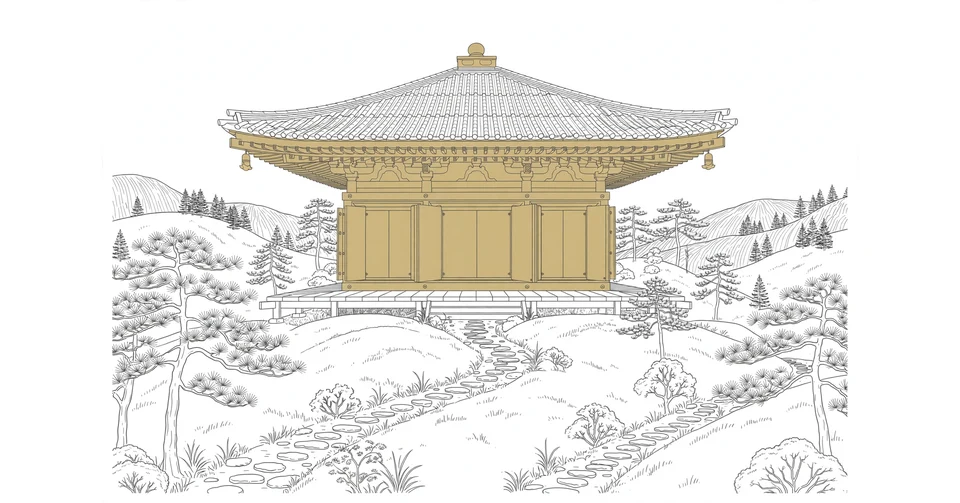
This is the story of how a frontier family became the richest clan in the north, what they built with that wealth, and why it fell so fast. The oshu fujiwara lasted barely a century, from the victory of their founder in 1087 to the destruction of their capital in 1189, yet the temples they left behind still draw visitors from around the world, and the gold they laid down still has not dimmed.
The founder who survived three wars
The oshu fujiwara began with a man who had lost almost everything before he was old enough to rule anything. Fujiwara no Kiyohira was born in 1056 in the Kitakami Basin, in what is now Iwate Prefecture, to a Fujiwara father and an Emishi mother. He grew up on the border between two worlds, the imperial court in Kyoto and the Emishi peoples of the far north, and the wars fought over that border took his grandfather, his uncle and his father before he was grown. You can read his full story in Fujiwara no Kiyohira Turned War Into Gold, which follows him from a childhood shaped by loss to the building of the Golden Hall.
Kiyohira won his independence in 1087, at the end of the Gosannen War, with the help of Minamoto no Yoshiie. Victory cost him his wife and his son, killed by his own half brother during the fighting. He was thirty one years old, a victor with almost nothing left to celebrate, and he spent the rest of his life answering that loss. His answer was not another army. It was a capital built as a prayer.
Around 1105, Kiyohira chose Hiraizumi as the seat of the oshu fujiwara. The site was careful and deliberate. It stood on the Frontier Way, the main highway running south to the capital and north to the lands he controlled, and it sat at the centre of his realm, measured from the Shirakawa Barrier in the south to the far northern coast. It also stood on the southern bank of the Koromo River, in what had traditionally been Japanese territory, while Emishi forts had always been built on the northern side. Kiyohira, the son of an Emishi mother and a Fujiwara father, was planting his flag in Japanese territory while ruling a land that was mostly Emishi, and the geography itself declared that the two sides of his blood could share one capital.
I keep coming back to that choice of site, because it shows how the oshu fujiwara thought about power. The oshu fujiwara did not build a fortress on a cliff and dare their enemies to come. They built a city on a highway, open to trade and travellers, and the oshu fujiwara made it beautiful on purpose. A fortress says that you expect to be attacked. A temple city says that you expect to be remembered, and the oshu fujiwara, for all their wealth, seem to have understood that memory lasts longer than walls.
Kiyohira spent the second half of his life building temples on Mount Kanzan, the mountain above Hiraizumi, and the work went on in stages for twenty years. He raised the Saishoin hall in 1105 and a two storey Amida hall in 1107, and he completed the Konjikido, the Golden Hall, in 1124, when he was sixty eight years old. He died four years later, on August 10, 1128, and he did not live to see his dynasty at its height. He saw only the beginning of it, and that was enough for him.
How the Oshu Fujiwara paid for a golden age
Hiraizumi did not grow rich by accident, and the wealth of the oshu fujiwara rested on three things that the north had in abundance: gold, horses and trade. Gold was mined in the hills around Hiraizumi. Horses were bred on the northern plains, and they were prized across Japan. And the city sat on the highway that carried goods between the capital and the far north, which made the oshu fujiwara middlemen in a trade that reached far beyond their own borders.
That trade is the part of the story that surprises people most. The oshu fujiwara did not only sell what the north produced. They acted as middlemen in the trade in luxury goods from continental Asia and from the far northern Emishi, and they kept their independence from Kyoto by the strength of their warrior bands. A small northern capital of the oshu fujiwara was importing mother of pearl from turban shells of the southern seas to inlay into the pillars of the Golden Hall, which tells you how far Hiraizumi trade reached. Gold on a temple in Iwate, shells from southern waters, and the money to pay for both: that is the signature of a trading power, not a backwater.
The reach of that trade also shows in what the oshu fujiwara attracted. At the height of their rule, they drew artisans from the imperial capital at Heian, modern Kyoto, and brought the high culture of the court into a region that Kyoto had long treated as a frontier. They introduced Heian culture to the north and built many temples, and Hiraizumi grew steadily in cultural sophistication and political power until visitors compared it with the national capital itself. Japan Guide, the travel guide to the country, notes that the city grew until it rivalled Kyoto, and the comparison is worth taking seriously. Kyoto had the emperor and a thousand years of history. Hiraizumi had gold, horses and a family that knew how to spend both.
There is a lesson in that, and it is not only about the twelfth century. Wealth spent on display fades with the power that paid for it. Wealth spent on beauty, on temples and gardens and lacquerware that other people can use and love, has a way of outliving its owners. The oshu fujiwara spent their gold on a vision of paradise, and nine centuries later visitors still come to see it. The gold mines around Hiraizumi are quiet now. The temples are not.
The same craft culture that gilded the Golden Hall also produced the lacquerware of Hiraizumi. Hidehira-nuri, named after Hidehira, the third lord, carries gold diamonds and cloud patterns over black and vermilion lacquer, and it shares a single idea with the hall itself: that gold laid over lacquer is the proper language of a northern court. When you see a bowl of hidehira-nuri, you are looking at the same taste, the same workshops and the same confidence that built the Golden Hall of the oshu fujiwara, and that confidence was paid for by horses and trade as surely as it was paid for by gold.
Three lords, one vision
The oshu fujiwara are often described as three generations of glory, and the phrase fits, because the clan was really the work of three men: Kiyohira, his son Motohira, and his grandson Hidehira. A fourth lord, Yasuhira, inherited the ruin. The three who built are the ones who matter, and each of them added something different to the capital their founder had begun.
Kiyohira founded the oshu fujiwara dynasty and set its purpose. He chose the site, built the first temples on Mount Kanzan, and fixed the idea that Hiraizumi would be a Pure Land on earth, a place where temples, gardens and ponds would stand in for paradise itself. The Konjikido was his final act, and it enshrines Amida Nyorai, the Buddha of Infinite Light, whose paradise the hall was meant to make visible. You can read the full story of that hall in Konjikido Is the Golden Hall That Outlived a Fallen Capital, which describes its gold leaf, lacquer and mother of pearl in detail.
Motohira, the second lord, continued the building programme of the oshu fujiwara, and his great work was Motsu-ji, a Tendai temple south of the city centre. The temple tradition holds that Motsu-ji was founded in 850 by the monk Ennin, known as Jikaku Daishi, who was travelling through the northeast when he stopped at this spot and built a hall there. By Motohira's time the old temple had fallen into ruin, and Motohira took on its reconstruction in the middle of the twelfth century, pouring the profits of the region's gold mining into the work. He built a temple called Enryu-ji on the site around 1150, and then ordered an almost exact copy, Kasho-ji, to be built beside it.
Hidehira, the third lord, completed what his father had begun at Motsu-ji, and under Hidehira, the third lord of the oshu fujiwara, the temple reached its greatest scale. At its peak the complex is said to have held more than forty buildings and five hundred monastic dwellings, and the medieval chronicle Azuma Kagami described it as a sacred site unparalleled in majesty. That figure should be treated with the caution that old chronicles deserve, since they counted generously, but the scale of the foundations that survive today shows that the claim was not pure invention. Motsu-ji was a city of monks beside the city of the lords, and Hidehira was its patron.
What strikes me about this succession is how steady it was. Kiyohira, Motohira and Hidehira each ruled for decades, each built on what the last had left, and none of them broke the pattern. Most dynasties in Japanese history are stories of a brilliant founder followed by quarrelling sons. The oshu fujiwara were the opposite: a founder who set a vision, a son who extended it, and a grandson who completed it. That steadiness is part of why Hiraizumi grew so fast, and part of why its fall, when it came, felt so sudden. A family that had never fought itself was destroyed from outside, in a single year, by a quarrel it had not started.
| Lord | Relation | Main work |
|---|---|---|
| Fujiwara no Kiyohira | Founder | Chuson-ji and the Konjikido, completed 1124 |
| Fujiwara no Motohira | Second lord, son of Kiyohira | Rebuilt Motsu-ji, Enryu-ji around 1150 |
| Fujiwara no Hidehira | Third lord, son of Motohira | Completed Motsu-ji, Hiraizumi at its height |
| Fujiwara no Yasuhira | Fourth lord, son of Hidehira | Sheltered Yoshitsune, lost the capital in 1189 |
The table looks tidy, but the century behind it was not. Each of these men ruled a frontier that Kyoto regarded with suspicion, each of them kept an army ready while building temples, and each of them knew that the independence of the oshu fujiwara depended on gold, horses and the goodwill of warriors. The oshu fujiwara held all three for a hundred years, which is longer than most families manage, and they spent the whole century turning that holding into something beautiful.
A capital built as a prayer
The most important thing to understand about Hiraizumi is that the oshu fujiwara did not build it to show off. They built it to comfort the dead. Kiyohira had lived through the long wars of the Tohoku region, and he built the Konjikido to comfort the spirits of everyone who had died in them, friend and foe alike. His sons kept that purpose. The temples, gardens and ponds of Hiraizumi were meant to be a Pure Land on earth, a paradise that people could walk into, and the whole city was arranged around that idea.
Motsu-ji, rebuilt by the oshu fujiwara, shows the idea at its largest. Its Pure Land garden is built around Oizumi-ga-ike, a pond about 180 metres by 90 metres, with a rocky islet, a stone covered beach and islands arranged to represent the coast of Iwate and the wider world. The garden was designed following the Sakuteiki, Japan's oldest book on garden making, an eleventh century treatise that the designers of Motsu-ji clearly knew well. The pond and its garden survive much as they were eight hundred years ago, and the grounds are doubly designated as a Special Historic Site and a Special Place of Scenic Beauty, one of the few places in Japan to hold both honours at once.
The Konjikido shows the same idea at its smallest. It is a hall about five and a half metres on each side, coated inside and out in black lacquer overlaid with gold leaf, and it holds three altars with thirty three statues. The gold was not decoration for its own sake. In Pure Land teaching, the paradise of Amida glitters, and a hall covered in gold was a way of making that paradise visible to people who would never read a sutra. The hall was meant to be seen, felt and walked into, a small room that carried the weight of a whole theology.
There is a famous theory about the Konjikido that is probably wrong, and it is worth telling because it shows how far the hall's reputation travelled. In the Travels of Marco Polo, written around 1300, the Venetian merchant describes a place called Zipangu, Japan, which he had heard about while in China, where there were said to be tremendous quantities of gold and a king's palace roofed with pure gold. One theory holds that the palace Marco Polo heard about was the Konjikido. The temple itself is honest about it: there is no historic basis for the theory at present, though a lot of gold was indeed produced in the area. I like that the temple refuses to claim the legend. A lesser site would print it on every brochure. Chuson-ji tells you the truth and then lets you stand in front of the gold and decide for yourself.
The oshu fujiwara built their capital as a prayer, and that choice is why anything of it survives at all. Palaces burn and streets vanish, but a prayer made of gold leaf and lacquer, guarded by monks for nine centuries, is harder to destroy. UNESCO inscribed Hiraizumi as a World Heritage site in 2011, under the name Hiraizumi, Temples, Gardens and Archaeological Sites Representing the Buddhist Pure Land, and the listing covers four temple complexes and the sacred mountain of Kinkeisan. The Konjikido is the only structure among them that remains from the twelfth century in its original form, and almost ninety percent of the structure and materials used when it was first built still survive. A wooden building from 1124 should not exist in this condition. It exists because almost every generation since has decided, separately, that it was worth the trouble.
The guest who destroyed the capital
The oshu fujiwara survived for a century by staying out of the wars of the south. During the Genpei War, fought between the Minamoto and the Taira from 1180 to 1185, the clan remained neutral, and Hidehira kept Hiraizumi at peace while the rest of Japan burned. Neutrality was the great skill of the oshu fujiwara, and it was also what destroyed them, because the war eventually came to their door in the shape of a single guest.
Minamoto no Yoshitsune, the younger brother of Minamoto no Yoritomo and one of the great generals of the Genpei War, fled to Hiraizumi after falling out with his brother. Hidehira, who had protected him, decided to give him refuge. It was a generous decision and a dangerous one, and Hidehira died soon after making it, leaving the problem to his son Yasuhira, the fourth lord of the oshu fujiwara.
Yasuhira gave in to Yoritomo's demand and had Yoshitsune assassinated in April 1189. Yoshitsune's severed head was delivered to Kamakura by July for Yoritomo to see, but it did nothing to repair the damaged relations. Yoritomo was already set on conquering Hiraizumi, and the assassination only proved that the oshu fujiwara could be pressured. On September 1, 1189, Yoritomo's army set out to attack the capital. Yasuhira fled Hiraizumi on October 2, leaving it afire, and Yoritomo entered the city the next day. Yasuhira was found and killed on October 14, in what is now Odate in Akita Prefecture, and the Battle of Oshu ended the clan and completed Yoritomo's domination of Japan.
The speed of it still shocks me. A capital that the oshu fujiwara had taken a century to build, a city that rivalled Kyoto, was gone in six weeks, from the first march to the last flight. The oshu fujiwara had survived three generations of frontier war, the suspicion of Kyoto, and the slow work of building a paradise in the north, and they were destroyed by a single act of hospitality. Hidehira's decision to shelter Yoshitsune was not foolish. It was the decision of a man who believed that a guest was sacred and that a promise, once made, had to be kept. It was also the decision that ended his family.
There is a temptation to blame Yasuhira, the son who killed the guest his father had protected, but the blame sits badly on him. He inherited a problem his father had created and a demand from the most powerful man in Japan, and whatever he did, Yoritomo was coming. He chose the course that seemed to offer survival, and it offered nothing. The lesson is not that Yasuhira was weak. The lesson is that neutrality, which had protected the oshu fujiwara for a century, had an expiry date, and when the wars of the south finally reached the north, no amount of gold could buy the family another year.
The poet Matsuo Basho visited the ruins five centuries later and wrote that three generations of glory had vanished in the space of a dream. He was standing on grass where a capital had been, and the line has lasted longer than the city it mourned. It lasts because it is true in a way that goes beyond Hiraizumi. Every golden age feels permanent while it lasts, and every one of them turns out to be a dream that someone wakes from.
What the Oshu Fujiwara left behind
Hiraizumi never recovered its former prominence, and it is a small town today, but what the oshu fujiwara left behind is larger than the town. The Konjikido still stands in its glass enclosure at Chuson-ji, its gold leaf and mother of pearl intact. The Pure Land garden of Motsu-ji still holds its pond and its islands, much as it was eight hundred years ago. The mummified remains of three generations of the family still lie beneath the altars of the Golden Hall, and the head of the fourth lord, Yasuhira, rests there too, sent back to his family after his death. The hall that was built to comfort the dead ended up holding the dead of the very family that built it, and that is the detail that turns the story from history into something closer to a family story, and family stories are the ones that last.
If you go to Hiraizumi today, go slowly. The sites are spread out and best reached by the loop bus from the station, or by bicycle, and a single ticket at Chuson-ji covers the Golden Hall, the treasure house, the sutra repository and the old sheltering hall. Give your eyes a minute at the glass of the Konjikido to adjust. What looks at first like a flat wall of gold resolves, slowly, into pillars, peacocks and bodhisattvas that have watched nine centuries pass. Then walk to Motsu-ji and sit by the pond. The garden was built to be a picture of paradise, and it still works, quietly, without asking anything of you.
For the full picture of the clan, the Northern Fujiwara article on Wikipedia traces the family from its founding in 1087 to its fall in 1189, and the Hiraizumi travel guide on Japan Guide lists the temples and gardens that survive today. Both are worth reading before a visit, and both agree on the shape of the story: a family that built a golden capital in the north, and lost it in a single season.
I think the oshu fujiwara matter for a reason that has nothing to do with gold. They matter because they chose, at the height of their power, to build something that comforted the dead of every side, including their enemies. Kiyohira had every reason to build a monument to revenge, and he built a prayer instead. His sons kept building it, and the prayer outlived the family, the capital and the power that paid for it. Grandeur fades and empires fall, but a small thing made with total care, and then cared for by strangers for nine hundred years, can outlive them all. The oshu fujiwara built a golden capital in the north, and the capital is gone. The gold is still there, and so is the prayer.
More in Culture & Society
- Sagemono Are the Hanging Treasures Samurai Wore at the Waist
- Fujiwara no Kiyohira Turned War Into Gold
- Motsu-ji Keeps Hiraizumi's Pure Land Garden Alive
- Hiramaki-e Keeps the Gold Flat and Lets the Picture Speak
- Chuson-ji Is the Mountain Temple That Guarded the Golden Hall
- Urushi Kabure Is the Rash Lacquer Apprentices Learn to Live With
Latest posts
- Harajuku and the Tokyo Streets Where Fashion Refuses to Sit Still
- Konjikido Is the Golden Hall That Outlived a Fallen Capital
- Hidehira-Nuri Keeps Hiraizumi's Golden Age in Lacquer
- Urushiol Is the Itch Behind Japan's Most Beautiful Lacquer
- Wajima-nuri Is the Lacquer That Survives Being Dropped
- Tsugaru-nuri Hides Four Seasons of Colour Under the Lacquer
- Shunkei-nuri Lets the Wood Grain Shine Through the Lacquer
- Takamaki-e Raises Gold Off the Lacquer Until You Can Feel It
- Shibayama Turns Shell Ivory and Coral Into Small Paintings in Lacquer
- Togidashi Buries Gold in Lacquer and Polishes It Back Into the Light
- Nashiji Scatters Gold Dust Like Pear Skin Across Black Lacquer
- Raden Turns Mother of Pearl Into Lacquer That Catches the Light
- Maki-e Sprinkles Gold Dust Onto Wet Lacquer
- Urushi Is the Tree Sap Japan Turns Into Lacquer That Outlives Centuries
- Ojime Is the Tiny Bead That Keeps a Netsuke From Slipping Away