Chuson-ji Is the Mountain Temple That Guarded the Golden Hall
· 17 min read
Chuson-ji, the Tendai mountain temple above Hiraizumi, has guarded the Golden Hall since 1124 through war, fire and nine centuries of quiet daily prayer.
Most visitors climb the hill at Hiraizumi for one building. They come for the Konjikido, the small hall covered in gold leaf that has survived since 1124, and they are right to come. But the Golden Hall never stood alone. It stood inside Chuson-ji, a Tendai mountain temple founded in 850 on a forested hill called Kanzan, and it is the temple that kept the hall alive through war, fire and long centuries of decline.
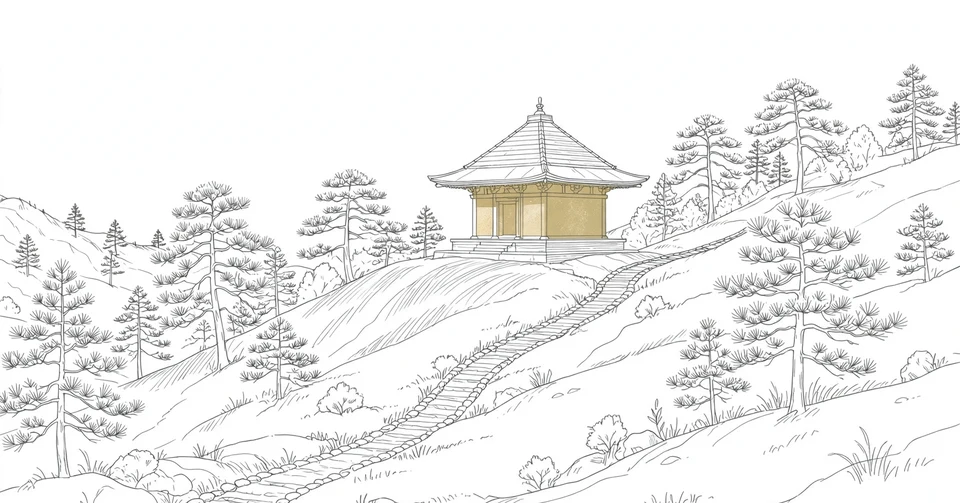
Chuson-ji is the head temple of the Tendai sect in the Tohoku region, and its story is longer and rougher than the story of its famous hall. It began as a mountain temple raised by a travelling monk, grew into a complex of more than forty halls under the Fujiwara lords, lost almost everything to fire in 1337, and still opens its gates every morning. The gold gets the photographs. The mountain does the work.
I think that is the right way to see the place. A single golden hall can dazzle you in a minute, but a temple that has been rebuilt, burned, neglected and tended again over more than eleven centuries tells you something slower and more useful about Japan. Chuson-ji is not a monument frozen in one golden year. It is a working temple that happened to keep one perfect thing safe while everything around it changed.
A temple founded on a hill in 850
Chuson-ji stands on top of a hill named Kanzan, a wooded rise of about 130 metres in the middle of Hiraizumi, and it is often called Kanzan Chuson-ji after the hill itself. According to the temple records, it was founded in 850 by Ennin, known after his death as Jikaku Daishi, a monk of the great monastery Enryakuji and the third head abbot of the Tendai sect. Ennin is also remembered for the record of his travels and study of Buddhism on the continent, a book some scholars regard as one of the great travel writings of the world.
That founding date deserves a small note of caution. The temple's own records say 850, and most modern guides repeat it, but the historian George Sansom argued instead that Chuson-ji was founded by Fujiwara no Kiyohira in 1095. The two claims are not easy to reconcile, and the honest version is that a small Tendai temple probably existed on the hill long before Kiyohira, while the great temple everyone visits today is Kiyohira's creation. The 850 date belongs to the mountain's first monk. The temple as a power belongs to the twelfth century.
Either way, the choice of ground was deliberate. Tendai temples were mountain temples by tradition, and the Tendai sect had grown out of Enryakuji on Mount Hiei above Kyoto, where monks trained in the hills away from the noise of the capital. A hilltop in the far north, wrapped in forest and a short climb from the plain, gave Chuson-ji the same character: a place set apart, where the walk up was part of the prayer. The hill still does that work today. You climb through cedars before you reach any hall, and by the time the roofs appear you have already left the town behind.
Ennin himself never saw the golden age that would come. He died in 864, more than two centuries before Kiyohira rebuilt the temple, and his connection to Chuson-ji rests on the temple's own tradition rather than on documents that survive. But the tradition matters, because it gave the later temple a lineage to claim. When Kiyohira built on Kanzan, he was not starting from nothing. He was building on a holy hill that already had a Tendai past, and that past gave his new capital a spiritual claim older than his own family.
Kiyohira turns a hillside temple into a Pure Land
The great rebuilding of Chuson-ji began in the early twelfth century, when the first Oshu Fujiwara lord, Fujiwara no Kiyohira, began the construction of a massive temple complex of halls and pagodas on the hill. According to the Azuma kagami, the official history of the Kamakura shogunate, there were more than forty halls and pagodas at Chuson-ji, and over three hundred monks' residences. The hill that had held a small mountain temple became a city of temples in its own right.
Kiyohira's motive was not display, or at least not display alone. He intended that Chuson-ji would placate the spirits of those who had died, friend or foe, in the bitter conflicts that had dominated Tohoku in the latter half of the eleventh century. He further wished to create a peaceful state based on the principles of Buddhism, a Pure Land made real on earth, with temples, gardens and ponds standing in for paradise itself. The temple was an act of grief turned into architecture.
That intention survives in his own words. In the dedication pledge for Chuson-ji, known as the Ganmon, Kiyohira writes that all travellers, regardless of status, would be greeted affectionately by the Buddhas and without fail receive their blessings. The merits of Chuson-ji were to be distributed evenly and universally to all who desired them. It is a generous promise for a warlord to make, and it sets the tone for everything that followed at the temple. The gates were open to everyone, not only to the clan that paid for them.
The work went on for years. Kiyohira raised the Saishoin hall in 1105 and a two storey Amida hall in 1107, and completed the Konjikido in 1124, near the end of his life. His son Motohira inherited the vision and commissioned his own great temple, Motsu-ji, which was completed by his son Hidehira. Hidehira in turn commissioned Muryokoin Temple, close to Yanagi no Gosho, the government complex from which the Oshu Fujiwara administered their Tohoku domain. Hiraizumi flourished for nearly one hundred years, a time of peace and prosperity, and Chuson-ji stood at the centre of it, the temple that gave the capital its spiritual shape.
There is something touching about the scale of that ambition. A family that had won its power in war decided that the proper use of the peace was to build a paradise on a hill and invite everyone in. It did not last, as such things rarely do, but the attempt is still visible in the ground plan of the temple and in the pledge Kiyohira left behind. Chuson-ji was built to be a refuge, and it has spent nine centuries trying to stay one.
The Golden Hall at the heart of Chuson-ji
At the centre of that vanished complex stands the one building that never left. The Konjikido, completed in 1124, is the only twelfth century structure to survive in its original form at Chuson-ji, a small hall dedicated to Amida Nyorai, the Buddha of Infinite Light, and covered with gold leaf both inside and out, apart from the roof. It is the reason most people climb the hill, and it is the reason the temple's name is known far beyond Iwate.
The full story of the hall belongs to its own article, and it is worth reading in full: the Konjikido is a Buddha hall and a family tomb at once, holding the coffins of four generations of Fujiwara lords beneath its altars, and almost 90 percent of its original materials still survive. What matters here is what the hall means for Chuson-ji itself. The temple built a golden room to comfort the dead, and the golden room ended up carrying the temple's name through the centuries when the temple itself had almost nothing left to show.
The hall was not the only survivor. The Kyozo, the sutra repository of Chuson-ji, predates the Konjikido by sixteen years, which places its building around 1108, and it is the second of the two buildings from the Fujiwara period that still stand. A repository is a humble thing beside a golden hall, a storehouse for Buddhist scripture rather than a place of display, but its survival tells you what the monks valued. They kept the words as carefully as they kept the gold, and both outlived the halls that were built to be impressive.
The craft that made the hall possible also runs through the wider culture of Hiraizumi. The same gold and lacquer that cover the Konjikido appear in hidehira-nuri, the lacquerware of Hiraizumi that carries gold diamonds and cloud patterns over black and vermilion lacquer, named for Hidehira, the third lord whose coffin lies in the hall. When you see a bowl of hidehira-nuri, you are looking at the same taste, the same workshops and the same confidence that built the Golden Hall, carried on in objects people could hold in their hands after the capital itself was gone.
The fire of 1337 and what the mountain kept
Hiraizumi flourished for nearly one hundred years, and then it fell apart with a speed that still shocks the reader. Hostility from the Kyoto court and the rise of Minamoto no Yoritomo's regime in Kamakura dragged the city into the violent politics of the late twelfth century. When Minamoto no Yoshitsune, the younger brother and former general of Yoritomo, fell out with his elder sibling, he fled north to Hiraizumi, where his protector Hidehira soon fell ill and died. Hidehira's heir Yasuhira attacked the fugitive in early 1189 and forced him into suicide, and Yoritomo attacked Yasuhira in turn, bringing the curtain down on the century long Oshu Fujiwara dynasty.
Chuson-ji survived the war of 1189, but its fortunes changed drastically in the succeeding Kamakura period, and the temple slid into a long decline without its patrons. Then, in 1337, fire consumed many of the temple's halls, pagodas and treasures. The founding complex that had spread over the hill and its foot was largely destroyed, and an inscription on the temple bell records that the building on top of the mountain burned down in that year. What had taken a generation to build was gone in a night.
Yet the loss was not total, and the scale of what survived is the most surprising fact about Chuson-ji. More than 3,000 National Treasures and Important Cultural Properties survived the fire, principal among them the Konjikido, the small golden Amida hall which was the first structure designated a Japanese National Treasure. The Kyozo survived beside it. The hall had been given a wooden sheltering roof in the Kamakura period, and that second skin, together with the hall's small size, is the main reason it is still here. A great hall would have been harder to cover. A small one could be protected, and it was.
I find the number 3,000 quietly moving. It means the fire did not strip the temple bare. Statues, sutras, ritual objects, lacquer and metalwork came through, carried out or sheltered or simply lucky, and they form an integrated collection of many different crafts, including lacquer work, woodwork, metalwork, dyeing and calligraphy, representing the pinnacle of Heian period Buddhist art in eastern Japan. Chuson-ji lost its buildings and kept its treasures, which is the opposite of what usually happens to temples, and the temple has spent the centuries since learning how to be a guardian of objects rather than a city of halls.
The Sankozo and the treasures that left the hall
For most of its history, the treasure of Chuson-ji stayed where it was made, inside the halls and storehouses of the hill. That changed in 2000, when the Sankozo Museum was opened to preserve the temple's various treasures and cultural assets for future generations. Most of the more than 3,000 National Treasures and Important Cultural Properties of Chuson-ji are now housed there, among them Buddhist statues, sutras and the burial accoutrements of the Oshu Fujiwara lords.
The Sankozo is the right second stop after the Golden Hall, and the temple knows it. A single ticket covers the Konjikido and the Sankozo together, and the museum is where the objects that could not stay in the hall are kept in conditions they need. The hall itself holds the coffins and the altars. The museum holds the rest: the statues that flanked the Buddhas, the sutras copied by hand, the small personal objects buried with the lords. Together they give you the whole temple in two rooms, one golden and one quiet.
There is a practical wisdom in the arrangement that I admire. The Konjikido now stands inside a concrete shelter behind glass, at controlled temperature and humidity, because gold leaf and lacquer cannot survive nine more centuries in open air. The Sankozo gives the other treasures the same protection without asking them to share a room with a tomb. Chuson-ji stopped trying to be the city it was in the twelfth century and became something humbler and more durable: a careful keeper of things other people made with total devotion.
The temple's own history page tells this story plainly, from the founding on Kanzan to the fire and the museum, and it is the best single place to check the facts before a visit. You can read the temple's own account on the official Chuson-ji Temple site, which also lists the current admission fees and visiting hours.
Walking up Tsukimizaka today
The main approach to Chuson-ji is called Tsukimizaka, the Moon Viewing Slope, and it is one of the finest walks in Tohoku. On either side of the path stand cryptomeria trees planted three to four centuries ago by the Date clan of Sendai, whose domain this was in the Tokugawa period. The trees are older than the present main hall, older than the museum, older than almost everything a visitor will see except the Golden Hall and the sutra repository, and they set the mood before any building does. The slope is gentle, the forest is deep, and the climb takes the noise of the town out of your ears.
The attractions of Chuson-ji are spread along a network of paths that extend about one kilometre into the forest, so the visit is a walk as much as a tour. The main rituals and rites of the temple are performed at the Hondo, the main hall, where twenty to twenty three monks work at any given time, supported by seventeen subsidiary halls. The present Hondo was most recently rebuilt in 1909, and its principal image is Shaka Nyorai, the Historical Buddha. On either side of the image stand the eternal lights of Chuson-ji, lit with flame from the Tendai sect's main temple, Enryaku-ji, where the flame is reputed to have burned since the time of the sect's founder Saicho. That unbroken flame is a small thing to mention, but it is the kind of detail that makes a temple feel alive rather than preserved.
Beyond the Hondo, the precinct holds the Konjikido in its modern shelter, the Sankozo museum, the Kyozo sutra repository and a beautiful Noh theatre stage belonging to Hakusan Shrine. The stage is easy to miss among the trees, and it is worth seeking out, because it reminds you that the temple was never only a place for monks. It was a centre for the arts of its region, and the arts kept coming back to the hill long after the Fujiwara were gone.
A typical visit takes one to two hours, and the temple's hours are 8:30 to 17:00, with admission ending ten minutes before closing and an earlier close of 16:30 in the winter months from November to February. There are no closing days. The standard adult ticket, covering the Konjikido and the Sankozo, costs 1,000 yen at the time of writing. Tickets are sold at the Sankozo reception rather than at the Golden Hall entrance, so it is worth starting there. For the practical details of the walk, the bus from the station and the layout of the precinct, the Japan Guide page on Chusonji Temple gives a clear short overview that matches the temple's own information.
Go slowly if you go. Hiraizumi rewards the unhurried visitor, and Chuson-ji most of all, because its treasures are not arranged for a quick photograph. The gold is behind glass, the sutras are in a quiet repository, and the best part of the visit may be the walk itself, cedars on both sides, the town falling away below, and the sense that you are climbing toward something that people have climbed toward for more than a thousand years.
Chuson-ji at a glance
| Fact | Detail |
|---|---|
| Founded | 850, by Ennin (Jikaku Daishi), according to temple records |
| Sect | Tendai, head temple of the sect in the Tohoku region |
| Location | Mount Kanzan, Hiraizumi, Iwate Prefecture |
| Peak | More than 40 halls and pagodas, over 300 monks residences |
| Golden Hall | Konjikido, completed 1124, first building designated a National Treasure |
| Sutra repository | Kyozo, built about 1108, sixteen years before the Konjikido |
| Great fire | 1337, most halls lost, more than 3,000 treasures survived |
| Treasure house | Sankozo Museum, opened 2000 |
| World Heritage | Part of the Hiraizumi inscription since 2011 |
| Main hall | Hondo, rebuilt 1909, principal image Shaka Nyorai |
The table makes the temple look tidy, but the history behind it is not tidy at all. A temple does not survive eleven centuries by being well built alone. It survives because people keep choosing to protect it, and that choice has to be remade by every generation. Chuson-ji has now been chosen many times over, by monks, by lords, by the Date clan that planted its cedars, by restorers and by the visitors who climb the slope and pay to see the gold through glass.
Why the mountain temple matters
Chuson-ji matters because it is proof that a place can lose almost everything and still keep its soul. Hiraizumi lost its palaces, its streets and its power, and what remains of its golden age is a small golden room on a forested hill, guarded by a temple that has spent nine centuries tending it. That is not a consolation prize. It is the thing itself, the reason the city existed at all, preserved while the city around it turned to grass.
UNESCO inscribed Hiraizumi as a World Heritage site in 2011, under the name Hiraizumi, Temples, Gardens and Archaeological Sites Representing the Buddhist Pure Land, and Chuson-ji is one of the five components of that listing. The inscription recognises the temples and gardens as symbolic manifestations of the Buddhist Pure Land on earth, and it names the heavily gilded temple of Chuson-ji as the only one remaining from the twelfth century. The world came to agree with what the monks of the hill had always known: that a small golden room, kept with total care, was worth more than a city.
I think there is a lesson in that for anyone who builds things, whether temples or blogs or small businesses. Grandeur fades and empires fall, but a small thing made with total care, and then cared for by strangers for nine hundred years, can outlive them all. Chuson-ji was built to comfort the dead, and it ended up comforting the living instead, one quiet visitor at a time, climbing a cedar lined slope toward a hall of gold that has not dimmed since 1124.
More in Culture & Society
- Hiramaki-e Keeps the Gold Flat and Lets the Picture Speak
- Urushi Kabure Is the Rash Lacquer Apprentices Learn to Live With
- Konjikido Is the Golden Hall That Outlived a Fallen Capital
- Hidehira-Nuri Keeps Hiraizumi's Golden Age in Lacquer
- Urushiol Is the Itch Behind Japan's Most Beautiful Lacquer
- Wajima-nuri Is the Lacquer That Survives Being Dropped
Latest posts
- Tsugaru-nuri Hides Four Seasons of Colour Under the Lacquer
- Shunkei-nuri Lets the Wood Grain Shine Through the Lacquer
- Takamaki-e Raises Gold Off the Lacquer Until You Can Feel It
- Shibayama Turns Shell Ivory and Coral Into Small Paintings in Lacquer
- Togidashi Buries Gold in Lacquer and Polishes It Back Into the Light
- Nashiji Scatters Gold Dust Like Pear Skin Across Black Lacquer
- Raden Turns Mother of Pearl Into Lacquer That Catches the Light
- Maki-e Sprinkles Gold Dust Onto Wet Lacquer
- Urushi Is the Tree Sap Japan Turns Into Lacquer That Outlives Centuries
- Ojime Is the Tiny Bead That Keeps a Netsuke From Slipping Away
- Inro Is the Little Lacquered Box That Carried a Samurai's Day
- Hachimaki Is the Headband Japan Ties On Before the Hard Part Begins
- Netsuke Held a Samurai's World on a Cord
- Tenugui Is the Thin Cotton Cloth Japan Uses for Everything
- Kinchaku Carries a Whole Festival in One Small Bag