Kakigori and the Thousand-Year History of Japan's Shaved Ice
· 12 min read
Kakigori is Japan's shaved ice, a dessert with a thousand years of history, from Heian court luxury to summer festival staple.
Kakigori looks simple, almost too simple to be interesting. A mound of finely shaved ice, a spoonful of syrup, a paper cup or a glass bowl. Yet this is one of the oldest desserts in Japan, a treat that began as a luxury for the imperial court a thousand years ago and ended up in the hands of every child at a summer festival. The secret is in the shave. Done right, kakigori does not crunch like a snow cone. It melts on the tongue like fresh snow, soft and quiet, and the syrup follows a moment later.
The word itself gives the game away. Kakigori comes from kaku, to shave, and kori, ice. It is not crushed ice and it is not ice cream. It is a block of plain ice, shaved so thin that the flakes pile up like powder, then dressed with syrup, fruit, beans, or condensed milk. Once you have eaten a good one on a humid August afternoon, the cheap festival version never quite satisfies again, and that is the point. Japan took a cup of ice and spent a thousand years refining it.
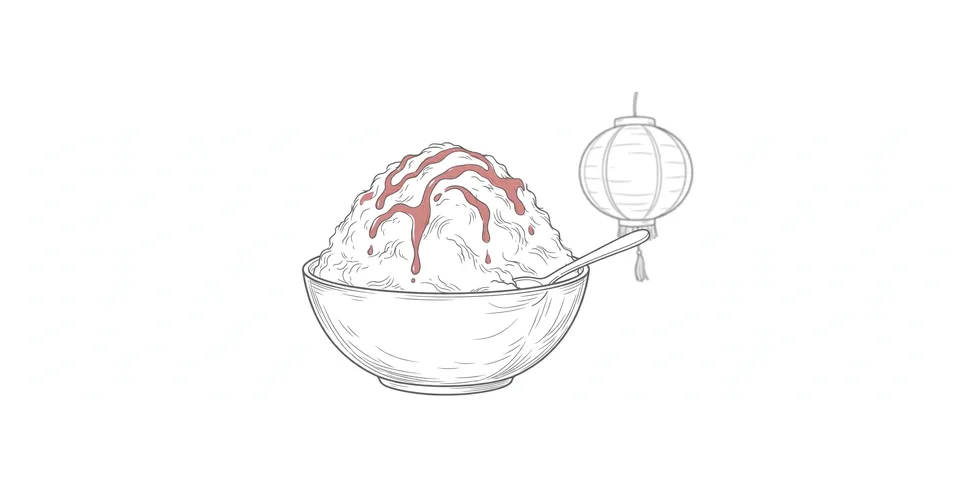
Kakigori is everywhere in a Japanese summer. Festival stalls sell it in paper cups for a few hundred yen, department store basements serve it in glass bowls, and a handful of famous specialty shops draw queues that stretch down the street, with customers waiting an hour for a bowl that costs well over a thousand yen. The range is part of the charm. The same dessert can be a quick way to cool down at a neighborhood matsuri or a serious craft with a waiting list, and neither version is pretending to be the other.
Part of what makes kakigori worth writing about is how little it has changed in spirit. The tools improved, the flavors multiplied, and the price fell from aristocratic to ordinary, but the idea stayed the same: take ice, shave it fine, sweeten it lightly, and eat it before it melts. Japan has a talent for this kind of patience, for taking a simple pleasure and refusing to hurry it.
What kakigori actually is
A proper kakigori starts with a solid block of ice, not cubes from a freezer tray. The block is held against a sharp blade, by hand in the old style or by machine today, and shaved into flakes so fine they barely hold together. The flakes are piled loosely into a bowl or cup, never packed down, because packing kills the texture. Then comes the syrup, poured over the top so it seeps down through the layers instead of pooling at the bottom.
The classic syrups are the ones every Japanese child knows: strawberry, melon, lemon, and the bright blue one called Blue Hawaii. A drizzle of condensed milk, known as rennyu, is the usual upgrade, adding a milky sweetness that softens the sharper fruit flavors. More traditional toppings come from the world of wagashi, Japanese sweets: sweet red bean paste, kuromitsu black sugar syrup, kinako roasted soybean flour, and mochi. A bowl dressed this way tastes less like a fairground treat and more like a dessert with roots.
The difference between kakigori and its cousins elsewhere is worth noting. Korean bingsu is built on milk ice, shaved from a frozen milk block, which makes it richer and creamier. Hawaiian shave ice is closer in spirit, but its ice is usually finer and its syrups fruitier, and it often sits on a scoop of ice cream. Kakigori keeps its ice plain and lets the toppings do the talking. The result is lighter, cleaner, and, on a hot day, somehow more refreshing than either.
A thousand years of shaved ice
The earliest record of kakigori comes from the Heian period, which ran from 794 to 1185. In The Pillow Book, a collection of observations written by the court lady Sei Shonagon around the year 1000, shaved ice appears among the elegant things in life: ice scraped fine, served in a new metal bowl, flavored with sweet sap from vines. In those days it was called kezurihi, shaved ice, or korimizu, ice water, and it was strictly for the aristocracy.
Ice in summer was a genuine luxury. Winter ice was cut from frozen ponds and rivers, packed into himuro, underground icehouses dug deep to stay cold, and kept through the hot months for the imperial court. The sweetener was amazura, a syrup made from the sap of ivy vines, since sugar was scarce and expensive. A bowl of shaved ice in July meant wealth, connections, and a very good icehouse. Ordinary people could only imagine it.
That exclusivity lasted for centuries. Through the Edo period, kakigori remained a treat for the rich, served in teahouses and the homes of the well connected. The recipe barely changed. What changed, slowly and then all at once, was who could get ice, and that story belongs to the Meiji era.
How ice became a treat for everyone
The turning point came in the second half of the 19th century. After Japan opened to the outside world, ice became a business rather than a privilege. The food entrepreneur Kahe Nakagawa found a way to ship ice harvested in Hokkaido down to the greater Tokyo area by the new railroads, at a fraction of the old cost, and his Hakodate Ice company opened in 1872. Suddenly ice was a commodity with a price, not a treasure locked in a himuro.
The second breakthrough was the machine. In 1887, an ice seller named Hanzaburo Murakami patented a hand-cranked ice-shaving machine that could shave a block finely and quickly, work that had once taken a skilled hand and a sharp blade. With cheap ice and a fast machine, the first kakigori shops appeared in Yokohama in the early Meiji years, and the dessert began its long walk from the court to the street, a shift Atlas Obscura traces to the new railroads and the ice trade. By the 1890s, middle class families could buy a bowl, and the festival stall version was not far behind.
There is a certain irony in the story. Japan's most democratic summer dessert arrived on the back of railroads, industrial ice, and a patent, the same forces that were remaking the whole country. Kakigori did not resist modernity. It rode it, and kept its soul intact: thin shavings, light syrup, eaten fast before the heat wins.
Reading the menu
Ordering kakigori for the first time can feel like a small exam, because the menu is long and the names are poetic. A few landmarks help.
| Flavor | What it is |
|---|---|
| Strawberry | The classic red syrup, often with condensed milk |
| Melon | Bright green, sweet, and the taste of summer festivals |
| Lemon | Sharp and clean, the least sweet of the classics |
| Blue Hawaii | Blue, sweet, and unapologetically artificial |
| Uji kintoki | Matcha syrup with sweet red beans, mochi, and matcha ice cream |
| Shirokuma | Condensed milk, fruit, and agar, from Kagoshima |
| Mizore | Plain sweet syrup over white ice, the simplest bowl |
Uji kintoki deserves a closer look, because it is the bowl that best shows what kakigori can be. It is named after Uji, the small city in Kyoto Prefecture famous for its green tea, and kintoki, the sweet red bean paste named for the folk hero Kintaro, whose face is usually painted red. Matcha syrup, red beans, soft mochi, and a scoop of matcha ice cream arrive in one bowl, bitter and sweet at once, and it is the closest thing kakigori has to a signature dish. If you only eat one bowl in Japan, this is the one to try.
Shirokuma, meaning polar bear, comes from Kagoshima at the southern tip of Kyushu. It is said to have started there in the Edo period, and it looks the part: white shaved ice dressed with condensed milk, fruit, and colorful agar jelly, arranged to resemble the animal. It is sweeter and busier than uji kintoki, a festival of toppings rather than a study in green tea, and Kagoshima locals defend it fiercely.
The modern menu goes further. Specialty shops serve kakigori with fresh mango, roasted soybean flour and black sugar, sake lees, sweet potato, and even cheese. Some shops change flavors with the season, the way a good restaurant changes its menu. The old festival flavors are still there, and still good, but they are no longer the whole story.
The modern craft
The most serious development in kakigori is also the oldest idea coming back around: natural ice. A small number of ice makers still harvest ice from mountain lakes in winter and store it in sawdust until summer, the way the Heian court stored ice in himuro. Natural ice freezes slowly, which makes it harder and denser than factory ice, and it shaves into finer, fluffier flakes that melt more slowly on the tongue. Shops that use it advertise the fact, and their bowls cost more because the ice itself took months to make.
The machine matters too. The best shops still use hand-cranked shavers, or electric machines with blades adjusted by feel, because the shave is everything. Too coarse and the bowl crunches. Too fine and it collapses into slush. The right shave piles up like fresh snow and holds its shape for the minute or two it takes to eat. Watching a skilled operator work a block is a small pleasure in itself, closer to a craft demonstration than to fast food.
This is why queues form. A famous shop may serve only a few dozen bowls a day, with flavors that sell out by early afternoon, and customers accept the wait as part of the experience. Japan has July 25 marked as Kakigori Day, and the summer festival calendar keeps the dessert in front of everyone from June to September, but the craft shops treat it as a year-round pursuit. The contrast is the point: the same dessert, done two ways, both honest.
Where to eat it
The easiest kakigori to find is the festival kind. At a summer matsuri, stalls sell paper cups of shaved ice in the classic colors, strawberry red, melon green, Blue Hawaii blue, for a few hundred yen. It is the version most Japanese people grew up with, eaten while walking between food stalls, and it is exactly right for the moment. If you are at a festival, eat it there, standing up, before it melts.
The second kind lives in department stores and shopping streets. Shops in places like Tokyo and Kyoto serve kakigori in glass bowls with proper toppings, condensed milk included, at prices that reflect the setting. These are a good middle ground: better ice, better syrup, no queue.
The third kind is the specialty shop, and it takes planning. Names change with the season and with fashion, so the practical move is to check a current guide before you go, and to arrive early, because popular flavors sell out. Expect to pay well over a thousand yen, expect a queue, and expect a bowl that justifies both. It is the closest a cup of ice gets to fine dining.
My own view, after years of eating kakigori in all three settings, is that the festival cup is the one that matters most. The craft bowls are wonderful, and I would not talk anyone out of queuing for one, but the dessert was never meant to be precious. It was meant to be cold, sweet, and eaten quickly on a hot day, with syrup on your fingers and summer going on around you. The thousand-year history is real, and so is the simple pleasure. The best bowl of kakigori I ever had cost almost nothing, at a small festival I had wandered into by accident, and I finished it standing in the shade of a shrine gate, listening to drums. That is the version I would go back for.
For a deeper taste of the same summer, the food stalls around a festival are the natural next stop. The yatai stalls at a matsuri sell takoyaki and festival food that pair well with something cold, and a bento eaten on a train is the same idea in a different form: good food, made portable, eaten in the moment. Kakigori belongs to that family, the food that Japan designed to be eaten outside, in the season it was made for. And like cherry blossom season, it is better for being brief. Summer ends, the stalls close, and the next bowl is a year away, which is exactly why it tastes so good.
Kakigori is a small dessert with a long memory. It remembers the Heian court and the icehouse, the Meiji railroads and the patent machine, the festival stall and the craft shop. A thousand years of history, shaved thin, in a bowl that melts in minutes. That is a fair trade.
More in Food & Travel
- Mugicha Is the Barley Tea Japan Pours All Summer Long
- Bancha Is the Everyday Tea Japan Drinks Without Thinking
- Hojicha Is the Roasted Tea Japan Reaches for After Dinner
- Genmaicha Turns Roasted Rice Into Japan's Nuttiest Green Tea
- Takuan Turns a Humble Daikon Into Japan's Yellow Crunch
- Nukazuke Is the Living Pickle Bed Japan Feeds Every Day
Latest posts
- Chusonji Is the Mountain Temple That Outlasted Its Golden Age
- A Pure Land Garden Is a Paradise You Can Walk Through
- Sagemono Are the Hanging Treasures Samurai Wore at the Waist
- Oshu Fujiwara Built a Golden Capital in the North
- Harajuku and the Tokyo Streets Where Fashion Refuses to Sit Still
- Fujiwara no Kiyohira Turned War Into Gold
- Motsu-ji Keeps Hiraizumi's Pure Land Garden Alive
- Hiramaki-e Keeps the Gold Flat and Lets the Picture Speak
- Chuson-ji Is the Mountain Temple That Guarded the Golden Hall
- Urushi Kabure Is the Rash Lacquer Apprentices Learn to Live With
- Konjikido Is the Golden Hall That Outlived a Fallen Capital
- Hidehira-Nuri Keeps Hiraizumi's Golden Age in Lacquer
- Urushiol Is the Itch Behind Japan's Most Beautiful Lacquer
- Wajima-nuri Is the Lacquer That Survives Being Dropped
- Tsugaru-nuri Hides Four Seasons of Colour Under the Lacquer