A Pure Land Garden Is a Paradise You Can Walk Through
· 17 min read
A pure land garden is a Heian period pond garden built as a vision of Amida Buddha's Western Paradise, and the best surviving example waits at Motsu-ji in Hiraizumi.
There is a kind of garden in Japan that was never meant to be admired from a bench. A pure land garden was built to be walked through, slowly, the way you might walk through a story, because the story it tells is paradise itself. In the Heian period, when many at the Kyoto court believed the world was sliding toward its final age, wealthy patrons built gardens that showed what waited on the other side, a pond for the waters of the Western Paradise, an island for the blessed shore, and a hall for Amida Buddha at the water's edge.
The idea sounds grand, and it was, but the experience is quiet. You do not need to know Buddhist doctrine to feel what a pure land garden is doing. You walk a path around still water, you cross a small bridge, you look back at a hall reflected in a pond, and for a little while the world feels arranged, calm and complete. That feeling was the whole point, and it is the quiet magic of a pure land garden.
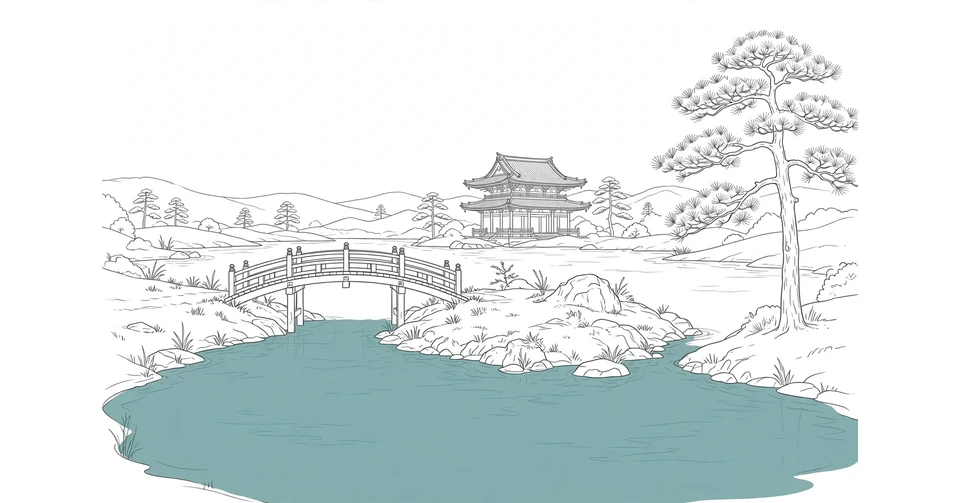
Motsu-ji in Hiraizumi keeps one of Japan's few surviving pure land gardens alive, a twelfth century pond garden that outlived the great temple built around it. We told that temple's story in our piece on Motsu-ji, and this article steps back to explain the idea itself, where it came from, how it is put together, where else you can still see one, and how to visit one the slow way it deserves.
What a pure land garden is
A pure land garden is a pond garden with a theology. It takes the paradise of Amida Buddha, the Western Paradise known in Sanskrit as Sukhavati, and builds it on earth with water, stone and timber, so that a person standing on its shore can see the place they hope to be reborn into. The doctrine behind it is Pure Land Buddhism, which teaches that sincere devotion to Amida, and the recitation of his name, can carry a believer to his paradise after death. In the late Heian period, when the year 1052 was widely believed to mark the start of mappo, the latter days of the Buddhist law, that promise mattered more than ever, and the richest family in Japan, the Fujiwara, spent a fortune building it in visible form.
The garden was never a private pleasure ground in the modern sense. It was a stage for devotion. Worshippers stood on the eastern shore of the pond and looked west, toward the setting sun and toward the paradise that was believed to lie in that direction, while the hall of Amida waited across the water like a palace on the far shore. A pure land garden is therefore a piece of religious architecture that happens to be outdoors. The pond is its floor, the island is its furniture, and the hall is its altar, and the whole composition only makes sense when you stand in it and look across the water.
I think that is why a pure land garden still moves people who know nothing about Buddhism. Most sacred buildings ask you to go inside and look up. A pure land garden asks you to stay outside and look across, and the distance across the water does the work that walls and ceilings do in a hall. The paradise is near enough to see and far enough to long for, and that gap, crossed by a bridge and a glance, is the whole theology in miniature. It is a small miracle that a pure land garden can do so much with so little, water, stone and a view.
The oldest surviving manual of Japanese garden making, the Sakuteiki, written in the Heian period, describes how to arrange water and stone in just this spirit. It tells the gardener to study real mountains, coasts and streams, and then to compress them into a small space, so that a pond becomes a sea and a standing stone becomes a cliff. A pure land garden follows that advice literally. Its pond stands for the sea around the paradise, its beach stands for the shore, its rocks stand for the mountains at the edge of the world, and its island stands for the blessed land in the middle of the waters. Nothing in it is decoration for its own sake.
The pond, the island, the bridge and the hall
Every pure land garden is built from the same small vocabulary, and learning the vocabulary changes the way you see one. The pond comes first, because water is the element that makes the whole idea legible. A pond can reflect a hall, carry a bridge, hold an island and frame a mountain, all at once, and no other garden element can do so much work. In the Heian imagination, the pond was the sea that separates this world from the next, and crossing it, even by eye, was a small act of faith.
The island comes second. It sits in the middle of the water, out of reach, and it is the part of the garden that most clearly belongs to paradise rather than to us. At Motsu-ji the great island is an arc of stone in the middle of Oizumi-ga-ike, and two bridges once joined it to the shore, so that monks could cross to it on ceremonial days. In a pure land garden, the island is the one element you are meant to look at rather than use. It is a destination for the imagination, a piece of the far shore brought close enough to touch, and the fact that you usually cannot walk on it is part of its meaning.
The bridge comes third, and it is the most eloquent part of the design. A bridge in a pure land garden is a crossing between worlds, and the garden builders knew it. That is why the bridge in a pure land garden is never just a way across the water. Arched bridges rise high over the water so that the crossing feels like a small journey, and their curve is reflected in the pond below to make a full circle, a shape with no beginning and no end. When you stand on such a bridge and look down at your own reflection joined to the bridge's own, you are standing in the middle of the idea, halfway between this shore and the next.
The hall comes fourth, and it is the reason the other three elements exist. A pure land garden is arranged around an Amida hall, a building that enshrines the Buddha of the Western Paradise, and the hall always stands at the water's edge, facing the pond so that the Buddha looks out over his own paradise. At Byodo-in the Phoenix Hall faces east, so that worshippers on the far bank look west across the pond toward it, and the hall's reflection doubles it on the water. At Motsu-ji the main hall once stood in the same relation to its pond, hall and water answering each other across a short stretch of shore.
There is usually a fifth element, borrowed scenery, the mountains and hills beyond the garden that the designer frames as part of the composition. At Hiraizumi the sacred hill of Mount Kinkeisan rises behind the temple gardens, and three of the four gardens there are aligned toward it, so that the paradise in the garden and the sacred mountain in the distance belong to one picture. A pure land garden is small, but it is designed to feel large, because it borrows the landscape around it and makes the whole valley part of the paradise.
Motsu-ji, the garden that survived
The finest surviving pure land garden in Japan is at Motsu-ji in Hiraizumi, and it survives by a kind of stubbornness. The temple was founded, according to its own legend, by the monk Ennin in 850, and it was rebuilt on a grand scale in the twelfth century by Fujiwara no Motohira and completed by his son Hidehira. At its peak it held forty halls and five hundred priests' quarters, a temple city to rival Chuson-ji on the hill above. Then the patrons fell, the fires came, and by the Edo period almost every building was gone. What survived was the garden, because fire cannot burn a pond.
The pond, Oizumi-ga-ike, measures about 180 metres from east to west and 90 metres from north to south, and its shape is unchanged since the twelfth century. An arc shaped island roughly 70 metres by 30 metres dominates the middle of the water, and rounded stones cover the island and the edge of the pond. Two bridges once connected the island to the shore, and the excavated piers of those bridges, each about 27 centimetres in diameter, are the oldest bridge remains in Japan. Water reaches the pond through a feeder stream called yarimizu, an 80 metre meandering channel that is the only feeder stream from the Heian period still remaining in Japan. The whole pure land garden is, in effect, a map of paradise drawn in water and stone, and every part of it still works.
The Japanese government has recognised the garden twice over, as both a Special Historic Site and a Special Place of Scenic Beauty, and UNESCO included Motsu-ji in the Hiraizumi World Heritage listing of 2011. For the practical side of a visit, the bus, the hours and the layout of the grounds, the Japan Guide page on Motsuji Temple gives a clear short overview that matches the temple's own information.
I find Motsu-ji the most moving of all the pure land gardens precisely because so little else remains there. At Byodo-in the hall still stands in glory, and the garden serves it. At Motsu-ji the halls are foundation stones in the grass, and the garden is the temple. Walking the 500 metre path around the pond, you are walking through a building that has no roof and no walls, only water and stone, and it still works as a place of worship. That is a remarkable thing for a garden to achieve, and it is why garden historians treat Motsu-ji as the reference point for the whole form.
Byodo-in in Uji, the older model
If Motsu-ji is the best preserved pure land garden, Byodo-in in Uji is the most famous, and it is older. The temple was converted from a villa into a Buddhist temple by Fujiwara no Yorimichi in 1052, and its Phoenix Hall, the Amida hall at the edge of the pond, was completed in 1053. Inside sits a seated Amida Buddha about 2.4 metres tall, carved by the great sculptor Jocho, and the hall's reflection in the pond called Aji-ike has become one of the most photographed views in Japan. The hall is so familiar that it appears on the ten yen coin, which makes it the only pure land garden most Japanese people carry in their pockets. The garden at Byodo-in is the pure land garden the whole world knows best, even if most people know it only from a coin.
Byodo-in matters to the history of the form because it became the model. The Phoenix Hall, with its central hall flanked by wing corridors and a tail corridor, set the pattern for Amida halls across Japan, and its garden, a pond with the hall at its edge and worshippers looking west across the water, set the pattern for the gardens too. When Hidehira built his own great temple at Hiraizumi, the Muryoko-in, he copied Byodo-in openly, building his hall and pond as a northern echo of Uji. A pure land garden is a copy of paradise, and Byodo-in is the copy that other copies copied.
There is a contrast between the two great survivors that I keep coming back to. Byodo-in was preserved because it was beautiful and famous, a national treasure from early on. Motsu-ji was preserved because it was too large and too watery to destroy. One survived by admiration and the other by stubbornness, and between them they show the two ways that old things make it through the centuries, by being loved and by being hard to erase. The Golden Hall of Chuson-ji, the Konjikido, survived a third way, by being small enough to shelter and precious enough to protect, and the three together are the reason Hiraizumi still feels like a capital even though its palaces are gone.
Four gardens, one World Heritage listing
Hiraizumi holds not one pure land garden but four, and that concentration is what earned the town its place on the World Heritage List. In 2011 UNESCO inscribed Hiraizumi under the name Hiraizumi, Temples, Gardens and Archaeological Sites Representing the Buddhist Pure Land, a serial listing of five components: Chuson-ji, Motsu-ji, the remains of Kanjizaio-in and Muryoko-in, and the sacred hill of Mount Kinkeisan. The inscription recognised the temples and gardens as symbolic manifestations of the Buddhist Pure Land on earth, under criteria (ii) and (vi), for the way they fuse Buddhist ideas with Japan's indigenous feeling for nature. The pure land garden is the thread that ties all five components together.
Each of the four is a pure land garden in its own state of survival, and together they show the idea at different stages. The pure land garden at Motsu-ji is the survivor, preserved almost whole. The garden at Kanjizaio-in, founded by the wife of Motohira, has been reconstructed from excavation, so that visitors can see the pond and island as they were. The gardens at Chuson-ji and Muryoko-in remain buried, known from archaeology rather than from walking, and UNESCO's own decision notes that two gardens are reconstructed and two remain buried. That honesty is part of the listing's value. Hiraizumi does not pretend that everything survived. It shows what survived, what was rebuilt, and what is still underground, and it asks you to imagine the rest.
The listing also matters because it treats gardens as heritage on equal terms with buildings. Most World Heritage sites are recognised for what was built in stone or timber. Hiraizumi was recognised for what was planted and dug, for ponds and islands and streams, and that recognition changed how Japan talks about its own garden history. That is why the pure land garden, not the golden hall, is the real subject of the Hiraizumi listing. A good account of the temple and its garden, with photographs of the pond and the rocky islet, is the Nippon.com feature on Motsuji, which describes the garden as an exquisite incarnation of the Fujiwara aim to build paradise on earth.
How to visit a pure land garden slowly
A pure land garden rewards slowness, and the worst way to see one is in a hurry. A pure land garden is not a sight to tick off, it is a place to spend time in. The gardens are not large, and a visitor in a rush can circle the pond at Motsu-ji in twenty minutes and leave thinking they have seen it. They have seen the water, but they have not seen the garden, because the garden is not the water alone. It is the sequence of views as you walk, the hall appearing and disappearing behind trees, the island changing shape as your angle changes, the mountain coming into frame and then going out again. Give it an hour, and it starts to give back.
Start by walking the full circuit of the pond before you stop anywhere. At Motsu-ji the path runs about 500 metres around Oizumi-ga-ike, and the circuit takes less than an hour at a slow pace. Walk it once without stopping, just to learn the shape of the place, and then walk it again, stopping where the view opens up. The second lap is always better than the first, because you know what is coming and you can wait for it. That is how a pure land garden was meant to be used, not as a picture to collect but as a place to sit in. Sit on a bench if there is one, and look at the hall across the water for a while. A pure land garden was designed for exactly that kind of looking.
The seasons change a pure land garden more than they change most places. Late spring brings the irises at Motsu-ji, some 30,000 flowers of about 300 varieties, planted by townspeople from 1953 onward, and the purple and white drifts around the pond are one of the great flower views of northern Japan. Autumn brings the maples, and the red leaves double themselves in the still water. Winter strips the garden back to stone and water and sky, which is the form at its most severe and, to my eye, its most honest. There is no bad season for a pure land garden, only different ones, and the gardeners who tend these places know that the year is part of the design. In every season, the pure land garden is a different garden, and the same garden.
A few practical notes help. Motsu-ji is a three minute ride on the Hiraizumi loop bus from Hiraizumi Station, or a ten minute walk, and it is open from 8:30 to 17:00, closing at 16:30 from November 5 to March 4, with no closing days. Byodo-in is a short walk from Uji Station, on the way to the river, and its garden is best seen in the morning, when the sun is behind you and the Phoenix Hall is lit from the front. Stay on the paths, keep your voice low near the halls, and remember that these are working temples, not parks. A pure land garden is a place of worship that happens to be beautiful, not a beautiful place that happens to be a temple, and behaving as a guest rather than a customer is part of the visit.
Why a paradise you can walk through still matters
The Fujiwara built their paradise because they believed the world was ending, and the world did not end. Their capital fell, their halls burned, and their gold was locked away in a small hall on a hill. What lasted was the idea they planted in water and stone, the belief that paradise could be built, walked through and tended by hand. A pure land garden is that belief in its most durable form, a paradise that does not depend on patrons or priests or gold, only on people who keep the pond clear and the path open. That is the promise a pure land garden makes, and the promise it keeps.
I think that is why these gardens feel so current, almost a thousand years after the first one was built. We live in a time that also feels late and uncertain, and we also build small paradises, a room of our own, a shelf of books, a garden behind a house, a walk we take every morning. The Fujiwara built theirs on a grand scale, with ponds and halls and gold, but the impulse is the same, to make one place where the world feels arranged and kind. A pure land garden is a reminder that the impulse is old, that it has been built before, and that the things built from it can outlast the people who built them by centuries.
Go and walk one, slowly, and let it do its quiet work. Stand on the far shore and look west across the water at a hall you cannot enter, cross a small bridge and feel the ground change under your feet, and sit for a while with the sound of water and the sight of stone. You will not see paradise, because paradise is not a place you can visit. But you will have walked through somebody's careful idea of it, and that is close enough to matter. A pure land garden does not promise you the next world. It only shows you what the next world might look like, reflected in this one, and then it lets you walk home.
More in Culture & Society
- Chusonji Is the Mountain Temple That Outlasted Its Golden Age
- Sagemono Are the Hanging Treasures Samurai Wore at the Waist
- Oshu Fujiwara Built a Golden Capital in the North
- Fujiwara no Kiyohira Turned War Into Gold
- Motsu-ji Keeps Hiraizumi's Pure Land Garden Alive
- Hiramaki-e Keeps the Gold Flat and Lets the Picture Speak
Latest posts
- Mugicha Is the Barley Tea Japan Pours All Summer Long
- Bancha Is the Everyday Tea Japan Drinks Without Thinking
- Hojicha Is the Roasted Tea Japan Reaches for After Dinner
- Kakigori and the Thousand-Year History of Japan's Shaved Ice
- Genmaicha Turns Roasted Rice Into Japan's Nuttiest Green Tea
- Harajuku and the Tokyo Streets Where Fashion Refuses to Sit Still
- Chuson-ji Is the Mountain Temple That Guarded the Golden Hall
- Urushi Kabure Is the Rash Lacquer Apprentices Learn to Live With
- Konjikido Is the Golden Hall That Outlived a Fallen Capital
- Hidehira-Nuri Keeps Hiraizumi's Golden Age in Lacquer
- Urushiol Is the Itch Behind Japan's Most Beautiful Lacquer
- Wajima-nuri Is the Lacquer That Survives Being Dropped
- Tsugaru-nuri Hides Four Seasons of Colour Under the Lacquer
- Shunkei-nuri Lets the Wood Grain Shine Through the Lacquer
- Takamaki-e Raises Gold Off the Lacquer Until You Can Feel It