Hiramaki-e Keeps the Gold Flat and Lets the Picture Speak
· 20 min read
Hiramaki-e is the flat form of maki-e, where gold or silver powder is sprinkled onto wet lacquer and polished until the design lies level with the surface, and its restraint is exactly what makes it beautiful.
Hiramaki-e is the flat form of maki-e, the Japanese art of sprinkled gold. The artist draws a picture in wet lacquer, sprinkles gold or silver powder over it while the lacquer is still sticky, seals the powder under clear coats, and polishes the surface until the design lies level with the ground around it. Nothing rises up to meet your finger. The gold stays flat, and the picture does all the work.
That flatness is the whole point, and it is also what makes hiramaki-e easy to overlook. It has no raised relief to catch the light and no buried depth to discover, so at first glance it can look like the simplest thing a lacquer artist could do. Look a little longer and the simplicity starts to look like a choice. A flat gold crane on black lacquer does not need to stand up, because it already has the whole surface to itself, and the eye is free to follow the line of the wing instead of the shadow of the relief.
In hiramaki-e the design lies flat, in takamaki-e it is built up in relief, and in togidashi the whole surface is polished down until the design sits level with the ground. That one sentence, from the story of the inro, holds the whole family of maki-e in three parts, and this article is about the first of the three, the flat one, the one that asks the least of the material and the most of the drawing.
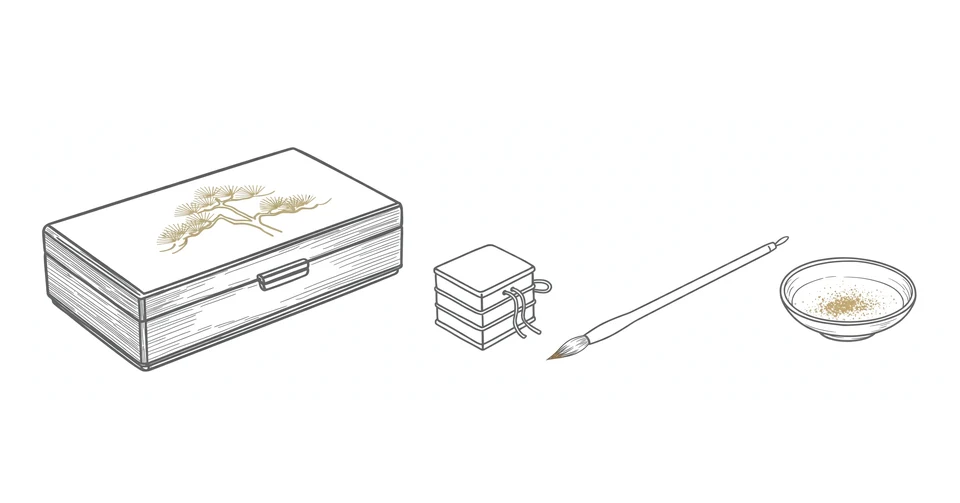
The first thing to understand about hiramaki-e is that flat does not mean shallow. The gold in a good piece is sealed under layers of clear lacquer, polished again and again, until the surface is as smooth as glass and the metal shines from inside the lacquer rather than sitting on top of it. Your finger slides over a pine branch and feels nothing but lacquer. Your eye sees gold. That gap between what the hand feels and what the eye sees is the quiet pleasure of the technique, and it works only because the design stays flat.
I find that restraint moving in a way that raised work rarely is. A raised gold dragon wants applause, and it usually deserves it, but a flat gold moon over flat gold water wants only attention, and it rewards attention the way a good poem rewards rereading. There is nothing to show off with, so the drawing has to be right, the spacing has to be right, and the gold has to be laid exactly where the picture needs it and nowhere else.
What hiramaki-e actually is
Hiramaki-e, written in Japanese as flat sprinkled picture, is one of the three basic forms of maki-e. The word maki-e itself joins maki, meaning sprinkling, and e, meaning picture or design, so the name of the whole art already describes the act: a picture made by sprinkling. In hiramaki-e the sprinkling is done directly onto a design drawn in wet lacquer, and the finished picture sits in the same plane as the surface around it. The fullest account of the technique, including its history and its place among the other forms, is given in the Wikipedia article on maki-e, which is the best place to start for the technical detail.
The family has three members, and each one answers the same question differently: how high should the gold stand? Hiramaki-e answers that it should not stand at all. Takamaki-e answers that it should rise, built up on a raised foundation of lacquer mixed with charcoal or mineral powder. Togidashi answers that the whole surface, picture and ground together, should be coated in lacquer and polished down until everything is level. Three answers, three textures, one family, and hiramaki-e is the one that keeps the surface honest.
That honesty has a practical side. A flat design does not catch on sleeves, it does not chip at the edges the way raised work can, and it does not demand the extra foundation layers that raised work needs. A writing box decorated in hiramaki-e can be opened and closed a hundred times without the picture wearing away, because the picture has no high points, and the clear lacquer above the gold is polished level with the ground.
There is a common misunderstanding worth clearing up early. Hiramaki-e is often called the oldest form of maki-e, but the sources do not support that. The oldest form is togidashi, which was developed and completed in the Heian period, when the technique for refining gold and silver powder was still undeveloped and the grains were rough. Hiramaki-e came later, in the latter half of the Heian period, and was completed in the Kamakura period, once powder could be made fine enough for the flat method to work well. What hiramaki-e is, without doubt, is the simplest of the three, and that simplicity is a fact about the process, not a judgment about the result. Some of the finest maki-e ever made is flat.
How hiramaki-e is made, step by step
The making of hiramaki-e begins long before any gold appears. First the object itself must be finished as a piece of lacquerware, with a thick foundation built up by repeated coating, drying, and polishing. The surface has to be flawless, because a flat gold design will show every bump beneath it, and there is no raised relief to distract the eye. The preparation is invisible in the finished piece, and that is the point.
Then comes the drawing. If the design is complex, the artist begins with a step called okime, a preliminary sketch. The picture is first drawn on paper, thin washi is laid over it, and the outline is copied onto the washi from above. Lacquer is brushed along the outline, and the sheet is pressed onto the surface of the lacquerware to transfer the lines. If the picture is simple, this step may be skipped, and the artist draws directly onto the surface with a fine brush. Either way, the drawing is done in lacquer, and the lacquer is the glue that will hold the gold.
The next step is called jigaki, the preparation before the powder is sprinkled. Lacquer is applied to exactly the places where metal powder is meant to stick, and nowhere else. Precision matters here, because powder will cling to any wet lacquer it touches, and a stray brushstroke becomes a stray fleck of gold. Then comes funmaki, the sprinkling itself. The artist shakes metal powder onto the wet lacquer using a bamboo tube or the shaft of a bird feather, and the gold settles onto the sticky lines of the drawing.
Once the powder is down, the artist coats it with lacquer to protect it, sealing the metal under a transparent skin, and then the lacquer is left to dry. The first polishing, called funtogi, rubs the surface gently, just enough to expose the metal powder where it lies embedded in the lacquer. After that comes a longer sequence of polishing with abrasives of different grain sizes, and between the rounds a step called suriurushi, in which lacquer is rubbed onto the surface and dried, over and over. The result is a glossy surface in which the gold shines through clear lacquer, level with everything around it. A clear and practical walkthrough of these stages, written with a working lacquer artist, is published in the Musubi Kiln guide to maki-e, and it is worth reading alongside the account given here.
Every one of those steps is slow, because lacquer dries on its own schedule. Urushi, the sap of the lacquer tree, hardens through a reaction with moisture in the air, not by evaporation, so a piece must rest in a humid cabinet while each coat cures. An artist who rushes a coat gets a dull surface, and a dull surface in hiramaki-e is a failure, because the whole beauty of the technique is the contrast between the deep black ground and the bright gold. Patience is not a virtue in this craft. It is a material requirement.
Hiramaki-e beside takamaki-e and togidashi
The three techniques are best understood side by side, because each one defines the others. A maker choosing between them is choosing a texture, and the texture changes what the picture can say.
| Technique | How the design sits | How it is made | Character |
|---|---|---|---|
| Hiramaki-e | Flat, level with the surface | Design drawn in wet lacquer, powder sprinkled on, sealed and polished | Clear, graphic, precise |
| Takamaki-e | Raised in relief | Design built up on a foundation of lacquer mixed with charcoal or mineral powder, then decorated | Bold, sculptural, tactile |
| Togidashi | Level with the surface, buried in lacquer | Whole surface coated in lacquer after sprinkling, then polished down until the design appears | Soft, hazy, distant |
The differences are tidier than most craft distinctions. Run a finger across takamaki-e and you feel the picture rise under your hand. Run a finger across togidashi and you feel nothing at all, only a smooth surface with a picture that seems to float beneath it, as if seen through water. Run a finger across hiramaki-e and you also feel a smooth surface, but the picture is crisp rather than hazy, sitting in the lacquer rather than under it. The eye can learn the difference quickly, and once learned, it is hard to unsee.
Each technique also suits different subjects, and makers have used that for centuries. Togidashi is often chosen for distant mountains and for goldfish swimming underwater, because its soft, buried quality makes things look far away or submerged. Takamaki-e is chosen for things that should feel near and solid, for flowers in the foreground, for rocks, for the raised scales of a dragon. Hiramaki-e is chosen for things that should read clearly, for crests, for calligraphy, for the clean outline of a pine branch or a sailing boat. A single object can combine them, using flat work for the emblem, raised work for the flower beside it, and buried work for the hills behind, and museum pieces often do exactly that. An Edo period inro in the collection of the Metropolitan Museum of Art, for example, is described as combining togidashi and hiramaki-e on the same small case, flat gold for one part of the picture and buried gold for another, and the combination is the point.
The comparison also explains why hiramaki-e became popular when it did. In the Azuchi-Momoyama period, from the late sixteenth century, there was a demand for maki-e in larger quantities, for castle and temple furnishings and for gifts between powerful families, and hiramaki-e, being the simplest of the three methods, was the one that could be produced at that scale without losing its quality. Simplicity is not only an aesthetic choice. It is also a practical one.
A short history, from the Heian court to the Momoyama workshops
The story of hiramaki-e begins with maki-e itself, and maki-e begins in the Heian period, from 794 to 1185, when the imperial court in Kyoto was the center of Japanese culture and when the word maki-e first appears in the record. An earlier technique, called makkinru, used gold powder mixed with lacquer to decorate a sword scabbard kept in the Shosoin Repository in Nara, and some accounts trace maki-e back to that Nara period object. Whether the story starts in Nara or in Heian, the picture is the same: gold powder on lacquer, at the center of court life, more than a thousand years ago.
Togidashi came first among the three methods. It was the mainstream of maki-e until the late Heian period, and it stayed the mainstream for a simple reason. When gold powder was coarse, burying it under lacquer and polishing it down was the safest way to hold it in place. The rough grains were locked into the surface by the coating above them, and the polishing revealed them gradually. It was a forgiving method for an unforgiving material, and the earliest dated maki-e treasures use it.
Hiramaki-e followed, in the latter half of the Heian period, and it was completed in the Kamakura period, from 1185 to 1333. The delay was a matter of materials. Flat work needs fine powder, because coarse grains cannot be polished level without tearing out of the lacquer, and fine powder needed better refining. Once the refining improved, the flat method could be finished properly, and it spread. By the Azuchi-Momoyama period it was the method of choice for large commissions, and the great example of the age is the Kodaiji maki-e, the decoration of the mausoleum and furnishings of Kodaiji Temple in Kyoto, a masterpiece of the Momoyama period created using hiramaki-e.
In the Kamakura and Muromachi periods that followed, hiramaki-e was often overshadowed by takamaki-e, which was developed in the middle of the Kamakura period and grew bolder in Muromachi, when makers learned to raise the pattern higher by mixing lacquer with powdered whetstone or clay. Raised work was new and dramatic, and it suited an age of warriors who liked their art to announce itself. Flat work did not disappear. It waited, and it came fully into its own in later centuries, when makers and buyers began to value restraint again. What one generation finds plain, the next finds honest.
The people who carried the technique forward were the maki-e masters, and their training was long. Young artists spent years learning to draw in lacquer, to sprinkle powder evenly, and to polish without cutting through, before they were trusted with a commission of their own. The first lacquer master linked to specific surviving works was Koami Docho, who lived from 1410 to 1478. He and another master, Igarashi Shinsai, founded the two great schools of lacquer making in Japan. Behind every flat gold crane on a black box is a lineage like that, and the flatness of the work hides the length of the training completely. That is how craft should be. The effort disappears and the object remains.
Where hiramaki-e shows up
If you want to see hiramaki-e, the best place to look is on the small objects of daily life, because flat gold suits things that are handled. The inro is the classic example. These little stacked boxes hung from a man's sash, and their surfaces were decorated in maki-e of all three kinds, often on a single case. Flat gold was used for crests, for the fine lines of a landscape, for the parts of the picture that needed to read at a glance when the case was pulled from the sash. The full story of the inro itself is told in Inro Is the Little Lacquered Box That Carried a Samurai's Day, and the decoration described there is very often hiramaki-e, whether the article names the technique or not.
Writing boxes are the second home of the technique. A writing box, the suzuri-bako, held a calligrapher's tools, the inkstone, the water dropper, the brushes, and its lid was a broad flat surface, the ideal field for a flat picture. Some of the most famous maki-e in the world are writing boxes, including the great Eight Bridges design, where flat gold was the natural choice for the clean lines of bridges and irises on a black ground. A flat surface invites a flat picture.
Trays and food boxes come next. A tray is used, washed, stacked, and used again, and a raised design on a tray is a design waiting to be chipped. Flat gold survives that life, because there is nothing to catch, and because the clear coats above the gold are the same lacquer that protects the tray itself. The same logic applies to sake cups and small dishes, where the decoration often mixes techniques, a family crest in flat gold beside a tortoise in slight relief, the crest meant to be read, the tortoise meant to be felt. That mix is a small lesson in how makers thought about the three methods, not as rivals but as a vocabulary.
Sword fittings are the most surprising home of the technique, and the oldest. The scabbard of the Kara-tachi sword in the Shosoin Repository, a treasure that once belonged to Emperor Shomu, who reigned in the eighth century, carries gold decoration made with an early method close to togidashi, and later sword furniture used flat gold for crests and scrollwork on guards and scabbards. A sword is drawn and sheathed, gripped and carried, and flat decoration suits it for the same reason it suits a tray. Nothing sticks up to be worn away, and the hand that draws the sword feels only smoothness.
The broader point is that hiramaki-e is not a museum technique. It is a working technique, made for objects that were used every day by people who carried them, wrote with them, ate from them, and fought with them. The gold is not there to be admired from a distance. It is there to be lived with, and flatness is what makes living with it possible. It was made to be handled, and handling was part of its design.
Gold powder, silver powder, and the choice of grain
The materials of hiramaki-e are few, and each one earns its place. The lacquer is urushi, the sap of the lacquer tree, refined into different kinds for different jobs. Raw lacquer is the starting point. Shuai lacquer is mixed with vermilion, bengara lacquer with red iron oxide, and colored lacquers are made for the ground and the drawing. The lacquer is at once the paint, the glue, and the varnish, and the whole technique depends on that triple role.
The powders are the second material, and they are where the money goes. Gold is the most common, silver the second, and the list of metals used runs on through copper, brass, lead, aluminum, platinum, and pewter, with alloys of these as well. Gold powder close to pure gold is sometimes called yakifun, or burnt powder. Silver is used for the moon, for water, for the pale parts of a picture, and it has one honest flaw: it loses its shine with use and with time, and it must be polished gently with silver polish to bring the light back. Gold does not tarnish, and that is part of why it dominates. A gold moon stays a gold moon.
The grain of the powder is a choice the artist makes for each part of the picture, and the choice changes the look completely. Fine powder gives a soft, even gold, good for large areas and for the fine lines of a drawing. Coarse powder gives a bright, flashing gold, because its larger grains catch the light from many angles, and it suits the parts of a picture that should sparkle, for water, for stars, for the edge of a wave. Very fine powder, called keshifun, is easy to work with but turns whitish and dull, while large powder, called marufun, is hard to work with but durable and bright. Flat flakes of gold, called hirame-fun, reflect light differently again, with a shimmer that seems to move as the piece turns in the hand. A single picture can use three grains of gold, and the eye reads them as three different kinds of light, even though the metal is the same. That is the quiet virtuosity of hiramaki-e. It makes one material behave like several.
How to look at a flat gold picture
The best way to look at hiramaki-e is to move, because the gold changes as you do. Hold the piece still and the gold is one color. Tilt it toward the window and the gold brightens. Tilt it away and the gold deepens, and the black ground seems to rise up around it. The picture does not change, but the light on it does. A photograph of hiramaki-e is a poor substitute, because a photograph fixes one angle, and the technique is made of many angles.
Look next at the edges of the design. In good flat work the edge of a gold shape is clean, without stray flecks or a fuzzy border, and that cleanliness is the signature of a steady hand in the jigaki stage, when the adhesive lacquer was laid down. A ragged edge means the brush wavered. Then look at the spacing. Flat gold needs empty black space around it to breathe, and the best pieces are often the emptiest ones, a single branch across a whole lid, a single boat on a whole sea. The empty lacquer is not wasted space. It is the silence that makes the gold audible.
Look last at the polish. A well finished piece has a surface like still water, and the gold seems to lie inside the lacquer rather than on it. If the surface is cloudy, the polishing was cut short, or a coat was rushed. If the surface is mirror bright, the maker finished the work properly, and the picture will hold its shine for a very long time. These are small tests, and anyone can learn them in an afternoon in a museum. The reward is that lacquer stops being a blur of black and gold and starts being a language, with flat, raised, and buried as its three words.
The quiet case for flat gold
Hiramaki-e has spent a thousand years being the simplest member of its family, and it has survived by being exactly that. It does not need a raised foundation, it does not need the whole surface to be buried and polished back, and it does not ask the viewer to admire the difficulty of its making. It asks only for a good drawing, fine powder, clear lacquer, and patience, and from those four plain things it makes a picture that can last for centuries. The Kodaiji maki-e has lasted since the Momoyama period on that recipe, and it is still flat, still gold, still clear.
I keep returning to the idea that flatness is a kind of confidence. A maker who raises the gold is saying, look at what I can do. A maker who keeps the gold flat is saying, look at what I drew. The first is impressive, and the second is trusting, and trust is the rarer quality. Hiramaki-e trusts the line, trusts the spacing, trusts the viewer to come close and look properly, and that trust is repaid every time someone stops in front of a black box, tilts it toward the light, and sees a gold crane appear out of the dark. The gold was flat all along. The picture was doing the work, quietly, and it was enough.
More in Culture & Society
- Chuson-ji Is the Mountain Temple That Guarded the Golden Hall
- Urushi Kabure Is the Rash Lacquer Apprentices Learn to Live With
- Konjikido Is the Golden Hall That Outlived a Fallen Capital
- Hidehira-Nuri Keeps Hiraizumi's Golden Age in Lacquer
- Urushiol Is the Itch Behind Japan's Most Beautiful Lacquer
- Wajima-nuri Is the Lacquer That Survives Being Dropped
Latest posts
- Tsugaru-nuri Hides Four Seasons of Colour Under the Lacquer
- Shunkei-nuri Lets the Wood Grain Shine Through the Lacquer
- Takamaki-e Raises Gold Off the Lacquer Until You Can Feel It
- Shibayama Turns Shell Ivory and Coral Into Small Paintings in Lacquer
- Togidashi Buries Gold in Lacquer and Polishes It Back Into the Light
- Nashiji Scatters Gold Dust Like Pear Skin Across Black Lacquer
- Raden Turns Mother of Pearl Into Lacquer That Catches the Light
- Maki-e Sprinkles Gold Dust Onto Wet Lacquer
- Urushi Is the Tree Sap Japan Turns Into Lacquer That Outlives Centuries
- Ojime Is the Tiny Bead That Keeps a Netsuke From Slipping Away
- Inro Is the Little Lacquered Box That Carried a Samurai's Day
- Hachimaki Is the Headband Japan Ties On Before the Hard Part Begins
- Netsuke Held a Samurai's World on a Cord
- Tenugui Is the Thin Cotton Cloth Japan Uses for Everything
- Kinchaku Carries a Whole Festival in One Small Bag