Urushi Kabure Is the Rash Lacquer Apprentices Learn to Live With
· 13 min read
Urushi kabure is the itchy rash that comes with learning Japanese lacquer, and almost every apprentice meets it sooner or later. This is what it is, why the first outbreak is usually the worst, and how craftspeople learn to live with it.
Every lacquer student in Japan knows the rash by its Japanese name, urushi kabure, and for most of them it is a rite of passage. It arrives quietly, usually days after the hands have touched wet lacquer, and it announces itself with an itch that seems to come from under the skin rather than from the surface of it.
Nobody in the workshop treats it as an accident. A new apprentice with red forearms is not a beginner who has made a mistake. Urushi kabure is the material introducing itself, and the introduction is rarely gentle.
The surprising part is how willingly people accept the deal. They keep coming back to the bench, gloves on, sleeves taped down, knowing the next rash may already be on its way. To understand why, it helps to understand what urushi kabure actually is, why the first one is the worst, and what a working life with it really looks like.
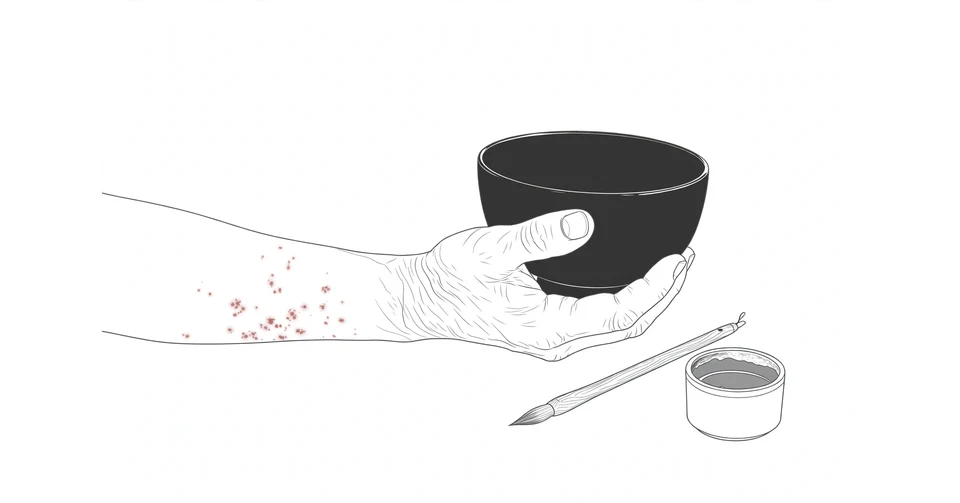
The answer starts with a tree. The lacquer tree, Toxicodendron vernicifluum, produces a sap that hardens into one of the toughest and most beautiful coatings in the world, and the same sap carries urushiol, an oily compound that the human immune system treats as an intruder.
What urushi kabure is, in plain language
Urushi kabure is the Japanese name for the rash that urushiol causes, a delayed allergic contact dermatitis. The word kabure means a rash or skin eruption, and urushi is lacquer, so the name is simply a description: the lacquer rash. It is the same kind of reaction that poison ivy causes, because poison ivy, poison oak, and the lacquer tree are botanical cousins that share the same irritating oil. The chemistry behind the rash is worth understanding on its own, because urushiol is the oily compound that gives lacquer both its beauty and its bite.
The reaction is delayed, and that delay is the first thing that confuses people. The rash does not appear the moment lacquer touches the skin. Hours pass, often a day or more, and the skin still looks fine. Then redness appears, then itching, then sometimes small blisters. A Japanese lacquer workshop guide describes urushi kabure as a delayed type allergic contact dermatitis, and it warns that symptoms typically show up hours to several days after contact, so a person can feel fine during the workshop and develop the rash after going home.
Doctors classify this as a type IV hypersensitivity, which is a slower branch of the immune system at work. Unlike a reaction that arrives in minutes, this one needs time because immune cells must first recognize the urushiol, travel to the skin, and start the inflammation. That is why urushi kabure behaves like a slow tide rather than a sudden wave, and why it can appear on skin that never touched lacquer at all. The same workshop guide notes that the allergic response travels through the lymphatic system, so itchy patches can show up on sensitive areas far from the original contact.
The numbers are striking, and they explain why workshops treat protection as a rule rather than a suggestion. Roughly 85 percent of people react to urushiol, according to the American Academy of Dermatology, and a Japanese lacquer workshop guide puts the figure higher for direct contact with liquid lacquer, at about 98 percent of people. The two numbers measure different things, one general sensitivity and one direct skin contact with the raw material, so they do not really contradict each other. Either way, the honest starting point for anyone facing urushi kabure is that almost everyone will react. Only a small percentage of people seem to be naturally unaffected.
Why the first rash is usually the worst
Ask a lacquer master about their first urushi kabure and you will usually get a story, not a shrug. The first time is often the worst, and there is a clear reason for it. On a first exposure the immune system has never met urushiol before, so it needs days to learn what it is dealing with. The reaction can take a week or longer to appear, sometimes ten to twenty days, and when it arrives it can be strong, widespread, and deeply uncomfortable.
On later exposures the body already knows the enemy, so the rash arrives faster, usually within 12 to 72 hours, and often in a more familiar pattern. That sounds like bad news, and in one sense it is, because the apprentice starts reacting sooner. But the second part of the story is kinder. With repeated exposure over months and years, the reactions generally become milder. The same workshop guide puts it plainly: the first urushi rash tends to be the strongest, the body gradually becomes accustomed, and reactions become milder, but they never disappear entirely. Even experienced craftspeople still get rashes. That is the rhythm of urushi kabure: faster to appear, gentler when it does.
This is where the idea of immunity needs careful handling. There is a common belief among beginners that a lacquer worker eventually becomes immune, and it is simply not true. What builds up against urushi kabure is tolerance, and tolerance is partial. The skin still reacts, the itch still comes, but the outbreak is smaller, shorter, and easier to live with. No lacquer worker I have read about claims to be free of it entirely, and the guides are blunt on this point: adaptation is real, immunity is a myth.
The adjustment takes time, and nobody can promise a schedule for urushi kabure. Workshop accounts describe it as a slow process measured in months, and for many apprentices the worst years are the first one or two, before the reactions settle into their milder pattern. That is an approximate picture rather than a medical rule, and it varies from person to person, but it matches what masters describe. The rash is a tax that gets smaller with time, but it is never fully waived.
How long urushi kabure lasts
A typical outbreak lasts one to three weeks, and most accounts cluster in that range. The itch is usually worst in the first days, then the redness fades and the blisters dry. A Japanese workshop guide warns, though, that an untreated rash often peaks around the second week and may take about a month to fully settle. The difference between those two pictures is the difference between a mild reaction that is treated early and a strong first reaction left to run its course.
In urushi kabure, the itch is intense, sometimes described as burning, and it is worst at night, when there is nothing to distract from it. Scratching brings a few seconds of relief and then makes everything worse, because broken skin invites infection and the rash spreads further. The skin can swell, blister, and weep, and the patches can show up in places that never touched lacquer, which is frightening the first time it happens even though it is a known feature of the reaction.
Anyone who has had urushi kabure once recognizes the pattern immediately the second time: the delay, the itch, the slow spread, and then the slow fade. One comfort is that the rash itself is not contagious. The blister fluid contains no urushiol, so a person with the rash cannot give it to someone else by touch. What can spread it is the oil itself, left on a sleeve, a tool, a phone screen, or under a fingernail. The United States Food and Drug Administration notes that urushiol can linger on almost any surface for years until it is washed off with water or rubbing alcohol. The rash is not catching, but the oil is patient.
Learning to live with urushi kabure
This is the part of the story that outsiders find hardest to understand. If the material punishes everyone who touches it, why do people spend their lives with it? Part of the answer is the beauty of the finished work, which needs no defending. Lacquer hardens into a surface with a depth that no synthetic coating has matched, and the craft carries centuries of history. The other part of the answer is more human, and it is the part I find most admirable. The golden lacquer of Hiraizumi was not made by people who avoided the material. It was made by people who accepted urushi kabure as the price of admission and kept working anyway.
There is something quietly dignified about that bargain. Modern life trains us to expect comfort as the default and pain as a sign that something has gone wrong. A lacquer apprentice learns the opposite lesson: that some worthwhile things come with a cost that cannot be engineered away, and that the right response is not to quit but to prepare, to protect the skin, and to carry on. I think that attitude is worth more than the lacquer itself. It is easy to love a craft when it is painless. It is something else entirely to love it when it leaves you itching at two in the morning and you still show up at the bench the next day.
Living with urushi kabure teaches a practical attitude rather than a heroic one. Masters do not praise apprentices for suffering. They praise them for learning the routines that keep the suffering small: gloves always, sleeves down, no touching the face, wash hands the moment the work stops. The rash is treated as information, not as a badge of honor. A bad outbreak means a gap in the routine, and the routine gets fixed.
That attitude extends to the finished work as well. Once lacquer has fully cured, it is stable and safe to touch. A finished bowl cannot give you urushi kabure, no matter how many years it has been handled. The danger belongs entirely to the making, to the wet lacquer on the brush and the half dried surface that still holds active urushiol. Knowing that line, between the dangerous wet stage and the safe cured stage, is one of the first things an apprentice is taught, and it changes how they see every object in the workshop.
What actually helps in the workshop
The rules for avoiding urushi kabure are simple, they are the same in every workshop, and they are repeated until they become habit. Disposable gloves and arm covers or long sleeves are worn whenever uncured lacquer is handled. Loose clothing is tied back or avoided, because a brushing sleeve can carry wet lacquer to the skin without anyone noticing. The face, neck, and hair are left untouched during the work.
Cleaning up matters as much as covering up. Hands and exposed skin are washed thoroughly with soap immediately after the session, and lacquer guides recommend wiping the skin with vegetable oil first, because oil dissolves the urushiol before washing carries it away. Tools and work surfaces are wiped with alcohol, and contaminated wipes are bagged separately so they cannot surprise someone later. Health guidance for poison ivy and its relatives gives the same basic advice: wash the skin in soap and cool water as soon as possible, because the sooner the oil is removed, the better the chance of preventing urushi kabure.
There is also a habit that sounds odd until you think about it: a thin layer of hand lotion or barrier cream applied before work. It does not stop urushiol, but it makes the skin less absorbent and the oil easier to wash off. The guides that teach this are written by people who work with lacquer every day, and their advice has the ring of hard won experience rather than theory. Small routines, repeated without fail, are what keep urushi kabure small.
| First exposure | Later exposures | |
|---|---|---|
| Rash appears | Often after a week or more | Usually within 12 to 72 hours |
| Severity | Often the strongest | Usually milder |
| Duration | Up to about a month untreated | Often one to three weeks |
The table is only a rough guide, and individual reactions vary widely. Some people react within hours on their first contact, and some masters still get a fierce outbreak after years of work. But the pattern holds often enough that workshops plan around it: the newcomer gets the closest supervision, the strongest warnings, and the most careful protection, because the first bout of urushi kabure is the one that can put a person off the craft for good.
When a rash needs a doctor
Most outbreaks of urushi kabure can be managed at home, but there are clear lines where professional help is the right call. A rash that spreads widely, that covers the face or the eyes, that shows signs of infection such as pus or yellow scabs, or that keeps a person awake night after night should be seen by a doctor. Difficulty breathing is an emergency. The Food and Drug Administration lists the same warning signs for poison ivy rashes: fever, spreading redness, tenderness, and a rash that is not improving within a few weeks.
Treatment itself is symptomatic, which is a polite way of saying that no medicine cures the rash directly. The body heals itself, and medicine makes the waiting bearable. Over the counter steroid creams are generally considered too weak for a strong outbreak, and a dermatologist can prescribe a stronger topical steroid, which is usually the fastest way to calm the skin. Oral antihistamines can help with the itching, and for severe or widespread reactions a doctor may prescribe oral corticosteroids. The Food and Drug Administration lists wet compresses, soaking in cool water, over the counter topical corticosteroids, and skin protectants such as calamine and baking soda among the measures that relieve the itch. None of this cures urushi kabure, and nobody should expect it to. What it does is buy comfort while the body finishes the work.
The rash is part of the craft
In the end, urushi kabure is not a reason to stay away from lacquer. It is a reason to approach it properly, with gloves, with patience, and with respect for a material that has been demanding the same toll for centuries. The masters who make the most beautiful lacquer in the world are not the ones who never got the rash. They are the ones who got it, learned from it, and kept going.
There is a lesson in that which has nothing to do with lacquer. The best work often asks for something in return, and the people who do it well are the ones who decided, early on, that the price was worth paying. Urushi kabure is a small price, measured in itching and patience, for a craft that has outlasted empires. The apprentices who learn to live with it are not just learning a trade. They are learning how to love something enough to endure it.
More in Culture & Society
- Hiramaki-e Keeps the Gold Flat and Lets the Picture Speak
- Chuson-ji Is the Mountain Temple That Guarded the Golden Hall
- Konjikido Is the Golden Hall That Outlived a Fallen Capital
- Hidehira-Nuri Keeps Hiraizumi's Golden Age in Lacquer
- Urushiol Is the Itch Behind Japan's Most Beautiful Lacquer
- Wajima-nuri Is the Lacquer That Survives Being Dropped
Latest posts
- Tsugaru-nuri Hides Four Seasons of Colour Under the Lacquer
- Shunkei-nuri Lets the Wood Grain Shine Through the Lacquer
- Takamaki-e Raises Gold Off the Lacquer Until You Can Feel It
- Shibayama Turns Shell Ivory and Coral Into Small Paintings in Lacquer
- Togidashi Buries Gold in Lacquer and Polishes It Back Into the Light
- Nashiji Scatters Gold Dust Like Pear Skin Across Black Lacquer
- Raden Turns Mother of Pearl Into Lacquer That Catches the Light
- Maki-e Sprinkles Gold Dust Onto Wet Lacquer
- Urushi Is the Tree Sap Japan Turns Into Lacquer That Outlives Centuries
- Ojime Is the Tiny Bead That Keeps a Netsuke From Slipping Away
- Inro Is the Little Lacquered Box That Carried a Samurai's Day
- Hachimaki Is the Headband Japan Ties On Before the Hard Part Begins
- Netsuke Held a Samurai's World on a Cord
- Tenugui Is the Thin Cotton Cloth Japan Uses for Everything
- Kinchaku Carries a Whole Festival in One Small Bag