Konjikido Is the Golden Hall That Outlived a Fallen Capital
· 14 min read
Konjikido, the Golden Hall of Chuson-ji Temple in Hiraizumi, has kept its gold leaf and lacquer for nine centuries while the capital around it disappeared.
Hiraizumi was once a capital that rivalled Kyoto. In the twelfth century it was the political and commercial centre of northern Japan, a city of temples, gardens and gold. Then, in the space of a single lifetime, it fell. The poet Matsuo Basho visited the ruins five centuries later and wrote that three generations of glory had vanished in the space of a dream.
The great survivor is the Konjikido, the Golden Hall of Chuson-ji Temple. It was built in 1124 by Fujiwara no Kiyohira, the founder of the Oshu Fujiwara clan, and it enshrines Amida Nyorai, the Buddha of Infinite Light. It is a small building, about five and a half metres on each side, yet it holds the whole story of Hiraizumi inside its walls: the wealth, the faith, the grief and the stubborn luck that kept it standing.
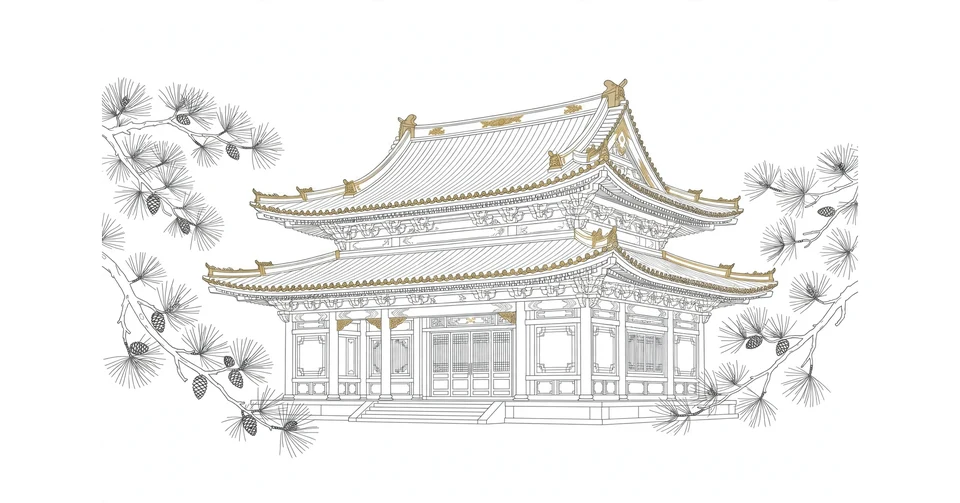
What strikes me first about the Konjikido is how small it is. A building that once stood for the wealth of an entire region is barely larger than a village hall, and you can walk around it in less than a minute. That smallness is part of its power. Gold on a vast temple would be a boast. Gold on a room this size feels like a secret, something made for prayer rather than display, and I think that is why it still moves people nine hundred years later.
A hall built to comfort the dead
Fujiwara no Kiyohira did not build the Konjikido to show off. He built it to comfort the spirits of everyone who had died in the long wars of the Tohoku region, friend and foe alike. The Later Three Year War had torn the north apart in the late eleventh century, and Kiyohira, who had lived through it, turned to Buddhism for an answer to the violence. His answer was a Pure Land on earth, a place where temples, gardens and ponds would stand in for paradise itself.
The work began in stages. According to the Agency for Cultural Affairs, Kiyohira raised the Saishoin hall in 1105 and a two storey Amida hall in 1107, and completed the Konjikido in 1124, near the end of his life. The date is not a guess. It comes from an inscription written on the ridge beam of the hall itself, which is why historians can state it with such confidence. The Konjikido was the last great act of a man who had spent his final years trying to turn a battlefield into a sanctuary.
The hall enshrines Amida Nyorai, the Buddha of Infinite Light, whose Pure Land was the goal of the faithful. For Kiyohira, the gold was not decoration for its own sake. In Pure Land teaching, the paradise of Amida glitters, and a hall covered in gold was a way of making that paradise visible to people who would never read a sutra. The Konjikido was meant to be seen, felt and walked into, a small room that carried the weight of a whole theology.
What the Konjikido looks like up close
From the outside, the Konjikido is a plain three bay hall with a pyramidal roof covered in wooden tiles, a rare choice that already sets it apart from most Japanese temples. The structure itself is simple, with bracket sets of the simplest form on round columns and deeply curved double eaves. The timber is hiba cypress finished with a spear plane, a smooth hand worked surface that still shows the care of the builders.
The elaboration is all on the surface, and it is total. The hall is coated inside and out, from the veranda to the tips of the eaves, in black lacquer overlaid with gold leaf. That is what kai-konjiki means, all gold, and the Konjikido is the classic example of the style. Even the Buddhist ritual utensils inside were covered in gold, so that nothing in the room broke the spell.
Step through the glass that now protects it, in your imagination at least, and the interior is richer still. Four makibashira pillars surround the shumidan altar, lavishly decorated with maki-e lacquer, raden mother-of-pearl inlay and gold. The columns carry bodhisattvas painted in maki-e, and peony arabesques in mother-of-pearl run across the tie beams and bracket sets on a ground of dense gold leaf. The mother-of-pearl came from turban shells of the southern seas, which tells you something about the reach of Hiraizumi trade. A small northern capital was importing shells from far southern waters to decorate a single room.
There are three altars, and they carry thirty three statues in all. The central altar holds an Amida triad, six Jizo and two guardian kings, and the flanking altars repeat the arrangement. The canopies, preaching seats, gong stands, tables and floral pendants survive from the founding as a complete set of furnishings, which is vanishingly rare. Most temples lose their fittings to fire or theft within a few generations. The Konjikido kept everything, and that completeness is part of why scholars call it the fullest achievement of architectural decoration in lacquer and metalwork.
The altar fittings deserve a closer look. The shumidan altar, where the bodies of three generations of Fujiwara leaders are enshrined, features peacock motifs shaped with a hammer and gilded with gold leaf. The relief like forms are small and exquisite, and they reward the kind of slow looking that the hall now demands of its visitors. A copper altar fitting called the kondo keman, decorated with karyobinga, the mythical half human, half bird beings said to inhabit the Pure Land, shimmers softly with gold. These are not the grand gestures of a palace. They are the fine details of a room built by people who believed that the smallest things mattered.
A tomb as well as a temple
The Konjikido is a Buddha hall and a family tomb at once, and that double purpose is what makes it so unusual. Beneath the altars lie coffins. After Kiyohira died, the hall became the mausoleum of four generations of the Fujiwara. His coffin rests inside the central altar. Those of his son Motohira and his grandson Hidehira lie within the flanking altars, together with the head of the fourth lord, Yasuhira.
Yasuhira is the sad coda of the story. After Hiraizumi fell, his head was sent to Minamoto no Yoritomo, and his remains were never reunited with his family. The hall that was built to comfort the dead ended up holding the dead of the very family that built it, and the last of them only in part. I find that detail quietly devastating, because it turns the Konjikido from a monument into a family story, and family stories are the ones that last.
The craft that made the hall possible also connects it to the wider world of Hiraizumi. The same gold and lacquer that cover the Konjikido also appear in hidehira-nuri, the lacquerware of Hiraizumi that carries gold diamonds and cloud patterns over black and vermilion lacquer. Hidehira, the third lord whose coffin lies in the hall, is the namesake of that ware, and the two arts share a single idea: that gold laid over lacquer is the proper language of a northern court. When you see a bowl of hidehira-nuri, you are looking at the same taste, the same workshops and the same confidence that built the Golden Hall.
How the Konjikido survived when a capital did not
Three generations of the Oshu Fujiwara ruled the north from Hiraizumi. Then war broke out again, and in 1189 the young city was almost entirely destroyed. The Konjikido escaped that calamity, and the reasons are worth knowing, because survival on this scale is never one lucky accident. It is a chain of decisions made by many people over many centuries.
The first protection came early. Rain screens were fitted beneath the eaves soon after construction, keeping weather off a building whose lacquer and gold would have suffered badly from rain. Then, in the Kamakura period, a wooden sheltering hall was built over the whole building. Many guides date that shelter to 1288, though the official record speaks more broadly of the Kamakura period, so the exact year should be treated with a little caution. Either way, the hall had a roof over its roof within two centuries of being built, and that second skin is the main reason it is still here.
Fire was the other great enemy. In 1337 a fire destroyed the founding complex that had spread over the hill and its foot, leaving only the Golden Hall and the sutra repository standing. Everything else at Chuson-ji from Kiyohira's time was lost, and the Konjikido survived because it was sheltered, and perhaps because it was small enough to protect. It is a strange thought that the building's modesty may have saved it, but small buildings are easier to cover, easier to guard and easier to love.
The modern chapter of the story began in 1965, when the Konjikido was moved into a new shelter of reinforced concrete, where it now stands in a glass enclosure at controlled temperature and humidity. The old wooden sheltering hall still stands in the precinct as an Important Cultural Property in its own right, so the site now holds two shelters, one medieval and one modern, and the golden hall inside both. Thanks to the joint efforts of monks, rulers and restorers over the years, almost 90 percent of the structure and materials used when the Konjikido was first built still survive, a figure that still surprises me every time I read it. A wooden building from 1124 should not exist in this condition. It exists because almost every generation since has decided, separately, that it was worth the trouble.
The Konjikido and the legend of the golden palace
There is a famous theory about the Konjikido that is probably wrong, and it is worth telling because it shows how far the hall's reputation travelled. In the Travels of Marco Polo, written around 1300, the Venetian merchant describes a place called Zipangu, Japan, which he had heard about while in China. There, the place was said to have tremendous quantities of gold, and a king's palace roofed with pure gold. One theory holds that the palace Marco Polo heard about was the Konjikido.
Haseki Shinsho, a monk at Chuson-ji Temple, is honest about it. It is true that a lot of gold was produced in this area, allowing for its extensive use in the construction of the Konjikido, but there is really no historic basis for the king's palace theory at present. Still, looking at the dazzling hall today, he admits it is tempting to imagine that the land of gold reported by Marco Polo, and dreamed about by explorers such as Christopher Columbus after him, might have been Hiraizumi.
I like that the temple itself refuses to claim the legend. A lesser site would print it on every brochure. Chuson-ji tells you the truth and then lets you stand in front of the gold and decide for yourself. That restraint is part of the hall's dignity, and it is why the Konjikido feels like a place of faith rather than a tourist attraction that happens to be old.
The gold itself was no accident of geology alone. Hiraizumi sat near productive gold workings, and the wealth of the Oshu Fujiwara rested on gold, horses and trade. The same craft culture that gilded the Konjikido also produced lacquerware that travelled far beyond the north. Wajima-nuri, the lacquer of the Noto Peninsula, is a different tradition from a different coast, but it shows the same Japanese instinct: take a humble wooden object, coat it in layer after layer of lacquer, and make something that outlasts the hands that made it. The Konjikido is that instinct carried to its highest form, a whole building treated like a lacquered bowl.
Konjikido at a glance
| Fact | Detail |
|---|---|
| Built | 1124, by Fujiwara no Kiyohira |
| Location | Chuson-ji Temple, Hiraizumi, Iwate Prefecture |
| Size | About 5.5 metres square, about 8 metres tall |
| Style | Kai-konjiki, all gold, lacquer and gold leaf inside and out |
| Enshrines | Amida Nyorai, the Buddha of Infinite Light |
| Designation | National Treasure since 1951 |
| World Heritage | Part of the Hiraizumi inscription since 2011 |
| Survival | Almost 90 percent of original materials survive |
The table makes the hall look tidy, but the history behind it is not tidy at all. A building does not survive nine centuries by being well built alone. It survives because people keep choosing to protect it, and that choice has to be remade by every generation. The Konjikido has now been chosen nine times over, by monks, by lords, by restorers and by the visitors who pay to see it through glass.
Visiting the Konjikido today
The hall stands inside its concrete shelter, and visitors view it from the front through glass. Photography inside is prohibited, and the shelter is kept quiet, which is exactly right for a room that is also a tomb. The inlay and lacquer on the altars are fine grained, so give your eyes a minute at the glass to adjust. What looks at first like a flat wall of gold resolves, slowly, into pillars, peacocks, bodhisattvas and the small dark faces of statues that have watched nine centuries pass.
A single ticket covers four sites at Chuson-ji, including the Sankozo treasure house, where many of the temple's finest objects are kept, the sutra repository and the former shelter hall. Tickets are sold at the Sankozo reception rather than at the Golden Hall entrance, so it is worth starting there. The Sankozo holds the objects that could not stay in the hall, and it is the right second stop after the gold itself, a quieter room for the treasures that survived beside it.
UNESCO inscribed Hiraizumi as a World Heritage site in 2011, under the name Hiraizumi, Temples, Gardens and Archaeological Sites Representing the Buddhist Pure Land. The listing covers four temple complexes and the sacred mountain of Kinkeisan, and the Konjikido is the only structure among them that remains from the twelfth century in its original form. The official UNESCO listing describes the heavily gilded temple of Chuson-ji as a reflection of the great wealth of the ruling clan, and notes that much of the area was destroyed in 1189 when the city lost its political and administrative status. You can read the full listing on the UNESCO World Heritage Centre site, and the story of the hall itself is told in detail by the Japanese government's Highlighting Japan magazine, which draws on the temple's own records.
If you go, go slowly. Hiraizumi rewards the unhurried visitor, and the Konjikido most of all. Stand at the glass, let your eyes adjust, and look for the peacocks on the altar and the bodhisattvas on the pillars. They have been there since 1124, and they will still be there when you leave, which is the whole point.
Why a small golden room still matters
The Konjikido matters because it is proof that a place can lose everything and still keep its soul. Hiraizumi lost its palaces, its streets and its power, and what remains of its golden age is a room the size of a garage, covered in gold leaf, holding the coffins of the family that built it. That is not a consolation prize. It is the thing itself, the reason the city existed at all, preserved while the city around it turned to grass.
I think there is a lesson in that for anyone who builds things, whether temples or blogs or small businesses. Grandeur fades and empires fall, but a small thing made with total care, and then cared for by strangers for nine hundred years, can outlive them all. The Konjikido was built to comfort the dead, and it ended up comforting the living instead, one quiet visitor at a time, standing at the glass and looking at gold that has not dimmed since 1124.
More in Culture & Society
- Hiramaki-e Keeps the Gold Flat and Lets the Picture Speak
- Chuson-ji Is the Mountain Temple That Guarded the Golden Hall
- Urushi Kabure Is the Rash Lacquer Apprentices Learn to Live With
- Hidehira-Nuri Keeps Hiraizumi's Golden Age in Lacquer
- Urushiol Is the Itch Behind Japan's Most Beautiful Lacquer
- Wajima-nuri Is the Lacquer That Survives Being Dropped
Latest posts
- Tsugaru-nuri Hides Four Seasons of Colour Under the Lacquer
- Shunkei-nuri Lets the Wood Grain Shine Through the Lacquer
- Takamaki-e Raises Gold Off the Lacquer Until You Can Feel It
- Shibayama Turns Shell Ivory and Coral Into Small Paintings in Lacquer
- Togidashi Buries Gold in Lacquer and Polishes It Back Into the Light
- Nashiji Scatters Gold Dust Like Pear Skin Across Black Lacquer
- Raden Turns Mother of Pearl Into Lacquer That Catches the Light
- Maki-e Sprinkles Gold Dust Onto Wet Lacquer
- Urushi Is the Tree Sap Japan Turns Into Lacquer That Outlives Centuries
- Ojime Is the Tiny Bead That Keeps a Netsuke From Slipping Away
- Inro Is the Little Lacquered Box That Carried a Samurai's Day
- Hachimaki Is the Headband Japan Ties On Before the Hard Part Begins
- Netsuke Held a Samurai's World on a Cord
- Tenugui Is the Thin Cotton Cloth Japan Uses for Everything
- Kinchaku Carries a Whole Festival in One Small Bag