Motsu-ji Keeps Hiraizumi's Pure Land Garden Alive
· 21 min read
Motsu-ji in Hiraizumi keeps one of Japan's few surviving Pure Land gardens alive, a twelfth century pond garden that outlived the great temple built around it.
Most visitors to Hiraizumi climb the cedar hill to Chuson-ji for the Golden Hall, and they are right to do so. But a short walk away, on flat ground near the station, Motsu-ji keeps something rarer alive. Its great halls are gone, burned centuries ago, yet its garden remains, a twelfth century Pure Land garden arranged around a broad pond, still holding the shape the Fujiwara lords gave it eight hundred years ago.
Motsu-ji is the quieter half of Hiraizumi. Where Chuson-ji dazzles with gold, Motsu-ji asks you to walk slowly around water and look at stones, and to imagine the halls that once stood on the foundation stones still visible in the grass. Motsu-ji holds one of the few Pure Land gardens left in Japan, and the temple is one of the reasons Hiraizumi was inscribed as a UNESCO World Heritage site in 2011 alongside its temples.
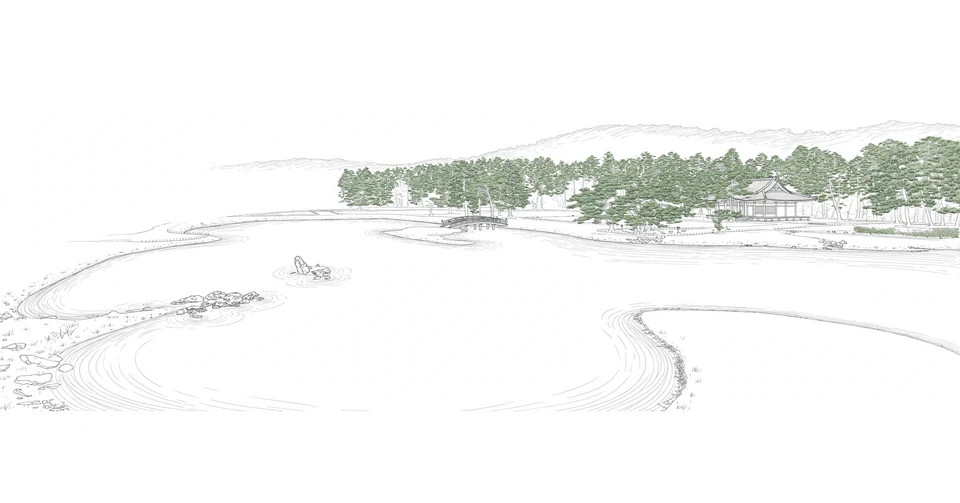
I think the garden is the more honest monument. Gold can be locked behind glass and kept safe, but a garden only survives if people keep tending it, season after season, for centuries. Motsu-ji has been tended that way, by monks, by townspeople, by gardeners and by the visitors who walk its pond path, and that long chain of care is what this article is about.
A white stag in the fog
The story of Motsu-ji begins, like the story of its neighbour on the hill, with the monk Ennin, known after his death as Jikaku Daishi. According to the temple history, in the year 850 Ennin was travelling through northern Japan when he became lost in a thick fog in this area and could not go another step. Looking down, he noticed hairs of a white deer lying beside his feet. He followed the trail and found the animal itself, a white stag, which vanished into the fog as he came near. In its place appeared a silver haired old man who told him this was a sacred place, and that if he built a temple here the Buddhist law would surely spread among the people. Ennin sensed that the old man was an incarnation of Yakushi, the healing Buddha, and followed his advice. He built a hall and named it Kashoji, and the temple counts that moment as its founding.
It is a beautiful legend, and it is worth pausing over what it claims. The white stag is a messenger, the old man is a Buddha in disguise, and the temple begins not with a lord's ambition but with a lost monk listening to a stranger in the fog. That is a very Tendai way to begin, and it matches the founding story of Chuson-ji, which the same monk is also said to have founded in the same year. The two temples share a founder, a sect and a founding date, and Motsu-ji and Chuson-ji have been sister temples ever since, one on the hill and one on the plain.
But the honest version of the story is more complicated, and the temple itself says so. The official guide to the grounds notes that the question of whether Kashoji existed before the twelfth century construction of the great hall still persists, and the foundation stones of the hall said to be Kashoji are almost exactly the same size and layout as those of the main hall built by the Fujiwara. It is possible that the small hall of 850 was real and the Fujiwara later rebuilt beside it. It is also possible that the 850 date is a pious tradition, claimed later to give a young temple an old lineage. The temple does not hide this doubt, and neither should we. What is certain is that a Tendai presence on this ground goes back a long way, and that the great temple everyone visits today is a creation of the Fujiwara, not of Ennin.
That doubt does not make Motsu-ji less interesting. If anything, it makes it more human. Temples, like families, tell stories about their origins that mix memory with hope, and the mixture itself is part of the history. Ennin may or may not have met a white stag in the fog, but the monks who kept his name alive for more than a thousand years believed the story mattered, and belief kept the temple going through centuries when it had almost nothing else. You can read the temple's own account of the legend and the history that follows it on the official Motsu-ji Temple site, which tells the story plainly and admits the gaps where the record runs thin.
Motohira and Hidehira build a rival to Chuson-ji
The Motsu-ji that mattered in history was built in the twelfth century, under the second and third lords of the Oshu Fujiwara. The chain of building runs straight through the family. Kiyohira, the first lord, had raised Chuson-ji on the hill above the town, with its Golden Hall at the centre. His son Motohira inherited the vision and commissioned his own great temple on the plain below, and as the Chuson-ji article puts it, "Motsu-ji, which was completed by his son Hidehira." Three generations of one family, three great temples, one small town holding them all.
At its peak, Motsu-ji was enormous. The temple history records forty temple buildings and five hundred priests' quarters, a scale of size and splendour that rivalled Chuson-ji itself. The main hall, called Enryuji, was the centre of the complex, and its principal image was a statue of Yakushi, the healing Buddha, carved by Unkei, one of Kyoto's most famous Buddhist sculptors. Winglike corridors stretched east and west from the hall before bending south, with a belfry at the end of the east wing and a sutra repository at the end of the west wing. Beside it stood Kashoji, an almost exact copy of the main hall, built to equal status. A two storey great gate led in from the south, and a lecture hall stood north of the pond. It was a temple built to the scale of a capital, because Hiraizumi was, for a short brilliant time, a capital in all but name.
There is something poignant about the rivalry between the two temples. Kiyohira built on the hill to comfort the dead of the wars that had made his family powerful. Motohira built on the plain to match him, and Hidehira finished what his father started. Father and son, hill and plain, gold hall and pond garden, each temple answering the other across a few hundred metres of flat ground. The Fujiwara were not only building temples. They were building a Pure Land on earth, a paradise made of halls, ponds and gardens, and they believed that if the paradise was beautiful enough, peace would follow. For nearly a hundred years, it seemed to work.
Then it fell apart, as suddenly as it had risen. Hidehira died, his heir Yasuhira betrayed the fugitive warrior Minamoto no Yoshitsune in 1189, and the Kamakura regime destroyed the Fujiwara in turn. Without its patrons, Motsu-ji slid into decline, and in the centuries that followed, fire took the buildings one by one. The great gate, the lecture hall, the corridors, the belfry, the sutra repository, all of it burned or rotted away. By the Edo period, the temple that had rivalled Chuson-ji was a memory marked by foundation stones in the grass.
I find that loss easier to accept at Motsu-ji than at other ruined places, because the temple never pretended otherwise. At Motsu-ji, the foundation stones were left where they fell, not cleared away, and today you can walk among them and read the ground plan of a vanished city of temples. The stones are the honest part. They do not claim the halls are still there. They only say where they stood, and how large they were, and that is enough to make the imagination do the rest.
The garden that outlived the temple
What survived the fires was the garden. The Pure Land garden of Motsu-ji, arranged around the pond called Oizumi-ga-ike, is preserved much as it was eight hundred years ago, and it is the reason the temple matters today. A Pure Land garden is a Buddhist idea made into landscape. It takes the paradise of Amida Buddha, the Pure Land, and builds it on earth with a pond, islands, bridges and rocks, so that a person walking through it can see paradise with their own eyes. In the Heian period, when the Fujiwara built Hiraizumi, this was the most fashionable garden style in Japan. Today, Motsu-ji holds one of the few that remain.
The pond is the centre of everything at Motsu-ji. Oizumi-ga-ike measures about 180 metres from east to west and 90 metres from north to south, and its shape is unchanged since the garden was created in the twelfth century. An arc shaped island roughly 70 metres by 30 metres dominates the middle of the water, and rounded stones cover both the island and the edge of the pond. In the past, two bridges connected the island to the shore, a seventeen bay arched bridge on the gate side and a ten bay skewed bridge on the main hall side. The bridge piers have been excavated, and two of them, each about 27 centimetres in diameter, are displayed in the temple's Cultural Assets Repository. They are the oldest bridge remains in Japan.
The garden was laid out according to Sakuteiki, the Treatise on Garden Making, the oldest garden manual in Japan, written in the Heian period. Every element in it is a quotation from nature. A peninsular beach and a rocky coastline in the southeast of the pond represent the sea coast of Iwate. Great rocks rise from the water to suggest cliffs. At the southwest corner, stones have been arranged to rise four metres from the surface, simulating a rocky mountainscape in the dry landscape style the manual describes. To the north stands a small hill called Mount Doyama, before which the whole temple and garden complex spreads out. The pond is the sea, the hill is the mountain, and the garden between them is a miniature Japan, built so that the Fujiwara could look at paradise from their own veranda.
Water reaches the pond through a feeder stream called yarimizu, a meandering channel to the northeast, designed on the geomantic principles of the same old manual, with rocks placed to imitate the falls and obstacles of a mountain stream. It is the only feeder stream from the Heian period that still remains in Japan, and that fact alone makes Motsu-ji important to garden historians. Most old gardens survive as pictures in books. This one survives as water still running through a channel dug eight centuries ago.
The Japanese government has recognised the garden twice over. The grounds of Motsu-ji are designated both a Special Historic Site and a Special Place of Scenic Beauty, a double designation that very few places in Japan hold. The first honours the history buried in the ground, the foundation stones and the excavated remains. The second honours the beauty still visible above it, the pond and the planting and the way the garden sits in its landscape. The double honour is fitting, because Motsu-ji is both things at once, a ruin and a garden, and neither half makes sense without the other.
I think the garden teaches a different lesson from the Golden Hall. The Konjikido survived because it was small enough to shelter and precious enough to protect. The garden of Motsu-ji survived because it was too large to destroy and too stubborn to disappear. Fire can burn a hall in a night, but it cannot burn a pond. Weeds can cover foundation stones, but they cannot move them. The garden outlived the temple not by being stronger, but by being the kind of thing that does not burn. There is a quiet encouragement in that for anyone who has lost something large. What remains may be humbler than what was lost, but it can still be beautiful, and it can still be enough.
Walking the pond at Motsu-ji
The best way to see Motsu-ji is to walk around the pond, and the temple makes it easy. A path leads about 500 metres around the circumference of Oizumi-ga-ike, and the full circuit takes less than an hour at a slow pace. Start at the gate and walk clockwise, and the garden opens up in sequence, first the rocky coastline, then the island, then the open water with Mount Doyama behind it. Signposts mark the sites of the vanished buildings, and the foundation stones lie where the halls once stood, so the walk is also a history lesson told by the ground itself.
The standing buildings you meet along the way are modest, and that modesty is part of the charm. The present main hall, the Hondo, was completed in 1989 in the Heian style, faithful to the temple's twelfth century roots, and it enshrines Yakushi Nyorai, the healing Buddha, flanked by the bodhisattvas Nikko and Gakko. It is a new building, and it does not pretend to be old, but it stands on the old idea, a hall facing a pond, a Buddha facing paradise. Near it stands the Jogyodo, the hall of constant walking meditation, rebuilt in 1732 to extend the military fortunes of the Sendai lord Date Yoshimura. Under its pyramidal thatched roof sits Amida Buddha, and hidden behind it is Matarajin, a secret Buddha shown to the public only once every thirty three years. The Kaizando commemorates Ennin and the three Fujiwara lords, with a statue of the Dainichi Buddha and a painting of Kiyohira, Motohira and Hidehira together.
Stop at the Cultural Assets Repository near the entrance to Motsu-ji. It is a small museum, but it holds twelfth century objects from the temple itself, Buddhist statues, written works, excavated fragments, and the costumes and implements used in the temple's ritual dances. The two old bridge piers are there too, modest cylinders of wood that happen to be the oldest bridge remains in Japan. I like that the temple keeps them on display without fuss. They are not gold, they are not beautiful, and they are eight hundred years old, which is its own kind of beauty.
Practical details are simple. Motsu-ji is a three minute ride on the Hiraizumi loop bus from Hiraizumi Station, or a ten minute walk. The temple is open from 8:30 to 17:00, closing at 16:30 from November 5 to March 4, with no closing days, and admission is 700 yen. The garden is at its best in late spring, when the irises bloom, and in autumn, when the maples turn, but the pond is worth walking in any season. Winter has its own reward, when the garden is lit up on New Year's Eve and the pond reflects the lights. For the practical details of the visit, the bus and the layout of the grounds, the Japan Guide page on Motsuji Temple gives a clear short overview that matches the temple's own information.
Walk slowly if you go. The pond does not reward hurry. Its beauty is in the stillness of the water and the patience of the stones, and the longer you stand and look, the more the garden gives back. That is the whole secret of Motsu-ji, and it is a secret that cannot be photographed in a hurry. You have to stay a while, and let the place slow you down.
The dances that never stopped
The buildings of Motsu-ji burned, but its dances did not. The Ennen no Mai, the longevity dances, have been performed at Motsu-ji for more than eight centuries, and they are the living heart of the place. Ennen means longevity, and the dances are performed after Buddhist services as a prayer for long life, peace and good harvests. More than ten pieces have been handed down at Motsu-ji, among them the dance of the old woman, Rojo, the dance of the young woman, Jakujo, the flower folding dance, Hana-ori, and the dance of the imperial envoy, Chokushimai. They are performed by monks, in costume, to music, in the Jogyodo hall, and they look now much as they must have looked in the twelfth century.
The dances survived things that destroyed almost everything else. In the mid nineteenth century, the anti Buddhist climate of the Meiji period wiped out the Noh plays that were once performed alongside them, and only one, Todomedori, has been revived in recent years. But the dances themselves endured, carried from one generation of monks to the next without a break. Together with the rite of samadhi by constant walking, the Jogyo Zanmai, which the temple says has been performed without interruption since its founding, the Ennen no Mai has been designated an Important Intangible Folk Cultural Property of Japan. The designation is a fine honour, but the real achievement is simpler. The monks just kept dancing.
You can see the dances at the temple's festivals through the year. The year begins with the first prayers of the New Year, when admission is free on December 31 and January 1 and the garden is lit up overnight. The Hatsukayasai festival, the twentieth night festival, runs from January 14 to 20, ending on the final night with a torchlit parade to the Jogyodo hall, offerings of daikon and cabbage for household safety, and a performance of the Ennen no Mai. The Spring Fujiwara Festival runs from May 1 to 5, with memorials for the Fujiwara lords and for Yoshitsune, and more performances of the dances. On the fourth Sunday in May comes Gokusui no En, the floating cup ceremony, when participants in court robes sit by the feeder stream and compose poetry before a cup of sake floated down the water reaches them. It is a recreation of an elegant Heian amusement, and it uses the yarimizu stream for exactly the purpose it was designed for, which is a lovely thought. A garden feature built eight hundred years ago is still doing its job.
Summer brings the iris festival. The iris garden of Motsu-ji holds about 30,000 flowers of some 300 varieties, and it began humbly in 1953 as a small planting in front of the Kaizando, proposed by citizens of Hiraizumi. The following year the temple received a hundred flowers, each a different variety, from Meiji Jingu Shrine in Tokyo, and the collection has grown ever since. The festival includes performances of the Ennen no Mai, children's sketching events and concerts of Japanese music, and the sight of thirty thousand purple, white and yellow flowers around the pond is one of the great flower views of Tohoku. I admire the way the iris garden of Motsu-ji began, not as a lord's project but as a townspeople's idea, a few flowers planted by neighbours. Motsu-ji was rebuilt by lords, but it was kept alive by ordinary people, and the irises are their signature on the place.
Basho and the summer grass
No account of Motsu-ji is complete without the poet who made its ruins famous. In 1689, the haiku poet Matsuo Basho walked the Narrow Road to the Deep North, and at Hiraizumi he stood among the foundations of the Fujiwara capital and composed the most famous haiku in Japan. The summer grass, he wrote, is all that remains of the dreams of warriors. The Japanese runs, natsukusa ya, tsuwamonodomo ga, yume no ato, and it has been translated many ways, but every version carries the same ache. Five centuries after the Fujiwara fell, a poet looked at grass growing over their palaces and understood, in seventeen syllables, what historians take volumes to say.
Japan Guide says it was the foundation stones of Motsu-ji that inspired Basho to compose the verse, and a stone monument inscribed in the poet's own hand stands on the grounds of Motsu-ji today. Whether he wrote the poem standing on this exact spot or at Takadachi, the hill across the river where Yoshitsune died, is a question scholars still discuss, and the honest answer is that the poem belongs to Hiraizumi as a whole, not to one patch of ground. But the monument at Motsu-ji is real, and the feeling behind the poem is exactly the feeling the garden gives you. Summer grass grows over everything, and what remains of glory is a trace, a dream, a pond.
I think Basho understood Motsu-ji better than any guidebook does. He did not mourn the lost halls. He looked at what was left, grass and stones and water, and found it enough to write about. That is the right way to visit the temple. Do not come looking for the Fujiwara capital, because it is gone. Come looking for what the capital left behind, a garden, a dance, a poem, and you will find that the remains are richer than the glory was. The warriors dreamed of eternity and got grass. The gardeners tended a pond and got eight hundred years. Basho, standing between the two, chose the grass.
Motsu-ji at a glance
| Fact | Detail |
|---|---|
| Founded | 850, by Ennin (Jikaku Daishi), according to temple legend |
| Rebuilt | By Fujiwara no Motohira, completed by his son Hidehira |
| Sect | Tendai, a head temple of special standing |
| Location | 58 Aza Osawa, Hiraizumi, Iwate Prefecture |
| Peak | 40 halls and pagodas, 500 priests' quarters |
| Garden | Pure Land garden around Oizumi-ga-ike pond, 180 by 90 metres |
| Designations | Special Historic Site and Special Place of Scenic Beauty |
| Living tradition | Ennen no Mai longevity dances, over eight centuries |
| World Heritage | Part of the Hiraizumi inscription since 2011 |
| Main hall | Hondo, rebuilt 1989 in the Heian style |
| Admission | 700 yen, open 8:30 to 17:00, no closing days |
The table makes Motsu-ji look tidy, but the history behind it is not tidy at all. A temple does not keep a garden alive for eight centuries by being well built alone. It survives because people keep choosing to tend it, and that choice has to be remade by every generation. Motsu-ji has now been chosen many times over, by monks who kept dancing when the halls were gone, by townspeople who planted irises, by gardeners who cleared the pond, and by visitors who walk the path and pay to see water and stones that ask for nothing but attention.
Why the garden matters
Motsu-ji matters because it is proof that a place can lose almost everything and still keep its soul. Hiraizumi lost its palaces, its streets and its power, and what remains of its golden age on the plain is a pond, a set of foundation stones and a dance. That is not a consolation prize. It is the thing itself, the reason the city existed at all, preserved while the city around it turned to grass.
UNESCO inscribed Hiraizumi as a World Heritage site in 2011, under the name Hiraizumi, Temples, Gardens and Archaeological Sites Representing the Buddhist Pure Land, and Motsu-ji is one of the five components of that listing. The inscription recognises the temples and gardens as symbolic manifestations of the Buddhist Pure Land on earth, and Motsu-ji is the clearest example of the idea. Chuson-ji keeps the gold. Motsu-ji keeps the paradise the gold was meant to serve.
I think there is a lesson in that for anyone who tends something old, whether a garden or a craft or a small business. Grandeur fades and patrons die, but a pond, kept clear and walked around by people who care, can outlive them all. Motsu-ji was built to be a paradise on earth, and it ended up becoming something humbler and more durable, a garden that asks nothing of you except that you slow down, look at the water, and remember that even the grandest dreams end as grass, while the quiet work of tending goes on.
More in Culture & Society
- Sagemono Are the Hanging Treasures Samurai Wore at the Waist
- Oshu Fujiwara Built a Golden Capital in the North
- Fujiwara no Kiyohira Turned War Into Gold
- Hiramaki-e Keeps the Gold Flat and Lets the Picture Speak
- Chuson-ji Is the Mountain Temple That Guarded the Golden Hall
- Urushi Kabure Is the Rash Lacquer Apprentices Learn to Live With
Latest posts
- Harajuku and the Tokyo Streets Where Fashion Refuses to Sit Still
- Konjikido Is the Golden Hall That Outlived a Fallen Capital
- Hidehira-Nuri Keeps Hiraizumi's Golden Age in Lacquer
- Urushiol Is the Itch Behind Japan's Most Beautiful Lacquer
- Wajima-nuri Is the Lacquer That Survives Being Dropped
- Tsugaru-nuri Hides Four Seasons of Colour Under the Lacquer
- Shunkei-nuri Lets the Wood Grain Shine Through the Lacquer
- Takamaki-e Raises Gold Off the Lacquer Until You Can Feel It
- Shibayama Turns Shell Ivory and Coral Into Small Paintings in Lacquer
- Togidashi Buries Gold in Lacquer and Polishes It Back Into the Light
- Nashiji Scatters Gold Dust Like Pear Skin Across Black Lacquer
- Raden Turns Mother of Pearl Into Lacquer That Catches the Light
- Maki-e Sprinkles Gold Dust Onto Wet Lacquer
- Urushi Is the Tree Sap Japan Turns Into Lacquer That Outlives Centuries
- Ojime Is the Tiny Bead That Keeps a Netsuke From Slipping Away