Fujiwara no Kiyohira Turned War Into Gold
· 17 min read
Fujiwara no Kiyohira survived the wars that killed his family, then built Hiraizumi and its Golden Hall as a memorial to friend and foe alike.
Fujiwara no Kiyohira lost his grandfather in battle, his uncle in battle, and his father to an executioner's blunt sword, all before he was old enough to rule anything. Then he lost his wife and his son in a war against his own half brother. A man with that past could have spent the rest of his life taking revenge. Instead he spent it building temples, and the gold he laid over them still shines nine centuries later.
That choice is why Fujiwara no Kiyohira is worth knowing. He is not famous for a single battle or a famous poem. He is famous for what he did after the battles ended, when he had the power to do anything at all. He founded a dynasty in the far north of Japan, made Hiraizumi its capital, and filled a mountain with temples meant to comfort the dead of every side. The gold was not a boast. It was an apology, and a prayer.
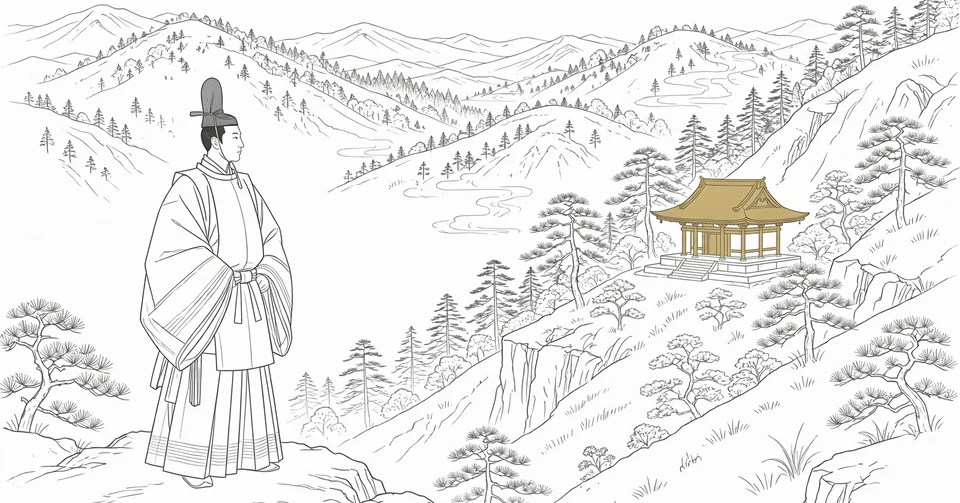
The story of Fujiwara no Kiyohira begins in a place that was barely Japan at all. He was born in 1056 in the Kitakami Basin, in what is now Iwate Prefecture, to a father from the Fujiwara clan and a mother from the Emishi people who lived beyond the frontier. His whole life would be shaped by the border between those two worlds, and by the wars fought over it.
A childhood shaped by war
Fujiwara no Kiyohira was born into a family at war with the central government. His father, Fujiwara no Tsunekiyo, was a mid level bureaucrat at Fort Taga, in present day Sendai, who married a daughter of the Emishi leader Abe no Yoritoki, left his post, and went to live with his wife's family in what is now Iwate Prefecture. To the authorities in Kyoto, that made Tsunekiyo a traitor. To the Emishi, he was family. Fujiwara no Kiyohira grew up inside that contradiction, a Fujiwara by blood raised in an Emishi household on Emishi land.
The wars came early and stayed late. The Earlier Nine Years War, fought on and off from 1050 to 1062, took his grandfather Abe no Yoritoki in battle in 1057 and his uncle Sadato in 1062. In that same year, all of his mother's brothers were deported to Kyushu, far to the south. His own father was beheaded by Minamoto no Yoriyoshi, and the sources record the grim detail that the sword used was blunt. Fujiwara no Kiyohira was six years old when his grandfather died, and the losses kept coming through his whole youth.
After his father's death, his mother became the concubine of Kiyohara no Takehira, the very man who had helped Minamoto no Yoriyoshi in the last war. Fujiwara no Kiyohira was brought up in this enemy clan as Kiyohara no Kiyohira, alongside his elder stepbrother Sanehira and his younger half brother Iehira. Imagine the strangeness of that childhood. The boy ate at the table of the man who had helped kill his father, and he was expected to call that household home. It is the kind of beginning that usually produces either a broken person or a ruthless one. Fujiwara no Kiyohira became neither, though it took him forty years to prove it.
I keep coming back to that detail, the boy raised by his father's enemy, because it explains so much of what followed. A man who had lived inside his enemy's house knew that enemies were people, with families and tables of their own. That knowledge does not excuse what he later did in war, but it may explain what he built after it.
Fujiwara no Kiyohira and the war that made him
The Latter Three Years War, also called the Gosannen War, ran from 1083 to 1087, and it was at heart a struggle among the three brothers of that tangled household. Fujiwara no Kiyohira fought against his own stepbrother and half brother, and he won the final victory in 1087 with the aid of Minamoto no Yoshiie, the son of another of his old enemies. Victory cost him his wife and his son, killed by his half brother Iehira during the fighting.
Think about what that means. Fujiwara no Kiyohira won the war and lost his family in the same stroke. He was thirty one years old, a victor with almost nothing left to celebrate. The men who had killed his father were dead or defeated, and so were the people he loved most. Revenge had delivered exactly what revenge always delivers, which is an empty room.
This is the turning point of his life, and I think it is the moment that makes Fujiwara no Kiyohira more than a footnote in a chronicle of frontier wars. Many warlords of his age treated victory as a licence to take more. Fujiwara no Kiyohira treated it as a warning. He had seen what forty years of fighting had done to the north, to his own family and to the families of his enemies, and he decided that the answer was not another army. The answer, he concluded, was a temple.
There is a temptation to make this sound like a sudden conversion, a warrior who saw the light in a single night. The truth was slower and more practical. Fujiwara no Kiyohira returned to his home at Fort Toyota, in present day Esashi Ward of Oshu City, and spent the years after the war planning his future. He was not a monk. He was a ruler with land, soldiers and gold, and he used those things the way rulers do, to build something that would last. What was different was what he chose to build.
From Fort Toyota to Mount Kanzan
Around 1090 to 1100, Fujiwara no Kiyohira built a new home on Mount Kanzan, Barrier Mountain, in what is now the town of Hiraizumi. The choice of site was careful, and the reasons for it tell you how this man thought. First, the site stood directly on the Frontier Way, the main highway leading south to the capital and north to the lands he controlled. Second, it was the centre of his realm, Oshu, measured from the Shirakawa Barrier in the south to Sotogahama in present day Aomori Prefecture in the north. Third, it stood on the southern side of the Koromo River, in what had traditionally been Japanese territory, while Emishi forts had always been built on the northern side of east or west flowing rivers.
That third reason matters more than it looks. Fujiwara no Kiyohira was the son of an Emishi mother and a Fujiwara father, raised in an Emishi household and then in an enemy clan. By building on the southern bank, he was planting his flag in Japanese territory while ruling a land that was mostly Emishi. He was, in stone and timber, declaring that the two sides of his own blood could share one capital. It was a political statement made with geography, and it worked. Hiraizumi grew into a city that rivalled Kyoto in wealth and culture, and it stayed the seat of his family for three generations.
One curious detail from the records shows how slowly his identity settled. There is evidence that Fujiwara no Kiyohira did not use the name Fujiwara until 1117, when he was more than sixty years old, and that before that he went by the name Kiyohara, the name of the clan that had raised him. He did use the Fujiwara name in the end, and he passed it on to his children, but the fact that he waited so long says something about the man. Names were not labels to him. They were loyalties, and loyalties took a lifetime to sort out.
His family life was complicated in the way frontier lives often were. Fujiwara no Kiyohira had several wives and consorts, including a Taira wife from Kyoto who was called the mother of his six children. She seems to have tired quickly of life on the remote frontier, returned to Kyoto, married a policeman, and never came back. He also had two Emishi wives. His eldest son and rightful heir was Koretsune, but his second son and eventual successor was Motohira, born about 1105, likely to one of his Emishi wives. The succession passed over the elder son, which suggests that the politics of the household were never simple, and that Fujiwara no Kiyohira chose his heir for ability rather than birth order.
A capital built on gold, horses and trade
Hiraizumi did not grow rich by accident. The wealth of the Oshu Fujiwara rested on gold, horses and trade, and Fujiwara no Kiyohira controlled all three. Gold was mined in the hills around Hiraizumi, horses were bred on the northern plains, and the city sat on the highway that carried goods between the capital and the far north. A ruler who held that ground could afford to build in gold leaf, and Fujiwara no Kiyohira did exactly that.
The reach of Hiraizumi trade is visible in the smallest details of the Golden Hall. The mother of pearl inlaid into its pillars and beams came from turban shells of the southern seas, which means a small northern capital was importing shells from far southern waters to decorate a single room. That is the signature of a trading power, not a backwater. Fujiwara no Kiyohira was not a hermit on a mountain. He was a merchant prince who understood that wealth spent on beauty was wealth that outlasted its owner.
The city he built kept growing after his death. His sons Motohira and Hidehira continued his work, adding temples, gardens and palaces, until Hiraizumi was a capital that visitors compared with Kyoto itself. Japan Guide, the travel guide to the country, notes that the city grew steadily in cultural sophistication and political power until it rivalled the national capital. That growth began with one man's decision to stop fighting and start building, and it is worth remembering that the most famous thing in Hiraizumi today is not a palace or a fortress. It is a temple.
I find that quietly instructive. We tend to measure rulers by the land they conquered, but the land Fujiwara no Kiyohira conquered is now ordinary farmland, and the temples he built are a World Heritage site. The things we build to show power fade with the power. The things we build to express belief tend to outlive us, which is a useful thought for anyone deciding what to spend their own energy on.
The temple programme of Fujiwara no Kiyohira
After setting up house in Hiraizumi, Fujiwara no Kiyohira began a Buddhist temple building programme on top of Mount Kanzan, at Chuson-ji. The complex of temples, pagodas, repositories and gardens was to be his legacy, the embodiment of his vision for himself, his family and his domain for all time. The work proceeded in stages, and the dates are unusually solid for the twelfth century because the Konjikido itself carries an inscription on its ridge beam.
| Year | Building | Purpose |
|---|---|---|
| 1105 | Saishoin hall | First hall of the new temple complex |
| 1107 | Two storey Amida hall | A hall dedicated to Amida Buddha |
| 1124 | Konjikido, the Golden Hall | Final hall, completed near the end of his life |
The table looks tidy, but the twenty years behind it were not. Fujiwara no Kiyohira was in his fifties when he raised the Saishoin hall, and sixty eight when the Konjikido was finished. He spent the whole second half of his life on this one project, which tells you how seriously he took it. This was not a monument thrown up in a year of surplus. It was the slow work of an old man who had decided what his life was for.
The Konjikido, completed in 1124, was the crown of the programme. It is a small building, about five and a half metres on each side, yet it holds the whole story of Hiraizumi inside its walls. It enshrines Amida Nyorai, the Buddha of Infinite Light, whose Pure Land was the goal of the faithful. In Pure Land teaching, the paradise of Amida glitters, and a hall covered in gold was a way of making that paradise visible to people who would never read a sutra. You can read the full story of the hall in Konjikido Is the Golden Hall That Outlived a Fallen Capital, which describes its gold leaf, lacquer and mother of pearl in detail.
Fujiwara no Kiyohira did not build the Konjikido to show off. He built it to comfort the spirits of everyone who had died in the long wars of the Tohoku region, friend and foe alike. That is the detail that lifts the whole story out of the ordinary run of temple building. Most memorials honour one side. Fujiwara no Kiyohira built his for both sides, including the men who had killed his father and the half brother who had killed his wife and son. He had lived inside the enemy's house as a boy, and he had fought his own brothers as a man, so he knew better than most that the line between friend and foe was thin, and that the dead on both sides deserved the same prayer.
Why the Golden Hall is so small
One question visitors always ask about the Konjikido is why it is so small. A ruler with gold mines and a capital to fill could have built something vast. Fujiwara no Kiyohira built a room barely larger than a village hall, and the smallness was the point. Gold on a vast temple would be a boast. Gold on a room this size feels like a secret, something made for prayer rather than display, and that is why it still moves people nine hundred years later.
There is also a practical side to the smallness. A small building is easier to protect, and the Konjikido needed protecting. In 1189, the year Hiraizumi fell, the city was almost entirely destroyed, yet the Golden Hall survived. Rain screens fitted beneath its eaves soon after construction kept the weather off the lacquer, and a wooden sheltering hall built over the whole building in the Kamakura period gave it a second skin. In 1337 a fire destroyed the founding complex that had spread over the hill and its foot, leaving only the Golden Hall and the sutra repository standing. Almost ninety percent of the structure and materials used when the Konjikido was first built still survive, a figure that still surprises me every time I read it.
The temple that holds the Golden Hall is itself part of the story. Chuson-ji Is the Mountain Temple That Guarded the Golden Hall tells how the mountain temple grew around the work Fujiwara no Kiyohira began, and how it kept guard over the hall through the centuries when the capital below had vanished. The hall survived because the mountain kept it, and the mountain kept it because one man chose that mountain for his home.
The English Wikipedia article on Fujiwara no Kiyohira gives the plain facts of his life, from his birth in 1056 to his death on August 10, 1128, and it is a useful check against the romance that gathers around a figure like this. The dates are not generous to legend. He was sixty eight when the Konjikido was completed, and he died four years later. He did not live to see his dynasty at its height. He saw only the beginning of it, and that was enough for him.
Sons, successors and the end of the dream
Fujiwara no Kiyohira died in 1128, and the headship of the family passed to his second son Motohira, who was born about 1105. Motohira continued his father's building programme, and his son Hidehira, the third lord, carried Hiraizumi to its greatest wealth and splendour. Three generations of the Oshu Fujiwara ruled the north from the capital Fujiwara no Kiyohira had founded, and for a while it looked as though his answer to war, a city of temples and gardens, would last as long as any empire.
It did not. In 1189, sixty one years after the death of Fujiwara no Kiyohira, Hiraizumi was razed by Minamoto no Yoritomo, the man who would soon after become Japan's first shogun. Yoritomo was looking for his brother and rival Yoshitsune, who was being given refuge by the local Fujiwara leader, and the city never recovered its former prominence. The poet Matsuo Basho visited the ruins five centuries later and wrote that three generations of glory had vanished in the space of a dream.
The dream was real, though, and it is still possible to walk through what remains of it. The Hiraizumi travel guide on Japan Guide lists the temples and gardens that survive, and it is a short list for a city that once rivalled Kyoto. The Konjikido is the only structure among them that remains from the twelfth century in its original form, and UNESCO inscribed Hiraizumi as a World Heritage site in 2011 under the name Hiraizumi, Temples, Gardens and Archaeological Sites Representing the Buddhist Pure Land.
There is a sadness in that ending, but it is not the whole story. Fujiwara no Kiyohira did not build Hiraizumi to last forever. He built it to comfort the dead, and the hall that did that job is still doing it. The palaces are gone, the streets are gone, the power is gone, and the small golden room is still there. If he had built a fortress instead, it would be a ruin like all the others. He built a prayer, and prayers are harder to destroy.
What Fujiwara no Kiyohira still teaches
The life of Fujiwara no Kiyohira offers a test that is easy to state and hard to pass. When you have been wronged, do you spend the rest of your life settling the score, or do you spend it building something that makes the score irrelevant? Fujiwara no Kiyohira had better reasons for revenge than most people ever will. His father was executed, his grandfather and uncle were killed in battle, his mother's brothers were exiled, and his own wife and son were murdered by his half brother. He won the war, and then he chose not to live in it anymore.
I think the gold matters here, and not only as decoration. Gold does not rust, and Fujiwara no Kiyohira chose a material that would not fade for a message that he did not want to fade either. The message was that the dead of every side deserved the same light, and that a city could be built on prayer instead of plunder. Nine centuries later, visitors still stand in front of that small golden room and understand the message without reading a word of it. That is the measure of the man, and of the choice he made when he had every excuse to choose differently.
Fujiwara no Kiyohira turned war into gold, and the gold is still there. The war is not.
More in Culture & Society
- Sagemono Are the Hanging Treasures Samurai Wore at the Waist
- Oshu Fujiwara Built a Golden Capital in the North
- Motsu-ji Keeps Hiraizumi's Pure Land Garden Alive
- Hiramaki-e Keeps the Gold Flat and Lets the Picture Speak
- Chuson-ji Is the Mountain Temple That Guarded the Golden Hall
- Urushi Kabure Is the Rash Lacquer Apprentices Learn to Live With
Latest posts
- Harajuku and the Tokyo Streets Where Fashion Refuses to Sit Still
- Konjikido Is the Golden Hall That Outlived a Fallen Capital
- Hidehira-Nuri Keeps Hiraizumi's Golden Age in Lacquer
- Urushiol Is the Itch Behind Japan's Most Beautiful Lacquer
- Wajima-nuri Is the Lacquer That Survives Being Dropped
- Tsugaru-nuri Hides Four Seasons of Colour Under the Lacquer
- Shunkei-nuri Lets the Wood Grain Shine Through the Lacquer
- Takamaki-e Raises Gold Off the Lacquer Until You Can Feel It
- Shibayama Turns Shell Ivory and Coral Into Small Paintings in Lacquer
- Togidashi Buries Gold in Lacquer and Polishes It Back Into the Light
- Nashiji Scatters Gold Dust Like Pear Skin Across Black Lacquer
- Raden Turns Mother of Pearl Into Lacquer That Catches the Light
- Maki-e Sprinkles Gold Dust Onto Wet Lacquer
- Urushi Is the Tree Sap Japan Turns Into Lacquer That Outlives Centuries
- Ojime Is the Tiny Bead That Keeps a Netsuke From Slipping Away