Shunkei-nuri Lets the Wood Grain Shine Through the Lacquer
· 14 min read
Shunkei-nuri is the lacquerware of Hida Takayama that uses clear lacquer so the grain of the wood stays visible, and its story begins with a carpenter, a split cypress log, and a tray made in 1607.
Most lacquerware hides the wood it protects. A black bowl or a vermilion box shows you the lacquer and nothing else, and the wood underneath could be anything. Shunkei-nuri does the opposite. It uses clear lacquer so the grain of the wood stays visible, and the whole craft is built around one simple idea: the wood is the decoration.
Hold a piece of shunkei-nuri in your hands and you see amber light caught in the grain. The lines of the timber run through the finish like rivers on a map, and no two pieces ever look the same. That is the point of the craft, and it is also the reason it has survived for more than four hundred years in the mountains of Gifu Prefecture.
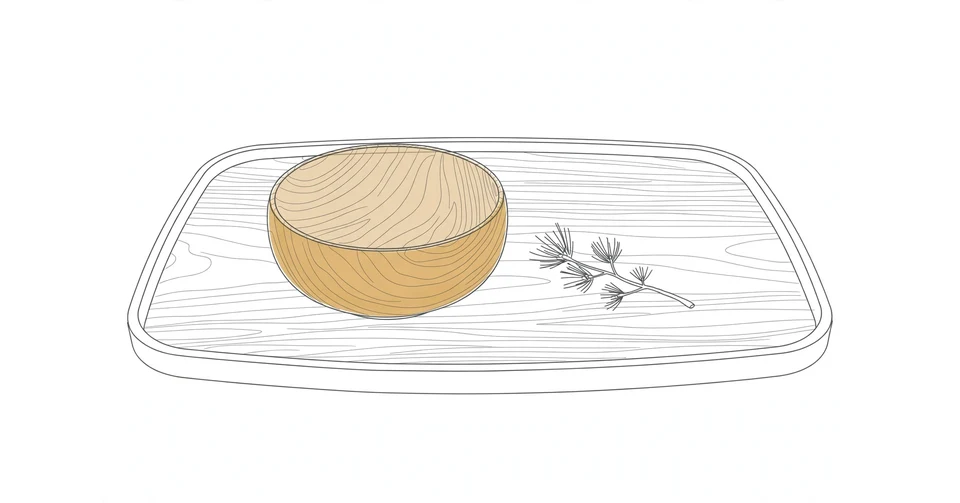
I like crafts that trust their material, and shunkei-nuri trusts its wood completely. It does not paint over the grain or carve it into a picture. It polishes the timber, seals it in clear lacquer, and lets the tree do the talking. The result is quieter than the gold-sprinkled lacquerware Kyoto is famous for, but it rewards a closer look, and the closer you look, the more you see.
A tray made from a split log in 1607
The story of shunkei-nuri begins in Takayama, in the Hida region of northern Gifu Prefecture, in the early seventeenth century. According to the history preserved by Takayama City, a master carpenter named Takahashi Kizaemon was working on the construction of temples and shrines in the castle town when he split a piece of sawara cypress and noticed how beautiful the grain was. Sawara cypress, known to botanists as Chamaecyparis pisifera, is a soft, fine-grained timber, and the split log showed lines that no carpenter would want to cover up.
Kizaemon made the wood into a tray in the shape of a clamshell. He attached a rim of bentwood and bark from the Japanese cherry tree, and the finished tray was presented to Kanamori Shigechika, the son of Kanamori Arishige, the second lord of Takayama Castle. Shigechika later became widely known as the tea master Kanamori Sowa, and he liked the tray enough to ask the official lacquerer Narita Sanemon to finish it with lacquer that would complement the grain rather than hide it.
Narita applied a transparent lacquer, and the colour of the result was said to resemble a celebrated tea caddy known as Hishunkei, traditionally associated with the potter Kato Kagemasa, who lived from 1168 to 1249. The lacquerware consequently came to be known as shunkei-nuri. The date usually given for the tray is 1607, in the Keicho era of the early Edo period, which makes the craft more than four hundred years old. A few sources give a different account of the name, tracing it to a lacquerer active in Sakai in the fourteenth century, but the Takayama story of the tray and the tea caddy is the version the city itself preserves, and it is the one the workshops still tell.
At first, shunkei-nuri was mainly used for tea utensils. The clear finish suited the tea room, where quiet materials and natural textures are valued more than show. During the Edo period, which ran from 1603 to 1868, production widened to trays, stacked food boxes, and other household items, and the ware moved from the tea room into ordinary homes. From the late Edo period through the Meiji period, makers added tiered boxes and practical board-built wares, and in the Taisho period and the early Showa period they developed curved and circular forms alongside the traditional angular ones, broadening the range to flower vessels and other household objects.
The craft was badly hit during World War II, when lacquer and other materials became hard to obtain, but it revived in the postwar years. During the rapid economic growth of 1955 to 1973, shunkei-nuri became a popular gift, and as the Hida Takayama area grew as a sightseeing destination, visitors began buying pieces as souvenirs. On February 17, 1975, Hida Shunkei was designated a Traditional Craft by the Japanese government, a recognition that still defines the craft today.
What makes shunkei-nuri different
Most Japanese lacquerware is opaque. The black finish comes from lacquer coloured with iron hydroxide, and the bright vermilion comes from lacquer mixed with cinnabar or red iron oxide. Shunkei-nuri uses suki-urushi, a clear, light amber lacquer made by refining raw urushi sap, and the difference is visible at a glance. Where other lacquerware presents a surface, shunkei-nuri presents a depth, with the grain floating just below a warm, glassy skin.
The clear lacquer is applied repeatedly, coat after coat, and each layer deepens the colour a little and adds to the lustre. The finished result is determined by the actual lacquer mixture, so no two pieces are ever the same, even when they come from the same workshop and the same shape. The pieces are generally yellow or crimson, and the colour changes over the years, growing deeper as the lacquer ages. I find that slow change reassuring. A piece of shunkei-nuri does not pretend to be finished on the day you buy it. It keeps maturing, the way good wood furniture does, and the owner gets to watch it happen.
The contrast with other lacquer traditions is instructive. Our guide to urushi, the tree sap Japan turns into lacquer explains how raw sap is filtered and stirred into clear suki-urushi, and shunkei-nuri is the tradition that puts that clear lacquer to its purest use. Where maki-e covers wet lacquer with gold powder, shunkei-nuri covers it with nothing at all. You can read about that gold-dusted technique in our story of maki-e, which sprinkles gold dust onto wet lacquer, and the two crafts make a fine pair: one hides the wood under gold, the other shows the wood through glass.
Two artisans, one piece
No single artisan makes a piece of shunkei-nuri alone. The craft requires collaboration between two kinds of artisan, and the division of labour has been part of the tradition since the beginning. The kijishi is the woodworker who shapes the wooden base, and the nushi, sometimes called a nurishi, is the lacquerer who applies the lacquer. Each must understand the other's work, because a flaw in the wood cannot be hidden by the lacquer, and a mistake in the lacquer can ruin weeks of woodwork.
The kijishi starts with timber chosen for its grain. Modern shunkei-nuri goes beyond its sawara cypress roots and is also made from hinoki cypress, Japanese horse chestnut, and other timbers with fine grains. Each wood differs in firmness and appearance, so handling them properly requires a lot of experience and expert knowledge. Timber processing is delicate work done by hand with many different tools, and the kijishi uses the natural grain of the timber to create the beautiful hegime lines that shunkei-nuri is famous for. Hegime is the fine, straight grain pattern that runs along the wood, and in a good piece it looks almost like flowing water.
There are different kinds of kijishi, each specialising in different products. The hegimeshi makes rectangular products like food boxes, the magemonoshi makes rounded objects like trays from bent wood, and the hikimonoshi uses a lathe to hollow out wood to create saucers and bowls. The base must be shaped perfectly, because clear lacquer is unforgiving. A scratch, a dent, or an uneven curve will show through every coat, so the woodwork has to be flawless before the lacquerer ever picks up a brush.
Then the nushi takes over, and the work slows down dramatically. The lacquer is blended by the nushi to complement each individual piece of wood, because no two pieces of timber take the lacquer in quite the same way. The nushi must maintain a steady temperature and humidity while carefully completing the painting process, including the undercoat, the blending, the top coat, and the drying. Urushi cures best in warm, humid air, roughly 20 to 30 degrees Celsius and 60 to 80 percent humidity, so the workshop has to be managed like a small climate of its own. Taking over 20 steps to complete, and with the painting of a single piece taking between 3 and 4 months, shunkei-nuri is not a craft for impatient people. I think that is exactly why it is worth knowing about. The slowness is not a flaw in the process. It is the process.
Why no two pieces look alike
The individuality of shunkei-nuri is not a marketing claim. It follows directly from the materials. The grain of each piece of wood is unique, the lacquer mixture is blended fresh for each piece, and the curing depends on temperature and humidity that shift with the season. The result is that every piece carries its own pattern, its own shade of amber, and its own lustre, and a pair of bowls made on the same day can look like cousins rather than twins.
Pieces recognised by the Hida-Shunkei Union Cooperative are required to be hand-painted using traditional techniques without the assistance of machines, and those that meet the standard carry a hand-painted mark confirming their authenticity. That mark is worth looking for when buying, because it separates the genuine craft from the many lacquered imitations on the market. A genuine piece is also easy to recognise by feel. The surface is warm and smooth, the grain is visible under the lacquer rather than printed on top of it, and the colour has a depth that a sprayed finish cannot copy.
The colour will keep changing after the piece leaves the workshop. Transparent lacquer is sensitive to ultraviolet light, which slowly deepens and darkens the tone, so a pale yellow tray will grow warmer and richer over the years. This is not damage. It is the same ageing that gives old lacquerware its patina, and it is one of the reasons owners come to love their pieces more with time. A piece of shunkei-nuri is not a frozen object. It is a living surface, and living with it means accepting that it will change.
From the tea room to the everyday table
Shunkei-nuri began as tea ware, but it did not stay there. As production widened in the Edo period, the craft moved into trays, tiered boxes, bowls, and food containers, and today the range is wider still. Traditional food boxes and trays remain the core of the craft, but workshops also make flower vases, small tables, and ornaments, and in recent years they have added smaller everyday items such as cups, ballpoint pens, accessories, clocks, business card holders, and photo frames. The idea is to let more people use the craft in daily life, not just on special occasions, and the workshops in Takayama sell pieces that are meant to be handled, not kept behind glass.
That everyday use suits the material. Lacquered wood is light, warm to the touch, and tougher than it looks, and a well made piece can be repaired and refinished rather than thrown away. A tray that has served tea for twenty years will show the soft wear of use, and that wear is part of its character rather than a flaw. I have always liked objects that are allowed to age in public like that. A plastic tray looks its best on the day you buy it and worse every day after. A shunkei-nuri tray looks better every year, and the scratches it gathers are a record of the meals it has carried.
Takayama itself helps the craft. The city sits in the centre of the Hida region in northern Gifu Prefecture, and its old centre retains the atmosphere of an Edo period castle and merchant town, earning it the nickname the Little Kyoto of Hida. Visitors who walk the old streets of Sanmachi, with their wooden facades and latticed fronts, often buy a piece of shunkei-nuri as a souvenir, and many workshops welcome visitors who want to see the work up close. The craft and the town fit each other. Both are quiet, both are built on wood, and both reward people who slow down enough to notice the grain.
How to choose a piece and look after it
Buying shunkei-nuri is mostly a matter of looking closely and choosing the wood you like. Since the grain is the decoration, the first thing to do is look at the pattern. Some pieces have bold, sweeping grain, while others have fine, straight hegime lines, and neither is better than the other. Choose the piece whose grain you enjoy looking at, because you will be looking at it for years. Check for the hand-painted mark of the Hida-Shunkei Union Cooperative, which confirms that the piece was hand-painted using traditional techniques. Then pick the piece up. It should feel light and warm, with a smooth surface and no rough patches, and the lacquer should feel like a skin over the wood rather than a thick coating on top of it.
Prices vary widely, from small affordable items like pens and card holders to large trays and tiered boxes that cost far more, and the price usually reflects the size of the piece, the quality of the timber, and the months of work behind it. A cheaper piece is not necessarily a worse one. It may simply be smaller, or made from a more common timber, and a small cup used every morning can give as much pleasure as a large tray used once a year. The honest advice is to buy the piece you will actually use, and use it often, because lacquerware that sits in a cupboard never gets the chance to age beautifully.
Looking after shunkei-nuri follows the same rules as looking after any lacquerware. Hand wash it with a mild detergent and a soft cloth, then dry it promptly. Avoid harsh detergents, long soaking, dishwashers, and microwaves, and keep it out of strong direct sunlight, since ultraviolet light degrades the surface over time and will darken the clear lacquer faster than you might like. Lacquer likes the same moderate humidity that people do, neither bone dry nor damp, so a normal room is the right place for it. Treated that way, a piece will last for decades, and a scratched surface can be recoated by a craftsman who knows the material.
Why shunkei-nuri still matters
There are easier ways to make a tray. A factory can press one out of plastic in seconds, and it will be cheaper, lighter, and perfectly uniform. Shunkei-nuri takes a different path. It takes a tree that grew for decades, a woodworker who shapes it by hand, and a lacquerer who spends three or four months coating it, all to produce a tray that shows you the tree it came from. That sounds inefficient, and in the narrow sense it is. But the tray that comes out of that slow process will still be in use when the plastic one is in a landfill, and it will look better at fifty than it did at five.
The craft also preserves a way of thinking about materials that is easy to lose. Shunkei-nuri does not improve on the wood. It does not cover it, carve it into a picture, or paint it a brighter colour. It simply protects it and makes it shine, and it trusts that the grain of a sawara cypress is beautiful enough on its own. That trust is the whole philosophy of the craft, and it is a generous one. It says that nature already did the hard work, and the artisan's job is to get out of the way.
For a fuller picture of the tradition, the KOGEI JAPAN guide to Hida Shunkei lacquerware traces the origins of the craft and its designation as a Traditional Craft, while the Japan House London display on Hida Shunkei lacquerware tells the story of the 1607 tray and the Takayama workshops. Both are worth reading before a visit to Takayama, and both make the same point this article has tried to make. Shunkei-nuri is a craft that lets the wood speak, and after four hundred years, the wood still has plenty to say.
More in Culture & Society
- Wajima-nuri Is the Lacquer That Survives Being Dropped
- Tsugaru-nuri Hides Four Seasons of Colour Under the Lacquer
- Takamaki-e Raises Gold Off the Lacquer Until You Can Feel It
- Shibayama Turns Shell Ivory and Coral Into Small Paintings in Lacquer
- Togidashi Buries Gold in Lacquer and Polishes It Back Into the Light
- Nashiji Scatters Gold Dust Like Pear Skin Across Black Lacquer
Latest posts
- Raden Turns Mother of Pearl Into Lacquer That Catches the Light
- Maki-e Sprinkles Gold Dust Onto Wet Lacquer
- Urushi Is the Tree Sap Japan Turns Into Lacquer That Outlives Centuries
- Ojime Is the Tiny Bead That Keeps a Netsuke From Slipping Away
- Inro Is the Little Lacquered Box That Carried a Samurai's Day
- Hachimaki Is the Headband Japan Ties On Before the Hard Part Begins
- Netsuke Held a Samurai's World on a Cord
- Tenugui Is the Thin Cotton Cloth Japan Uses for Everything
- Kinchaku Carries a Whole Festival in One Small Bag
- Takuan Turns a Humble Daikon Into Japan's Yellow Crunch
- Nukazuke Is the Living Pickle Bed Japan Feeds Every Day
- Tsukemono Is the Crunch Japan Puts Beside Every Meal
- Ochazuke Is Rice Tea and Comfort in One Bowl
- Aojiso Is the Green Leaf Japan Eats Fresh and Raw
- Akajiso Gives Umeboshi Its Deep Red Blush