Wajima-nuri Is the Lacquer That Survives Being Dropped
· 23 min read
Wajima-nuri is the lacquerware of Wajima in Ishikawa, built on cloth reinforcement and local diatomaceous earth so a bowl can survive a fall that would shatter ordinary ware.
Drop a bowl of Wajima-nuri on a hard floor and you will hear the sound every owner dreads, a sharp crack followed by silence. Drop a bowl made in Wajima and you may hear something else entirely, a dull knock and then nothing, because the bowl is still whole in your hand. That is the whole promise of Wajima-nuri, and it is not a trick of marketing. It is the result of a base coat built like armor, layer upon layer, under a surface that looks too delicate to survive anything at all.
Wajima-nuri is the lacquerware of Wajima, a small city on the Noto Peninsula in Ishikawa Prefecture, and its fame rests on toughness before beauty. The wood beneath the lacquer of Wajima-nuri is usually zelkova, a hard and heavy timber. The weak points of each piece are wrapped in cloth soaked in lacquer before any color goes on. The undercoat is mixed with a powdered earth found only around Wajima. Each piece passes through dozens of stages and as many as 124 separate hand operations before it is finished. Nothing about that process is fast, and that is exactly the point.
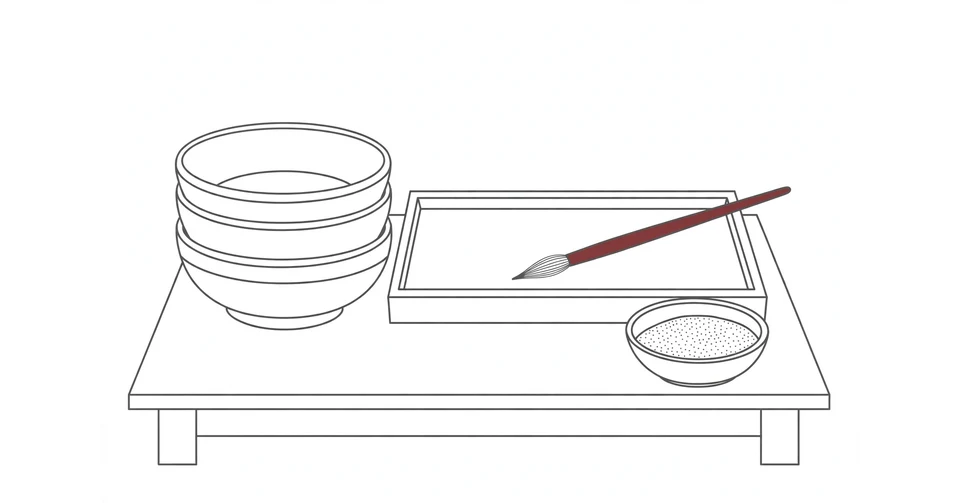
A piece of Wajima-nuri is not meant to sit behind glass. It is meant to hold hot soup every day, to be washed, dried, knocked against a sink, and picked up again the next morning. The people of Wajima have a word for living with lacquerware, sodateru, which means to raise it, the way you would raise a child. A piece of Wajima-nuri is supposed to grow more beautiful the longer you use it, and the craft is built so that it can survive long enough to do so.
What wajima-nuri is
Our guide to urushi introduced this lacquerware in passing as Wajima-nuri from Ishikawa, and that short phrase carries a whole geography inside it. Wajima sits near the northern tip of the Noto Peninsula, a long finger of land that reaches into the Sea of Japan. It is a small city, home to just under 30,000 people, and it became known across Japan for one thing above all, lacquerware that does not give up easily. The town is also famous for its morning market, its demon mask drumming, and its terraced rice fields stepping down to the sea, but lacquer is the craft that put its name on the map.
The simplest definition comes from the reference works. Wajima-nuri is a type of Japanese lacquerware from Wajima, Ishikawa, and its main distinguishing feature is the durable undercoating made by applying multiple layers of urushi mixed with powdered diatomaceous earth, called ji-no-ko, onto delicate zelkova wooden substrates. That sentence, from the Wajima-nuri entry on Wikipedia, sounds technical, but it is really a recipe for survival. The wood gives the bowl its shape. The earth gives it its strength. The lacquer holds the two together and seals them against water, heat, and time.
The word nuri itself simply means lacquered or coated, so the name is almost plain, lacquerware from Wajima. What makes Wajima-nuri special is not the name but the method, a way of building the undercoat that no other lacquer town in Japan uses in quite the same way. The makers of Wajima-nuri chose the most durable and the most labor intensive way of making the foundation, a method called hon-kataji, or true hard ground, and protected it rather than competing on low prices. That choice, made over generations, is why a Wajima-nuri bowl costs what it does and lasts as long as it does. I find something reassuring in that stubbornness. In a world that usually rewards the cheaper and the faster, here is a whole town that decided to be the slower and the stronger instead.
The cloth that catches the crack
Every bowl has weak points, and the makers of Wajima-nuri start by admitting that. The rim is thin. The foot is narrow. A knock in the wrong place can split the wood along its grain. So before any decorative coat goes on, the lacquerer wraps those weak points in cloth soaked in lacquer, a technique called nunokise, which means dressing in cloth. The cloth is usually hemp, coarse and strong, glued down with lacquer and smoothed flat until it disappears into the body of the piece.
Our earlier article on urushi described the trick in one long sentence, and it is worth quoting in full because it says so much in so few words. In Wajima, the famous lacquer town in Ishikawa Prefecture, the weak points of a bowl, such as the lip and the foot, are first reinforced with cloth soaked in lacquer, a technique called nunokise, and the base powder is a local diatomaceous earth found only around Wajima. That is the whole secret, stated plainly. Cloth where the bowl is weak, local earth where the bowl needs body, and lacquer to bind them into a single skin.
The idea behind Wajima-nuri is older than it looks, and it is not so different from the way a plasterer lays mesh over a crack before skimming a wall, or the way a boat builder lays fiberglass over a wooden hull. The cloth spreads the force of a knock across a wider area instead of letting it concentrate on one thin edge. A rim that would chip becomes a rim that flexes, just a little, and then holds. It is a humble idea, a piece of cloth, and it is easy to miss because it is buried under everything that comes after. But take it away and Wajima-nuri becomes ordinary again, pretty on the outside and fragile underneath. I think there is a lesson in that order of work. The makers of Wajima-nuri spend their first effort on the parts nobody will ever see, and the beauty comes later, on top of a foundation that has already been made honest.
Nunokise is applied with lacquer mixed with rice glue, and it is smoothed and dried before the earth coats begin. The lacquerer works it down with small spatulas and planes, feeling for any ridge or bubble with the flat of the hand. If the cloth is laid badly, every coat that follows will show the mistake, so this early step is done slowly, in good light, with no shortcuts. A piece of Wajima-nuri may pass through many hands before it is finished, but the cloth layer is where its long life is decided.
The earth that only Wajima has
If nunokise is the hidden skeleton of Wajima-nuri, then jinoko is its muscle. Jinoko means earth powder, and it is made by firing earth dug from Mount Komine near Wajima, then grinding it to a fine powder. The earth is diatomaceous, which means it is made of the microscopic shells of ancient single celled organisms, and it has a structure that bonds tightly with lacquer. Mixed into raw urushi, it forms a paste that is spread over the cloth reinforced base of a piece of Wajima-nuri, dried, ground smooth, and then spread again, over and over, building up the body of the piece a fraction of a millimetre at a time.
Each round of jinoko paste is rubbed on and polished back, and the powder grows finer with every round, three rounds in the usual telling, each one smoother than the last. The undercoat evens out the joins and small knots in the wood, reinforces the weak points, and creates a dense surface that later coats can grip. It also gives the piece its form, refining the subtle lines of the bowl as the lacquerer works. The base coat is invisible in the finished piece, which is why one lacquer house calls it the unsung hero of the craft, the least appreciated and the most valuable part of the whole process.
The fact that the earth in Wajima-nuri comes from one mountain near one town matters more than it sounds. Other lacquer towns mix other powders into their base coats, clay or volcanic ash, and their ware is good in its own way. But the diatomaceous earth in Wajima-nuri, the ji-no-ko of the old texts, is local in the strictest sense, and the strength of Wajima-nuri is tied to the ground under the town itself. You cannot move the craft somewhere else and get the same result, because the recipe includes the place. That is part of why the name carries weight. When you buy Wajima-nuri, you are buying a piece of a particular hillside, fired and ground and folded into lacquer by people who live beside it.
There is a quiet kind of pride in that, and I think it is worth noticing. Many crafts claim a connection to place, but here the connection is literal and measurable. The earth is in the bowl. The bowl would be weaker without it. The town dug its own foundation out of its own mountain, and then built a reputation on it that has lasted for centuries.
One hundred and twenty four steps, more or less
A finished piece of Wajima-nuri may pass through as many as 124 separate hand operations, grouped into more than 20 stages, and the number is worth pausing over. It is not 124 steps because someone counted for effect. It is 124 steps because each coat must dry, each surface must be ground flat, and each stage must be done by a specialist who does that one thing better than anyone else in the workshop. The work is divided by trade, and the division is part of the craft.
In Wajima-nuri, it begins with the wood. The wooden base is called the kiji, and it is made by the kijishi, the woodworker. For bowls and round trays, the makers use zelkova, Japanese cherry birch, and horse chestnut, woods that take lacquer well, and the round pieces are turned on a lathe by a specialist bowl turner, the wan-kijishi. The zelkova used for bowls is said to come from trees more than 100 years old. The rough shape is smoked and then dried, and one workshop account says the wood rests for around a year before it is finished. The turner shapes each piece with blades forged by hand, checking its curve against shaped templates, and the shape of the base depends on what the piece will be used for, with different specialists for different forms.
Then comes the coating of Wajima-nuri, and here the division of labor grows finer. The undercoater, the shitaji-nurishi, lays the cloth and builds the jinoko base. The middle coater, the naka-nurishi, lays the middle coats. The polisher, the togishi, grinds each coat flat. The top coater, the uwa-nurishi, brushes on the final layers of refined lacquer. Decoration is the work of the chinkin artist and the maki-e artist, and the final mirror polish is the work of the roiro-shi. A supervisor, the nushiya, oversees the whole process from making to marketing and delivery. No single person makes a whole bowl. A whole town of specialists makes it, one step at a time.
The drying alone explains why Wajima-nuri takes months to make. Lacquer does not dry the way paint dries. It cures in warm and humid air, roughly 20 to 30 degrees Celsius and 60 to 80 percent humidity, and each coat must rest in a humid cabinet, a furo, until it hardens. For the top coat, the piece is dried in a rotating cabinet, the kaiten-buro, which slowly turns the piece over as the lacquer hardens so it cannot run or pool. Dust is the great enemy at this stage. Any speck that settles on the wet surface must be picked off with a fine brush, and the lacquer is laid on roughly with one brush and smoothed with a finishing brush. The top coater must choose and blend lacquers to suit the season and the weather, because every lacquer behaves differently, and that judgment is built on years of experience rather than any written rule.
Wajima-nuri has two main finishes. Nuritate leaves the top coat exactly as it comes from the brush, a soft and subdued sheen with a moist and gentle look. In the world of the tea ceremony, black nuritate is called shin-nuri, true coating, and it is regarded as the most formal finish. Roiro is the opposite extreme. The hardened top coat is ground perfectly flat with special charcoal, then polished again and again while lacquer is rubbed into it, and the final polish is done with the soft palm of the hand. The result is the deep mirror gloss that most people picture when they think of lacquer. Both finishes of Wajima-nuri grow more lustrous with long use, which is why the makers say a piece is raised rather than merely owned. The more you use it, the more attached to it you become, and the more its character deepens.
Our own site has followed one lacquered object through its long making, the saya, the sheath that guards the katana, where a specialist may spend two or three months on a single piece, and the timescale stops sounding like an exaggeration. Wajima-nuri works on the same clock. It is simply what the material demands, and the craftsmen who work with it have never pretended otherwise.
A history carried by ships
The lacquer of Wajima-nuri is thought to date back to ancient times, and the ground keeps offering proof. Lacquer products from 6,800 years ago have been found at the Mibiki Ruins, also on the Noto Peninsula, and lacquer pieces have been excavated at the Yadani B ruins in Wajima itself, remains from the Heian period. A bowl using diatomaceous earth as a base was found at the Nishikawajima Gunmidate ruins in Anamizu, south of Wajima across the mountains, from the early Muromachi period. The oldest surviving piece of Wajima lacquerware is said to be the vermilion door of the former main hall of Juzo Shrine in Wajima, said to have been made in 1524, during the Muromachi period. Dates that old always carry a little uncertainty, and the honest wording is "said to be", but the broad fact is secure. People around Wajima were lacquering wood long before anyone wrote the town's name down.
The name Wajima first appears in historical records around the middle of the Muromachi period, in the 14th to 16th centuries. One account says a monk from Negoro-ji, a temple in present day Wakayama Prefecture famous for its lacquerware, came to Juren-ji temple in Wajima, made furnishings for the temple, and passed on his techniques. Another says a local person traveled to Negoro, learned the techniques, and brought them home. Either way, the craft arrived with a traveler, and it stayed because the town made it its own.
It was in the Edo period, from 1603 to 1868, that the robust undercoating techniques gradually took shape and Wajima-nuri became known as a specialty of Noto. The current technique is said to have been established during the Kanbun era in the early Edo period. Wajima, at the northern tip of the Noto Peninsula, was a port of call for the Kitamae-bune, the trading ships that sailed the Sea of Japan coast, and the makers used that shipping to expand their sales across the country. The lacquerware sellers, the nurishiya, traveled all over Japan with samples on their backs, selling door to door, and from the 18th century they also sold through ko, groups of customers who paid into a shared fund and took turns receiving pieces. A reputation for robustness traveled well, and Wajima lacquerware, famous for not breaking, was used all over Japan.
Decoration came later. Chinkin, in which a design is carved into the hardened lacquer and filled with gold, began in the Kyoho period in the middle of the Edo period, and maki-e, the sprinkled gold picture, came in the Bunsei period in the late Edo period. In maki-e, a design is painted in wet lacquer and gold or silver powder is sprinkled onto it before it dries, then sealed under more lacquer and polished to reveal the image. In chinkin, the line is carved with a sharp chisel and gold leaf or powder is pressed into the cuts, and unlike a painted line, an engraved line cannot be undone. Wajima is said to have perfected chinkin, and the town has produced many master craftspeople, including holders of Japan's highest craft honor, the Living National Treasures.
The wider world noticed. Wajima-nuri was exhibited at expositions overseas and traded at outstanding prices among lacquerware from the major production areas, even as exports declined during the Sino-Japanese and Russo-Japanese wars. In 1975 Wajima-nuri was designated a Traditional Craft by the Ministry of International Trade and Industry, now the Ministry of Economy, Trade and Industry, and on April 25, 1977 its technique was designated an Important Intangible Cultural Property of Japan. Those two dates mark the moment the country formally agreed with what Wajima had known for centuries, that this lacquerware was worth protecting. Our guide to urushi, the tree sap Japan turns into lacquer that outlives centuries tells the longer story of the material itself, from the first tap of the tree to the final polish, and Wajima-nuri is the hardest working chapter of that story.
What a bowl is for
For all its history, Wajima-nuri is not a museum piece. It is tableware, and it was made to be used. Bowls, soup bowls, serving bowls, plates, individual dining trays, tiered food boxes, chopsticks, and small personal trays are the everyday forms, and the wood for each is chosen to suit its job. Round pieces are turned from zelkova and cherry birch. Dining trays and tiered boxes are made from ate, hinoki cypress, and paulownia, woods that resist water so well they are also used in building. The makers of Wajima-nuri pay close attention to the character of each timber, because a bowl that holds hot soup every day has a different job from a tray that carries cups across a room.
The stacked lacquered box, the jubako, shows what daily use looks like at its most festive. Families keep one for decades, fill it for the New Year table, repair it when it chips, and hand it down, and the scratches it gathers are the record of the meals it has carried. Our guide to the jubako, the box that layers a family's luck one box at a time follows one of those boxes through its working life. A Wajima-nuri bowl belongs to the same world. It is not bought to be admired from a distance. It is bought to be held, and holding it is part of the pleasure, because wood conducts very little heat, so it keeps hot food hot and cold food cold, and it feels warm in the hand in a way that porcelain never does.
Looking after Wajima-nuri is simpler than people expect. Wash it gently with lukewarm water, a soft sponge, and a mild neutral detergent, just as you would wash china or glass. Soak it briefly in warm water before washing to soften anything stuck to it, rinse it well, and wipe it dry with a soft cloth. Keep it out of direct sunlight and away from very dry conditions, because the wood still holds a little moisture and the lacquer likes the same moderate humidity that people do. Never put it in a dishwasher or a microwave, which damage both the wood and the coating from within. If it is new, leave it out in the open for a while before first use, since fresh lacquer carries a smell that fades day by day. And use it often. Using and washing a piece every day gives it moisture, and that is what suits it best. That is what raising lacquerware means in practice, not a ceremony, but a habit, repeated across years.
I like the modesty of that advice. There is no special oil, no secret ritual, no cabinet with a lock. The care a Wajima-nuri bowl asks for is the care any good tool asks for, wash it, dry it, do not abuse it, and it will outlast the things you bought to replace it. The craft does not demand reverence. It rewards routine.
After the ground shook
On New Year's Day 2024, the Noto region of Ishikawa Prefecture was struck by a magnitude 7.6 earthquake, and the damage in Noto and the surrounding areas was severe. The region's centuries old legacy of traditional crafts took a heavy blow, and Wajima, at the tip of the peninsula, was among the hardest hit places in Japan. Many buildings were damaged or destroyed, with devastating effects on the workshops and products housed there. For a craft in which most Wajima-nuri artisans worked from workshops inside their own homes, the loss was not only of buildings but of the whole working pattern of a town, the lathes, the drying cabinets, the stocks of wood and lacquer, and the pieces that were months into their making.
The numbers tell part of the story of Wajima-nuri. At its peak in fiscal 1991, there were 2,928 Wajima lacquerware artisans. That number had already fallen below 2,000 before the earthquake, and after the disaster it fell to around 700 in fiscal 2024. The production value of Wajima lacquerware, about 2.4 billion yen in fiscal 2022, fell to about 1.4 billion yen in fiscal 2024. Those figures, reported by the Yomiuri Shimbun two years after the quake, measure a craft that was already shrinking and then lost a large part of what remained in a single day. Few of the town's hundred or so lacquer companies escaped damage, and many artisans found themselves working out of temporary studios while their homes and workshops were rebuilt or left as empty lots.
But the story of Wajima-nuri did not end at the loss. In Nomi, a city in southern Ishikawa known for Kutani ware, a company called CACL opened part of its facility as a temporary workshop for Wajima lacquerware artisans affected by the quake, so they could continue their work, and launched a crowdfunded project with a Wajima lacquer company called Stand with Noto. Most of the artisans invited to work in Nomi have since returned to Wajima, and one, Keizuka Hidenobu, stayed on as a full time employee with a permanent workshop there. The same company gathered around 10 tons of ceramic fragments from workshops and kilns damaged in the earthquake, and Wajima lacquerware artisans joined the pieces into new vessels with kintsugi, the technique of mending with lacquer painted with gold dust, then ornamented them with maki-e. A report by the Government of Japan on the project describes how fragments from crafts that had never worked together before were combined and reborn as unified craftworks with new value.
Back in Wajima, the rebuilding of Wajima-nuri has taken a practical shape. The lacquer company Taya Shikkiten, whose shop on the Asaichi-dori shopping street was destroyed in the fire that followed the quake, set up ten trailer houses on its parking lot and on the site of a damaged company building, and the area opened as Wajimanuri Village, a new base for sales and production where visitors can also see how the lacquerware is made. The company aims to turn it into a place where tourists can stay overnight as well as watch the work. It is a small and stubborn answer to a large disaster, a workshop built from trailers on the ground where the old shop stood, and it is still making Wajima-nuri.
This is where the reputation of Wajima-nuri for surviving a fall stops being a figure of speech. A bowl that resists chipping is a small thing. A craft that loses its workshops, its homes, and nearly two thirds of its artisans in a few years and still keeps making bowls is a larger one. The same qualities that make Wajima-nuri hard to break, a strong base, reinforcement at the weak points, and patience in the drying, are the qualities the town itself has needed since that New Year's Day. I do not want to make the earthquake sound like a gift, because it was not, and many artisans lost far more than their work. But there is something honest in noticing that the craft survived the way its bowls survive, not by being untouched, but by being built to take a blow and keep holding together.
Why a bowl that survives a fall matters
Wajima-nuri matters because it is proof that a slow material can outlast every fast one, and the proof fits in your hand. A plastic bowl is cheaper and lighter, and it will be in a landfill within a decade. A Wajima-nuri bowl takes months to make, costs far more, and may still be in use a century from now, growing more lustrous with every year it is washed and dried and put back on the table. The choice between them is not really about bowls. It is about what kind of time we want our objects to live in, and whether the things we touch every day deserve the same care as the things we put behind glass.
It also matters because it is honest about what strength costs. There is no shortcut to 124 steps. No machine lays cloth over a bowl's lip with the judgment of a person who has done it ten thousand times. No synthetic coating replaces earth dug from one mountain and fired and ground by hand. The price of a Wajima-nuri bowl is not a markup on a brand. It is the visible sum of all those hours, all those specialists, and all that waiting in humid cabinets, and the buyer pays for durability that was built in rather than promised on a label.
If you ever hold a piece of Wajima-nuri, hold it the way its makers intend. Feel the weight of the wood under the lacquer, run a finger around the rim and think of the cloth hidden just beneath it, and notice how the surface seems to glow from inside rather than shine from outside. Then put soup in it, eat from it, wash it, and do the same tomorrow. A bowl that survives being dropped is not a bowl that never falls. It is a bowl that was made by people who assumed it would fall, and built it anyway, so that the fall would not be the end of the story.
More in Culture & Society
- Tsugaru-nuri Hides Four Seasons of Colour Under the Lacquer
- Shunkei-nuri Lets the Wood Grain Shine Through the Lacquer
- Takamaki-e Raises Gold Off the Lacquer Until You Can Feel It
- Shibayama Turns Shell Ivory and Coral Into Small Paintings in Lacquer
- Togidashi Buries Gold in Lacquer and Polishes It Back Into the Light
- Nashiji Scatters Gold Dust Like Pear Skin Across Black Lacquer
Latest posts
- Raden Turns Mother of Pearl Into Lacquer That Catches the Light
- Maki-e Sprinkles Gold Dust Onto Wet Lacquer
- Urushi Is the Tree Sap Japan Turns Into Lacquer That Outlives Centuries
- Ojime Is the Tiny Bead That Keeps a Netsuke From Slipping Away
- Inro Is the Little Lacquered Box That Carried a Samurai's Day
- Hachimaki Is the Headband Japan Ties On Before the Hard Part Begins
- Netsuke Held a Samurai's World on a Cord
- Tenugui Is the Thin Cotton Cloth Japan Uses for Everything
- Kinchaku Carries a Whole Festival in One Small Bag
- Takuan Turns a Humble Daikon Into Japan's Yellow Crunch
- Nukazuke Is the Living Pickle Bed Japan Feeds Every Day
- Tsukemono Is the Crunch Japan Puts Beside Every Meal
- Ochazuke Is Rice Tea and Comfort in One Bowl
- Aojiso Is the Green Leaf Japan Eats Fresh and Raw
- Akajiso Gives Umeboshi Its Deep Red Blush