Hidehira-Nuri Keeps Hiraizumi's Golden Age in Lacquer
· 17 min read
Hidehira-nuri is the gold-leaf lacquerware of Hiraizumi in Iwate, born from the court culture of the Oshu Fujiwara and still made by hand today.
Some lacquerware whispers. Hidehira-nuri does not. A bowl of hidehira-nuri from Hiraizumi in Iwate Prefecture is black or deep vermilion, and across it run clouds and bold gold diamonds that catch the light before you even pick it up. It looks like something a court would eat from, and that is exactly the point.
The name honours Fujiwara no Hidehira, the third lord of the Oshu Fujiwara clan, who ruled the north from Hiraizumi in the late Heian period. Local tradition says he brought craftsmen from Kyoto and asked them to make lacquerware from the lacquer and gold of his own lands. The result was hidehira-nuri, a style that still carries the confidence of a city that once rivalled Kyoto itself.
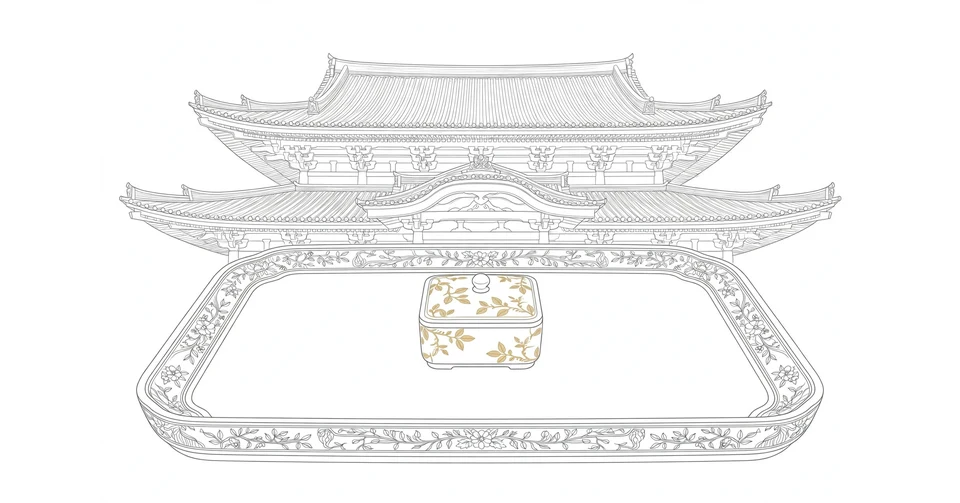
What makes hidehira-nuri worth knowing is not only the gold. It is the way the gold is used, as a pattern with meaning, painted in cloud forms and court diamonds over a lacquer ground built up layer by patient layer. This is lacquer as a record of a place, its wealth, its taste, and its long memory. Once you learn to read the pattern, an ordinary bowl starts to feel like a small piece of history you can hold in both hands.
What hidehira-nuri looks like
The first thing you notice about hidehira-nuri is the contrast. The ground is black lacquer or vermilion lacquer, deep and glossy, and the decoration sits on top of it in gold leaf that seems almost too bright for a humble bowl. The effect is deliberate. Gold against black reads from across a room, and gold against red feels warm rather than showy. A piece of hidehira-nuri is meant to be seen as well as used.
The pattern has a name, and learning it changes how you look at the work. The stylised cloud forms are called Genji-gumo, clouds from the world of the Tale of Genji and the Heian court. Over and around them sit large geometric diamonds known as yusoku motifs, designs drawn from the formal textiles and decorum of the imperial court. Painted floral and plant designs often fill the spaces between. Together the clouds and the diamonds give hidehira-nuri a look that is both soft and severe, drifting shapes held in place by hard geometry.
The shapes of the pieces matter as much as the decoration. Traditional bowls may follow a distinctive form known as Hidehira-gata, with a slightly inward curving rim, a rounded body, and a foot that widens toward the base. Many pieces pair a black exterior with a vermilion interior, so the colour changes as you lift the bowl and look inside. That quiet surprise is part of the pleasure, a second face that only the person using the bowl gets to see.
The range of objects is wide. Makers of hidehira-nuri produce bowls, trays, confectionery vessels, tiered boxes, tea utensils, and flower vessels, all carrying the same language of cloud, diamond, and gold. The consistency is the point. Whether the object is a soup bowl or a box for sweets, it speaks in the same voice, and that voice belongs unmistakably to Hiraizumi.
It helps to remember one distinction when you first meet the style. Some lacquerware hides its pattern inside layers of lacquer and reveals it by polishing, so the design seems to float beneath the surface. Hidehira-nuri works the other way. Its pattern is an emblem placed on the surface, clear and readable, like a crest. Hidehira-nuri does not hide its gold. It declares it.
The golden age behind the lacquer
To understand hidehira-nuri, you have to understand Hiraizumi in the twelfth century. The town was the capital of the Oshu Fujiwara, a clan that ruled the north of Japan as a semi autonomous region while Kyoto ruled the centre. Gold mined in the surrounding lands flowed into Hiraizumi, and the clan spent it on temples, gardens, and luxury goods with an ambition that matched the capital. During their reign, Hiraizumi rivalled Kyoto in population and splendour, a claim that sounds like local pride until you see what survives.
The great survivor is the Konjikido, the Golden Hall of Chuson-ji Temple. It was built in 1124 by Fujiwara no Kiyohira, the founder of the Oshu Fujiwara clan, and it enshrines Amida Nyorai, the Buddha of Infinite Light. Almost everything inside and outside the hall, including the Buddhist ritual utensils, was covered entirely with gold, a style known as kai-konjiki, or all gold. The hall measures around five and a half metres on each side and around eight metres tall, small enough to walk around in a minute, yet it holds more concentrated splendour than many palaces.
Kiyohira built the hall to comfort the spirits of all those who had died in the long power struggles of the region in the latter half of the eleventh century. He wanted Hiraizumi to be a peaceful realm, a Buddhist Pure Land on earth, with temples, gardens, and ponds to match. The gold was not decoration for its own sake. It was theology made visible, a picture of paradise built from the metal the land itself produced.
The golden age did not last. Starting with Kiyohira, three generations of the Oshu Fujiwara ruled the north, and then war returned. In 1189 Hiraizumi was almost entirely destroyed. Remarkably, the Konjikido escaped that calamity, and through centuries of protection and restoration by monks and rulers, almost ninety percent of the structure and materials from the time it was first built still survive. Today the hall stands inside a larger protective building, behind glass, and in 2011 Hiraizumi was registered by UNESCO as a World Heritage Site under the inscription Hiraizumi, Temples, Gardens and Archaeological Sites Representing the Buddhist Pure Land.
That is the world hidehira-nuri comes from. Hidehira-nuri does not copy the Golden Hall, and no honest account should claim that it does. But it shares the hall's logic, that gold and lacquer together can express an idea of paradise, and that a small object made with total seriousness can carry the weight of a whole culture. When you hold a bowl of hidehira-nuri, you are holding a descendant of that ambition, scaled down to the size of a meal.
An honest gap in the story
Here is where a careful writer has to slow down. The traditional story says Hidehira invited craftspeople from Kyoto and ordered lacquerware made from local lacquer and gold. It is a good story, and it fits everything we know about Hiraizumi's wealth and taste. But according to the craft researchers at KOGEI JAPAN, there is insufficient documentary evidence to establish an uninterrupted technical lineage between lacquerware produced during Hidehira's lifetime and the hidehira-nuri made today. Much of the craft's history in the centuries after the fall of the Northern Fujiwara remains unclear.
That gap matters, and it is better to say so plainly than to smooth it over. A more clearly documented lacquerware industry emerged during the late Edo period, particularly around the former Koromogawa area adjacent to Hiraizumi. Bowls and other practical lacquerware were produced there, and distinctive decoration using black and vermilion lacquer, gold leaf, cloud forms, and diamond motifs gradually became associated with what is now known as hidehira-nuri. Production continued through the Meiji period and into the twentieth century, with artisans preserving traditional techniques while adapting the range of products to changing lifestyles.
On May 22, 1985, hidehira-nuri was designated as a Traditional Craft by the Japanese government. The designation recognises the techniques, not a fairy tale of unbroken descent, and that is exactly as it should be. A craft does not need a perfect pedigree to be precious. It needs living hands, honest materials, and a community that refuses to let it die. I find this honesty more moving than the legend, because it honours the generations of unnamed artisans in a small northern town who kept making bowls through centuries when nobody important was watching.
How hidehira-nuri is made
A piece of hidehira-nuri begins as wood, and the choice of wood is part of the craft. Makers use zelkova, magnolia, horse chestnut, and beech, selecting the timber according to the intended product. For round objects such as bowls, the wood is cut to size and roughly shaped on a lathe, left slightly thicker than its final dimensions to allow for shrinkage during drying. The roughly turned base is then dried thoroughly, because wood that still holds moisture will warp later and ruin months of work.
Once the wood is stable, the base is mounted on the lathe again and shaped to its final form and thickness. Traditional bowls take the Hidehira-gata shape at this stage, the inward curving rim and widening foot that mark the style. Then raw lacquer is rubbed into the finished base so that it penetrates the surface of the wood. This process, known as kijigatame, hardens the surface and creates a stable foundation for everything that follows.
The undercoating is where hidehira-nuri earns its strength. The nationally designated traditional techniques include two principal methods. In hon-kataji, hemp cloth is applied with lacquer to reinforce areas such as rims and joints, followed by several undercoating stages using jinoko and tonoko powders and sabi-urushi, a mixture of tonoko and lacquer. Each layer is allowed to dry and harden before being polished, gradually creating a strong and even surface. In urushi-shitaji, lacquer is applied directly in repeated layers and wet polished between applications to create a smooth undercoat. The full sequence of undercoat, intermediate coat, and final coat follows, with each application dried under suitable temperature and humidity and polished when required.
The final lacquer finishes carry their own names. Hana-nuri leaves the final coat unpolished, preserving the smooth surface created directly by the brush. Roiro-nuri, by contrast, polishes the final lacquer surface to produce a deep and refined lustre. Either way, the ground must be flawless before the decoration begins, because gold leaf forgives nothing. A bump under the leaf becomes a bump in the gold.
Only then does the pattern arrive. The characteristic decoration of hidehira-nuri is applied after the final lacquer coating is complete. Cloud shaped motifs such as Genji-gumo are first painted in lacquer, in a process known as kumoji-gaki, and gold leaf is then applied to these areas. Additional motifs, including yusoku diamond patterns and floral or plant designs, are painted in lacquer to complete the decoration. The full process is described in detail by KOGEI JAPAN, which documents each stage from wood selection to final inspection.
It is worth pausing on what this means in practice. A single bowl passes through the hands of its maker dozens of times, with drying and polishing between almost every step. Lacquer hardens slowly, in humidity, and cannot be rushed without cracking or dulling. The gold leaf goes on last, which means the most expensive material is applied to a surface that already represents weeks of labour. That order is a kind of discipline. Nothing about the process is quick, and nothing about it is accidental.
Hidehira-nuri beside its neighbours
Japan has well over twenty recognised lacquerware traditions, and placing hidehira-nuri among them sharpens the picture. The most useful comparison is with Tsugaru-nuri from Aomori, its northern neighbour. Tsugaru lacquerware builds its pattern from many layers of coloured lacquer, then polishes the surface down so the design emerges from within, like a landscape appearing through mist. Hidehira-nuri does the opposite. It paints its pattern on the surface in lacquer and gold, bold and legible. One hides, the other declares, and both are beautiful for exactly opposite reasons.
The contrast with Wajima-nuri from Ishikawa is different again. Wajima ware is famous for its toughness, built up with cloth and a local diatomaceous earth undercoat into bowls that can survive a fall onto a hard floor. Hidehira-nuri shares the same serious undercoating tradition, with cloth reinforcement and many layers, but its identity lives in the decoration rather than in durability alone. A Wajima bowl proves itself when it is dropped. A Hidehira bowl proves itself the moment it is set on the table.
There is a broader point here about how regional crafts work. Each style answers the same question, what can lacquer do, with a different accent shaped by local materials, local patrons, and local history. Hiraizumi had gold and a court with imperial tastes, so its answer was gold on black, clouds and diamonds, a small piece of the Pure Land for daily use. Aomori had patience and many colours, so its answer was hidden layers. Wajima had a harsh climate and a need for toughness, so its answer was strength. None of these is the correct answer. Each is a true one, and the map of Japanese lacquer is richer for holding them all.
Where to see the real thing
The best way to understand hidehira-nuri is to see it where it was born. Hiraizumi is a small town, and its treasures sit close together, which makes a day there feel unhurried rather than rushed. Start at the Hiraizumi Cultural Heritage Center, a free museum with English explanations that sets the history of the area in context. Among its exhibits are a crucible and a bowl flecked with gold, evidence of the area's gold mining past, and a Heian period lacquerware mirror case that has survived several hundred years in beautiful condition.
From there, walk up to Chuson-ji Temple and the Konjikido. The hall is housed inside a protective building, and it has been enclosed for most of its existence. It was built in 1124, and a few years later a simple roof like cover was put over it to protect it from rain and snow. In 1288 a fully fledged wooden enclosure was constructed, and the hall remained inside it until 1965, when it was moved to its current fireproof shelter. The wooden enclosure from 1288 still stands a little way up the hill, open to visitors who want to imagine what the hall looked like inside it. Beside the Konjikido sits Sankozo, the temple treasure house, holding Buddhist statues and a magnificent nine hundred year old copy of the Great Perfection of Wisdom sutra, handwritten on indigo paper in silver and gold ink.
For hidehira-nuri itself, the living workshops are the destination. The Tohoku Golden Route's guide to Hiraizumi describes a visit to the workshop Ochiya, where fifth generation owner and craftsman Yuya Sasaki teaches visitors about the lacquerware making process, and notes that cups made by Sasaki were presented as gifts from Prime Minister Abe to world leaders at the G7 summit in 2016. That detail says something important. A craft that began as court luxury is still considered fit to represent Japan to the world, and the people who make hidehira-nuri are still working in the same small town. The full guide, with its walking route through the temples and the town, is well worth reading before a visit at the Tohoku Golden Route.
If a trip to Iwate is not possible soon, there are other ways to meet the real thing. Hidehira-nuri is produced in several parts of Iwate Prefecture, including Ichinoseki, Oshu, Hiraizumi, Morioka, Hanamaki, and Takizawa, and pieces appear in craft shops and department stores across Japan. When you see a piece of hidehira-nuri in person, look for the signs described above, the black or vermilion ground, the Genji-gumo clouds, the yusoku diamonds in gold leaf, and the Hidehira-gata bowl form. A genuine piece is easy to recognise once you know the vocabulary, and hard to forget once you have seen it.
Living with gold on the table
A question that follows any beautiful craft is whether it is meant to be used or only admired. With hidehira-nuri, the answer is firmly on the side of use. Quality hidehira-nuri is durable and will last for years even with daily use, and the makers design their bowls, trays, and boxes for real meals and real rooms, not for shelves behind glass. The gold leaf is not as fragile as it looks, protected as it is by lacquer, and a piece that is handled gently and washed with care rewards its owner for decades.
This matters because a craft survives only when people live with it. A bowl kept in a cupboard is preserved, but it is also forgotten. A bowl of hidehira-nuri used for soup on a winter evening, washed, dried, and set back on the shelf, becomes part of a household's memory. The makers of hidehira-nuri understand this, and their newer work includes objects suited to contemporary lifestyles alongside the traditional forms. Wine glasses with cherry blossom motifs in lacquer and gold leaf, for example, carry the old pattern into a modern evening. The tradition bends without breaking, which is the only way traditions ever survive.
There is also a quieter lesson in how the craft is made. Lacquer cannot be hurried. Each layer must dry, each surface must be polished, and the gold goes on only when everything beneath it is ready. In a world that rewards speed, that patience feels almost defiant. Yet the result is an object that outlasts almost everything made quickly around it. The bowl of hidehira-nuri you buy today could be used by your children, and perhaps by theirs. Few purchases offer that, and fewer still offer it with such beauty.
If you ever buy a piece, buy it because you love it, not because it might gain value. Crafts are not investments in the financial sense, and treating them as such misses the point. The value of hidehira-nuri is in the mornings and evenings it shares with you, in the way gold catches the light at breakfast, in the weight of a well made bowl in your hands. That is a modest kind of wealth, and it is the same kind Hiraizumi has been offering for centuries.
Why it still matters
Hidehira-nuri matters because it refuses to separate beauty from daily life. It takes the most ambitious idea a small northern capital ever had, that paradise could be built on earth from gold and lacquer, and shrinks it to the scale of a bowl you can hold. Hidehira-nuri carries the memory of a city that rivalled Kyoto, the honesty of artisans whose names are lost, and the patience of a process that cannot be rushed. It is, in the end, a practical object that insists on being beautiful, and a beautiful object that insists on being used.
If you visit Hiraizumi, go to the Golden Hall first and stand quietly in front of it. Then find a workshop, pick up a bowl of hidehira-nuri, and turn it in your hands. The hall and the bowl are telling the same story at different scales, one in gold leaf on a temple, the other in gold leaf on lacquer you can take home. Nine centuries separate them, and yet they belong together. That is what a living tradition looks like, not a relic behind glass but a golden age that still fits in your hands.
More in Culture & Society
- Hiramaki-e Keeps the Gold Flat and Lets the Picture Speak
- Chuson-ji Is the Mountain Temple That Guarded the Golden Hall
- Urushi Kabure Is the Rash Lacquer Apprentices Learn to Live With
- Konjikido Is the Golden Hall That Outlived a Fallen Capital
- Urushiol Is the Itch Behind Japan's Most Beautiful Lacquer
- Wajima-nuri Is the Lacquer That Survives Being Dropped
Latest posts
- Tsugaru-nuri Hides Four Seasons of Colour Under the Lacquer
- Shunkei-nuri Lets the Wood Grain Shine Through the Lacquer
- Takamaki-e Raises Gold Off the Lacquer Until You Can Feel It
- Shibayama Turns Shell Ivory and Coral Into Small Paintings in Lacquer
- Togidashi Buries Gold in Lacquer and Polishes It Back Into the Light
- Nashiji Scatters Gold Dust Like Pear Skin Across Black Lacquer
- Raden Turns Mother of Pearl Into Lacquer That Catches the Light
- Maki-e Sprinkles Gold Dust Onto Wet Lacquer
- Urushi Is the Tree Sap Japan Turns Into Lacquer That Outlives Centuries
- Ojime Is the Tiny Bead That Keeps a Netsuke From Slipping Away
- Inro Is the Little Lacquered Box That Carried a Samurai's Day
- Hachimaki Is the Headband Japan Ties On Before the Hard Part Begins
- Netsuke Held a Samurai's World on a Cord
- Tenugui Is the Thin Cotton Cloth Japan Uses for Everything
- Kinchaku Carries a Whole Festival in One Small Bag