Urushiol Is the Itch Behind Japan's Most Beautiful Lacquer
· 13 min read
Urushiol is the oily compound in the sap of the Japanese lacquer tree that causes a stubborn allergic rash and, through a remarkable chemical change, hardens into one of the most durable coatings in the world.
Urushiol is the oil inside the sap of the Japanese lacquer tree, and it is the reason a bowl can gleam for centuries and the reason the hands that made it itched for weeks. It is one chemical with two faces, a poison and a treasure, and Japan has lived with both faces for thousands of years.
The same compound that hardens into one of the toughest natural coatings on earth is also one of the most reliable skin irritants known to science. Roughly 85 percent of people react to it, according to the American Academy of Dermatology, and the lacquer tree does not care whether you are a master craftsman or a curious visitor. If raw sap touches your skin, an itchy, blistering rash is the likely result.
Yet without urushiol there would be no lacquerware at all. No black soup bowls with a depth like still water, no red trays polished to a mirror shine, no gold-dusted maki-e designs. The itch and the beauty come from the same molecule, and understanding one means understanding the other.
That contradiction is what makes urushiol worth a closer look. It is not a flaw in the material. It is the material, doing exactly what it evolved to do, and Japanese craftsmen learned over centuries to work around it, through it, and eventually with it.
What urushiol actually is
Urushiol is not a single chemical. It is an oily mixture of closely related organic compounds, each built from a catechol ring with a long hydrocarbon chain attached at the third position. The chain has 15 or 17 carbon atoms, and it may be saturated or carry one, two, or three double bonds. The exact blend varies with the plant, but the family resemblance is strong enough that the immune system treats them all as the same enemy.
The name comes from the Japanese word for the lacquer tree, urushi, and the tree itself is Toxicodendron vernicifluum. It belongs to the Anacardiaceae family, the same family that gives us poison ivy, poison oak, poison sumac, mangoes, and cashews. The sap of the lacquer tree is its richest source of urushiol, and Japanese lacquer sap typically contains roughly two thirds to three quarters pure urushiol, far more than poison ivy carries. In its pure form, urushiol is a pale yellow liquid with a density of about 0.968 grams per milliliter and a boiling point of 200 degrees Celsius.
The chemistry matters because it explains both the allergy and the art. The catechol ring is reactive, ready to bond with other molecules, and the long oily chain lets the compound slip through the skin's outer layer. The degree of unsaturation in that chain, the number of double bonds, decides how strongly most people react. Fewer than half of people react to the fully saturated form, but more than 90 percent react to forms with at least two double bonds. Longer chains tend to produce stronger reactions too.
Urushiol is also stubbornly persistent. The Japanese chemist Rikou Majima identified it as the irritant in lacquer sap in the early twentieth century, and he found that its structure lets it penetrate skin and survive on surfaces for months or even years. A pair of work gloves, a tool handle, or a cloth that touched raw sap can still cause a rash long after the sap itself has dried. This persistence is why lacquer workers treat every surface in the workshop with respect, and why a visitor who brushes against a sap-stained sleeve can go home with a rash they cannot explain.
For readers who want the full chemical detail, the Urushiol article on Wikipedia lays out the molecular structures, the side chain variations, and the history of its discovery in clear terms.
Why the lacquer tree makes it
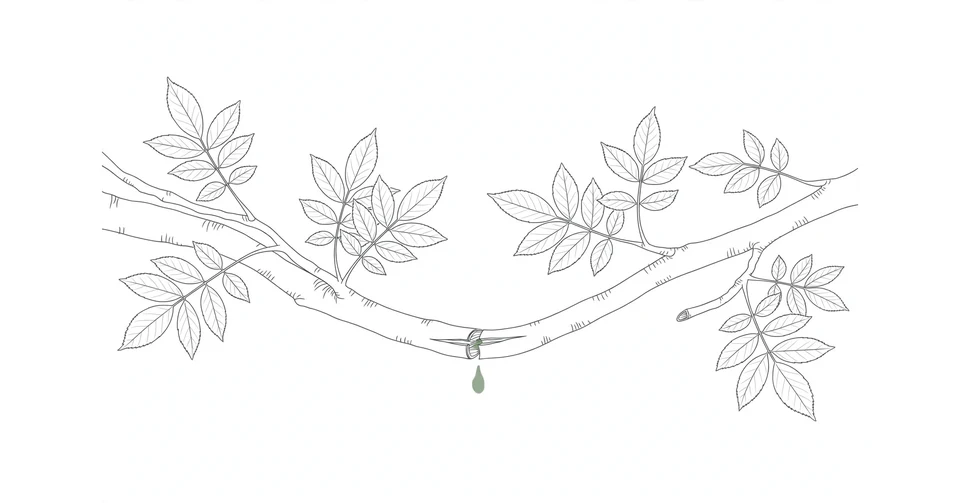
A tree does not produce poison for fun. The sap of the lacquer tree is a defense system, and urushiol is its active weapon. When the bark is cut or the wood is damaged, sap flows to the wound, and the urushiol inside it discourages insects and animals from eating further into the tree. The same reactivity that irritates human skin makes the sap hostile to anything that tries to chew through it.
The sap also seals the wound. As it meets air and moisture, urushiol begins to change, and the liquid slowly sets into a hard protective layer over the damaged bark. The tree is, in effect, bandaging itself with the same material that Japanese craftsmen later learned to paint onto wood. The defense and the craft are one process, borrowed by humans from the tree.
That borrowing has a long history. The lacquer tree grows in the mountainous areas of temperate Japan, Korea, and China, and people in the region have harvested its sap for thousands of years. Harvesters cut shallow grooves into the bark, collect the milky sap that weeps out, and strain it before use. A single tree yields only a small amount each season, which is one reason genuine lacquerware has always been precious. The full story of the tree and its sap is told in Urushi Is the Tree Sap Japan Turns Into Lacquer That Outlives Centuries, which follows the harvest from the forest to the workshop.
There is something quietly humbling about this. The tree was not making art. It was protecting itself. Humans simply noticed that the wound dressing was beautiful, durable, and waterproof, and spent centuries learning to use it on bowls instead of bark.
How urushiol turns into lacquer
Here is the strangest part of the story. The very compound that blisters skin becomes, once cured, completely safe to touch. Finished lacquerware does not cause reactions. The risk belongs only to the wet, uncured lacquer during the making process, and the change from dangerous to harmless is a chemical transformation, not a trick of dilution.
When raw sap is exposed to oxygen in humid air, an enzyme in the sap called laccase catalyzes the oxidation of urushiol. The catechol rings link together into long chains, a process called polymerization, and the liquid gradually sets into a hard, glossy film. The reaction needs moisture to keep the enzyme active, which is why lacquer is traditionally cured in a warm, humid chamber rather than left to dry in open air. Lacquer does not dry like paint. It hardens through chemistry, and the urushiol molecules are consumed in the process, locked into a polymer network that skin can no longer react to.
The result is remarkable. Cured urushi lacquer resists alkali, acid, and alcohol, and it can withstand temperatures of more than 300 degrees Celsius. It is damaged mainly by ultraviolet light, which slowly breaks down the polymer over years of sun exposure. A bowl coated in it can survive daily use, hot soup, washing, and drops that would shatter a ceramic cup. The famous durability of Wajima Nuri Is the Lacquer That Survives Being Dropped comes from this same chemistry, layer after layer of urushiol polymer built up over months of patient work.
Each coat must cure before the next is applied, and a fine piece may carry dozens of coats. The craftsman is therefore exposed to raw urushiol again and again, coat after coat, year after year. That repeated exposure is exactly what makes the allergy story so interesting, because the human body does something unexpected when it meets urushiol for the hundredth time.
Why urushiol makes skin itch
The rash that urushiol causes has a formal name, urushiol-induced contact dermatitis, and it is a delayed allergic reaction, not a burn. The oil itself does not damage the skin directly. Instead, it acts as a hapten, a molecule too small to trigger the immune system on its own, so it binds to proteins in the skin and changes their shape. The immune system then mistakes those altered proteins for foreign invaders.
Once urushiol has been absorbed, specialized cells in the skin called Langerhans cells carry the altered proteins to the lymph nodes, where they present them to T-lymphocytes. Those T cells then travel back to the skin and attack, releasing chemicals that cause redness, swelling, blistering, and the itch that gives this article its title. The whole process is a type IV hypersensitivity reaction, the slow branch of the immune system, which is why the rash takes time to appear.
Timing is the first thing that confuses people. Someone who has never reacted before may take 10 to 20 days to break out after a first exposure. Once the immune system has learned to recognize urushiol, most people break out 48 to 72 hours after contact. The rash typically lasts one to two weeks, though in some cases it can persist for up to five weeks. New patches may appear over several days, not because the rash is spreading from person to person, but because different areas of skin react at different speeds, or because unwashed oil on clothing or tools caused a fresh exposure.
Sensitivity varies widely. Roughly 15 to 30 percent of people do not react to urushiol at all, while at least a quarter of people have a very strong response with severe blistering. The fluid inside the blisters contains no urushiol, so it cannot spread the rash to another part of the body or to another person. The rash is not contagious. What spreads it is the oil itself, lingering on skin, clothes, pets, and tools, waiting for its next chance.
There is one more way urushiol can reach people that deserves a warning. Burning plants that contain it can carry the oil into smoke, and inhaling that smoke can cause a serious reaction in the airways and lungs. Anyone clearing brush should never burn poison ivy, poison oak, or lacquer trimmings, and should treat smoke from them as a hazard, not a nuisance.
Why lacquer craftsmen stop reacting, mostly
Every lacquer student in Japan knows the rash by its Japanese name, urushi kabure, and for most of them it is a rite of passage. New apprentices often break out in painful, blistering rashes that itch badly enough to ruin sleep, and the old workshop culture offered little sympathy. Gloves were frowned upon in some schools, and a rash was treated as proof that the student was not yet serious about the craft.
Then something strange happens. With repeated exposure over months and years, the reactions usually become milder. The body never develops full immunity to urushiol, and even experienced craftspeople still get rashes, but the ferocity fades. One lacquer artist trained at Tokyo University of the Arts wrote that building tolerance typically takes up to two years, and that students live in constant fear of the material until their immune system gradually stops responding so violently. Another guide for workshop visitors puts it more carefully, saying the first exposure is usually the most severe, reactions become milder with repeated contact, but they never disappear entirely.
The honest version sits between those two accounts. Tolerance to urushiol is real but partial and fragile. A craftsman who has worked with lacquer for a decade can still break out after a heavy exposure, a long break from the workshop, or contact with a fresh batch of sap. Some people never become tolerant at all and have to leave the craft, which is a quiet tragedy in a tradition that already struggles to find apprentices. Others are blessed with mild reactions from the start, and they are the ones most likely to stay.
I find this part of the story deeply moving, and it says something about how humans relate to difficult materials. The apprentice does not conquer the lacquer. The apprentice endures it, learns its moods, and is slowly accepted by it, or not. There is no shortcut and no medicine that grants immunity. There is only time, patience, and a willingness to itch. That is a strange kind of devotion, and it explains why lacquerware carries a value that no factory coating can match. Every flawless surface was paid for, in part, with someone's skin.
What to do if urushiol touches your skin
Speed matters more than anything else. Substantial amounts of urushiol can be absorbed within minutes, and once it has penetrated the skin, washing cannot undo the reaction. The first step is to wash the exposed skin thoroughly with soap, cool water, and friction as soon as possible, using a washcloth to help lift the oil. Soap matters because urushiol is an oil that repels water, and friction matters because the oil clings strongly to the skin.
Clothes, tools, and anything else that touched the sap should be washed too, since ordinary laundering with detergent removes urushiol from most fabrics, and bleach can deactivate it on hard surfaces. Pets that wandered through the area should be washed as well, because the oil can sit on fur for a long time without bothering the animal and then transfer to a person.
If a rash appears anyway, treatment is about comfort while the immune system finishes its work. The United States Food and Drug Administration recommends cool water compresses, topical corticosteroids available over the counter, or oral corticosteroids by prescription for severe cases, along with skin protectants such as calamine lotion. Antihistamines can help with itching, especially at night, and cool water or calamine can soothe the pain. Blisters should be left unbroken, and scratching should be avoided, since broken skin can become infected. Most rashes resolve within about two weeks without treatment, but a rash that covers the face or eyes, or one that shows signs of infection, deserves medical attention. The Urushiol-Induced Contact Dermatitis article on Wikipedia gives a thorough account of the symptoms, the mechanism, and the standard treatments.
For anyone joining a lacquer workshop in Japan, the practical rules are simple. Wear gloves and long sleeves, assume you will react even if you never have before, wash promptly if sap touches you, and do not touch your face while working. Finished lacquerware in a shop is safe, so there is no reason to fear the bowls. The danger lives only in the liquid, in the workshop, in the hands of the maker.
Living with a beautiful irritant
Urushiol is a reminder that nature does not sort its gifts into safe and dangerous. The same molecule that defends a tree, blisters a student's hands, and hardens into a bowl that outlives its maker is simply doing what chemistry allows it to do. Humans decided that the beauty was worth the itch, and that decision has shaped Japanese craft for thousands of years.
There is a lesson in that which reaches beyond lacquer. The things we value most are rarely the things that cost us nothing. A lacquer bowl is not just wood and sap. It is time, patience, and a body that learned to live with a poison until the poison became a finish. The next time you hold a piece of lacquerware, warm from soup and shining in the light, remember the oil inside it. It itched first, and it became beautiful second, and that order matters.
More in Culture & Society
- Hiramaki-e Keeps the Gold Flat and Lets the Picture Speak
- Chuson-ji Is the Mountain Temple That Guarded the Golden Hall
- Urushi Kabure Is the Rash Lacquer Apprentices Learn to Live With
- Konjikido Is the Golden Hall That Outlived a Fallen Capital
- Hidehira-Nuri Keeps Hiraizumi's Golden Age in Lacquer
- Wajima-nuri Is the Lacquer That Survives Being Dropped
Latest posts
- Tsugaru-nuri Hides Four Seasons of Colour Under the Lacquer
- Shunkei-nuri Lets the Wood Grain Shine Through the Lacquer
- Takamaki-e Raises Gold Off the Lacquer Until You Can Feel It
- Shibayama Turns Shell Ivory and Coral Into Small Paintings in Lacquer
- Togidashi Buries Gold in Lacquer and Polishes It Back Into the Light
- Nashiji Scatters Gold Dust Like Pear Skin Across Black Lacquer
- Raden Turns Mother of Pearl Into Lacquer That Catches the Light
- Maki-e Sprinkles Gold Dust Onto Wet Lacquer
- Urushi Is the Tree Sap Japan Turns Into Lacquer That Outlives Centuries
- Ojime Is the Tiny Bead That Keeps a Netsuke From Slipping Away
- Inro Is the Little Lacquered Box That Carried a Samurai's Day
- Hachimaki Is the Headband Japan Ties On Before the Hard Part Begins
- Netsuke Held a Samurai's World on a Cord
- Tenugui Is the Thin Cotton Cloth Japan Uses for Everything
- Kinchaku Carries a Whole Festival in One Small Bag