Hagoita Is the Paddle Japan Turns Into New Year Art
· 26 min read
A hagoita begins as a plain wooden paddle for a New Year game and ends as a raised silk portrait of a kabuki actor, a gift, and a collectible craft.
A wooden paddle should not be able to hold a theatre performance, and yet a hagoita does exactly that. It starts life as a flat board of pale paulownia wood, light enough for a child to swing, and it ends as a small stage on which a kabuki actor strikes a pose in silk and cotton, his face painted with a brush finer than a needle. The game it was made for takes a minute to learn. The craft it became takes a lifetime to master.
That contrast is the whole story of the hagoita. It is a piece of sporting equipment that slowly turned into a work of art, then into a lucky charm, then into a gift, and finally into a collectible that changes with the fashions of each year. The paddle outlived the game it served, and it did so by becoming more beautiful than the game ever needed it to be. Anyone who has held a plain playing hagoita in one hand and a decorated hagoita in the other knows the difference at once. One is a tool. The other is a portrait that happens to be shaped like a tool.
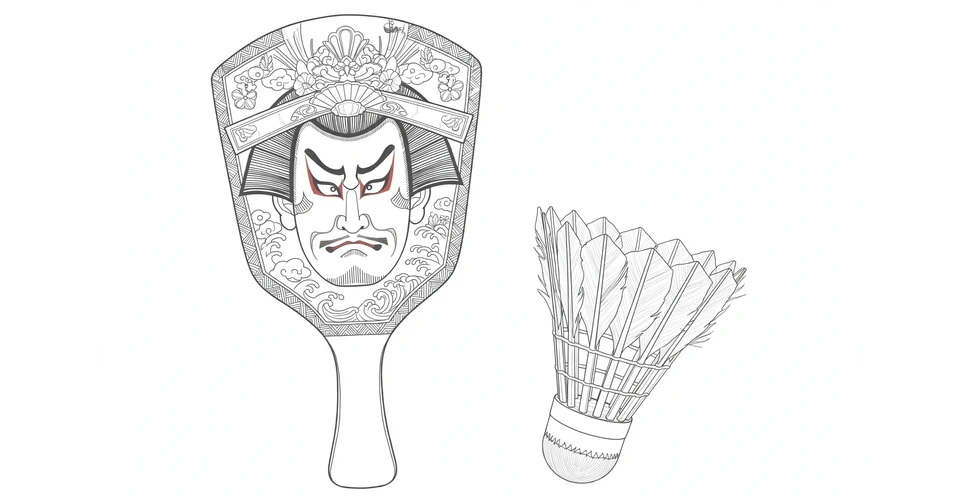
The paddle belongs to the Japanese New Year, and to understand it you have to start there. Hanetsuki, the game the paddle was built for, is a gentle rally in which two players bat a feathered shuttlecock back and forth with no net between them, trying to keep it in the air as long as possible. The game is a wish for health in the year ahead, and the hagoita is the instrument of that wish. But somewhere along the way, somewhere in the long centuries of the Edo period, people stopped looking at the hagoita as a bat and started looking at it as a canvas. That shift is what this article is about: how a flat piece of wood became one of the most charming objects in Japanese craft.
Two paddles with one name
Every conversation about the hagoita has to begin with a distinction, because the word covers two very different objects. The first is a playing hagoita, a plain, light, practical paddle made to survive many rallies. It is usually undecorated or painted with a simple design, and its job is to be swung. The second is a decorative hagoita, a paddle made to be looked at rather than used. It is heavier, stiffer, and covered with a raised picture built from silk, cloth, paper, and cotton. The two share a shape and a name, and almost nothing else.
A complete guide to the craft puts the split plainly: decorative paddles are New Year ornaments and gifts, while playing paddles are practical implements built for lightness and durability. A playing hagoita has to feel right in the hand, so it is kept simple. A decorative hagoita has to look right on a wall, so everything about it, from the wood to the last thread of hair, is chosen for appearance. The finest decorative paddles are called oshi-e hagoita, and their raised pictures stand out from the wood in shallow relief, almost like small sculptures in cloth.
The difference matters because it explains the prices you see at the December markets. A plain playing paddle can be bought cheaply, and simple ones are even sold at 100-yen shops for children and for do-it-yourself decorating. A fine decorative hagoita, on the other hand, can cost as much as a piece of furniture, and the largest and best made ones sell for hundreds of thousands of yen. The gap between one hagoita and another is not a matter of branding. It is the gap between a tool and a handmade work of art, and once you know how the decorated ones are made, the gap starts to look small.
I think the split is also the reason the hagoita survived when the game faded. A game needs players, open space, and free time, and modern New Year holidays offer less of all three. A decoration needs only a wall and someone who loves beautiful things. The playing hagoita quietly stepped aside while its decorated twin took over the family business, and the family business turned out to be the more durable one.
What a hagoita is made of
The materials of a hagoita read like a list from a textile shop rather than a sports shop, and that tells you most of what you need to know about the craft. The Tokyo Metropolitan Government, which certifies Edo oshi-e hagoita as a traditional craft of the city, lists the raw materials as paulownia wood for the paddle, silk and cotton textiles for the raised picture, cotton wadding to fill out the figures, and silk thread for the hair. The same page records the craft's formal certification date as July 15, 1985, and names Sumida, Koto, and Katsushika wards as the main areas of manufacture. These are the old craft districts of eastern Tokyo, and the paddle has belonged to them for centuries.
Paulownia is the right wood for a hagoita for several reasons. It is light, so a large paddle can still be lifted and hung with ease. It is soft enough to shape cleanly, yet stable enough to hold a flat surface for the picture. It resists splitting and warping better than many harder woods, which matters for an object that will be displayed for decades. The board itself is nearly trapezoidal, wider at the top and narrower toward the handle, and the craftsmen use the maximum area of that board for the design. A hagoita is not a rectangle with a picture squeezed onto it. It is a stage, and the picture is composed to fill the stage.
The textiles do the real work of the decoration on a hagoita. Silk gives the kimono its sheen, cotton gives the picture its body, and the wadding between them gives it depth. A single fine paddle can involve around two hundred steps and fifty to seventy different materials, all handled by hand, and most of those materials are cloth, paper, thread, and pigment rather than wood. That is a useful way to think about a hagoita. The wood is the frame. The picture is the painting, and the painting is sewn and glued as much as it is drawn.
There is a quiet honesty in this choice of materials. Nothing about a hagoita pretends to be grand. Paulownia is a humble, fast-growing wood. Cotton is an everyday fibre. Silk thread is the one luxury, and it is used sparingly, mostly for hair. The beauty comes from what patient hands do with ordinary things, and I find that more impressive than any amount of gold leaf. A craft that turns plain cloth into a face you can recognise is a craft that understands its materials deeply.
How the raised picture is built
The technique that makes an oshi-e hagoita is called oshi-e, which means a pushed or appliqued picture, and it is closer to building a small relief sculpture than to painting. The process begins with a design, sketched onto the paulownia board, and then each element of the picture is made separately before being fixed in place. Kimono sleeves, collars, fans, hair ornaments, and props are cut from silk or from fabric backed with Japanese paper, stuffed with cotton wadding to give them volume, and shaped with a small spatula and paste. The pieces are then layered onto the board, one over another, so that the picture rises from the surface in shallow, clean relief.
The Tokyo craft registry describes the core of the method in plain terms. Cotton wadding is stuffed between a stencil outline and a fabric base, and the finished padded collage is pasted onto the paddle with a spatula. Each small element is backed with Japanese paper as it is completed, which gives it stiffness and keeps its edges crisp. The result is a hagoita you can almost read with your fingertips: a sleeve that curves outward, a collar that overlaps the layer beneath it, a fan that stands proud of the background. The depth is shallow, a matter of millimetres, but it is enough to catch the light and give the figure a presence that a flat painting cannot match.
The face is the hardest part, and the craft treats it as a separate discipline. The surface of the face is smoothed by applying successive layers of gofun, a powder made from crushed seashells, until it has the pale, porcelain finish of a stage actor's makeup. Then the eyes, the mouth, and the nose are painted with a fine-tipped brush, in lines so delicate that a single stroke can change the expression. In many workshops the face is painted by a specialist called a menso-shi, a face painter, while another artisan, the oshi-e-shi, composes the padded collage. The two crafts meet on the same small board, and the paddle succeeds only if both of them succeed.
The finishing touches are small but telling. Silk thread becomes the hair, strand by strand. Metallic paper, cords, and seasonal motifs are added last, to give the picture life and depth. The back of the board is painted too, and the handle is wrapped, because a fine hagoita is finished on every side even though only the front will ever be displayed. That thoroughness is part of the charm. Nobody sees the back of the paddle on the wall, but the maker finishes it anyway, which is the mark of a craft that respects its own standards more than its audience.
The face decides the paddle
Ask any maker what makes or breaks a hagoita and the answer will be the face. The rest of the hagoita can be technically perfect, with crisp sleeves and rich fabrics, but if the face is wrong the paddle fails. The face carries the character, the mood, and the story, and it has to do all of that in a space a few centimetres wide. The actor's expression must be readable from across a room, yet fine enough to reward a close look. That is a hard balance, and it is why the face painter is the most respected figure in the workshop.
The challenge is not only technical. A kabuki actor's face is a language of its own, with painted brows, coloured lines, and expressions that belong to specific roles and famous performers. The maker has to know the play, the character, and the actor's traits before picking up the brush. Many faces follow the line conventions of ukiyo-e, the woodblock prints that pictured the same actors on paper, and the best paddles feel like those prints given a third dimension. The shading stays restrained, with a soft blur around the eyes rather than heavy shadow, so the face keeps the flat, graphic elegance of the print tradition while gaining the warmth of a real object.
This is also why the craft has stayed alive as a living tradition rather than a museum piece. Each year brings new plays, new stars, and new faces, and the makers study the real dramas as they are staged, then translate what they saw into cloth and paint. The Tokyo craft registry notes that design craftsmen work on their plans after seeing the real dramas being staged, and that they concentrate on the look of the human figure's face above all else. A hagoita is therefore not a copy of an old picture. It is a fresh portrait of a living performance, made in the same year the performance happened.
I find something moving in that discipline. A face a few centimetres wide, painted with a brush that holds almost no paint, decides whether months of work succeed or fail. It is a reminder that craft is not only about patience, but about judgment at a single decisive moment. The paddle teaches the same lesson as the game it came from: attention matters more than force, and the smallest gesture can carry the whole result.
Kabuki made the paddle famous
The hagoita did not become a work of art by accident. It became one because kabuki became popular, and the paddle became the souvenir that kabuki fans wanted to take home. The story runs through the Bunka and Bunsei eras, from 1804 to 1829, when the culture of the common people of Edo flourished and kabuki boomed alongside it. Woodblock artists published portraits of famous actors by the thousand, and the makers of oshi-e learned to put those same faces onto paddles. The genre they created is called yakusha hagoita, the actor paddle, and it turned the hagoita into a miniature stage.
The Tokyo craft registry tells the story with a detail that captures the excitement of the time. As each year drew to a close, there was competitive demand for the role depictions of that year's popular kabuki stars, and the sale of actor paddles acted as a barometer of an actor's popularity in any particular year. Fans hurried to buy the paddle of their favourite performer, and a strong seller at the year-end market was a sign that an actor's star was rising. The paddle was a poster, a portrait, and a popularity poll all at once, and it was made of wood and cloth.
The subjects on a hagoita went beyond actors. The inherited traditions use motifs of women in furisode, the long-sleeved kimono worn by young women, and of kabuki actors performing nichibu, traditional Japanese dance. Scenes from Japanese paintings and from kabuki plays fill the boards, and the best makers are praised for expressing the dynamics of a dance or a dramatic moment within the small, nearly trapezoidal frame. The picture has to suggest movement, a raised arm, a turn of the body, a glance over the shoulder, using only layered cloth and a painted face. When it works, the figure seems to be caught mid-performance, and the paddle feels less like a decoration than like a paused scene.
Modern stalls carry the same idea forward with the faces of the current year. Alongside the kabuki actors and the beauties in kimono, you will find film stars, television personalities, athletes, and even cartoon characters, because the craft follows the culture rather than freezing it. A hagoita from a given year is a portrait of that year, and collectors value the paddles partly for that reason. The tradition has never been about preserving a single image. It has been about picturing whoever the public loves right now, in the materials of two centuries ago.
A gift for a girl's first New Year
For all its glamour as a kabuki souvenir, the hagoita has always had a quieter and more tender role. It is a gift for a baby girl, given to celebrate her first New Year, the occasion known as hatsu-shogatsu. The tradition began after the 17th century, when families started presenting paddles to girls on their birthdays and at New Year, and it spread from samurai households to ordinary families during the Edo period. A hagoita given to a newborn girl is a wish made solid: may she grow up healthy, may bad luck be knocked away, and may the year ahead treat her kindly.
The wordplay behind the gift is part of its charm. The sound of the word hagoita suggests knocking or batting away, and the paddle became a symbol of batting evil spirits aside. A feathered shuttlecock that looks like a dragonfly carries the same wish, since dragonflies eat mosquitoes, and the game was long believed to protect children from illness and from insect bites in the summer to come. The paddle, the shuttle, and the game all pointed in the same direction, toward a child growing up safe and well, and the gift gathered all of those meanings into a single object that could be hung on a wall.
The gift is also a marker of growth. Hagoita come in many sizes, from small ones a child can hold to large display pieces nearly two metres tall, and families sometimes mark a girl's growth by the size of the paddle displayed for her. The most popular size at the markets measures about 60 centimetres and sells for around 60,000 yen, a serious purchase and a serious gift. The smallest paddles cost around 1,000 yen, and the largest and finest can cost hundreds of thousands, so there is a hagoita for every household and every budget. The price is less important than the gesture. A family that gives a paddle is saying, in wood and silk, that the child matters and that the year ahead should be kind to her.
The paddle is traditionally displayed in the home from mid-December through the middle of January, guarding the season while the New Year decorations are up. It stands alongside the pine at the gate and the other emblems of the holiday, and it stays up through matsunouchi, the week Japan keeps the pine up for its guest, the opening week of the year when the household is still in its festive dress. Then it is put away, carefully wrapped, until the next December. That rhythm of display and storage is part of the object's life. It appears for a few weeks, does its work as a charm and a decoration, and then rests in the dark for the rest of the year, waiting to be unwrapped again.
The December market at Senso-ji
If you want to see the hagoita as a living tradition rather than a museum piece, there is one place to go. Every year from December 17 to 19, the grounds of Senso-ji temple in Asakusa fill with stalls selling nothing but paddles and New Year goods, in a market called Hagoita-ichi, the paddle market. The event is part of Toshi-no-Ichi, the year-end fairs at shrines and temples, and it has grown around December 18, the last Kannon festival day of the year at Senso-ji, known as Osame no Kannon. The Tokyo craft registry records the market as a long-standing tradition held on those same three days, and it describes the stalls as displaying an amazing number of colourful paddles that look out on interested visitors.
The market is old. Its roots reach back to the Edo period, when vendors gathered at the temple to sell New Year goods and lucky charms to the crowds who came for the Kannon festival, and the paddles gradually became the stars of the fair. Today the market draws hundreds of thousands of visitors over its three days, and the stalls are piled high with oshi-e hagoita showing kabuki actors, beauties in kimono, and the celebrities of the year, alongside simpler paddles for families who want a charm rather than a showpiece. The game itself is described in our companion piece about hanetsuki, the New Year game played with a wooden paddle, but the market is where the paddle takes centre stage on its own.
There is a small piece of theatre at the market that visitors remember long after they forget the prices. When a customer buys a paddle, the seller often closes the sale with a rhythmic hand clap called sanbon-jime, three sets of three claps followed by one, a traditional way of sealing a deal and wishing good fortune. It is a brief ceremony, and it suits the market, because buying a hagoita is not really shopping. It is choosing a wish for the year ahead, and the clap is the punctuation at the end of the sentence.
The market also shows how the craft keeps changing. The traditional paddles still feature kabuki actors and treasure ships, but the stalls also carry faces from the year's films, television, and sports, and the designs follow the news as surely as any newspaper. A hagoita bought at Hagoita-ichi is a dated object in the best sense: it records who mattered in that particular year. That is why collectors return every December, and why a wall of old paddles reads like a small, silent history of Japanese popular culture.
Regional styles beyond Tokyo
Tokyo may own the most famous version of the craft, but the hagoita belongs to the whole country, and different regions have made it their own. The Tokyo style is the oshi-e paddle of Asakusa, with its raised silk portraits and its kabuki faces, certified as a traditional craft and made mainly in the eastern wards of the city. It is the style most visitors meet first, and it sets the standard by which the others are judged.
The Kansai region, around Kyoto and Osaka, is known for a more luxurious approach. Its paddles feature lacquer and gold leaf finishes, with an elegant design that owes more to the court and temple crafts of the old capital than to the theatre districts of Edo. Where a Tokyo hagoita builds its effect from layered cloth and a painted face, a Kansai paddle may gleam with lacquer and catch the light with gold. The two styles show the same object through different regional tastes, one theatrical and one refined, and both are unmistakably Japanese.
Other regions add their own local character. The Hokuriku region, on the snowy coast of the Japan Sea, sometimes features designs that emphasise white, reflecting its snowy climate. Saitama prefecture, just north of Tokyo, is another heartland of the craft, with the city of Kasukabe known for its workshops and its own seasonal markets. The craft survives because it is not confined to one city or one style. It is a shared language with many local accents, and each region speaks it slightly differently.
I like this regional spread because it keeps the craft honest. A single official style can harden into a formula, but many local styles keep makers looking at each other and borrowing ideas. The Tokyo paddle, the Kansai paddle, and the Hokuriku paddle are all answers to the same question, which is how to turn a flat piece of wood into something beautiful, and the fact that the answers differ is a sign that the craft is still alive.
Choosing and caring for a hagoita
A hagoita is easy to buy and easy to damage, so it is worth knowing how to choose one and how to keep it. The first question is purpose. A hagoita bought for play should be light, plain, and comfortable in the hand, with a firm surface and simple decoration. A hagoita bought for display should be judged the way you would judge a picture: by the quality of the face, the depth of the relief, the richness of the fabrics, and the name of the workshop. The face matters most of all. Look at it from across the room first, because that is how it will usually be seen, and then look closely at the brushwork around the eyes and the mouth.
Size is the second question, and the range is wide. Small paddles suit a shelf or a desk, while large ones become the centrepiece of a room. Compact paddles of about 30 to 45 centimetres work well in a modern interior, and larger paddles of 60 centimetres or more make a statement over a console or in an alcove. The ornamental paddles can be as short as 18 centimetres, small enough for a child's hand, or as long as 180 centimetres, nearly six feet tall. A stand helps: a simple black or paulownia stand lifts the piece, protects its bottom edge, and presents it the way a frame presents a painting.
Care is mostly a matter of treating the paddle like the textile object it is. Dust it gently with a soft brush or cloth, using light strokes rather than rubbing, and be especially careful around the raised cloth areas. Keep it out of direct sunlight, which fades the silk and weakens the colours, and store it in a dry place with low humidity when it is not on display. A dedicated case or a cloth bag protects it from knocks and dust, and wrapping the raised parts in soft material prevents friction damage. A playing paddle needs slightly different care: wipe it with a dry cloth or a slightly damp one, never use excess water, since that can warp the wood, and check the surface for wear, since deep scratches can be lightly sanded and oiled, or taken to a professional for repair.
These are small habits, but they matter, because a well-kept hagoita can last for generations. The paddles that collectors prize today are often decades old, and they survived because someone kept them out of the sun, dusted them gently, and stored them dry. A hagoita is not a fragile object, but it is a textile object, and textiles reward quiet, regular attention. Treat it the way you would treat a good kimono, and it will outlast the fashion of the year it pictures.
The paddle as a collectible and a canvas
The final chapter in the life of the hagoita is the one being written now, and it is the most surprising. The paddle that began as sporting equipment and became a charm has now become a collectible and a canvas, and it is finding audiences its Edo makers could never have imagined. Collectors prize old paddles for their faces, their workshops, and the year they record, and a wall of paddles from different decades reads like a gallery of changing taste. The finest pieces are treated as art, exhibited, catalogued, and traded among people who may never have played the game at all.
Contemporary artists have taken up the hagoita as a surface for new work, painting abstract and pop art designs onto the same paulownia boards that once carried kabuki actors. Galleries and events exhibit paddles that combine the traditional raised cloth technique with contemporary designs, and these shows have become meeting points between traditional craft and modern art. The paddle's shape is part of the appeal: it is a familiar, friendly form, and anything painted on it feels both new and rooted at the same time.
The craft has also opened up to amateurs. Do-it-yourself hagoita kits let people decorate plain paddles bought at 100-yen shops, turning an old craft into a personal project for a winter afternoon. Workshops and school events teach children to make and play with paddles they have decorated themselves, and the game is easy enough to learn in a single session. The same object that once required two hundred steps in a master workshop can now be the starting point for a child's first piece of craft, and both versions are genuine. The master paddle and the child's paddle are not rivals. They are two ends of the same tradition, and the tradition is wide enough to hold both.
There is also a quiet international life for the paddle now. Miniature paddles are popular souvenirs, small enough to carry home in a suitcase, and they appear at international exhibitions as symbols of Japanese culture. A complete guide to the craft of hagoita notes that the paddle is gaining attention abroad as interior decoration and as a gift, and that workshops and cultural events use it to introduce Japanese traditions to visitors. The paddle travels well because it needs no translation. Anyone can see, at a glance, that it is a beautiful object made with care, and that is a language every culture understands.
The Tokyo craft registry records Edo oshi-e hagoita as a certified traditional craft, made in Sumida, Koto, and Katsushika wards from paulownia, silk, cotton, and gofun, and that official recognition matters. It means the craft is not only loved but protected, with workshops, associations, and a market that still opens every December. A tradition survives when someone is willing to do the work, and the registry is a promise that the work will continue. You can read the full registry entry in Tokyo's official record of Edo oshi-e hagoita, which lists the materials, the techniques, and the history in one place.
A paddle that learned to last
A hagoita is a small object with a long memory. It remembers the court game of the Muromachi period, when imperial families divided into teams at New Year. It remembers the Edo period, when it became a charm and then a portrait. It remembers the kabuki stars of two centuries ago and the film stars of last year. It remembers the baby girl whose first New Year it celebrated, and the collector who hung it on a wall decades later. Few objects carry that much history in so little wood.
The lesson of the hagoita is a gentle one. Traditions do not survive by staying the same. They survive by finding new work to do. The hagoita stopped being a bat and became a picture, stopped being a picture and became a gift, stopped being a gift and became a collectible, and at every step it kept the wish it started with, that the year ahead should be healthy and kind. The game may be played less often now, but the wish is still on sale in Asakusa every December, and the paddle is still given to a baby girl for her first New Year.
I keep coming back to the face, because the face is where the whole craft concentrates itself. A few centimetres of painted silk, a few strokes of a fine brush, and suddenly a flat board has a person on it, looking back at you across two hundred years. That is what craft is for, I think. Not to preserve the past like a specimen, but to keep it looking at us, alive and recognisable, in the middle of our own rooms. The paddle does that with unusual grace. It asks for nothing more than a wall, a little shade from the sun, and a glance once a year, and in return it offers a small, bright piece of the Japanese New Year, kept safe in cloth and wood until December comes around again.
More in Culture & Society
- Oshi-e Hagoita Turns Silk Into a Picture You Can Touch
- Hyakunin Isshu Gave Karuta Its Hundred Poems
- Takoage Sends New Year Wishes Up on a Paper Kite
- Hanetsuki Keeps New Year in the Air With a Wooden Paddle
- Karuta Turns a Hundred Poems Into Japan's Fastest Card Game
- Hatsuyume Is the First Dream Japan Reads Like a Fortune
Latest posts
- The Two Lives of Japanese Coffee
- Chihayafuru Made a Card Game Feel Like a Sport
- Japanese Stationery and the Small Tools Japan Takes Seriously
- Japanese Manga and How It Became the World's Most Read Comics
- Toshikoshi Soba Is the Long Noodle Japan Eats at Midnight
- Hatsu-Hinode Is the First Sunrise Japan Wakes Up For
- Matsunouchi Is the Week Japan Keeps the Pine Up for Its Guest
- Osouji Is the Cleaning Japan Does Before the Gods Arrive
- Japanese Anime and How a Niche Hobby Conquered the World
- Toshigami Is the Guest Japan Prepares the Whole House For
- Urajiro Is the Fern That Wishes a Family Twice Over
- A Shimekazari Hangs the New Year Over the Front Door
- Make-Koshi Is the Eight Loss Line That Sends a Sumo Wrestler Down
- Japanese Arcades and the Game Centers That Refuse to Die
- Danpatsu-Shiki Is the Haircut That Ends a Sumo Career