Hatsuyume Is the First Dream Japan Reads Like a Fortune
· 33 min read
Hatsuyume is the first dream of the new year in Japan, read as a fortune for the year ahead, and this guide explains which night counts, what the lucky symbols mean, and what to do when the dream goes wrong.
Japan treats the new year as a series of firsts. The first sunrise has a name, the first shrine visit has a name, the first laugh has a name, and the first dream has a name too. That dream is hatsuyume, and it is the only one of the firsts that you cannot plan, rehearse, or buy a ticket for. It arrives while you sleep, uninvited and unedited, and by morning it is either a small piece of good news or a small puzzle to solve. Hatsuyume is the first dream Japan reads like a fortune.
The idea is simple enough to state in one sentence. The first dream of the new year is believed to foretell the luck of the dreamer in the year that follows. A good dream promises a good year. A bad dream warns of trouble, and it comes with a remedy. The belief has been in place since the early Edo period, which means it has survived about four hundred years of new calendars, new cities, and new ways of sleeping, and it is still observed every January. That survival is worth thinking about, because it tells you something about how Japan handles the unknown, and hatsuyume is a good example of it. Rather than pretending the future can be controlled, the custom gives the future a small, gentle shape, a mountain, a bird, a vegetable, and lets people wake up with something to hope for.
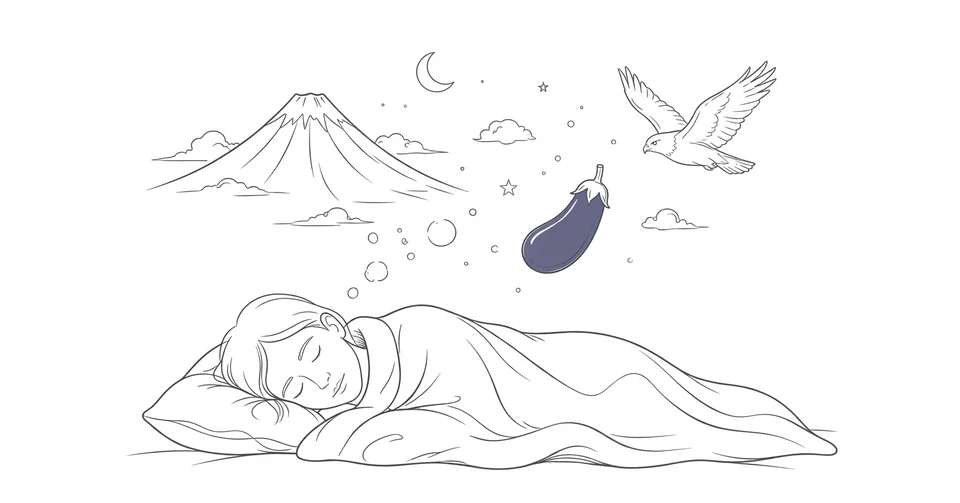
This article follows hatsuyume from its meaning to its practice, through the night that counts, the famous trio of lucky symbols, the longer list most people have forgotten, the wordplay that explains why those symbols were chosen, the treasure ship placed under the pillow, the dream eating creature called on when the dream goes wrong, and the quiet way the custom fits beside the sunrise and the shrine visit of the same season. It is a small custom, one dream on one night, and it opens a wide window onto how Japan thinks about beginnings, luck, and the part of life that cannot be willed into shape.
What hatsuyume means, word by word
Hatsuyume is written with the characters for first and dream, and it is read hatsu yume, the first dream. The word belongs to a family of firsts that mark the Japanese New Year. The first sunrise is hatsu-hinode, the first shrine visit is hatsumode, the first laugh is hatsuwarai, and the first dream is hatsuyume. The language itself treats the New Year as a sequence of beginnings, each one a small fresh start inside the larger one, and hatsuyume is the beginning that happens in sleep, between the noise of New Year Eve and the quiet work of the first morning.
Hatsuyume is older than the modern calendar, and that history explains a small confusion about dates that is worth clearing up at the start. In Japan, the night of December 31 was often passed without sleeping, so the first dream of the year was often experienced during the night of January 1, and the day after that night, January 2 in the Gregorian calendar, also came to be known as hatsuyume. Some traditions count the night of January 1 to 2 as the night of the first dream, while others count the night of January 2 to 3, and the difference comes from old calendar customs and from regional practice. The conservative way to put it, and the one most sources agree on, is that the night of January 1 to 2 is the night of hatsuyume. If you stay up all night on New Year Eve, as many people traditionally did, then the first night you actually sleep in the new year is the night of January 1, and the dream you have then is your hatsuyume. If you slept on New Year Eve itself, your first dream may already have passed, and hatsuyume is forgiving enough that people simply take the first dream they remember in the first days of January. The exact night matters less than the act of noticing, and the sources that argue over the date agree on the meaning of hatsuyume.
That meaning is a form of fortune telling, though it is a gentler kind than most. Hatsuyume does not claim to predict the future in detail. It does not name a job, a marriage, or a sum of money. It offers a sign, a symbol seen in sleep, and the symbol is read as a hint about the tone of the year. A mountain suggests height and steadiness. A hawk suggests strength and sharp sight. An eggplant suggests achievement, through a pun that only works in Japanese. The reading is simple, and its simplicity is part of its charm. A dream is already strange and hard to hold onto, and the hatsuyume reading gives it a shape that can be remembered, talked about over breakfast, and carried into the year.
I think there is something honest in that approach to fortune. A dream cannot be controlled, and hatsuyume does not pretend otherwise. It simply asks you to pay attention to what your sleeping mind offered up, and to treat it as a small piece of information rather than a command. That is a kinder way to meet the new year than a horoscope that tells you what will happen, because it leaves the year open. The dream is a hint, not a verdict, and the person who dreamed it still has to live the year.
The night the dream counts
The question of which night counts is the first practical question anyone asks about a hatsuyume, and it deserves a careful answer, because the sources do not all say the same thing. The most widely given answer is the night of January 1 to 2. This follows from the old practice of staying up through the night of December 31, known as omisoka, so that the first sleep of the year falls on the night of January 1. The dream of that night is the first dream, and the morning of January 2 is the morning when it is remembered and discussed. The day of January 2 itself is sometimes called hatsuyume as well, because it is the day after the night of the first dream.
Some families and some regions count the night of January 2 to 3 instead, and this is not a mistake so much as a different counting. In the traditional Japanese calendar the new year began at a different point in the season, and the night of the first dream fell on a different date, and local custom preserved different answers. Modern guides usually settle on the night of January 1 to 2 as the standard, and that is the answer to use if you are explaining the hatsuyume custom to a visitor. If you are in a Japanese home and the family counts differently, follow the family. Hatsuyume belongs to the household, and the household is always right about its own traditions.
There is a practical reason the night matters, and it is about sleep itself. New Year Eve in Japan is a long night. Families gather, the temple bells ring at midnight, and many people stay up late, sometimes through the whole night. By the time the night of January 1 arrives, the sleeper is tired, and tired sleep dreams vividly. Hatsuyume may have grown out of that simple fact. The first real sleep of the year is deep, and deep sleep brings dreams that feel important, and a culture that already believed dreams could carry messages was ready to read them. Hatsuyume turns a fact of the body, that the first proper sleep of the year is a heavy one, into a fact of the calendar, that the first dream is the one that counts.
If you want to greet your own first dream, the preparation is the simplest of all the New Year customs, and hatsuyume asks for very little. Go to bed on the night of January 1, sleep properly, and try to remember what you dreamed when you wake. Keep a notebook by the bed, or tell the dream to someone at breakfast before it fades. Dreams are famously hard to hold onto, and hatsuyume is no exception. Hatsuyume does not demand that you remember perfectly. It only asks that you try, and that you treat the attempt as part of the new year.
Ichi-Fuji, ni-taka, san-nasubi, the lucky trio
The heart of the hatsuyume tradition is a list of three things, and the list is one of the best known sayings in Japan. It runs ichi-Fuji, ni-taka, san-nasubi, which means first Mount Fuji, second a hawk, third an eggplant. Dreaming of any one of these three is considered particularly good luck, and dreaming of all three together is the best fortune of all. The saying is memorised by schoolchildren, quoted in New Year cards, and repeated in guides every January, and the hatsuyume belief has been in place since the early Edo period, with mentions in the poetry of Matsuo Basho, the great haiku poet of the seventeenth century.
Each of the three carries its own meaning, and the meanings are worth taking one at a time, because they show how the custom thinks. Mount Fuji is Japan's highest mountain, and dreaming of it is said to stand for the highest aspiration, for safety, and for a long life. The mountain is steady, it is visible from far away, and it does not move. A dream of Fuji is a dream of something solid and lasting, and it is the most auspicious of the three, which is why it comes first. The hawk is second, and it stands for strength, intelligence, and high advancement in life. A hawk sees far, flies high, and strikes with precision, and a dream of a hawk is read as a sign that the dreamer will rise, see clearly, and succeed. The eggplant is third, and it is the strangest of the three to a foreign ear, until the wordplay is explained. The word for eggplant, nasu or nasubi, sounds like the verb nasu, to achieve or to accomplish something great. Dreaming of an eggplant is therefore a dream of achievement, of getting things done, of a year in which effort bears fruit.
The order matters, and the saying is always given in the same order. Fuji first, hawk second, eggplant third. The order is part of the charm, a little counting rhyme that makes the list easy to remember, and it is also a ranking. Fuji is the grandest, the hawk is the sharpest, the eggplant is the most practical. Together they cover the three things most people want from a year: a long and safe life, success and advancement, and the achievement of something real. The hatsuyume trio is not asking for one thing. It is asking for a whole life, in three symbols, and that is why the trio has lasted.
There is a second layer to the meanings, and it runs through the sounds of the words themselves. Fuji is said to echo fushi, a word for immortality or for living without death, and also buji, a word for safety. Taka, the hawk, sounds like the word for high or lofty, so the hawk promises high advancement. Nasu, the eggplant, sounds like the verb to accomplish. The puns are not decoration. They are the reason the symbols were chosen, or at least one of the reasons, and they show how Japanese folk belief often works through the ear. A word that sounds like a good thing is treated as a good thing, and a dream that contains that word is treated as a promise.
The longer list most people forget
The famous trio is only the beginning of the list, and the continuation is far less well known. It runs yon-sen, go-tabako, roku-zato, which means fourth a fan, fifth tobacco, sixth a blind acupressurer. The full list of six is ichi-Fuji, ni-taka, san-nasubi, yon-sen, go-tabako, roku-zato, and it is worth learning in full, because it shows that hatsuyume was once a richer custom than the three item version suggests.
The fan, sen, is fourth. A fan opens wide, and it is a symbol of a future that opens up, of good fortune spreading out like the ribs of a fan. The fan is also a formal object, used in ceremony and in dance, and it carries a sense of occasion. Dreaming of a fan is read as a sign that the year will open well, that opportunities will spread, and that the dreamer will have room to move. Tobacco, tabako, is fifth, and it is the hardest of the six for a modern reader to accept, because tobacco is now known to be harmful. In the Edo period, tobacco was a luxury, a pleasure, and a sign of ease, and dreaming of it suggested a year of comfort and plenty. The meaning has aged badly, and most modern guides mention tobacco with a small note of embarrassment, but it belongs in the list, and it is a reminder that folk customs carry the values of their time. The blind acupressurer, zato, is sixth. In Edo period Japan, blind acupuncturists and masseurs were respected professionals, and the zato was a figure of skill, independence, and a steady living. Dreaming of one was read as a sign of good health and of a year in which the body would be cared for.
It is unclear whether the second trio was added after the original three or whether the hatsuyume list of six originated at the same time, and the sources are honest about that uncertainty. What is clear is that the second trio is much less often quoted, and that most people who know hatsuyume know only the first three. The second trio deserves to be remembered, not because it is more important, but because it shows the custom in full. The first three are grand and poetic, a mountain, a bird, a vegetable. The second three are domestic and practical, a fan, a smoke, a healer. Together they make a year that is both high and ordinary, and that is a fair picture of what a good year actually looks like.
There is a table below that sets out the six symbols in order, with the meaning of each, so that the whole list can be seen at a glance. It is a short list, and it is worth keeping, because it is the kind of thing that is easy to forget and easy to look up again each January.
| Order | Symbol | Meaning |
|---|---|---|
| 1 | Mount Fuji | Highest aspiration, safety, long life |
| 2 | Hawk | Strength, intelligence, high advancement |
| 3 | Eggplant | Achievement, getting things done |
| 4 | Fan | A future that opens wide, good fortune spreading |
| 5 | Tobacco | Comfort and plenty in the Edo period sense |
| 6 | Blind acupressurer | Skill, health, a steady living |
The table is a summary, not the custom itself. The custom is the dream, and the dream is personal. A person who dreams of a fan has had a good dream, even if the fan is not as famous as Fuji, and a person who dreams of none of the six has not had a bad year. The hatsuyume list is a guide, not a test, and it should be read that way.
Why these three, wordplay, the shogun, and Suruga
The question of why these three symbols, of all the things a person could dream about, came to stand for good luck has more than one answer, and the sources offer several theories without settling on one. The honest way to present them is to lay them out side by side, because each one tells you something different about how the custom grew.
The first theory is the wordplay theory, and it is the one most guides give first. Fuji sounds like fushi, meaning immortality, and like buji, meaning safety. Taka sounds like the word for high, so the hawk promises high advancement. Nasu sounds like the verb to achieve. The three symbols are lucky because their names sound like lucky words, and the custom is built on the ear as much as on the eye. This is a common pattern in Japanese folk belief, where a pun is treated as a real connection, and it explains why the list is so memorable. The rhyme does half the work of remembering it.
The second theory is the shogun theory. It suggests that the combination arose because Mount Fuji, falconry, and early eggplants were favourites of the shogun Tokugawa Ieyasu, the founder of the Tokugawa shogunate and the most powerful man in Japan at the start of the Edo period. On this account, the three things were lucky because they were the tastes of a great man, and what the shogun loved became lucky for everyone else. The theory is plausible, and it is widely repeated, but it is not proven, and it should be presented as a theory, not as a fact.
The third theory is the Suruga theory, and it is the most local of the three. It suggests that the three things are all tall or high things in Suruga, the old province around what is now Shizuoka, where Tokugawa Ieyasu spent his retirement. Mount Fuji is the highest mountain in Japan and it dominates the view from Suruga. The hawk is high in the sky. The eggplant, in this theory, refers to the high price of fine local eggplants, which were an expensive early crop in the region. On this account, hatsuyume is a local list that went national, a set of Suruga things that came to stand for good luck everywhere.
I find the wordplay theory the most convincing, because it explains the exact choice of words, and because puns are so central to Japanese folk custom, but I also like the Suruga theory, because it roots hatsuyume in a real place. I live in Shizuoka, in the old province of Suruga, and Mount Fuji stands to the north east of my city, visible on clear days, and the idea that the most famous dream list in Japan may have started here, as a list of local things, gives the custom a warmth that a purely linguistic theory does not. The theories are not in conflict. A list can be chosen for its puns and then explained by the tastes of a shogun and the pride of a province, and all three explanations can be true at once. The hatsuyume custom is old enough to have gathered more than one origin story, and that is a sign of a living custom, not a confused one.
The treasure ship under the pillow
The hatsuyume tradition is not only a custom of reading dreams. It is also a custom of preparing for them, and the preparation is one of the most charming parts of the tradition. On the night of the first dream, many people place a picture under their pillow, and the picture is meant to bring a good dream and keep a bad one away. The picture shows the takarabune, the treasure ship, carrying the Seven Gods of Fortune, and it is sometimes called a hatsuyume makurafuda, a first dream pillow talisman.
The treasure ship is laden with treasure, as its name promises, and the Seven Gods of Fortune ride on it together. The gods include Ebisu, the god of fishermen and good fortune, and Daikokuten, the god of agriculture and commerce, and the other five, all crowded onto a single boat with sacks of gold, bales of rice, and lucky charms. The image is cheerful and crowded, and it is meant to be slept on. You put the picture under your pillow, you lie down on it, and you sleep on the treasure ship, and the tradition says that this will give you a good dream for the new year. The hatsuyume preparation is simple, physical, and a little funny, and it is easy to see why children love it. You go to sleep on a boat full of gods and gold, and you wake up hoping to have dreamed of a mountain.
The origin of the treasure boat pictures is not clear, and one Edo period record indicates that they originated in the Muromachi period, the century and a half before the Edo period began. Pictures of boats were handed out on the night of Setsubun or on New Year Eve, people slept on them, and the next morning they gathered them up to float away or bury. The practice of sleeping on a picture and then disposing of it the next morning is a practical kind of magic. The picture carries the bad dream away with it, or it carries the good dream into the year, and either way the sleeper does not have to carry it alone.
The treasure ship has one more detail that matters, and it connects this section to the next. The character for baku, the dream eating creature, is sometimes written on the sail of the treasure ship, so that the baku will eat any bad dream that comes. The ship carries the gods, and the sail carries the baku, and the sleeper is protected twice over. It is a small detail, and it shows how carefully the custom was assembled. Nothing in hatsuyume is left to chance, not the picture, not the gods, not the creature on the sail.
Today the makurafuda is still sold, and pictures of the treasure ship are still placed under pillows for hatsuyume, though the practice is less common than it once was. The custom survives in a quieter form, in families that keep the tradition, in shops that sell the talisman each December, and in the memory of people who were told as children to put the picture under their pillow. I think the survival matters, because it shows that the hatsuyume custom is not only about reading a dream. It is about preparing for one, about taking a small, practical step the night before, and then letting sleep do the rest. That is a good model for the new year in general. Prepare carefully, and then let go.
When hatsuyume goes wrong, the baku and the bad dream
Not every first dream is a good one, and the hatsuyume tradition has an answer for that, which is one of the most beloved parts of the tradition. If you have a bad dream, you should call upon the baku, the dream eating creature, and ask it to devour the dream before it can do any harm. The words are simple. Oh baku, devour my bad dream. Say it three times, or call out baku-san, come and eat my dream, and the creature will come and eat the nightmare, and the bad luck with it. The custom is described in detail in a long guide to the baku, which explains that the creature is an imaginary composite beast from Chinese mythology, with the trunk and tusks of an elephant, the eyes of a rhinoceros, the tail of an ox, and the paws of a tiger, and that it helps to ensure that the first dream during the New Year holiday is favourable and auspicious. The guide is worth reading in full, and it is linked here as a guide to the baku, the dream eater.
The baku came to Japan from China, where it was called mo, and it was reinterpreted in Japan as a creature that eats bad dreams. The change happened gradually. In China the creature was a beast that warded off pestilence, and sleeping on its pelt was said to keep illness away. In Japan, by the end of the Muromachi period, pictures of the baku and its written character were used as good luck charms, and by the Edo period, pictures of the baku, or the character for baku, or drawings of the treasure boat with the character written on the sail, were placed under the pillow to provide protection against bad dreams. Baku effigies rose to popularity in the Edo period, and images of the creature were placed under the eaves of temples and shrines to ward off evil spirits, and carved into the beam ends of shrine buildings, where they can still be seen today.
The hatsuyume remedy for a bad dream is not only the call to the baku. If you have a bad dream, you can also set your picture adrift in the river or sea to forestall bad luck, or put salt on the paper of the gods of fortune and then dispose of it. The disposal matters, because it gives the bad dream somewhere to go. A dream that is eaten, floated away, or thrown out is a dream that cannot stay in the house, and the custom understands that a bad dream is worse when it is left to sit. The remedy is practical, physical, and a little theatrical, and that is why it works as comfort. You do something with your hands, you say something out loud, and the fear has less room to grow.
There is a warning attached to the baku, and it is worth mentioning, because it shows that the custom is not naive. Some traditions warn that calling on the baku too often, or without true need, might cause it to devour good dreams and hopes as well, leaving the caller empty. The warning is a folk one, and it should be taken as a piece of wisdom rather than a fact, but the wisdom is real. A remedy used too often becomes a habit, and a habit of handing your fears to a creature is a habit of not facing them yourself. The baku is for the bad dream that truly frightens you, not for every uneasy night. Use it sparingly, and it keeps its power.
I find the baku the most touching part of the hatsuyume tradition, because it is the part that admits the custom can fail. A dream list is a hopeful thing, and a treasure ship is a cheerful thing, but a bad dream is a real thing, and the custom does not pretend otherwise. It gives you a creature to call, words to say, and a picture to float away, and it lets you wake up from a frightening dream and do something about it before breakfast. That is a kind tradition, and it is a practical one, and it is the reason hatsuyume has lasted. Hatsuyume does not only promise good luck. It also offers help when the luck goes wrong.
What counts as a good dream, and what counts as a bad one
The trio and the longer list are not the only dreams that count, and the tradition has a wider sense of what makes a dream good or bad. A good dream, in the broader reading, includes seeing the Seven Gods of Fortune, or the treasure ship they ride on, dreaming of a snake, dreaming of going through a torii gate, dreaming of the morning, and dreaming of fire. A bad dream includes having your teeth fall out, being chased by something, and laughing in the dream, which is read as an unlucky sign. These wider readings come from guides to the tradition, and they are worth knowing, because they mean that most people will have had a good dream or a bad dream even if they dreamed of none of the six symbols.
The wider list is generous, and its generosity is deliberate. A tradition that only counted three symbols would leave most people out, and hatsuyume does not want to leave people out. In hatsuyume, a dream of a torii gate is a good dream, because the gate is the entrance to a sacred place. A dream of the morning is a good dream, because the morning is the start of the day. A dream of fire is a good dream, because fire is warmth and light, though it is worth noting that fire in a dream can mean many things, and the reading is a hopeful one. A dream of a snake is a good dream, because the snake is a messenger of the gods in Japanese folk belief, and it sheds its skin and begins again, which is a fitting symbol for the new year.
The bad dreams are fewer, and they are the ones that frighten people in ordinary life. Teeth falling out is a common anxiety dream in many cultures, and it is read here as a loss, a weakening, a sign that something is coming loose. Being chased is a fear dream, and it is read as a sign that trouble is following the dreamer into the year. Laughing in a dream is read as unlucky, which is a curious one, because laughter is usually a good thing, and the reading may come from an old belief that laughing in sleep invites spirits, or that it shows a lack of seriousness at a serious time. The reading is a folk one, and it should be taken as a curiosity rather than a rule, but it is part of the tradition, and it shows that hatsuyume reads the feeling of the dream as well as its contents.
There is also a gentler answer for a bad dream, and it is worth knowing. Some people simply brush a bad dream off as a sakayume, a dream that does not make sense if applied to reality, and see nothing bad or unlucky in it. The word sakayume means a dream that is backwards, or upside down, and the idea is that a dream that makes no sense in waking life has no power over waking life. It is a sensible answer, and it is the one most modern people take. A bad dream is only a dream, and a dream that is nonsense is only nonsense. Hatsuyume offers both answers, the baku and the shrug, and it lets the dreamer choose. I think that choice is the wisest part of the custom. It does not force a remedy on anyone. It offers one, and it also offers permission to ignore the dream entirely.
Hatsuyume beside hatsu-hinode and hatsumode
The hatsuyume dream does not stand alone in the Japanese New Year. It belongs to a family of firsts, and it sits between two of the most visible customs of the season. The first sunrise, hatsu-hinode, is watched on the morning of January 1, and the first shrine visit, hatsumode, follows in the first three days of the year. Hatsuyume is the dream that comes between them, on the night of January 1, and the three customs together make a sequence: the sun in the morning, the dream at night, the shrine in the days that follow. Each one is a beginning, and each one is a different kind of beginning. The sunrise is a beginning you watch. The dream is a beginning you sleep through. The shrine visit is a beginning you walk to.
The connection to hatsu-hinode is the closest, because the two customs share a word and a season, and because they are both about the first light and the first sleep of the year. The companion article on this site about hatsu-hinode, the first sunrise Japan wakes up for follows the morning half of the season, from the meaning of the sunrise to the places where people gather to watch it, and it pairs well with this article, because the two customs are two sides of the same morning and night. The sunrise is watched with open eyes, and the dream is watched with closed ones, and both are read as a sign of the year. A person who watches the sunrise and then dreams well has greeted the year twice, once in light and once in sleep, and the day feels complete in a way that either custom alone would not achieve.
The connection to hatsumode is just as close, and it runs through the shrine visit that usually follows the dream. A person who has dreamed on the night of January 1 will often walk to a shrine on January 2 or 3, and the shrine visit is a chance to pray for the year that the dream has hinted at. The companion article on this site about Japan meeting the new year at hatsumode follows the shrine visit itself, including which shrines draw the largest crowds and how to handle the queues, and it is the natural next read after this one, because the dream and the shrine visit are two halves of the same greeting. The dream tells you what the year might hold, and the shrine visit is where you ask for help with it.
The word hatsu is the thread that ties the three together, and it is worth noticing, because it shows how the Japanese language treats the New Year. Hatsu is assigned to any activity done for the first time in the New Year. The first sunrise is hatsu-hinode, the first dream is hatsuyume, the first shrine visit is hatsumode, the first laugh is hatsuwarai, and the first writing is hatsugaki. The language itself treats the New Year as a series of firsts, each one a small beginning inside the larger beginning. Hatsuyume is one of those firsts, and it is the quietest of them, because the hatsuyume dream happens while you sleep, and it is the one you cannot perform. You can go out to watch a sunrise, and you can walk to a shrine, but you cannot choose your dream. Hatsuyume is the first that chooses you, and that is why it feels like a fortune. It is the one beginning that arrives uninvited, and it tells you something about yourself that you did not decide to say.
How to greet your own hatsuyume
If you want to take part in the hatsuyume tradition, the instructions are the simplest of any New Year custom, and they are worth setting out plainly. Sleep on the night of January 1, and try to remember your dream when you wake on January 2. Keep a notebook or a phone by the bed, and write down what you remember before it fades, because dreams fade fast, and the details that matter, the mountain, the bird, the vegetable, are the first to go. Tell the dream to someone at breakfast, or keep it to yourself. The tradition says that if you have a lucky dream you must not tell anyone about it, or you forfeit its power, and that is a rule worth respecting, because it keeps the dream private and precious, and it stops the breakfast table from becoming a competition. If you have a bad dream, call on the baku, or brush it off as a sakayume, and do not let it spoil the day.
If you want to prepare more fully, buy or make a picture of the treasure ship, and place it under your pillow on the night of January 1. The picture does not need to be expensive, and it does not need to be old. A print, a card, or a drawing will do, as long as it shows the Seven Gods of Fortune on their boat, and as long as you place it with intention. The act of placing the picture is the preparation, and the preparation is part of the custom. It tells your sleeping mind that you are paying attention, and it gives the night a small ceremony. Some people also write the character for baku on the sail of the ship, or place a picture of the baku itself under the pillow, and either is fine. The custom is forgiving, and it rewards the attempt.
There is one more piece of advice, and it is the most practical of all. Do not worry if you dream of none of the six symbols. Most people do not, and the tradition is generous enough to cover that. A dream of a torii gate, a snake, the morning, or fire is also a good dream, and a dream of nothing in particular is not a bad dream. It is only a night of sleep, and a night of sleep is a good thing in itself. The hatsuyume custom rewards attention, not achievement, and the person who goes to bed hoping for a good dream has already taken part in hatsuyume, whether the dream comes or not.
A dream that asks for nothing but sleep
The hatsuyume tradition is a small custom, and its smallness is its strength. It asks for nothing but sleep, a notebook by the bed, and a few minutes of attention in the morning. It does not ask for money, or for belief, or for a particular place. It asks only that you notice what your sleeping mind offered up, and that you treat it as a small piece of news about the year ahead. The mountain, the hawk, and the eggplant are the famous signs, and the fan, the tobacco, and the blind acupressurer are the forgotten ones, and the treasure ship and the baku are the helpers that stand beside them. Together they make a custom that is hopeful without being naive, and careful without being fearful.
The belief that hatsuyume foretells the year cannot be proved, and it should not be presented as if it could. What can be said, honestly, is that a year that begins with attention to a dream, with a picture under the pillow and a wish for the morning, has begun with care, and that a person who starts the year in that way has given themselves a better chance of carrying the calm of that night into the months that follow. A hatsuyume dream does not decide the year. The person who dreams it decides, by the attention they pay and the hopes they carry, and hatsuyume is the occasion for that decision, not the cause of it.
So the next time January 1 approaches, and the question comes of what to do with the first night, the answer that hatsuyume gives is a simple one. Sleep well, keep a notebook by the bed, and wake up ready to remember. If you dream of Fuji, a hawk, or an eggplant, take it as a good sign. If you dream of a fan, tobacco, or a blind acupressurer, take it as a good sign too. If you dream badly, call on the baku, or call it nonsense, and let it go. The year will go on from there, with its work and its worries and its joys, and hatsuyume will be behind you, a small bright memory at the start of it. That is enough. A year that begins with a good dream is a year that has been greeted properly, and the hatsuyume dream is the name of that greeting. For a fuller account of the tradition, including the night it falls on and the longer list of six symbols, the Hatsuyume article on Wikipedia is a useful reference, and it is the source for several of the details in this piece.
More in Culture & Society
- Takoage Sends New Year Wishes Up on a Paper Kite
- Hanetsuki Keeps New Year in the Air With a Wooden Paddle
- Karuta Turns a Hundred Poems Into Japan's Fastest Card Game
- Japanese Manga and How It Became the World's Most Read Comics
- Hatsu-Hinode Is the First Sunrise Japan Wakes Up For
- Matsunouchi Is the Week Japan Keeps the Pine Up for Its Guest
Latest posts
- Japanese Stationery and the Small Tools Japan Takes Seriously
- Toshikoshi Soba Is the Long Noodle Japan Eats at Midnight
- Osouji Is the Cleaning Japan Does Before the Gods Arrive
- Japanese Anime and How a Niche Hobby Conquered the World
- Toshigami Is the Guest Japan Prepares the Whole House For
- Urajiro Is the Fern That Wishes a Family Twice Over
- A Shimekazari Hangs the New Year Over the Front Door
- Make-Koshi Is the Eight Loss Line That Sends a Sumo Wrestler Down
- Japanese Arcades and the Game Centers That Refuse to Die
- Danpatsu-Shiki Is the Haircut That Ends a Sumo Career
- Kachi-Koshi Is the Eight Win Line That Moves a Sumo Wrestler Up
- Tachiai Is the One Second That Decides a Sumo Bout
- A Gunbai Points at the Winner and Nobody Argues
- Izakaya, the After-Work Pubs Where Japan Unwinds
- Dondo-Yaki Is the Fire That Closes the Japanese New Year