Karuta Turns a Hundred Poems Into Japan's Fastest Card Game
· 15 min read
Karuta is a Japanese card game built on a hundred classical poems, where two players kneel on tatami and race to grab the right card the instant a reader speaks its first lines.
Imagine a game where the playing pieces are poems. A reader speaks the first few syllables of a verse written eight centuries ago, and before the line is finished, two players lunge across a tatami mat to slap the card that holds its ending. That is karuta, and it is one of the fastest games in Japan.
Karuta looks simple from the outside. One hundred poems, two hundred cards, and a pair of quick hands. But the game joins three things that rarely share a table: classical literature, sharp memory, and the reflexes of a sprinter. A player who wins at karuta has memorized a whole anthology and can act on the first sound of a poem before a rival has even turned toward the card.
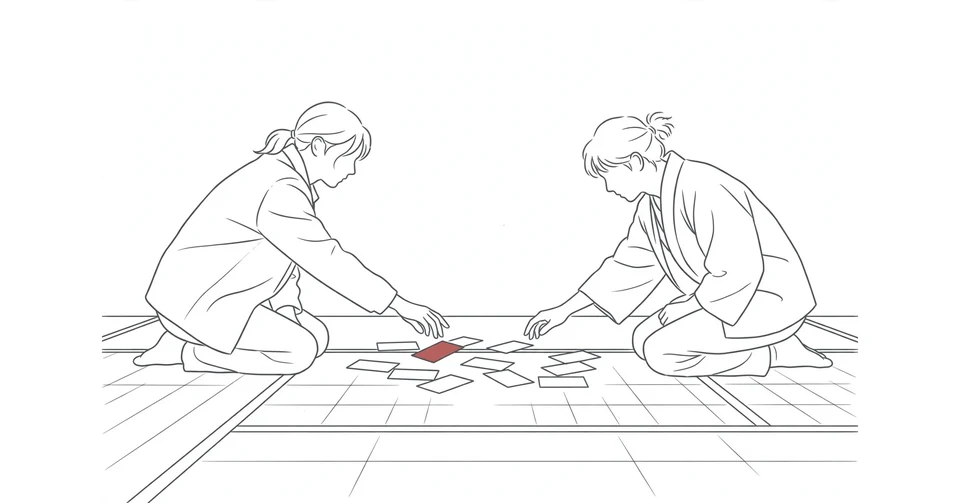
The word itself gives away the first surprise. Karuta comes from the Portuguese word carta, meaning card, and it arrived in Japan with Portuguese sailors in the sixteenth century. What began as a foreign deck of playing cards became, over a few centuries, a game built on the most Japanese material imaginable: a hundred tanka poems chosen by a court poet in the 1230s. This article follows that journey, from a Portuguese deck to a New Year family game to a national championship held every January.
A Portuguese word that became a Japanese game
The Japanese word karuta derives from the Portuguese carta, which shares a root with the English word card. Portuguese sailors introduced the word and the game during the European Age of Discovery, in the sixteenth century. The cards they brought were Latin suited, with suits named clubs, swords, cups, and coins, and the Japanese who adopted them reportedly mistook the cup for a bag. It is a small misunderstanding, and it is a good emblem for what happened next. Japan took a foreign object and read it in its own way.
In the seventeenth century, the Tokugawa shogunate closed Japan's borders and restricted foreign interaction and trade. From that point on, carta transformed into a uniquely Japanese form, with popular sets that featured tanka poems and were decorated with portraits of the poets. That is how Japan's karuta came to be. The card stayed, the suits went, and poetry took their place.
The idea of a matching game was not new to Japan. Long before the Portuguese arrived, the court played kai-awase, a shell matching game in which pictures and poems were painted inside gilded clam shells, and e-awase, a contest of judging pictures. Karuta is best understood as a meeting of those two traditions: a native love of matching pairs, and a foreign piece of printed card that made the matching faster, cheaper, and portable. I find that meeting rather moving. A game that now feels entirely Japanese began as an import, and it became Japanese not by rejecting the import but by filling it with Japanese poetry.
There are many kinds of karuta, including picture cards for children and regional sets with their own rules, but the famous one is uta-garuta, the poetry card game built on the Hyakunin Isshu anthology. That is the game this article is about, and it is the one played at New Year tables and in national championships alike.
One hundred poets, one poem each
The anthology at the heart of karuta is called the Hyakunin Isshu, which means one hundred people, one poem. It is a collection of one hundred waka poems, also called tanka, compiled by the poet and scholar Fujiwara no Teika in the 1230s. Teika was one of the most admired poets of his time, and he had already helped compile the Shin Kokin Wakashu, one of the great imperial poetry anthologies. For the Hyakunin Isshu he chose one poem from each of one hundred poets, spanning the seventh century to his own day.
The full name of the collection is the Ogura Hyakunin Isshu, after Mount Ogura near Kyoto. Teika is said to have selected the poems at the request of Utsunomiya Yoritsuna, his son's father in law, and written them out in his own hand to decorate the sliding doors of Yoritsuna's villa near the mountain. The poems were first a decoration for a house, and only later a deck of cards. That detail suits the game. Karuta still turns poetry into something you can hold in your hands and lay out on the floor.
The first poem in the collection is attributed to Emperor Tenji, who reigned from 661 to 672, and the hundredth to Emperor Juntoku, who reigned from 1210 to 1221. Between them are emperors, low ranking aristocrats, priests, and court ladies. The tanka form itself is strict: five lines in a 5-7-5-7-7 syllable pattern, thirty one syllables in all. The poems are written in classical Japanese, which is substantially different from the modern language, so even native speakers usually learn them as sounds and shapes before they understand every word.
The game of karuta was originally conceived as a way to memorize the tanka, and it eventually evolved into a game in its own right. That origin explains a lot about it. Karuta is not a card game that happens to use poems. It is a memory exercise that became a sport, and the memory is still the point. A player who knows all one hundred poems can hear the first syllable of a reading and know, before the second line begins, which card to reach for.
How karuta is played
A set of karuta has two hundred cards in two decks of one hundred. The yomifuda are the reading cards. Each one carries a complete tanka poem and a picture of the poet, and the reader keeps them. The torifuda are the grabbing cards. Each one carries only the second half of a poem, the closing two lines of seven syllables each, known as the shimo no ku. The reader reads the first half aloud, and the players race to find and touch the card with the second half.
In the family version of the game, all one hundred torifuda are spread on the floor, and the reader works through the yomifuda one by one. In the competitive version, known as kyogi karuta, the game is tighter and faster. Fifty torifuda are chosen at random from the hundred, and the other fifty are set aside as dead cards, or karafuda. Each player takes twenty five of the fifty and arranges them face up in three rows in a territory officially designated as 87 centimetres wide, with a small gap between the two territories. The players are then given fifteen minutes to memorize the position of every card on both sides of the mat, and in the final two minutes they are allowed to practice their strike.
Then the reciter, called the yomifude, begins. The game opens with an introductory poem that is not one of the hundred, which lets the players get used to the reader's voice and rhythm. After that, the reader draws yomifuda at random and recites them, including the dead cards that match nothing on the mat. The moment a player recognizes a poem, that player lunges for the matching torifuda. The first to touch it takes the card, and if the card came from the opponent's territory, the player who took it must send one of their own cards over to the opponent. The first player to clear every card from their own territory wins.
The speed comes from a detail called the kimariji, the decisive syllables. Seven poems can be identified from their very first syllable, and most of the rest from the first two or three. Three poems begin with the sound chi, and they are the famous trio that gives the manga Chihayafuru its title: chihayaburu, chigirikina, and chigiriokishi. A player who hears chi must wait, because the three cards cannot be told apart until the poem reaches its decisive stretch. A player who hears a unique opening syllable can move before the reader has finished the first line. That is why the game looks like a sport. The contest is decided in the gap between hearing and touching, and that gap is often a fraction of a second.
Mistakes carry a price. Touching a card when a dead card is read, or touching a card in the wrong territory, is a fault called otetsuki, and the penalty is to receive a card from the opponent. Touching the wrong card in the same territory as the target is not a penalty, which is why players sweep nearby cards aside as they strike. There is no referee in karuta. If a dispute arises, the players must arrive at a consensus themselves. An average game lasts about ninety minutes, including the fifteen minute memorization period, and in national tournaments the winner usually plays five to seven matches in a row.
The competitive game and its champions
Competitive karuta has been played since the early nineteenth century, before the Meiji Restoration, but the rules varied by region until the Tokyo Karuta Association unified them in the early twentieth century. The first competitive karuta tournament was held in 1904. The All Japan Karuta Association was founded in 1957, and it now sets the format and rules for the official game.
There are about fifty official tournaments every year that count toward a player's dan ranking, from E class for beginners up to A class for players ranked fourth dan and above. The national championship is held every January at Omi Shrine in Otsu, in Shiga Prefecture. The men's champion is awarded the title of Meijin, a title given since 1955, and the women's champion is awarded the title of Queen, given since 1957. A separate national championship for high school students is held every July. The shrine itself is dedicated to Emperor Tenji, the author of the first poem in the anthology, which makes it a fitting home for the game. It is often called the karuta shrine.
The competitive world is small. The number of competitive karuta players in Japan is estimated at ten thousand to twenty thousand, of whom about two thousand are ranked above C class and registered with the All Japan Karuta Association. All official matches use cards made by a single maker, Oishi Tengudo, so that every player handles the same deck. The game is recognized as a kind of sport in Japan, and the players treat it as one. The action can get so intense that players sometimes slam hands and suffer jammed fingers, dislocations, or even fractures. The physical risk is real, and it is part of why the game commands respect.
The strongest players list five factors behind success: memory, focus, strategy, split second action, and mental fortitude. That list comes from Kusunoki Saki, who became the youngest queen in history at fifteen and then won ten straight championships before retiring. Her career is a reminder that karuta rewards a whole person rather than a single talent. A player with a great memory but a slow hand will lose to a faster rival, and a player with a fast hand but a weak memory will commit faults and hand cards to the opponent. The game asks for both, at the same time, under pressure, for ninety minutes.
I think that is the most admirable thing about competitive karuta. It is a sport with no money prizes, no professional league, and almost no audience outside its own community, and yet its players train as seriously as athletes in any stadium. The national champions tend to have other occupations. They play because the game itself is worth playing, and because a hundred poems are worth knowing by heart. That is a quieter kind of ambition than most sports offer, and it suits the material. A poem is not a ball. You cannot win it by force. You can only win it by knowing it.
Karuta at New Year
For most Japanese people, karuta is not a tournament game. It is a New Year game, played at home with family while the house is still in its holiday mood. During matsunouchi, the week when the pine decorations stay up at the gate, families gather, visit shrines, and eat together, and the old games come out: hanetsuki, a form of badminton played with wooden paddles, kite flying, and karuta. The cards are spread on the floor after the shrine visit and the meal, and the game runs on laughter rather than rankings.
The family game is slower and kinder than the competitive one. Nobody has memorized all one hundred poems, so the reader reads the whole first half, and sometimes the whole poem, before anyone moves. Children play with picture cards first and graduate to the poetry set when they are older. The point is not to win. The point is to sit on the floor together and hear the old language spoken aloud, once a year, in the same room. Osechi, the tiered boxes of small dishes prepared in advance so that no cooking is needed during the first days, are served through the same period, and the two traditions belong together. The food is made to last and to be shared, and the game is made to be played slowly, by people who have nowhere else to be.
That setting is where karuta does its quietest work. A child who plays the game at New Year learns, without studying, that poems have a shape and a rhythm, and that a verse written a thousand years ago can still decide who reaches a card first. The game carries the anthology into homes that would never open a book of classical poetry, and it carries it in the form of play rather than homework. I think that is why it has survived so long. A tradition that only lives in museums fades. A tradition that lives on the floor at New Year, with children shouting over the cards, renews itself every January.
The Chihayafuru effect
In recent years, karuta has found a new audience through a manga. Chihayafuru, written and illustrated by Yuki Suetsugu, began in 2007 and follows a high school girl, Chihaya Ayase, who takes up competitive karuta after a classmate introduces her to the game. The fiftieth and final volume was published in December 2022, ending a fifteen year run, and the series has sold more than twenty seven million copies in total. It was adapted into a televised anime and three live action films released from 2016 to 2018.
The series is credited with boosting the popularity of competitive karuta in Japan and abroad. Its title comes from the poem by Ariwara no Narihira that begins with the word chihayaburu, one of the three chi poems that players must wait to distinguish. The manga treats the game with the seriousness of a sports story: training, rivals, injuries, and the long road to the national championship at Omi Shrine. Readers who had never heard of the Hyakunin Isshu learned the names of the poems alongside the heroine, and some of them went on to join clubs and play for real.
The effect is visible beyond Japan as well. The number of people overseas who have embraced competitive karuta has been increasing, and the first international tournament was held in September 2012, with players from the United States, China, South Korea, New Zealand, and Thailand taking part. In 2020, the Hyakunin Isshu Competitive Karuta Chihayafuru Ogurayama Cup was established to introduce fans to the joys of watching the game, with its fourth tournament held in Kyoto's Arashiyama district in February 2023. A manga about a card game does not usually create a tournament, and that is a measure of how far the series reached.
There is a risk in a story like this, and it is worth stating plainly. A game can become a fashion and then fade when the fashion passes, and karuta has already seen its popularity fall and rise more than once. But the manga did something that a fashion alone cannot do. It showed the game from the inside, as a discipline, and it gave its readers a reason to learn the poems rather than only to watch the matches. A reader who memorizes a poem because a character loves it has already joined the tradition, whether or not that reader ever kneels on a tatami mat.
A game that asks you to know the poems
Karuta is unusual among games because its winning move is an act of remembering. A chess player wins by calculation, and a sprinter wins by speed, but a karuta player wins by having a hundred poems ready in the mind and a hand ready to follow. The game takes the oldest material in Japanese literature and turns it into the fastest contest in the country, and it does so without changing a word of the poems. The anthology is the same one Teika compiled in the 1230s. Only the table has changed, from a court villa to a family living room to a shrine hall in January.
If you ever get the chance to watch a match, watch the hands rather than the cards. The cards sit still. The hands hover, trembling slightly, waiting for a single syllable to arrive. That hovering is the whole game: a body held ready by a mind that knows what is coming. And if you ever get the chance to play, even badly, take it. You will lose, and you will enjoy losing, because every card you fail to reach is a poem you have just heard for the first time. That is a fair trade, and it is why a hundred poems are still being played with, eight centuries after they were written down.
More in Culture & Society
- Takoage Sends New Year Wishes Up on a Paper Kite
- Hanetsuki Keeps New Year in the Air With a Wooden Paddle
- Hatsuyume Is the First Dream Japan Reads Like a Fortune
- Japanese Manga and How It Became the World's Most Read Comics
- Hatsu-Hinode Is the First Sunrise Japan Wakes Up For
- Matsunouchi Is the Week Japan Keeps the Pine Up for Its Guest
Latest posts
- Japanese Stationery and the Small Tools Japan Takes Seriously
- Toshikoshi Soba Is the Long Noodle Japan Eats at Midnight
- Osouji Is the Cleaning Japan Does Before the Gods Arrive
- Japanese Anime and How a Niche Hobby Conquered the World
- Toshigami Is the Guest Japan Prepares the Whole House For
- Urajiro Is the Fern That Wishes a Family Twice Over
- A Shimekazari Hangs the New Year Over the Front Door
- Make-Koshi Is the Eight Loss Line That Sends a Sumo Wrestler Down
- Japanese Arcades and the Game Centers That Refuse to Die
- Danpatsu-Shiki Is the Haircut That Ends a Sumo Career
- Kachi-Koshi Is the Eight Win Line That Moves a Sumo Wrestler Up
- Tachiai Is the One Second That Decides a Sumo Bout
- A Gunbai Points at the Winner and Nobody Argues
- Izakaya, the After-Work Pubs Where Japan Unwinds
- Dondo-Yaki Is the Fire That Closes the Japanese New Year