Osouji Is the Cleaning Japan Does Before the Gods Arrive
· 24 min read
Osouji is Japan's great year end cleaning, a December deep clean that purifies the home and prepares it to welcome Toshigami, the deity of the new year.
Every December, Japan cleans its houses the way other countries decorate theirs. The shops fill with sponges and spray bottles, neighbours wash windows on balconies in the cold, and families set aside a weekend for the one cleaning job that is bigger than all the rest. The job is called osouji, and it is not ordinary housework. Osouji is the great cleaning of the year end, the deep clean that turns an ordinary home into a place fit for a god to visit.
The god in question is Toshigami, the deity of the new year, who is believed to visit each home at the turn of the year. A guest like that cannot be welcomed into a dusty house, so the cleaning comes first and everything else follows. The pine at the gate, the straw rope over the door, the round rice cakes in the best room, all of them are put up after osouji, never before. Clean first, then decorate. That order is the whole teaching of the season, packed into a mop bucket and a broom.
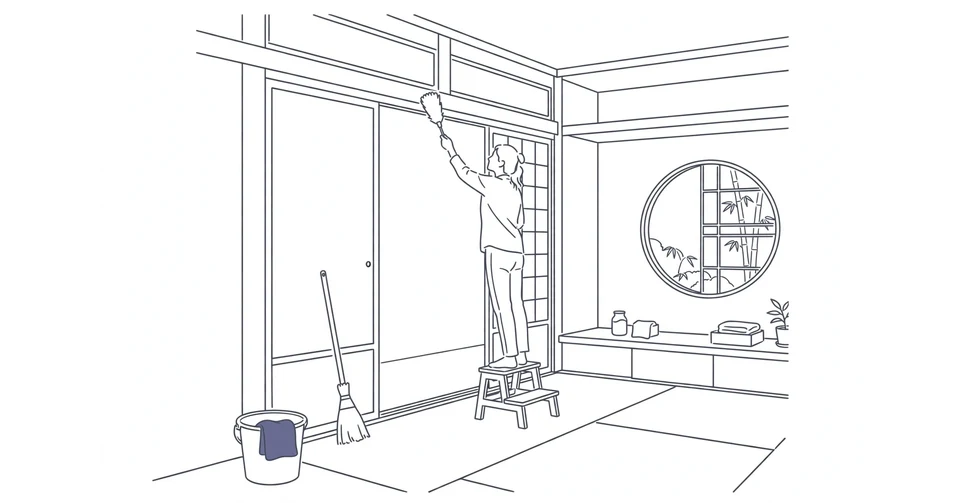
I have come to think of osouji as the most honest festival on the Japanese calendar. It asks for no money, no special skill, and no travel. It asks only for attention, paid to the corners of your own home, and it gives back a feeling that no decoration can buy. When the floors are scrubbed and the shelves are dusted and the entrance is swept, the house feels different, as if it has taken a deep breath after holding one all year. That feeling is the point. Osouji is not a chore that happens to fall in December. It is December, in the form of work done by your own hands.
What osouji actually is
The word osouji is written with the characters for great and cleaning, and the literal translation is the great cleaning or the big cleaning. Everyday cleaning in Japanese is just soji. Osouji is the once a year version, the one where you clean the places you usually ignore. Behind the fridge, the top of the wardrobe, the grease on the kitchen fan, the mould in the bathroom, the tracks of the sliding windows, the dust on the beams. If ordinary cleaning keeps a house liveable, osouji keeps it honest.
The cleaning is thorough because the purpose is larger than tidiness. In the Japanese understanding, physical cleanliness and spiritual purity are closely connected, and a home that has gathered a year of dust has also gathered a year of stale air, unfinished business, and things left unsorted. Osouji clears all of it at once. Walls are wiped, floors are scrubbed, tatami mats are beaten and aired, sliding doors are cleaned, kitchen appliances are degreased, closets are organised, and accumulated possessions are sorted, discarded, or passed on. Nothing is left for later, because later is the new year, and the new year deserves a fresh start.
It is worth saying plainly that osouji is not a spring clean that happens to fall in winter. A spring clean is about comfort. Osouji is about renewal. The difference shows in the timing, the scale, and the mood. People do not do osouji because the house looks dirty. They do it because the year is ending, and ending a year properly matters. The whole country does it at the same time, in homes, schools, offices, temples, and shrines, which turns a private chore into a shared national moment. Everyone is scrubbing at once, and that shared effort is part of the comfort of it.
From soot to sweeping, where osouji comes from
Osouji did not begin as a cleaning trend. It grew out of susuharai, the sweeping away of soot, a ritual that is documented as far back as the Heian period and was formalised in the Edo period. A thorough guide to the history of osouji traces the custom to Shinto ideas of purification, where impurity gathers through daily life and must be periodically swept away to restore balance. In those days houses were heated by open fires, and soot collected on the beams and rafters over the course of a year. Sweeping it out at the year end was practical, but it was also a purification. The house was being made clean for the visit of Toshigami, and the soot had to go before the god could come in.
The old form of the custom was a major household event. In Edo period homes, the entire household took part, family members of all ages and servants alike, sweeping soot from the rafters, beating tatami mats, and scrubbing every surface, and the work was followed by celebratory eating and drinking that acknowledged the collective effort. The cleaning was not assigned to one person while the rest of the family watched. It was something the household did together, and the meal afterwards was part of the custom, not a reward added later.
The traditional date for beginning the preparations is December 13, a day known as Shogatsu Kotohajime, the start of New Year preparations. Few families clean that early now, and most do their osouji in the last week or two of December, often intensifying in the final days before New Year's Eve. The old date still matters, though, because it shows how the custom was understood. December 13 was chosen because it was considered auspicious in the old calendar system, and the cleaning was the first act of the New Year, not the last act of the old one. The year end cleaning was never an afterthought. It was the opening ceremony of the season.
That older form, susuharai, has never fully disappeared. Many temples and shrines still hold a ceremonial susuharai in December, and the custom lives on inside modern osouji as well. Every time a family dusts a high shelf that has not been touched since last December, it is repeating a gesture that is more than a thousand years old. The tools have changed. The gesture has not.
Why the cleaning comes before the decorations
The order of the Japanese New Year is strict, and osouji sits at the front of it for a reason. A house that has been decorated but not cleaned is a house that has put the wrapping before the gift. The decorations of the season are beautiful, and each one has a job, but none of them can do that job in a dirty house. The rope over the door marks a purified space. The pine at the gate marks a house that is ready. The rice cakes wait in the best room for a guest. If the house behind those signs is dusty and cluttered, the signs are only decoration, and decoration without the work behind it is the one thing the season refuses to accept.
This is why osouji is best understood as the real offering, with the decorations as the sign that the offering has been made. A god who visits instead of waiting is the heart of the Japanese New Year, and a visiting god notices the difference between a house that has been prepared and a house that has been dressed up. Anyone can buy a decoration. Not everyone will scrub the floor beneath it. The cleaning is the part that cannot be bought, and that is exactly why it counts.
There is a practical side to the order as well. Dust falls downward, so a house cleaned from the top down stays clean. Grease softens with soaking, so a kitchen fan left to soak while the windows are washed saves an hour of scrubbing. Rubbish must be sorted and put out before the last collection day of the year, or the bags will sit on the street for days while collection pauses over the holiday. The sequence of osouji is not superstition. It is a workflow refined over centuries, and it works just as well in a modern apartment as it did in a wooden farmhouse.
I think there is a lesson in that order that reaches beyond the New Year. Preparation is the gift, and the visible sign is only the wrapping. We spend a great deal of our lives buying the wrapping, the right clothes, the right words, the right profile, and hoping no one looks underneath. Osouji looks underneath first. It starts with the dirtiest, least visible corners of the house, and only when those are clean does it turn to the things a visitor will see. A life ordered the same way would be a quieter, more honest life.
The order that makes osouji work
Osouji has an order, and the order is the useful part. It runs from the top of each room to the floor, from the rooms furthest from the door toward the door itself, and it finishes at the entrance on the last day. The entrance is last on purpose. It is the first thing seen in the New Year, and the first thing a guest sees, so it is cleaned last and kept clean.
The rules behind the order are simple enough to remember. Work top to bottom, so dust falls onto surfaces that have not been cleaned yet. Work dry before wet, so dust is removed before it becomes mud. Work from the back of the house toward the door, so you are never walking through rooms you have already finished. And finish at the genkan, the entrance, so the house is left the way a guest will meet it.
| Rule | What it means in practice |
|---|---|
| Top to bottom | Ceilings, high shelves, and light fittings first, floors last |
| Dry before wet | Dust and sweep first, then wipe and wash |
| Back to front | Start in the rooms furthest from the door |
| Entrance last | The genkan is cleaned on the final day |
The order also shapes the schedule. Some families tackle one room per day over the course of a week. Others designate a single intensive cleaning day. Some divide responsibilities among family members, with children expected to participate as both a practical contribution and a formative experience in the values of cleanliness, responsibility, and communal effort. None of these schedules is the correct one. What matters is the order, and the willingness to start at the top and finish at the door.
If you have never done osouji, the order is the kindest possible place to begin. You do not need a plan for the whole house. You need a plan for the highest shelf in the furthest room, and then the next shelf down, and then the next room toward the door. A big job becomes a series of small jobs, and a series of small jobs is only ever one small job at a time. That is how a whole house gets cleaned in a weekend, and it is how most large things in life get done.
What gets cleaned, room by room
The kitchen receives particular attention in osouji, and anyone who has ever cleaned a Japanese kitchen in December will understand why. Range hoods, ovens, refrigerators, and ventilation fans are subjected to thorough degreasing and scrubbing, because a year of cooking leaves a film on everything, and the film only comes off with patience. The fan filter is soaked, the stove is scrubbed, the inside of the fridge is emptied and wiped, and the cupboards are opened and sorted. It is the hardest room in the house, and it is usually done first, while energy is high.
The bathroom comes next in difficulty. Grout, drains, and fixtures accumulate mineral deposits and mildew over the year, and the deep clean means getting into the corners that daily cleaning skips. The bath is scrubbed, the mirror is polished, the ventilation fan is cleaned, and the bottles on the shelf are wiped and sorted. There is a safety rule here that every household in Japan knows. Bottles of strong bathroom cleaner carry a warning in large red characters, mazeru na kiken, meaning dangerous, do not mix. Strong cleaners must never be combined with acidic cleaners, because the mixture can release toxic gas. Use one product at a time, and open a window.
Windows are washed inside and out, including the tracks of sliding windows and the frames of screens, because winter light is low and weak, and a clean window makes a real difference to a room in December. Closets, storage spaces, and the genkan are organised and decluttered. Tatami rooms, if present, receive special treatment, including the airing and beating of tatami mats and the cleaning of fusuma sliding panels and shoji paper screens. The paper of a shoji screen tears easily, so it is dusted gently, and a torn screen is often replaced as part of the year end work.
The tools of osouji are a mix of old and new. The classic tool is the zokin, a folded cotton cloth, and children often sew or bring one to school for classroom cleaning. The hoki broom and the chiritori dustpan are the old sweeping pair, and a practical guide to the words and tools of the year end clean is worth reading before you start, if only to learn that the verbs for wiping, sweeping, polishing, and washing are not interchangeable in Japanese, and that vacuuming is sōjiki o kakeru, never sōjiki suru. Modern shelves add detergent sprays, rubber gloves, sponges, baking soda, and mould remover, and home centres and supermarkets stock extensive osouji sections in December, offering everything from heavy duty degreasers to delicate wood polishing oils. The tools change with the times. The work does not.
Osouji in the modern apartment
Most people in Japan today do osouji in apartments, not farmhouses, and the custom has adapted without losing its shape. There are no rafters to sweep for soot, and there may be no tatami to beat, but there is still a kitchen fan full of grease, a bathroom full of mildew, windows that have not been washed since spring, and a cupboard full of things nobody has used since last December. The modern apartment has fewer rooms and more stuff, and osouji is the day the stuff gets judged.
The judging is the part people dread, and it is also the part that does the most good. Anything that has not been used since last December is a candidate for letting go, and the Japanese word for that process is danshari, a modern term combining Buddhist ideas of refusal, disposal, and separation. The question is not whether an object is broken or useless. The question is whether it serves a purpose, carries a good association, or contributes to daily life. If it does none of those things, it is taking up space without paying rent, and December is the time to evict it.
The practical side of letting go is rubbish, and Japanese rubbish rules do not forgive a last minute rush. Most cities separate burnable, non burnable, and recyclable rubbish, each with its own collection day. Large items such as a chair, a bike, or a futon are sodai gomi, oversized rubbish, which usually needs an appointment and a paid sticker from the city. Book early in December, because slots fill up, and check the last collection day on your city calendar, because collection often pauses over the New Year. An osouji that ends with bags sitting on the street for a week is an osouji that was not finished.
I live in a small place myself, and I have learned that osouji in a small home is mostly about the cupboards. A small home hides its clutter well, and a year of small purchases adds up to a cupboard that will not close. The first time I did a proper osouji, I found cables for devices I no longer owned, a bag of batteries of unknown age, and three identical screwdrivers. None of it was valuable. All of it had been taking up space in my head as well as in the cupboard, because every time I opened the door I saw the mess and closed it again. Throwing it away took ten minutes. The relief lasted weeks. That is the quiet mathematics of osouji. Ten minutes of deciding is worth weeks of not seeing a mess every day.
Osouji at school and at work
Osouji is not only a household custom. It extends into schools, offices, factories, and public institutions across Japan, and in those places it carries the same meaning it carries at home. It marks the completion of the year's work, the clearing away of unfinished business, both literal and metaphorical, and the preparation of a clean slate for the challenges of the coming year.
In Japanese schools, where daily cleaning by students is already a standard part of the educational routine, the year end osouji is an intensified version of the daily practice. Students spend extended periods cleaning their classrooms, hallways, gymnasiums, and school grounds, often tackling areas that are not part of the daily rotation, such as storage rooms, equipment sheds, and the spaces behind and beneath furniture. It is understood not merely as a custodial task but as an educational experience that teaches responsibility, cooperation, gratitude for shared spaces, and the connection between physical environment and mental well being. An assistant language teacher who joins in is appreciated, and the joining in matters more than the cleaning itself.
In workplaces, the year end osouji typically takes place on the last working day before the New Year holiday, often December 28 or 29, when employees collectively clean their offices, desks, meeting rooms, and common areas. They wipe surfaces, organise files, dispose of accumulated papers, and restore the workspace to a fresh, orderly state before the holiday break. The practice of cleaning together, executives alongside entry level employees, managers alongside support staff, reinforces workplace solidarity and the Japanese value of shared responsibility for communal spaces. The day ends with thanks for the year and a wish for a good New Year, and the office is left empty and clean behind them.
There is something I admire about a workplace that cleans together. In most offices, cleaning is invisible work done by invisible people after everyone has gone home. The year end osouji makes it visible and shared, and it says something true about work. The office belongs to everyone who works in it, and the last act of the year is to look after it together. A company that will scrub its own floors is a company that has not forgotten that work is done by people, in a place, with their hands.
Temples and shrines still sweep the soot
The oldest form of the custom is still alive in the places where it began. At major temples and shrines across Japan, the year end cleaning is a major event that may involve dozens or hundreds of volunteers, monks, priests, and staff working together to clean buildings, grounds, statues, and ritual objects. The cleaning prepares these holy spaces for the enormous influx of visitors who come for hatsumode, the first shrine or temple visit of the new year.
The most visually striking expression of temple osouji is the susuharai ceremony at major Buddhist temples, in which monks and volunteers use enormous bamboo poles fitted with bundles of bamboo leaves to sweep accumulated dust from the high ceilings and rafters of temple halls. The ceremony has been documented at temples like Nishi Honganji in Kyoto and Todaiji in Nara for centuries, and it draws media coverage and public attention as a picturesque symbol of the year's end. The bamboo poles are long enough to reach the highest beams, and the dust falls like slow snow through the hall while the monks work.
At Shinto shrines, the year end cleaning includes the purification of sacred objects, the renewal of shimenawa sacred ropes, and the general preparation of shrine buildings and grounds for the hundreds of thousands or millions of visitors who may arrive during the first days of January. The communal nature of these cleaning events, in which volunteers from the local community work alongside religious practitioners, reinforces the connection between osouji and the broader social values of community, shared responsibility, and collective spiritual renewal.
I find the temple ceremonies moving because they show the custom at its original scale. A home is a small temple, and a temple is a large home, and both are cleaned the same way, from the top down, by the people who use them, before the god arrives. The bamboo pole in the temple hall and the duster on the step stool in the kitchen are the same tool, at different sizes, doing the same job. The soot has changed. The sweeping has not.
The letting go inside the cleaning
Every osouji has two halves, and the second half is harder than the first. The first half is dirt, and dirt is simple. You scrub it, and it is gone. The second half is things, and things are complicated, because things carry memories, intentions, and guilt. The shirt that does not fit but might fit one day. The gift that was never liked but cannot be thrown away. The box of cables for devices that no longer exist. Osouji asks you to look at each one and decide, and the deciding is the real work of the day.
The Japanese tradition of decluttering inside osouji has travelled around the world in recent years, most famously through Marie Kondo and her KonMari method, which asks practitioners to keep only items that spark joy. The global popularity of that method reflects the international appeal of this part of Japanese cleaning culture, though osouji predates it and holds it inside a broader seasonal framework. The method is a tool. The season is the reason. You are not decluttering because a book told you to. You are decluttering because the year is ending, and the new year should not have to carry the weight of the old one.
The honest way to decide is to ask three questions, and to answer them quickly. Have I used this in the past year. Would I buy it again today. Does it make the room better, or does it only make the cupboard fuller. An object that fails all three is not a possession. It is storage, and you are paying for that storage with space in your home and attention in your head. Letting it go is not wasteful. Keeping it is wasteful, because the space it occupies is space you could use for something you actually need.
That is my own rule for osouji, and it has served me well. I do not keep things for the person I might become, because that person has never arrived, and the things are still sitting in the cupboard. I keep things for the person I am, in the home I have, in the year I am living. Everything else can go, and the house feels lighter for it. A clean house is not an empty house. It is a house where everything in it has earned its place.
How to do your own osouji without dreading it
The reason most people dread osouji is that they imagine it as one enormous job, and one enormous job is frightening. The custom itself has the answer. Break it into rooms, break the rooms into surfaces, and break the surfaces into the order of top to bottom, back to front, entrance last. Then start, and do not stop to admire the plan. A plan that is not started is only a list, and a list does not clean anything.
Start early, even if early only means the second weekend of December. The last weekend before the New Year is cold, crowded, and short, and every shop is full of people buying the same sponges. Starting early also spreads the work out, so one room per day over a week replaces a single exhausting day. Book the oversized rubbish pickup in the first week of December, not the last, because the slots fill up and a sofa on the balcony in January is a monument to bad planning.
Work with other people when you can. Osouji in a family or a share house starts with dividing the work, and the dividing is half the job. One person takes the kitchen fan, another takes the bathroom, a third takes the windows, and the music goes on. In a share house, the old rule still applies. Ask before throwing anything away. A roommate's box is not your decision, and a quick question saves a long argument. The phrases are simple, and the habit of asking is what makes a shared clean feel fair.
Keep the tools simple. A folded cotton cloth, a broom and dustpan, a vacuum cleaner, a sponge, rubber gloves, and one good spray for grease and one for the bathroom will carry you through most of a home. Do not buy ten products for one day of cleaning. Most of the work is water, cloth, and patience, and patience is the only product that never runs out. Open the windows while you work, even in the cold, because fresh air is part of the point. You are not only cleaning the house. You are airing it out for the year to come.
And when the work is done, stop. Osouji has a finish line, and the finish line is the entrance, cleaned last, on the last day. Sweep the genkan, wipe the door, put the shoes in order, and step back. The house is clean. The year is ending. There is nothing more to do, and that feeling of nothing more to do is the reward. Sit down, make tea, and look at the clean rooms. You have earned the quiet.
The cleaning is the offering
When the decorations go up, they go up on a clean house, and that is the whole of it. The straw rope over the front door marks a threshold that has been swept. The pine at the gate stands in front of windows that have been washed. The rice cakes sit in a room where the dust has been beaten out of the mats. None of it would mean the same in a house that had not been cleaned, because the cleaning is the part that says the household is serious. The decorations are the announcement. Osouji is the work.
That is why osouji has lasted so long, and why it will last as long as people live in houses and mark the turning of the year. It does not depend on money, or on belief, or on tradition in the narrow sense. It depends only on the willingness to look at your own home honestly, to see the dust and the clutter and the unfinished corners, and to deal with them before the year turns. A person who does not believe in Toshigami can still do osouji, and still feel the same lift when the last room is done, because the feeling does not come from the god. It comes from the work, and the work is available to everyone.
I will do my osouji this December the way I do it every year, one room at a time, top to bottom, back to front, entrance last, with the music on and the windows open. I will find things I forgot I owned, throw away things I should have thrown away a year ago, and finish at the genkan with a swept entrance and a quiet house behind me. Then I will hang the decorations, put the rice cakes in the best room, and wait for the new year the way the custom asks. Clean house, open door, and nothing left unfinished. That is osouji, and it is enough.
More in Life & Style
- Inside Japan's 100 Yen Shops, Where Everything Costs a Coin
- Akihabara and How Tokyo's Electric Town Learned to Sell Everything
- Kotatsu, Japan's Heated Table That Warms Winter
- The History of the Bicycle From Wooden Wheels to Japanese City Bikes
- A Shukubo Lets You Sleep Inside a Working Temple
- Kaburiyu Is How You Talk Your Body Into the Bath
Latest posts
- Matsunouchi Is the Week Japan Keeps the Pine Up for Its Guest
- Japanese Anime and How a Niche Hobby Conquered the World
- Toshigami Is the Guest Japan Prepares the Whole House For
- Urajiro Is the Fern That Wishes a Family Twice Over
- A Shimekazari Hangs the New Year Over the Front Door
- Make-Koshi Is the Eight Loss Line That Sends a Sumo Wrestler Down
- Japanese Arcades and the Game Centers That Refuse to Die
- Danpatsu-Shiki Is the Haircut That Ends a Sumo Career
- Kachi-Koshi Is the Eight Win Line That Moves a Sumo Wrestler Up
- Tachiai Is the One Second That Decides a Sumo Bout
- A Gunbai Points at the Winner and Nobody Argues
- Izakaya, the After-Work Pubs Where Japan Unwinds
- Dondo-Yaki Is the Fire That Closes the Japanese New Year
- Hakkeyoi Is the Word That Starts a Sumo Bout
- A Yobidashi Calls the Wrestlers and Sweeps the Ring