Danpatsu-Shiki Is the Haircut That Ends a Sumo Career
· 15 min read
The danpatsu-shiki is the ceremony in which a retiring sumo wrestler has his topknot cut away strand by strand, and this article explains how it works, who takes part, and why it matters.
A sumo wrestler can lose his last bout and keep going. He can be injured, demoted, and forgotten by the rankings, and still be a wrestler. What he cannot do is keep his hair. When his career is over, the topknot he has worn every day for years is cut away in front of everyone who mattered to him, and that is the moment his life as a wrestler truly ends. The ceremony is called the danpatsu-shiki, and it is one of the most moving rituals in Japanese sport.
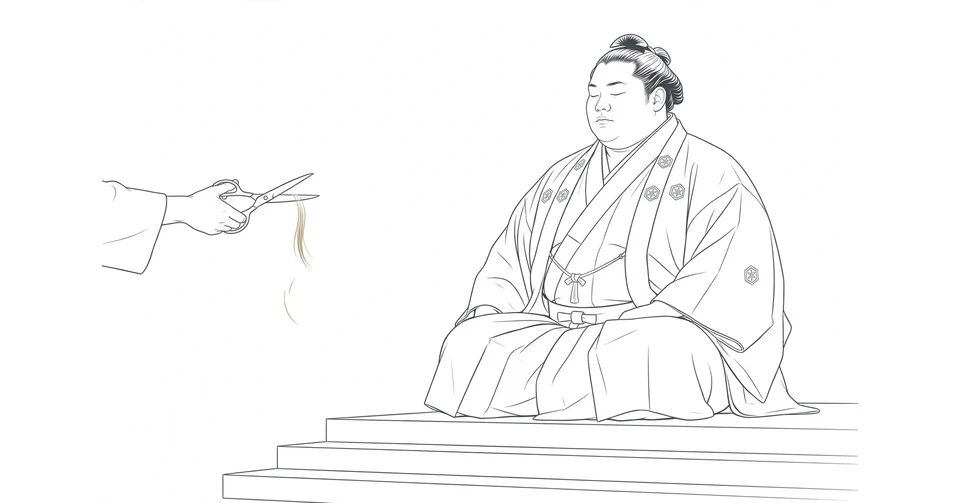
The danpatsu-shiki, written 断髪式 and literally meaning hair cutting ceremony, is the formal farewell of a retiring wrestler. He sits in the center of the room or the ring, dressed in formal kimono, while the people who shaped his career come forward one by one. Each of them takes the scissors and cuts a small strand of his topknot. By the end of a danpatsu-shiki, the hair that marked him as a wrestler is gone, and so is the life that went with it.
What makes the danpatsu-shiki unusual is that it is not a private goodbye. Most athletes retire with a press conference and a statement. A sumo wrestler retires by letting hundreds of people take a piece of his identity away in a danpatsu-shiki, a few strands at a time, in full view of a crowd. The ceremony turns a personal ending into a shared one, and that is exactly the point.
What a danpatsu-shiki is
Every oichomage has a last day. When a wrestler retires, he marks the end of his career by cutting off his topknot in a ceremony called the danpatsu-shiki, the hair cutting ceremony. That sentence, from our earlier article on the oichomage, is the whole story in miniature. The danpatsu-shiki is the last day of the topknot, and therefore the last day of the wrestler.
The word itself is plain. Danpatsu means cutting hair, and shiki means ceremony. There is no poetry in the name, and there does not need to be. The danpatsu-shiki is the poetry. A man who has lived in a stable since his teens, eating, sleeping, and training with the same group of men, sits down in front of them and lets them dismantle the most visible sign of who he has been.
One detail surprises many first time viewers. The wrestler usually retires several months before the danpatsu-shiki takes place. The official announcement comes first, and the danpatsu-shiki follows later, once the arrangements are made. So the danpatsu-shiki is not the moment the decision is taken. It is the moment the decision is made real, in front of witnesses, with scissors.
The scale of the event depends on the wrestler. For a lower ranked wrestler, the danpatsu-shiki is often a quiet affair, held at the usual end of tournament party, with a small circle of stablemates and friends. For a top ranked wrestler, the danpatsu-shiki becomes a large public event, run like a charity tournament, with exhibition matches, presentations, and performances by prestigious guests. The same danpatsu-shiki, in other words, can be a family gathering or a full arena show. The rank decides the size, but the meaning stays the same.
The topknot that gets cut away
To understand why a haircut can end a career, you have to understand what the hair means. A sumo wrestler wears his hair in a topknot called a chonmage, a style with roots in the samurai hairstyles of the Edo period. The knot is not fashion. It is a badge of rank, history, and belonging, and it is the first thing anyone notices about a wrestler.
Wrestlers who climb into the two salaried divisions, juryo and makuuchi, earn the right to wear a grander version of the knot, the oichomage, fanned out like a ginkgo leaf. We explained how that fan is earned in How an Oichomage Turns a Wrestler Into a Sekitori, and how the simpler knot beneath it works in Chonmage. The knot a man wears tells you where he stands, and the danpatsu-shiki is the day that statement is taken away.
The topknot is also a daily discipline. It is dressed each morning by a specialist hairdresser, oiled and shaped, and kept in place through training and tournaments. A wrestler does not simply grow his hair long and tie it up. He maintains it, the way he maintains his body and his manners. Cutting it away in a danpatsu-shiki is therefore not like getting a haircut at a barber shop. It is the removal of something he has tended for years, in a single afternoon.
There is a practical side to this too. Once the topknot is gone, the man in the chair looks different, and everyone in the room knows it. The hair was the uniform he never took off, even outside the ring. Without it, he is no longer a wrestler to the eye, and that visible change is part of the danpatsu-shiki. It leaves no room for pretending that nothing has changed.
Who holds the scissors
The heart of the danpatsu-shiki is the order of the cutting. The wrestler sits still while his guests come forward in succession, and each of them cuts only a few strands of his hair with a pair of gold plated scissors. Family members, stablemates, fellow wrestlers, sponsors, and supporters all take their turn. A referee, known as a gyoji, stands nearby with the scissors on a tray, guiding each guest to the right place to cut.
Guests at a danpatsu-shiki traditionally pay a symbolic participation fee for the honour of cutting a strand. That detail matters, because it shows the danpatsu-shiki is not a show put on for spectators. It is a shared act, and the people cutting have bought into it, literally and emotionally. They are not watching a retirement. They are performing it, snip by snip.
The order of the cutting is a map of the wrestler's life. Early in the line come the people who knew him as a boy or as a junior wrestler. Later come the rivals, the sponsors, and the famous names. The line moves slowly, and the mood in the room changes as it goes. Guests who were smiling at the start often find themselves crying by the end, because each small cut is a reminder of a memory, and the memories pile up faster than the hair falls.
The final cut is always reserved for one person, the retiring wrestler's master, the stablemaster who trained him. When the master takes the scissors and cuts the last hairs holding the topknot together, the wrestler's career is officially over. It is a fitting end to a danpatsu-shiki. The man who took the boy in, taught him, fed him, and disciplined him is the one who releases him. I find that detail quietly devastating, and quietly right. No committee, no announcement, and no paperwork can do what that single cut does.
After the danpatsu-shiki, the wrestler goes back to the locker room, where a professional barber waits to cut and style what is left of his hair into an ordinary modern style. The transformation is complete in the most literal sense. He walks into the room a wrestler, and he walks out a former wrestler, with hair like anyone else on the street.
Why some ceremonies fill the Kokugikan and others do not
A danpatsu-shiki can take place almost anywhere. Many are held in hotels, and some in the wrestler's own stable. The grand ones, though, take place at the Ryogoku Kokugikan, the great sumo arena in Tokyo, and that privilege is not open to everyone.
The rule is clear. A wrestler must have served at least thirty tournaments as a sekitori, a wrestler of the two salaried divisions, to hold his danpatsu-shiki at the Kokugikan. Thirty tournaments is five years at the top level, which means the arena is reserved for men who proved themselves over a long career, not for a brief flash of success. That is a sensible rule, and a kind one. It keeps the biggest stage for the biggest farewells.
This is why a danpatsu-shiki at the Kokugikan feels so large. The men who qualify have had long careers, which means long lists of friends, rivals, sponsors, and supporters. Depending on the wrestler, three to four hundred guests may take part in the danpatsu-shiki. Each one needs a moment at the scissors, so a big danpatsu-shiki can run for hours, and the arena fills with people who all have a claim on a piece of the afternoon.
There is also a financial logic to the big danpatsu-shiki events. The top ranked retirements are run as charity tournaments, with exhibition bouts and performances filling the day around the cutting itself. Fans pay to attend, and the event becomes a celebration of a career rather than a wake. The cutting is still the emotional peak of the danpatsu-shiki, but the day around it is a festival, and that balance of joy and grief is very Japanese.
One night at the Kokugikan as Tochiazuma says goodbye
If you want to see what a great danpatsu-shiki looks like, the farewell of Ozeki Tochiazuma is a good place to start. On February 2, 2008, Tochiazuma put a definitive end to his career by having his oicho mage cut at the Kokugikan, in front of a crowd that filled all 10,000 seats. Demand had vastly exceeded capacity, which was a notable achievement at a time when sumo's popularity was low, and a measure of how much the public admired him.
Tochiazuma had surprised his fans with an abrupt retirement. A sudden rise in blood pressure had caused internal bleeding and complications with his heart, and although a life threatening diagnosis was averted, the aftereffects on his heart would remain with him for the rest of his life. He lost no time lowering his body mass, and it was a trimmed down Tochiazuma who made his last appearance. The danpatsu-shiki had taken eight months to organize, and the Japan Sumo Association had given itself that long so that no detail would be left unattended. Even so, it nearly did not happen on the day. A tremendous snowstorm hit Tokyo the day before, and if the ceremony had been scheduled one day earlier, the buses full of supporters would not have been able to reach the Kokugikan.
The afternoon was a full celebration of his career. Friends were invited to take a snip at his hair, and 313 chosen guests passed the scissors from one to another, cutting the oicho mage strand by strand. The singer Maeda Nobuteru arrived to sing on the dohyo, and the Yokozuna Asashoryu, his great rival, was there too. Asashoryu had always had trouble with Tochiazuma's technical, arm controlling style, and the two men had built a mutual respect out of years of hard bouts.
Then came the final cut. The Kokugikan held its breath as Tamanoi Oyakata, Tochiazuma's father, applied the scissors to the last of the oicho mage. A 13 year career, dotted with tournament championships in each of the six divisions, came to an end. Afterward, Tochiazuma devoted himself to training wrestlers at the Tamanoi stable, which he would inherit in 2009 upon his father's retirement. The haircut ended one career and started another, which is exactly how it is supposed to work.
Tochiazuma's farewell also shows why the danpatsu-shiki is so hard to watch without tears. For many wrestlers, the danpatsu-shiki is a form of torture, because memories, good as well as bad, come back to the surface as the scissors move. Even men as tough as Tochiazuma find it hard to hold back, and tears are usually pouring down in streams by the end. A man who has not cried in public for years cries in front of ten thousand people, and nobody in the room thinks less of him for it.
What happens after the last strand falls
The danpatsu-shiki ends, but the wrestler's life does not. The first thing that happens is small and practical. The severed topknot is kept, customarily in a box or a glass case, as a keepsake of a finished career. It is a strange object to keep, a knot of hair in a box, but it makes sense. It is the one part of his old life he can hold in his hands.
Then comes the question every retired wrestler faces, which is what to do next. Most of them joined a stable in their teens, which means they have no other work experience and little formal education beyond what they picked up along the way. The danpatsu-shiki marks the end of the only job most of them have ever had, and the next chapter starts from almost nothing. Some become television personalities or commentators. Many open chankonabe restaurants, putting to good use the cooking techniques they learned while preparing meals in the stable. Others find work in food service, care for the elderly, or sports coaching.
That is why the danpatsu-shiki matters beyond sentiment. It is a public acknowledgment that a man has given his youth to a sport, and that the sport owes him a proper goodbye. In a world where most careers end with an email and a cardboard box, sumo insists on a room full of people, a pair of golden scissors, and an afternoon of shared memory. The wrestler leaves with his hair in a box and his dignity intact, and everyone who cut a strand has promised, in a small way, to remember him.
Retirement is not the same as becoming an elder
It is worth clearing up one common misunderstanding. The danpatsu-shiki ends a wrestler's career as an active competitor, but it does not by itself make him a coach or an elder in the Japan Sumo Association. Those are separate things, and confusing them misses how sumo actually works.
Retired wrestlers who stay in the sport become toshiyori, or elders, more commonly called oyakata. They form a group of 105 coaches responsible for training wrestlers and running the association, and becoming one is a privilege, not a right. The qualifications are strict. A yokozuna, an ozeki, or a wrestler of the san'yaku ranks needs only one tournament at that rank to be considered for elder status. A maegashira must have held his rank for twenty tournaments, and a juryo wrestler for thirty. Yokozuna and ozeki receive preferential treatment and can remain in the association without acquiring elder status for five years and three years respectively, while they arrange their future.
Most retiring wrestlers never become elders at all. Only a small fraction are given the chance, and the rest must build a life outside the association. The danpatsu-shiki is for all of them, whatever comes next. The elder system is a career path for the lucky few. The haircut is a farewell for everyone, and that is part of its power. It does not ask what rank you reached or what job you will get. It only asks you to sit still while the people you love cut your hair.
Why a haircut can carry so much weight
There is a reason the danpatsu-shiki stays with people who see it, even people who know nothing about sumo. Most of us never get a ceremony for our endings. Jobs end, relationships end, chapters close, and they close quietly, often alone, often without anyone marking the moment. We tell ourselves that moving on is a private matter, and then we wonder why the endings feel unfinished.
Sumo refuses that bargain. The danpatsu-shiki says that an ending deserves witnesses, and that the people who shared a life should be the ones to close it. The scissors pass from hand to hand, and each cut is small, but together they add up to a complete separation. No single person ends the career. Everyone does, a little at a time, which is the truth of how a career is built in the first place.
I think there is something to learn here beyond sumo. A career is never really a solo achievement, even when one name is on the ranking sheet. It is the stable that fed you, the rivals who pushed you, the fans who paid to watch, and the master who believed in you. The danpatsu-shiki makes that visible by giving each of those people a turn with the scissors, and by letting the master finish the job. The hair is only hair. What is really being cut away is the idea that the wrestler did it alone.
So the next time you see a photograph of a wrestler sitting still in his formal kimono, his topknot slowly disappearing strand by strand, look past the sadness. Look at the line of people waiting their turn, and the master standing behind him with the scissors. That is not a man losing something. That is a man being thanked, properly, by everyone he ever fought for, and then being sent out into the rest of his life with his head held high and his hair, at last, his own.
More in Culture & Society
- A Shimekazari Hangs the New Year Over the Front Door
- Make-Koshi Is the Eight Loss Line That Sends a Sumo Wrestler Down
- Japanese Arcades and the Game Centers That Refuse to Die
- Kachi-Koshi Is the Eight Win Line That Moves a Sumo Wrestler Up
- Tachiai Is the One Second That Decides a Sumo Bout
- A Gunbai Points at the Winner and Nobody Argues
Latest posts
- Izakaya, the After-Work Pubs Where Japan Unwinds
- Dondo-Yaki Is the Fire That Closes the Japanese New Year
- Hakkeyoi Is the Word That Starts a Sumo Bout
- A Yobidashi Calls the Wrestlers and Sweeps the Ring
- A Dohyo Is Sacred Ground Long Before the First Bout
- A Kadomatsu Guards the Door Until the New Year Fire
- A Shikona Gives a Wrestler His Second Name
- Japanese Street Food, From Takoyaki Stalls to Festival Yatai
- Komusubi Is the Smallest Chair at Sumo's Top Table
- A Sekiwake Waits One Win From Sumo's Highest Door
- Tanabata Festival and the Star-Crossed Lovers Behind the Bamboo Wishes
- A Maegashira Climbs the Numbered Ladder One Bout at a Time
- An Ozeki Stands One Step From the Top and Cannot Afford to Slip
- An Oyakata Is the Father a Sumo Stable Cannot Replace
- A Tokoyama Spends Ten Years Learning to Dress a Topknot