Japanese Stationery and the Small Tools Japan Takes Seriously
· 12 min read
Japanese stationery turned pens, paper, and notebooks into objects people collect, gift, and travel for. This is why the world fell for bungu, and where to find the best of it.
Walk into a stationery shop in Tokyo and you will understand something quickly. Nobody here treats a pen as a disposable object. Shoppers test five gel pens before choosing one, compare the tooth of three notebooks, and hold an eraser up to the light like a jeweller judging a stone. Japanese stationery is not a hobby for a small club of enthusiasts. It is a national habit, and the rest of the world has started to copy it.
Japanese stationery earns that attention the honest way. The pens write smoother, the paper bleeds less, and the notebooks solve small problems you did not know you had, like pages that tear out cleanly or covers that age gracefully instead of falling apart. This is the story of how a country that treats handwriting as an art ended up making the best small tools on earth, and why people now plan whole trips around buying them.
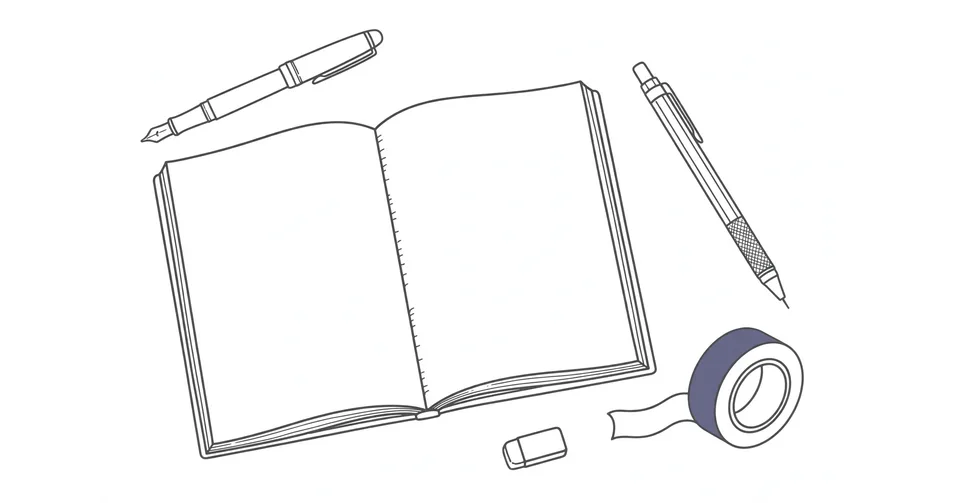
The first thing to know is that the Japanese word for it, bungu, carries more weight than the English word stationery. Bungu covers everything from a 100 yen pencil to a handmade fountain pen, and the culture around it treats all of it as worth doing properly. That attitude is the real product. The pens and notebooks are just where it shows up most clearly.
Why Japanese stationery conquered the world
Japanese stationery did not become famous through advertising. It spread through travellers who came home with a pen that wrote better than anything they owned, and through online shops that turned a niche into a global market. JetPens, the largest American retailer of Japanese stationery, has reported that more than 70 percent of its top selling items originate in Japan, with customers naming paper quality, ink flow, and durability as the reasons they keep coming back.
The deeper reason is cultural. In Japan, children learn to write thousands of kanji characters by hand, and careful writing is still taught as a skill worth practising. A language that demands precise strokes needs tools that reward precision, so manufacturers spent decades refining the smallest details. A pen that skips on the third stroke of a complex character is a failed pen, and the market never forgave that.
There is also the philosophy of kaizen, continuous improvement, and the pride of the craftsman, shokunin kishitsu. Japanese stationery brands compete on tiny refinements rather than grand reinventions. A clip that holds better, a barrel that balances a fraction lower, a paper coating that lets ink dry a second faster. None of these changes makes a headline, but together they make tools that feel considered in the hand.
The pen that started it all
Ask a fan to name the greatest pen in Japanese stationery and you will start an argument, which is itself proof of how good the competition is. The Pilot Hi-Tec-C, a needle tipped gel pen, became a cult object among students and artists for lines so fine they could annotate a textbook margin without bleeding through. Zebra answered with the Sarasa, a gel pen so smooth and so cheap that it became the default pen of Japanese offices and exam halls. Mitsubishi Pencil built the Jetstream, a ballpoint whose low viscosity ink glides like a gel pen but dries fast enough for left handed writers.
Then there is the erasable pen. Pilot launched the FriXion in Japan in 2006, a pen whose ink disappears with friction heat, and it solved a problem every student had quietly accepted as permanent. Teachers first banned it, then gave in, then used it themselves. Today the FriXion is one of the most recognisable pens in the world, and it started as a small piece of Japanese chemistry in an ordinary looking barrel.
The fountain pen world has its own Japanese heroes. Pilot, founded in 1918, and Sailor, founded in 1911, make nibs in sizes Western brands never bothered with, including extra fine nibs ground for kanji and a soft nib that flexes with pressure. A Japanese extra fine nib writes a line so thin it can fit notes between the lines of a printed page, which is exactly what a country of dense notebooks demands. Buying one in Tokyo, where the price is often far lower than abroad, is a small ritual for visitors who know what they are looking for.
Paper that respects the ink
Japanese stationery is only half about the pen. The other half is paper, and Japan treats paper as a serious material. The traditional craft of washi, handmade from the fibres of kozo, mitsumata, and gampi plants, taught the country that paper could be both delicate and nearly indestructible. Modern Japanese notebooks inherit that respect. Their paper is engineered to take fountain pen ink without feathering, to let gel ink sit on the surface instead of soaking through, and to survive years in a bag without yellowing.
Kokuyo, founded in 1905 and now one of the largest stationery makers in the country, built its reputation on this kind of care. Its Campus notebooks are the standard issue of Japanese student life, and their pages are micro perforated so a sheet tears out cleanly without damaging the one beside it. It is a tiny detail that reveals the whole philosophy. Somebody at Kokuyo decided that a torn page edge was a problem worth solving, and then solved it properly.
Maruman, another old name, makes the Mnemosyne notebooks that designers and writers carry everywhere, with paper smooth enough for fountain pens and layouts that divide a page into time, notes, and action items. The idea is always the same. The page should help you think, not just hold your words.
The notebook as a system
The most interesting part of Japanese stationery is not any single product but the systems people build from them. The Midori Traveler's Notebook, launched in 2006, is a leather cover that holds thin paper inserts, and it was inspired by the notebooks carried by post war motorcycle messengers, compact, durable, and meant to age gracefully. Owners customise it with extra inserts, pockets, and charms until it becomes a diary, a wallet, a sketchbook, and a travel journal at the same time. It is less a notebook than a way of carrying your life in one object.
The same system thinking shows up in the Hobonichi Techo, a daily planner whose thin Tomoe River paper takes fountain pen ink without bleeding, and whose fans treat the first page of a new year like a small ceremony. Bullet journalers, who need paper that can take markers, stickers, and washi tape without falling apart, made Japanese notebooks their default years ago. Planner communities on Instagram and TikTok now treat brands like Kokuyo, Midori, and Hobonichi as the gold standard, and the shops that sell them ship worldwide.
This is also where Japanese stationery connects to a wider Japanese habit. The same care that goes into a notebook shows up in the way Japan treats its calligraphy, where the brush, the ink, and the paper are all chosen with intent, and in the slow ritual of the Japanese tea ceremony, where every object earns its place. Stationery is the everyday version of that same attention.
Cute, minimal, and everything between
Japanese stationery refuses to pick one style, which is part of its charm. At one end sits Muji, founded in 1980, whose plain notebooks and clear pencil cases made minimalism affordable for everyone. A Muji notebook has no logo shouting at you, no decoration, and paper that simply works. At the other end sits the whole kawaii universe, Sanrio characters, sushi shaped erasers, stickers, and washi tape in hundreds of patterns, all of it made with the same care as the serious tools.
Washi tape deserves a mention of its own. It began as industrial masking tape and became a craft supply, a journaling tool, and a souvenir all at once. A single roll costs little, weighs nothing, and turns a plain notebook page into something personal. Tourists buy it by the dozen, and the best Japanese stationery shops in Tokyo stock patterns that change with the seasons, so a roll bought in autumn will not be there in spring.
Tombow, founded in 1913, sits comfortably in the middle. Its Mono eraser is the quiet classic of Japanese desks, and its dual brush pens became the standard tool for hand lettering worldwide, with a fine tip on one end and a brush on the other. Zebra's Mildliners, soft coloured highlighters that do not scream from the page, became a study essential the same way, passed from student to student until they were everywhere.
Where to find the best of it in Japan
The pilgrimage has its temples. Itoya, the twelve storey stationery shop in Ginza, has sold paper goods since 1904 and still feels like a museum where everything is for sale. Loft and Tokyu Hands stock a dizzying range in every big city, and their stationery floors are where most visitors first realise the scale of the obsession. For the deepest cut, the Jimbocho book district in Tokyo hides small Japanese stationery shops where fountain pen nibs are ground to order and paper is sold by the sheet.
The practical advice is simple. Go to the 100 yen shops first, because Daiso and Seria sell washi tape, stickers, and notebooks that are shockingly good for the price, and you will understand the baseline of Japanese stationery before you spend real money. Then go to Itoya or Loft for the things worth paying for, a good pen, a notebook with real paper, and a roll of tape you cannot find at home. The difference between the two tiers is smaller than you would expect, which says a lot about the country.
Prices help too. A Japanese stationery pen that costs fifteen dollars abroad might cost five in Tokyo, and limited editions that never leave Japan sit on ordinary shelves. That is why so many travellers leave with a bag that rattles, and why Japanese stationery has become one of the most common souvenirs that is not food. A pen is small, light, useful every day, and it reminds you of the trip each time you pick it up.
The small lesson inside the small tools
There is an opinion I have held since I moved to Japan, and stationery is where I see it most clearly. A culture that takes small things seriously ends up doing big things well, because the habit is the same. The country that refines a pen nib until it writes a perfect line is the same country that runs trains to the minute and folds an entire lunch into a box that looks like art. The pen is not the point. The care is.
That is probably why Japanese stationery travels so well. Nobody needs a better pen in the way they need food or shelter, but everyone recognises the feeling of using a tool that was made by people who cared. A notebook that opens flat, a pen that never skips, a page that tears out cleanly, these are small kindnesses, and they add up to a different kind of day.
So the next time you pick up a pen, pay attention to what it does. If it drags, if it blobs, if it bleeds through to the next page, know that somewhere in Japan there is a company that has already fixed that problem, and that a better version is sitting on a shelf in Ginza waiting for you. Japanese stationery will not change your life, but it might change your mornings, and that is a fair trade for a few hundred yen.
A short guide to starting your own collection
If you are new to Japanese stationery, start with four things and stop there until you know what you like. A Zebra Sarasa Clip in 0.5, the pen most Japanese students would hand you if you asked for a recommendation. A Kokuyo Campus notebook, to learn what good paper feels like. A roll of washi tape in a pattern you actually love, not one you think you should love. And a Tombow Mono eraser, because even your mistakes deserve a good tool.
From there, follow your own habits. If you journal, try a Midori Traveler's Notebook and see if the system fits your life. If you draw, try a Maruman sketchbook and a set of Tombow brush pens. If you study, try a Mildliner set and a Hobonichi planner and watch your notes turn into something you want to keep. The whole point of Japanese stationery is that the tools adapt to you, not the other way around.
And when the collection grows, as it will, remember the one rule that keeps it joyful rather than overwhelming. Buy the thing you will use tomorrow, not the thing that looks good on a shelf. Japanese stationery is made to be used, written in, torn, taped, and carried until it falls apart. A pen that stays in its box is just a decoration, and Japan already has enough of those. The best Japanese stationery is the kind with ink in it and pages missing, because that means it did its job.
More in Life & Style
- Osouji Is the Cleaning Japan Does Before the Gods Arrive
- Inside Japan's 100 Yen Shops, Where Everything Costs a Coin
- Akihabara and How Tokyo's Electric Town Learned to Sell Everything
- Kotatsu, Japan's Heated Table That Warms Winter
- The History of the Bicycle From Wooden Wheels to Japanese City Bikes
- A Shukubo Lets You Sleep Inside a Working Temple
Latest posts
- Takoage Sends New Year Wishes Up on a Paper Kite
- Hanetsuki Keeps New Year in the Air With a Wooden Paddle
- Karuta Turns a Hundred Poems Into Japan's Fastest Card Game
- Hatsuyume Is the First Dream Japan Reads Like a Fortune
- Japanese Manga and How It Became the World's Most Read Comics
- Toshikoshi Soba Is the Long Noodle Japan Eats at Midnight
- Hatsu-Hinode Is the First Sunrise Japan Wakes Up For
- Matsunouchi Is the Week Japan Keeps the Pine Up for Its Guest
- Japanese Anime and How a Niche Hobby Conquered the World
- Toshigami Is the Guest Japan Prepares the Whole House For
- Urajiro Is the Fern That Wishes a Family Twice Over
- A Shimekazari Hangs the New Year Over the Front Door
- Make-Koshi Is the Eight Loss Line That Sends a Sumo Wrestler Down
- Japanese Arcades and the Game Centers That Refuse to Die
- Danpatsu-Shiki Is the Haircut That Ends a Sumo Career