Toshikoshi Soba Is the Long Noodle Japan Eats at Midnight
· 25 min read
Toshikoshi soba is the buckwheat noodle dish Japan eats on New Year Eve, and this guide explains the long noodle, the clean break, the history, the regional bowls, and how a visitor can try it on December 31.
On the last night of the year, most of Japan sits down to the same quiet meal. It is not a feast, and it is not a party dish. It is a bowl of buckwheat noodles in hot broth, eaten at home with family or at a small soba shop, while the television plays in the background and the year runs out. That bowl is toshikoshi soba, and for millions of people it is the one New Year custom that never gets skipped, even when every other tradition is simplified or dropped.
The name is a small sentence in itself. Toshikoshi means crossing over into the new year, and soba is the buckwheat noodle. Put together, toshikoshi soba means the year crossing noodles, the food you eat while you step from one year into the next. The name tells you when to eat it, and the noodle tells you why. It is long, so it wishes you a long life, and it breaks easily, so it lets you leave the old year behind.
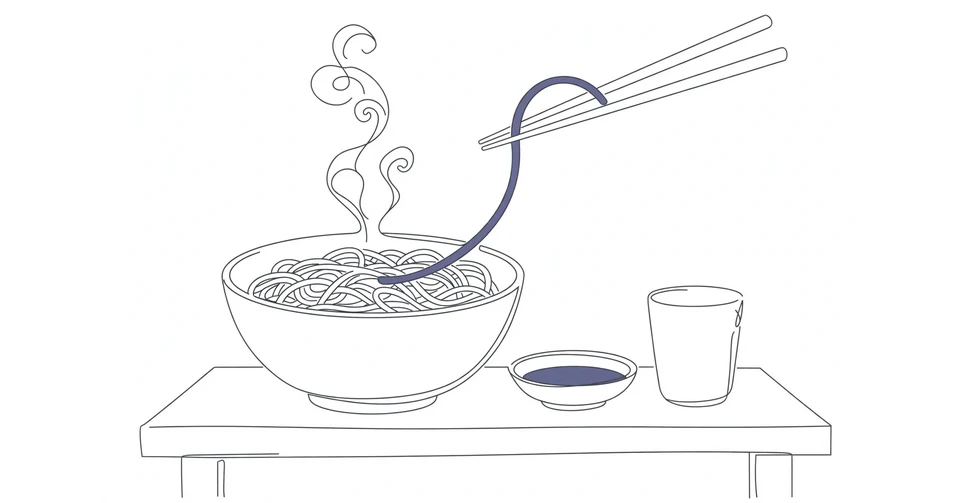
What makes toshikoshi soba interesting is that it is two wishes in one bowl, and the two wishes seem to pull in opposite directions. One wish is to hold on, to a long life and a year that stretches out ahead of you. The other wish is to let go, of the troubles, the mistakes, and the bad luck of the year that is ending. A single strand of noodle carries both ideas at once, and the meal takes only a few minutes. That is the whole custom, and it has lasted for centuries because it is simple enough to keep and meaningful enough to matter.
What toshikoshi soba actually is
At its simplest, toshikoshi soba is a bowl of soba noodles eaten on omisoka, the last day of the year, December 31. The noodles are made from buckwheat flour, sometimes mixed with a little wheat flour, and they are served hot in a dashi broth seasoned with soy sauce, or cold on a bamboo tray with a dipping sauce. The hot version is the common one on New Year Eve, because the night is cold and a steaming bowl suits the hour. The toppings are usually simple, sliced green onions, a piece of fish cake, a sheet of nori, or a piece of tempura. Nothing about the dish is grand, and that is part of the point. The last meal of the year is a humble one.
Soba itself is an everyday food in Japan, eaten all year as a quick lunch or a light dinner, so toshikoshi soba is not a special noodle made only for the occasion. It is the ordinary noodle, eaten on an extraordinary night, and the occasion changes the noodle rather than the other way round. A bowl of toshikoshi soba in a station noodle stand tastes much like a bowl of soba on any other day, but the person eating toshikoshi soba is thinking about the year that is ending. The custom does not need a rare ingredient or a difficult recipe. It needs a date, and the date does the work.
The timing is loose by design. Some families eat their toshikoshi soba as an early dinner, around six or seven in the evening, and then spend the rest of the night watching television or visiting a temple. Others keep it for later, eating close to midnight so that the last bite falls just before the year turns. There is a common belief that the bowl should be finished before midnight, because carrying noodles into the new year would mean carrying the old year troubles with them. Not everyone follows that rule strictly, and some people eat after midnight without a second thought, but the idea behind it is widely known. The meal belongs to the old year, and it should end with it.
The long noodle and the noodle that breaks
The symbolism of toshikoshi soba is the reason the custom has lasted, and it is worth slowing down for, because it is more thoughtful than it looks at first. There are several meanings layered into one bowl, and each one comes from something you can see or feel while you eat.
The first meaning is the length. Soba noodles are long and thin, and in Japan a long thin thing has always suggested a long life. Eating toshikoshi soba is a way of wishing for a long and healthy life in the year ahead, and the wish is made with the body as well as with words. You lift a long strand, you eat it whole if you can, and the length of the noodle becomes the length of the life you hope for. It is a small act of sympathetic magic, the kind that turns up in food customs all over the world, and it works because it is easy to understand. Long noodle, long life. Nobody needs it explained twice.
The second meaning is the break. Buckwheat flour has no gluten, so a cooked soba noodle is more brittle than a wheat noodle. It snaps rather than stretches, and it is easy to bite through. That ordinary physical fact became a piece of symbolism. Because the noodle breaks easily, eating toshikoshi soba came to mean cutting off the hardships, the misfortunes, and the bad luck of the year that is ending. The custom is intended to let the household let go of the year hardship, because the noodle is easily cut while it is eaten, and each bite is a small act of separation. You do not carry the old year into the new one. You cut it, chew it, and leave it behind.
It is a neat pairing, and I think it is the real genius of toshikoshi soba. The same noodle gives you both wishes, and the two wishes answer each other. The length asks for more life, and the break asks for less baggage. Most end of year rituals only do one of those things. A resolution looks forward and forgets to let go. A regret looks backward and forgets to hope. Toshikoshi soba does both in the same mouthful, and it does it without a speech, a ceremony, or a single solemn word. You just eat, and the meaning eats with you.
The third meaning comes from the plant itself. Buckwheat is a hardy crop. It grows in poor soil, it stands up to wind and rain, and it recovers quickly after harsh weather. That toughness became part of the symbolism too, and soba came to stand for strength and resilience, for the ability to take a bad year and keep growing anyway. After a hard year, that is a better wish than good luck, because luck is out of your hands and resilience is not. A bowl of toshikoshi soba says, in its quiet way, that you survived the year, and that surviving is a skill worth carrying forward.
There are other meanings attached to the dish, and they are best treated as stories rather than facts. One story says that goldsmiths in old Japan used buckwheat flour dough to pick up scattered gold dust in their workshops, so soba came to symbolise wealth and the gathering of good fortune. Another says that the word soba sounds like the word for being beside someone, so eating the noodles strengthens family ties. These stories are charming, and they are still told, but nobody can prove where they started, and they are not the reason most people eat toshikoshi soba. The length and the break are the meanings that matter, and they are the ones that show up in every account of the custom.
How a monthly habit became a New Year ritual
Nobody knows exactly when toshikoshi soba began, and the honest sources say so. The tradition is generally dated to the Edo period, which ran from 1603 to 1868, and as Wikipedia notes, the custom grew up as soba itself became a common food for ordinary people in the cities. Before that, soba had been around for centuries, but the idea of eating it on the last night of the year seems to belong to the Edo period, when the noodle shops of Edo, the city we now call Tokyo, were crowded, cheap, and open late. A food that was already in every neighbourhood was easy to turn into a custom, and the custom spread because the food was already there.
One thread of the history runs through the end of the month. In Edo, merchants had a habit of eating soba on the last day of each month, a dish called misoka soba, as a way of closing the accounts and starting fresh. The last day of the year is only the last day of a month taken to its limit, so the monthly habit grew naturally into a yearly one. The toshikoshi soba eaten on the last night of the year kept the same logic, close the books, settle what can be settled, and begin again. The year end version simply mattered more, because the books being closed were a whole year long.
Another thread runs through a temple story, and it should be told as a story rather than as settled history. In the Kamakura period, centuries before the Edo period, the Jotenji Temple in Hakata is said to have served soba to poor people on New Year Eve, a dish sometimes called yo-naoshi soba, or world renewing soba, and those who ate it were said to find better fortune in the year that followed. Whether the story happened exactly as told is impossible to verify now, and the sources that repeat it do not agree on the details, but the shape of it is believable. A temple feeding hungry people on the coldest night of the year is the kind of act that becomes a custom, because people remember being fed. Even if the temple story is only a legend, it tells you something true about toshikoshi soba, that it began as food for ordinary people, not as a luxury.
The name itself collected other names along the way, and they show how many meanings people found in toshikoshi soba. Old names for the dish include misoka soba, tsugomori soba, kure soba, jumyo soba, fuku soba, and unki soba, and those names point in different directions. Misoka, tsugomori, and kure all refer to the last day, to the ending itself. Jumyo means lifespan, a nod to the long noodle. Fuku and unki both mean happiness or good fortune. A single bowl of toshikoshi soba that can be called the last day noodles, the lifespan noodles, and the happiness noodles is a dish that has been thought about for a long time. The many names are a sign of how widely the custom was kept, and how differently people explained it to themselves.
By the late Edo period, toshikoshi soba was firmly established, and it has stayed established ever since, surviving the move from the lunar calendar to the solar calendar, the war years, and the arrival of convenience stores and instant noodles. Part of the reason is that the custom is attached to a food that never went away, and part of it is that the custom does not ask for belief. Plenty of people eat toshikoshi soba every year with no thought for the symbolism at all. They eat it because their parents ate it, because it is what you do on December 31. A custom that works as a habit will outlive a custom that only works as a belief, and toshikoshi soba works as both.
Hot or cold, dark broth or light
Travel around Japan on December 31 and you will find that toshikoshi soba is not one dish. The name is the same everywhere, but the bowl changes as you move, and the differences are a small map of the country itself. The core of toshikoshi soba is constant, buckwheat noodles on the last night of the year, and almost everything else is local.
The most famous split in toshikoshi soba is between Kanto and Kansai, the east and the west, and it shows up first in the colour of the broth. In the Kanto region, around Tokyo, the broth is dark and strongly flavoured, made by boiling katsuobushi, or bonito flake, dashi with koikuchi, a dark soy sauce, plus mirin and sugar. The bowl looks almost black, and the flavour is bold and salty. In the Kansai region, around Kyoto and Osaka, the broth is lighter in colour and milder, built on a dashi of bonito and kelp and seasoned with usukuchi, a light soy sauce. The bowl looks pale amber, and the flavour is gentler. The same noodle, two different soups, and a person who grew up with one will often find the other one strange, which is exactly how regional food is supposed to work.
For toshikoshi soba, the hot or cold question splits the country too, though less neatly. Hot soba in broth, called kake soba, is the most common form for toshikoshi soba, because the night is cold and a hot bowl is warming. But cold soba is also eaten on New Year Eve, served on a bamboo tray with a dipping sauce, and there is no strict rule against it. Some households in the Kanto region serve cold zaru soba even in December, and some people simply prefer the clean taste of a cold noodle. The choice is personal rather than regional, and nobody will correct you for picking the other one. The custom cares about the noodle and the night, not the temperature.
The toppings are where the regions really show off their toshikoshi soba. In Tokyo, the classic New Year topping is tempura, often a single shrimp laid across the noodles, and the shrimp itself is a symbol of longevity, because its curved back is said to resemble an old person bent with age. In Kyoto, the signature topping is nishin soba, a whole piece of dried herring simmered sweetly and laid on top of the noodles, a dish with a long history in a city far from the sea. In Hokkaido, herring shows up again, for a practical reason rather than a ceremonial one, because herring fishing off the northern coasts was once huge, and herring was the cheap protein available in December. The same fish means different things in different places, and both meanings are true.
Further from the big cities, the variations get more local still. Niigata is known for hegi soba, noodles served in small bundles on a wooden tray, and Nagano is famous for Togakushi soba, served in small bundles in a round basket. In Aizu, in Fukushima Prefecture, some households eat their soba on New Year Day rather than New Year Eve, a local exception that proves the custom is a folk one, kept by families rather than enforced by anyone. In Okinawa, some households substitute Okinawa soba, a wheat noodle rather than a buckwheat one, as their year crossing dish. The custom has always been more about the occasion than about the flour, and a tradition that makes room for Okinawa is a tradition that understands its own point.
For a visitor, the regional differences are a gift rather than a problem. They mean that toshikoshi soba is not a single dish to tick off a list, but a dish to try in different places and compare. A dark bowl of toshikoshi soba in Tokyo and a pale bowl in Kyoto are two answers to the same question, and tasting both tells you more about Japan than either one alone. The custom is national, and the bowl is local, and that combination is one of the most Japanese things about it.
At home with family, or at a soba shop
Most toshikoshi soba is eaten at home, and the home version is usually the simplest one. Dried noodles from a supermarket, a packet of concentrated broth diluted with hot water, sliced green onions from the fridge, and a bowl each. The whole meal takes less than fifteen minutes to prepare, and it is eaten at the kitchen table or in front of the television, often while the long running New Year Eve song show plays in the background. There is no ceremony to it, no special plates, no dressing up. The simplicity is the ceremony.
That simplicity is also why toshikoshi soba is so widely kept. A recent survey by the Japanese company Recruit, asking 1,034 people across Japan aged from 20 to 69, found that toshikoshi soba was the most popular food eaten on special occasions in the Japanese calendar, with 66.7 percent of respondents saying they eat it every year. It beat the osechi boxes of New Year Day and the Christmas cake, and it was popular with people of all ages, especially women in their thirties to sixties, of whom around 75 percent said they ate it every year. Those numbers describe a custom that is not fading or surviving on nostalgia. It is the most kept food tradition in the country, and it is kept in ordinary kitchens rather than in restaurants or on television. The survey results are reported by Nippon.com, and the gap between toshikoshi soba and everything else on the list is a good measure of how deep the habit runs.
The home version of toshikoshi soba has its own small rituals, even without ceremony. Some families make the broth from scratch, simmering dashi and seasoning it to the taste they grew up with, and the flavour of that broth is one of the tastes of childhood for many Japanese people. Others buy fresh noodles from a local soba shop in the morning and cook them at home in the evening. A few households still make the noodles by hand, though that is rare now, and it is usually the work of a grandparent who learned the skill decades ago. The point in every case is the same. The bowl is made at home, by the people who will eat it, on the last night of the year.
The soba shop version of toshikoshi soba is a different experience, and it has its own place in the custom. A good soba shop serving toshikoshi soba on December 31 is busy from the afternoon onwards, with a queue at the door and a stack of takeaway orders waiting on the counter. Many shops sell special New Year Eve sets, enough noodles and broth for the whole family to eat at home, and those sets are often ordered days in advance. Eating in the shop itself is quieter than you might expect. People come in, order, eat quickly, and leave, because there is a queue behind them and a night ahead of them. The shop is warm, the steam rises from the bowls, and the whole room smells of dashi and buckwheat. It is a good place to be on a cold night.
Midnight, the temple bells, and the last bite
The hour around midnight is when toshikoshi soba meets the other great sound of New Year Eve, the temple bells. At temples across Japan, a ceremony called joya no kane is held in the last hours of the year, in which a large temple bell is rung 108 times. Each chime is said to represent one of the earthly temptations or worries that cloud the human mind, and the ringing is meant to clear them away before the new year begins. The bell is usually rung 107 times during the old year, with the final chime falling just after midnight, so that the last sound of the old year and the first sound of the new year are the same bell. It takes a few hours, and visitors often help with the ringing, taking turns at the rope.
Toshikoshi soba and the bells belong to the same idea, and they work the same way. The bell rings away the worries, and the noodle cuts them off. One is sound, the other is food, but both are about leaving things behind. A family that has eaten its toshikoshi soba and then walks to a temple to hear the bells has done the same thing twice, once at the table and once in the dark, and the repetition is the point. The year is not left behind in a single gesture. It is left behind in layers, a bowl and a bell, a meal and a sound.
That is also why the timing of toshikoshi soba matters to so many people. Finishing the noodles before midnight is the common advice, and it is tied to the same logic as the bells. If the last bite falls in the old year, then the old year is finished properly, and nothing is carried over. If the noodles are still being eaten when the year turns, then the old year has leaked into the new one, and the clean break is spoiled. Not everyone believes this literally, and plenty of people eat after midnight without worrying, but the idea is strong enough that most households aim to finish before twelve. It is a small discipline, and it gives the evening a shape. Dinner has a deadline, and the deadline is midnight.
Once the toshikoshi soba is finished and the bells have rung, the year is over, and the food of the new year takes over. The osechi boxes, the tiered boxes of small dishes prepared in advance, are waiting for January 1, and they are a different kind of meal altogether, formal and slow, meant to last for days. Osechi packs a whole year of luck into stacked boxes, and it belongs to the new year in the way that toshikoshi soba belongs to the old one. The two meals face each other across midnight, one closing and one opening, and together they frame the turn of the year. The noodle says goodbye, and the boxes say welcome.
The days that follow have their own food and their own rhythm. The pine decorations stay up at the gate for the week of matsunouchi, while the deity of the new year is believed to be in residence, and the household moves slowly back to ordinary life. Toshikoshi soba is the last ordinary meal before that week begins, and it is the meal that makes the week possible, because it closes the old year cleanly enough for the new one to start. A year that is not properly ended is hard to begin, and a bowl of noodles is a small but real way of ending it.
Trying toshikoshi soba as a visitor on December 31
If you are in Japan on December 31, trying toshikoshi soba is one of the easiest and most rewarding things you can do, but it takes a little planning, because the night is the busiest of the year and almost everything runs on a different timetable. The first thing to know is that many restaurants close early on December 31 or close altogether, and the ones that stay open are crowded. A soba shop that is quiet on a normal Tuesday will have a queue on New Year Eve, and the queue will be made up of regular customers who order the same thing every year. That is a good sign rather than a bad one. It means the shop is trusted, and it means you should arrive early.
The practical move is to decide in the afternoon, not in the evening. Find a soba shop near where you are staying, check whether it is open on December 31, and go for an early dinner, around five or six, when the queue is shortest and the noodles are freshest. Many shops sell out of their New Year Eve sets, and some run out of noodles entirely, so an early visit is not just convenient, it is the difference between eating and not eating. If the shop you wanted is closed or sold out, a convenience store or a supermarket will sell fresh or dried soba and a bottle of concentrated broth, and a bowl made in a hotel room or a rented kitchen is a perfectly good version of the custom. The tradition was made for home cooking, and a visitor cooking it is keeping it in the original spirit.
Ordering is simple, and you do not need much Japanese. The words toshikoshi soba will be understood everywhere on December 31, and most shops will have a special menu for the night, often with just a few choices, hot or cold, plain or with tempura. Pointing at the menu works, and the staff will be used to visitors on this night. If you are offered a choice of toppings, shrimp tempura is the classic festive option, and plain kake soba with green onions is the simplest and most traditional toshikoshi soba. Either one counts. The custom does not grade your order.
There are a few pieces of etiquette worth knowing, and they are all easy. Slurping is not bad manners with soba. It is the normal way to eat it, and it is said to bring the aroma of the noodles to the mouth, so a little noise is fine and expected. If you order cold soba, you will often be given a small pot of sobayu, the hot water the noodles were cooked in, to thin the dipping sauce at the end, and drinking that is part of the meal. Do not leave toshikoshi soba in the bowl if you can help it. Finishing the bowl before midnight is the custom, and leaving a half eaten bowl on the table is a small breach of it. Eat at a comfortable pace, but finish what you ordered.
One warning matters more than the etiquette, and it is a health one. Buckwheat is a serious allergen, and a buckwheat allergy can be severe. If you have any doubt about whether you can eat buckwheat, do not try toshikoshi soba, and ask about ingredients before ordering any noodle dish in Japan. Soba noodles are sometimes mixed with wheat flour, so a wheat allergy is also worth mentioning. The staff at a soba shop will take an allergy question seriously, and there is no shame in asking. A custom that is about health and long life should not be the thing that harms you.
The last piece of advice is about the night itself. After your noodles, walk to a nearby temple if one is open for the bell ringing. Many temples welcome visitors to watch or to help ring the bell, and the sound of it in the cold night air is one of the most memorable things in Japan. You came for a bowl of noodles, and you will leave with a memory of a whole evening, which is a fair trade.
A quiet bowl to end the year
Toshikoshi soba has lasted for centuries without ever becoming grand, and that is probably the secret of it. Toshikoshi soba is a bowl of noodles, eaten on the last night of the year, carrying two wishes that fit in a single strand. Be long, and be free. Live long, and let go. The custom asks for almost nothing, a little buckwheat, a little broth, a few minutes before midnight, and it gives back a moment of order at the most disorderly hour of the year. That is a good exchange, and it is one that millions of people renew every December 31, in kitchens and in shops, in Tokyo and in Kyoto, at home and far from home.
I think there is a lesson in the bowl that goes beyond the New Year, and it is about how to end things well. Most of us are bad at endings. We drag them out, we leave them unfinished, we carry them into the next thing before the last one is done. Toshikoshi soba is a small lesson in doing it properly. Finish the bowl, put the chopsticks down, and let the year end. The noodle breaks because it is meant to break, and the break is not a loss. It is a release, and a release is what an ending is for.
So if you are in Japan on the last night of the year, find a bowl of toshikoshi soba. It does not need to be the best bowl, and it does not need to be in a famous shop. It needs to be eaten before midnight, with attention, and with a thought for the year that is ending and the year that is about to begin. Lift a long strand of toshikoshi soba, eat it whole if you can, and let the year go. The new year will arrive whether you are ready or not, but a bowl of toshikoshi soba is a good way to be ready, and the night will feel different for it.
More in Food & Travel
- Izakaya, the After-Work Pubs Where Japan Unwinds
- Japanese Street Food, From Takoyaki Stalls to Festival Yatai
- Namasu Turns Daikon and Carrot Into a Red and White Wish
- Ebi Bends Like an Old Back and Wishes You a Long Life
- Kobumaki Rolls Joy Into a Strip of Kelp
- Kurikinton Is the Golden Mash That Wishes You Wealth
Latest posts
- Takoage Sends New Year Wishes Up on a Paper Kite
- Hanetsuki Keeps New Year in the Air With a Wooden Paddle
- Japanese Stationery and the Small Tools Japan Takes Seriously
- Karuta Turns a Hundred Poems Into Japan's Fastest Card Game
- Hatsuyume Is the First Dream Japan Reads Like a Fortune
- Japanese Manga and How It Became the World's Most Read Comics
- Hatsu-Hinode Is the First Sunrise Japan Wakes Up For
- Matsunouchi Is the Week Japan Keeps the Pine Up for Its Guest
- Osouji Is the Cleaning Japan Does Before the Gods Arrive
- Japanese Anime and How a Niche Hobby Conquered the World
- Toshigami Is the Guest Japan Prepares the Whole House For
- Urajiro Is the Fern That Wishes a Family Twice Over
- A Shimekazari Hangs the New Year Over the Front Door
- Make-Koshi Is the Eight Loss Line That Sends a Sumo Wrestler Down
- Japanese Arcades and the Game Centers That Refuse to Die