A Shimekazari Hangs the New Year Over the Front Door
· 19 min read
A shimekazari is the small decorated straw rope hung above a Japanese front door for the new year, and every strand and leaf on it carries a wish for the household inside.
A shimekazari is a small decorated straw rope hung above the front door of a Japanese home for the new year. It is not large, it is not loud, and from the street it can look like a simple loop of straw with a few leaves and an orange tucked into it. Look closer, though, and the whole thing turns out to be a sentence written in objects. Straw, paper, fern, pine, and a bitter orange each say something about the year the household hopes to have, and the rope itself draws a line that bad luck is not supposed to cross.
The household version of the shimenawa is called a shimekazari, a smaller decorated rope with fern fronds, pine, bitter orange, and shide, hung above the front door for the new year. That line comes from an earlier article on this site about the sacred rope itself, and it is the seed of this one. The shimenawa is the great rope of the shrine, stretched around sacred trees and across the entrances of holy places. The shimekazari takes that same idea and brings it home, shrinking it to the size of a doorway and dressing it for a family rather than a shrine. Its purpose is to prepare the home to receive Toshigami, the new year deity, and to keep the fresh purity of the new year intact.
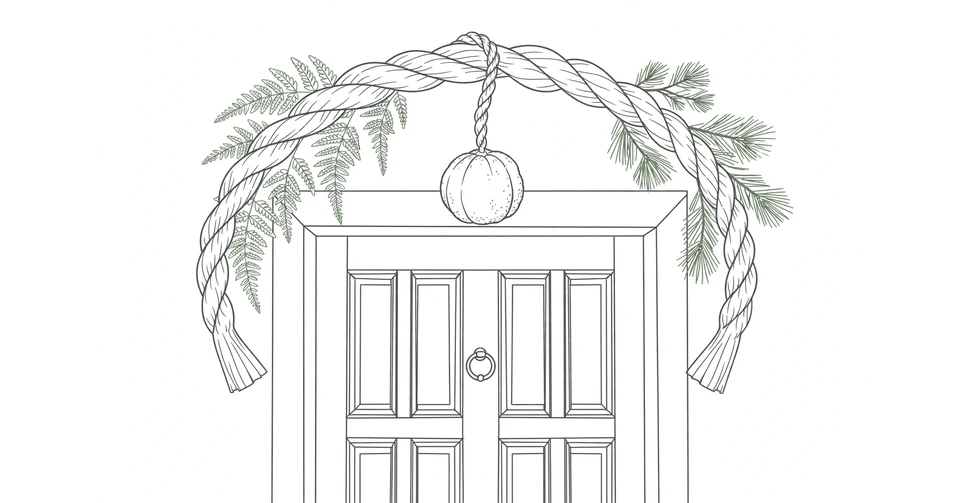
Walk through a Japanese neighbourhood in the last week of December and you will see a shimekazari above door after door, on houses, on apartment doors, on shop entrances, and sometimes even on the front of a taxi. Some are plain twists of straw with a single white paper streamer. Some are round wreaths crowded with pine, red berries, a little folding fan, and a bright orange. Beneath the variety, the job is always the same. A shimekazari marks the entrance as clean and protected, and it tells the new year deity that this house is ready to be visited.
What a shimekazari is made of
Start with the rope. A shimekazari is built on a shimenawa, a rope twisted from rice straw, and the straw matters more than it first appears. Rice is the crop that fed Japan for centuries, and straw is what is left when the harvest is gathered in. To twist the leftover straw of the harvest into the decoration of the new year is to carry the old year forward in a useful form, and to ask, quietly, for the next harvest to be as good. The rope is twisted to the left, the pure or fortunate side, and the straw hangs down from it in short tufts at intervals. Even before anything is added to it, the rope already means something. It is a boundary and a blessing made from the fields.
Into that rope go the ornaments, and each one carries a wish. The white zigzag paper strips are called shide, and they are the clearest sign that a space has been marked as sacred. You see the same paper at shrines, hanging from ropes and from wooden wands, and wherever shide appears it says that this place has been set apart and purified. On a shimekazari, the shide tells anyone passing, human or spirit, that the doorway is not ordinary ground. It is a threshold that has been prepared.
The fern fronds are called urajiro, and they do double work. Their leaves spring in pairs from the stem, so they have long been read as a sign of a happy married life and of a family that grows. The underside of the leaf is pale, almost white, and that pale underside is read as purity and a sincere heart. One plant, two wishes, and I value them more than wealth or luck on their own. Wealth passes. A family that stays together and stays honest has something sturdier.
Pine is the next element, and pine needs little explanation once you have seen it survive a winter. Pine stays green when other trees stand bare, so it has become the sign of endurance, long life, and the strength to keep going through hard seasons. On a shimekazari, a few sprigs of pine say that the household intends to last, the way the pine lasts. Beside the pine often sits a leaf of yuzuriha, the evergreen whose old leaves cling to the branch even after the young leaves have appeared. The old generation does not fall away before the new one is ready. Fortune and responsibility pass from hand to hand without being dropped, and a shimekazari with yuzuriha on it is a wish that the passing will go smoothly in this house too.
Then there is the orange, and it is not an ordinary orange. It is a daidai, a bitter orange, and its name is the whole point. The word daidai sounds like the phrase for generation after generation, so the fruit has become the symbol of a family line that continues. A daidai can also stay on the tree for years, with one branch carrying fruit across several seasons. A shimekazari that carries a daidai is asking for the household to continue, for children and grandchildren to be part of the story. Modern versions often use a plastic daidai, which lasts longer in the winter rain, and I find that forgivable. A wish does not stop being a wish because the fruit is made of plastic.
Some forms of shimekazari add more. A tamakazari, the thick circular rope common in eastern Japan, may carry a small folding fan and a shrimp, the shrimp standing for longevity because its bent back resembles the back of a person who has lived many years. The fan opens outward, a sign of a future that opens rather than closes. Not every shimekazari carries these extras. The core of the decoration is the straw rope, the shide, the urajiro, the pine, and the daidai. Everything else is a regional accent, and the decoration works just as well in its simplest form.
How a shimekazari differs from a shimenawa
It is easy to confuse a shimekazari with a shimenawa, because one is made from the other. A shimenawa is a rope that separates a sacred area from the outside world, one of the marks that draws a boundary. Shimenawa are stretched around shrines, sacred objects, sacred trees, and other places that are considered sacred areas. They can be enormous. The great shimenawa at some shrines weigh hundreds of kilograms and hang like a curtain of straw across a hall. They are permanent, or close to it, and they belong to a place rather than a season.
A shimekazari is the household version of that rope, made smaller, decorated, and tied to a single season. It is hung above the front door for the new year, and it comes down again a week or two later. The difference is not only size. A shimenawa at a shrine marks a place that is always sacred. A shimekazari marks a home that is sacred for the new year, while the deity of the year is visiting. The first is a permanent boundary. The second is a temporary one, put up for a guest and taken down when the guest has gone. A home is not a shrine, and it does not pretend to be one. For a week or so, it borrows a shrine's language and speaks it over its own front door.
The boundary itself works in two directions, and that is worth pausing over. A shimekazari keeps bad luck and impure things out of the house, and it also keeps the purity of the new year in. It is a filter at the threshold, not a wall. People still come and go, and life goes on through the doorway, under the rope. The rope does not stop ordinary life. It only insists that what passes under it should be clean, and that the house behind it is ready for something good. I think that is a wise way to think about a boundary. The best boundaries are not the ones that shut the world out. They are the ones that decide what kind of world is allowed in.
The story behind the rope
Every shimekazari carries an old story with it, even if the household that hangs it never tells the story aloud. The story belongs to Amaterasu, the sun goddess, who once hid herself in a cave and left the world in darkness. The other gods gathered outside with music and dancing to tempt her out, and when she stepped toward the light, a god stretched a rope of straw across the mouth of the cave so that she could not go back in. The rope was the line between darkness and light, between the world hidden away and the world returned to the sun. That is why a straw rope still means a boundary between the ordinary and the sacred. It is the same line, drawn again at a smaller scale, over a front door.
The story also explains why the rope is a welcome rather than a warning. The gods did not stretch the rope to keep Amaterasu away. They stretched it to keep her with them, to keep the light from leaving again. A shimekazari works the same way. It is hung to keep the new year deity close, to hold the blessing in the house once it has arrived. The rope is not there to frighten anyone. It is there to make a promise. This house is ready. This house is clean. Please come in, and please stay a while. There is something generous about that, and it is one of the reasons the custom has lasted so long.
It is worth saying, honestly, that the story is a myth, and that not everyone who hangs a shimekazari believes in Toshigami in a literal sense. Many households hang one because their parents did, or because the neighbours do, or because the shops sell them in December and the street looks bare without them. The custom survives on habit as much as on belief, and that does not make it empty. A habit that reminds a family to clean its house and to wish each other well is worth keeping, whether or not a deity walks through the door.
When to hang a shimekazari and when to take it down
Timing is everything with a shimekazari, and Japan has strong opinions about it. The decoration is traditionally hung after the year end cleaning, the great scrub known as osōji, which prepares the home to receive Toshigami. A house that is still dusty has not finished its preparations, and a rope hung over a dirty doorway would be a decoration without the work behind it. Clean first, then hang. The order matters. Preparation is the real offering, and the decoration is only the sign that the preparation is done.
The most common time to hang a shimekazari today, according to a detailed guide to the decorations, is between 25 and 28 December. The 28th is often called the best day of all, because the number eight is lucky in Japan, its character opening outward like a fan, a shape that suggests a future that widens. The 30th is also considered a good day, a nice round number. Two days are avoided, and the reasons are a small lesson in how the Japanese language shapes the calendar. The 29th is avoided because nine sounds like the word for suffering. The 31st is avoided because hanging a decoration on the last night is called a one night decoration, and it is considered rude to the deity, as if the welcome had been left to the last minute. A guest who is welcomed properly is welcomed early. A god is no different.
How long the shimekazari stays up depends on where you live. In most of Japan, including Tokyo and the Kanto region, the decorations are removed around 7 January, at the end of the period called matsunouchi, the days when the pine decorations stand at the gate. In the Kansai region, around Kyoto and Osaka, the period runs longer, and the decorations often stay up until 15 January. The difference goes back centuries, to a time when an order about the end of the New Year period reached the east but not the west, and the two regions kept different calendars ever after. It is a good reminder that even a custom as widespread as this one is not uniform.
Removal is not the end of the story. The shimekazari is not thrown away like ordinary rubbish, or at least it should not be. In many regions the decorations are taken to a shrine and burned in a ritual bonfire called dondo-yaki, usually held around the middle of January. The fire takes the straw decorations, the pine, and the paper, along with the first brush writing of the year, and the rising smoke is understood to carry thanks upward and to send the deity off properly. Children in some towns collect the decorations from each house and carry them to the fire themselves. If burning is not possible, the respectful alternative is to wrap the decoration in white paper, sprinkle it with salt, and dispose of it separately from other rubbish. The salt is a purifier, the same salt used at shrines and at the entrance of sumo rings. Even in disposal, the decoration is treated as something sacred, not as waste. A thing that has held a blessing for two weeks is not thrown away casually, and I think there is a lesson in that for how we treat other things we have finished with. The end of a thing deserves as much care as the beginning.
Regional variations of the shimekazari
Travel around Japan in late December and the shimekazari changes shape from place to place, the way dialects change from town to town. The thick circular tamakazari is common in eastern Japan, a heavy ring of straw dressed with fern, shide, daidai, a folding fan, and sometimes a shrimp, often used for front entrances. The wakazari is a simpler loop, a plain circular rope with minimal ornaments, popular in modern apartments and smaller homes, where a big decoration would overwhelm a narrow door. The goboujime is a more traditional braided rope hung horizontally, often seen at shrines or traditional houses, closer in form to the great shimenawa from which all of these descend. Modern compact styles, smaller and lighter, suit city living. The variety is not a sign that the custom is falling apart. It is a sign that it is alive, bending to fit the houses people actually live in.
One regional custom stands out, and it belongs to Ise, in Mie Prefecture, home to the great shrine of Ise Jingu. In Ise, many households display their shimenawa year round, not just for the New Year, in the belief that the home should remain constantly connected to purity and divine protection. A distinctive feature of the Ise style is a wooden tag attached to the decoration, a small plaque that marks the blessing. Visitors to Ise sometimes notice the ropes above doors in midsummer and wonder if they have mistaken the season. They have not. In Ise the season never quite ends. Elsewhere the rope is a seasonal guest. In Ise it is a permanent resident.
The differences between regions are worth more than a passing mention, because they answer a question that visitors often ask. Is there one correct shimekazari? There is not. There is a family of forms, all built from the same materials and all carrying the same wishes, shaped by the size of the door, the wealth of the household, the customs of the region, and the taste of the person who bought or made it. A small loop on an apartment door in Tokyo and a heavy tamakazari on a farmhouse gate in the east are both a shimekazari, and neither is more correct than the other. The custom is forgiving that way. It asks for sincerity, not for precision.
Making a shimekazari and buying one
Most households today buy their shimekazari rather than making it, and the shops of December are full of them. Supermarkets, home centres, department stores, shrine stalls, and 100 yen shops all stock them from early December, in sizes from a palm sized loop for an apartment door to a broad wreath for a house gate, and in styles from plain straw to elaborate wreaths dressed with silk flowers, gold thread, and a bright red ribbon. The Daiso chain, Japan's best known 100 yen shop, has published guides to choosing one, showing straw bases, paper fans, ribbons, pine sprigs, and tags that read welcome spring and invite good fortune. Buying one is easy, and there is no shame in it. A family that works long hours in December does not have an afternoon to twist straw, and a bought rope still does the work of a made one.
Making a shimekazari is still possible, and it is still done by hand, by people who enjoy the work and by communities that teach it. The base is a rope of rice straw, twisted by hand to the left, and the twisting itself is a skill. Straw that is twisted too loosely falls apart, and straw that is twisted too tightly snaps. The hands learn the right tension only by doing it. Workshops are held in some towns, sometimes using straw from local farms, and participants leave with a rope they made themselves, a little uneven and entirely their own. The unevenness is not a flaw. It is the mark of a hand. If you have the chance to join a workshop, take it. You will understand the decoration better for having twisted the straw yourself.
Whether bought or made, a shimekazari is hung in the same way, in the top middle of the front door, or above the entrance where it can be seen from the street. It should be secure enough to survive winter wind, and it should hang straight, not tilted to one side. A straight rope looks like care was taken, and care is the whole point. Hang it after the cleaning, before the year turns, and let it do its quiet work. There is no ceremony required, no prayer that must be spoken. The hanging is the ceremony.
What a shimekazari says about welcoming toshigami
The deepest meaning of a shimekazari is not in any one of its parts. It is in the act of welcome itself. Toshigami, the new year deity, is believed to visit each house at the new year, bringing the power of life and happiness for the year ahead. The deity is not a god of a single shrine or a single religion. The belief is a folk one, handed down through generations, in which the new year deity gathers together the god of good fortune, the spirits of ancestors, and the god of grains, and arrives as a single welcome guest. A household that hangs a shimekazari is saying that it has prepared a place for that guest, that the house is clean, and that the year can begin.
I find something quietly radical in that idea. The welcome does not depend on wealth. A poor household can twist straw as well as a rich one, and a small loop on a rented apartment door carries the same meaning as a great wreath on a mansion gate. The welcome does not depend on belonging to a particular faith, either. The rope is Shinto in origin, but it is hung by households of every belief and of none, because the wish behind it belongs to everyone. May the year be good. May the family be safe. May the people inside continue. Those are not religious wishes. They are human ones, and the rope gives them a shape.
There is also a humility in the custom that appeals to me. A shimekazari does not ask for a fortune, a promotion, or a miracle. It asks for health, safety, and continuity, the ordinary blessings, and it asks for them in the form of straw and leaves, the cheapest materials imaginable. The new year is not a lottery ticket. It is a door opening onto twelve ordinary months, and the best way to meet it is with a clean house and a clear doorway. The rope does not promise that nothing bad will happen. It promises that the household has done what it can to be ready, and that is a promise a person can actually keep.
Look at the rope one more time, and notice what it does not do. It does not advertise the household. It does not say how rich the family is, or how fashionable, or how devout. It says only that a family lives here, that it has thought about the year ahead, and that it has taken a little time to mark the occasion. In a season full of noise, of sales and countdowns and fireworks, the shimekazari is quiet. It hangs above the door and says nothing, and in saying nothing it says something worth hearing. The year is coming. We are ready. Come in.
That is the whole of it, and it is enough. A shimekazari is straw and paper and leaves and an orange, arranged with care above a front door. It is also a wish, a boundary, a welcome, and a small act of hope, repeated on door after door at the same time every year. When the decorations come down in January and the fire takes them, the wish does not end. It goes up with the smoke, and the house stands ready for whatever the year brings, its doorway clean, its people together, and its rope already a memory, waiting to be hung again when December comes around.
More in Culture & Society
- Make-Koshi Is the Eight Loss Line That Sends a Sumo Wrestler Down
- Japanese Arcades and the Game Centers That Refuse to Die
- Danpatsu-Shiki Is the Haircut That Ends a Sumo Career
- Kachi-Koshi Is the Eight Win Line That Moves a Sumo Wrestler Up
- Tachiai Is the One Second That Decides a Sumo Bout
- A Gunbai Points at the Winner and Nobody Argues
Latest posts
- Izakaya, the After-Work Pubs Where Japan Unwinds
- Dondo-Yaki Is the Fire That Closes the Japanese New Year
- Hakkeyoi Is the Word That Starts a Sumo Bout
- A Yobidashi Calls the Wrestlers and Sweeps the Ring
- A Dohyo Is Sacred Ground Long Before the First Bout
- A Kadomatsu Guards the Door Until the New Year Fire
- A Shikona Gives a Wrestler His Second Name
- Japanese Street Food, From Takoyaki Stalls to Festival Yatai
- Komusubi Is the Smallest Chair at Sumo's Top Table
- A Sekiwake Waits One Win From Sumo's Highest Door
- Tanabata Festival and the Star-Crossed Lovers Behind the Bamboo Wishes
- A Maegashira Climbs the Numbered Ladder One Bout at a Time
- An Ozeki Stands One Step From the Top and Cannot Afford to Slip
- An Oyakata Is the Father a Sumo Stable Cannot Replace
- A Tokoyama Spends Ten Years Learning to Dress a Topknot