Matsunouchi Is the Week Japan Keeps the Pine Up for Its Guest
· 24 min read
Matsunouchi is the week after New Year when the pine decorations stay up at the gate, because the deity Toshigami is believed to still be in residence, and this guide explains how long it lasts, why the dates differ by region, and how it ends.
Walk down a residential street in Japan in the first week of January and you will see something that looks like a decoration but behaves like a duty. Pine branches stand in pairs at the gates. A twisted straw rope hangs above the front door. The house is clean, the shoes are lined up, and the whole entrance looks as if it is waiting for someone. It is waiting. The period has a name, and the name tells you exactly what is going on. Matsunouchi is the week Japan keeps the pine up for its guest.
Matsunouchi means the days of the pine, and it is the stretch of days at the start of the year when the New Year decorations stay in place because the deity Toshigami is believed to be in residence. The pine is not there to look festive, and matsunouchi is not a decoration season. It is a signpost and a seat for a visitor, and the house keeps it standing for as long as the visit lasts. When matsunouchi ends, the pine comes down, and ordinary life resumes.
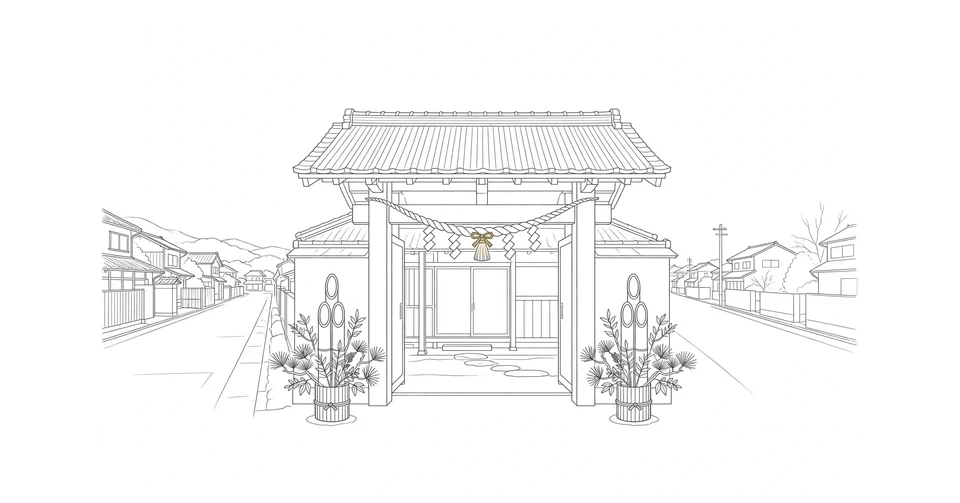
The idea behind matsunouchi is easy to state and hard to live up to. If a god is staying in your house, you do not take the welcome down early, and you do not leave it up after the guest has gone. The calendar of the pine is therefore a small act of manners, repeated by millions of households at the same time. This article follows that week from its first morning to its last, through the two dates that divide the country, the food and visits that fill it, and the quiet way it ends.
What matsunouchi means, word by word
The word matsunouchi is written with the characters for pine and for inside, and it is usually translated as the days of the pine. The name comes from the kadomatsu, the paired pine arrangements that stand at the gate, and from the simple fact that the pine is what marks the period. While the pine is up, matsunouchi is still running, and the New Year is still in the house. When the pine comes down, the New Year is over. The whole season can be read from a single doorway.
The pine at the centre of matsunouchi was chosen for a reason. Pine stays green through the winter, and in Japan it has long been a symbol of longevity and endurance. A tree that does not lose its leaves in the cold is a natural emblem for a year that is meant to last and a life that is meant to go on. The kadomatsu pairs that green pine with bamboo, which grows straight and fast, and the combination is a wish set out in plants. Health, long life, and steady growth, standing at the gate where everyone can see it.
Matsunouchi is not a public holiday, and it does not appear on a calendar as a block of days off. It is a folk period, a span of time defined by what households do rather than by what the government declares. Most businesses shut down from January 1 to January 3, and then they reopen, while the pine stays up for several days more. That gap is part of the charm of matsunouchi. The office has gone back to work, but the house has not yet said goodbye to its guest.
The length of matsunouchi depends on where you are. In the Kanto region, around Tokyo, it traditionally runs to January 7. In the Kansai region, around Kyoto and Osaka, it often runs to January 15. The two dates are not a mistake, and they are not a disagreement. They are two survivals of the same custom, kept alive in different regions for more than three hundred years, and both are correct where they are observed.
The guest the pine is waiting for
To understand matsunouchi, you have to understand the guest. Toshigami is the deity of the new year, the god who is believed to visit every home at the turn of the year and bring the power of life, health, and a good harvest for the year ahead. The decorations of the Japanese New Year are not ornaments in the usual sense. They are the furniture of a visit, and each one has a job. The kadomatsu at the gate is a marker for the deity to find the house. The straw rope above the door marks the boundary of a clean and sacred place. The round rice cakes in the best room are a seat and an offering for the guest. The days when Toshigami is believed to be in residence are called matsunouchi, the days of the pine.
The name Toshigami carries its own history. The character for year originally meant harvest, because the harvest came once a year, and the word for the harvest slowly became the word for the year itself. Toshigami was therefore first of all the god of abundant harvests, and specifically of grain or rice. The whole season is still built from rice. The straw of the decorations is rice straw. The cakes offered to the deity are rice cakes. The wine poured out is rice wine. Even today, when most Japanese people buy their rice in a supermarket and have never stood in a paddy field, the New Year still runs on rice, and the guest at the centre of it is the god of that crop.
The belief is a folk one, handed down through households rather than handed down from a single shrine or a single priesthood. According to the old chronicle called the Kojiki, Toshigami was the son of Susanoo, the storm god, and the older brother of Ukanomitama, the deity of food and agriculture. The family connection is fitting. A god of the harvest who is the brother of the god of food belongs to a family that feeds people. Yet the details of the mythology matter less than the shape of the belief. Most gods in Japan are visited. A person goes to a shrine, and the god stays where the god is. Toshigami reverses the arrangement. At the New Year, the god does the travelling, and the household does the waiting. That single reversal explains the entire season, and it explains why matsunouchi exists at all. If the god is coming to the house, the house must stay ready for as long as the god is there, and the pine is the sign that the house is still ready.
There is something quietly democratic about a visiting god, and I think it is the best part of the belief. A shrine god can be far away, up a mountain or across a prefecture, and a poor person may never make the journey. A visiting god comes to every door, rich or poor, and the welcome costs little more than effort and attention. Straw is cheap. Rice cakes are cheap. A clean floor costs nothing but time. Matsunouchi is the week when that welcome stays up, and it belongs to every household equally.
Why Tokyo takes the pine down on January 7 and Kyoto waits until January 15
The split between the two dates goes back to the Edo period, and it has a specific origin. On January 6, 1662, according to the lunar calendar then in use, the shogunate issued a notice to the castles under its rule that the New Year decorations should come down on January 7. The order set seven days as the length of matsunouchi in the east, and the practice spread through the Kanto region and much of eastern Japan. The notice did not reach as far as the Kansai region in the west, and so the older practice survived there, with matsunouchi running to January 15 and the Little New Year, the day known as koshogatsu.
The older date was tied to the lunar calendar and to the old agricultural cycles of the year, and the newer date was a practical decision by a government that wanted a shorter holiday and a quicker return to work. Both reasons are still visible in the custom today. In Tokyo, the pine comes down after a week, and the city moves on. In Kyoto and Osaka, the pine stays up for a second week, and the season keeps a slower, older rhythm. Neither side is wrong. They are simply keeping different chapters of the same history.
The difference between the two versions of matsunouchi shows up in the details as well as in the dates. In the Kanto region, the kadomatsu and the straw rope decorations are displayed until January 7, and the kagami mochi rice cakes stay until January 11. In the Kansai region, the kadomatsu and straw decorations are displayed until January 15, and the kagami mochi stay until January 20. The cakes last longer than the pine in both regions, because they have their own ending, a ceremony of their own that comes a few days after matsunouchi closes. The house does not return to normal all at once. It returns in stages, one decoration at a time.
| Region | Matsunouchi ends | Pine and straw rope come down | Kagami mochi come down |
|---|---|---|---|
| Kanto, around Tokyo | January 7 | January 7 | January 11 |
| Kansai, around Kyoto and Osaka | January 15 | January 15 | January 20 |
The table makes the split look neat, and in practice it is messier, which is how folk customs usually are. Some households in Kansai take the pine down on January 7 because their neighbours do, and some households in Kanto keep it up longer because their family came from the west. Shops and offices often follow the shorter date for convenience, while temples and shrines follow the older one. The dates in the table are the traditional ones, and the real behaviour of a street is a mixture of both. That mixture is not a failure of the custom. It is the custom working the way it always has, passed from family to family rather than enforced from above.
There is a lesson in the split that goes beyond the New Year. Japan is often described from the outside as a uniform country, and the two dates of matsunouchi are a small correction to that picture. A custom can be national and regional at the same time, and the same pine can mean a seven day visit in one city and a fifteen day visit in another. The country holds both versions of matsunouchi, and it does not ask either side to give way.
How the pine gets there in the first place
Matsunouchi begins before it begins. The decorations are best put up on December 28, so that matsunouchi can begin with the house already ready, and the days around that date each carry their own meaning. The preparations traditionally start on December 13, a day known as the start of New Year preparations, though in modern life most families begin after Christmas, when the shops fill with pine and straw and the television starts counting down. Whenever the preparations start, the first job is always the same. The house is cleaned.
The great year end cleaning is called osouji, and in its older form it is known as susuharai, the sweeping away of soot. It is not ordinary housework. It is a ritual to purify the house and welcome Toshigami into a clean and fresh environment. Every room is cleaned, the high shelves are dusted, and the corners that are ignored all year are finally reached. The cleaning is the real offering, and the decorations that follow are only the sign that the cleaning is done. A rope hung over a dirty doorway would be a decoration without the work behind it. Clean first, then decorate.
Two days are avoided when the decorations go up. December 29 is avoided because the number nine sounds like the word for suffering, and the twenty ninth is read as double suffering. December 31 is avoided because hanging a decoration on the last night is called a one night decoration, and it is considered rude to the deity, as if the welcome had been left to the last minute. A guest who is welcomed properly is welcomed early, and a god is no different. December 28 is considered the best day, partly because the number eight is auspicious, and partly because it leaves a comfortable margin before the year turns. If the twenty eighth falls on an unlucky day, the twenty sixth, twenty seventh, or thirtieth will do. The point is the same either way. The welcome should be ready before the guest arrives, not thrown together as the guest is knocking.
The kadomatsu themselves are placed in pairs, one on each side of the gate or entrance, and the pair matters. A single pine at a door would be a decoration. A pair is a gate, and a gate is a place where someone enters. The kadomatsu is a yorishiro, a thing in which a god or spirit can dwell, and its job is to welcome Toshigami into the house. The bamboo in the middle is cut at a slant, the pine branches are arranged around it, and the base is tied with straw rope. In Kansai the arrangement is often taller and more elaborate, with three bamboo stalks and ornamental cabbages in red and white at the front. In Kanto it is often shorter and simpler. The regional difference in the object matches the regional difference in the dates, and both go back to the same old split. A street where every gate carries a pair is a street in the middle of matsunouchi.
What happens during matsunouchi
The days of matsunouchi are the busiest and the quietest days of the Japanese year at the same time. They are busy because families gather, visit shrines, and eat together, and they are quiet because the first day of the year is supposed to be full of joy and free of stress and anger, with everything clean and no work done. The contradiction is only apparent. The work of the season was done in December. The week of matsunouchi is for enjoying what the work was for.
The first three days, from January 1 to January 3, are the heart of the season, and the Japanese New Year is the most important holiday in the country. Most businesses are shut, families gather to spend the days together, and the New Year is treated as a complete fresh start. The tradition is that each new year is viewed as entirely separate from the one before it, and all duties are supposed to be completed by the end of the old year. The old worries are left behind at parties held for exactly that purpose, the year forgetting parties, and the new year begins with a clean slate and a clean house.
The first morning starts with the first sunrise of the year, called hatsu-hinode, which is traditionally believed to be representative for the whole year that has just commenced. People rise early to watch it, and the day is supposed to be full of joy. Then comes hatsumode, the first shrine or temple visit of the year. It is a tradition to visit a shrine or temple during the New Year period, and the most popular shrines and temples, such as the Meiji Shrine in Tokyo, attract several million people over the three days. The most impressive visits happen at the actual turn of the year, when the great temple bells are rung at midnight. A family that has spent a week preparing its own house for a visiting god now walks out of that house to visit a god at a shrine, and the two movements, the god coming in and the family going out, complete each other during matsunouchi.
Food is central to matsunouchi, as it is to every part of the season. Osechi ryori, the tiered boxes of small dishes prepared in advance so that no cooking is needed during the first days, are served through the period. Otoso, a sweetened rice wine, is drunk. Ozoni, a soup with rice cakes, is eaten. On New Year Eve, before matsunouchi begins, toshikoshi soba, the buckwheat noodles that symbolise longevity, are served, and the long noodle is a wish for a long life, eaten on the last night of the old year. The food of matsunouchi is food that was made to last and to be shared, and that is the point. A household that is hosting a god does not cook from scratch every morning. It prepares in advance, and then it sits down together.
There are also the small pleasures that have faded a little with time. Hanetsuki, a form of badminton played with wooden paddles, takoage, kite flying, and karuta, a card game, are some of the games traditionally played at New Year, though their popularity has decreased in recent times. New Year cards are sent in large numbers, specially marked to be delivered on January 1, and it is not uncommon for one person to send out several dozen cards to friends, relatives, and co-workers. The cards arrive on the first morning of matsunouchi, and they are a reminder that the season is not only about the household. It is about every relationship the household has, renewed at the same time.
The week also has a practical rhythm that modern life has not erased. Schools and companies begin to reopen after the first three days, and people go back to work while the pine is still up at the gate. The commute resumes, the emails return, and the decorations stay where they are, a little out of step with the working day, while matsunouchi carries on quietly behind the working day. I find that out of step quality rather touching. The calendar of work says the holiday is over, and the calendar of the house says the guest is still here, and for a few days the house wins. Matsunouchi is the space between those two calendars, and it is worth protecting precisely because it does not fit neatly into either one.
The rice cakes that stay longer
Not everything comes down when matsunouchi ends. The kagami mochi, the two round rice cakes stacked with a bitter orange on top, stay in place after the pine has gone, because they have their own ending. They are displayed until the day of kagamibiraki, the breaking of the mirror cakes, and that day also differs between the regions. In Kanto it falls on January 11, and in Kansai it falls on January 20. The cakes are offerings to Toshigami, and they are also understood to be a seat for the deity, a place where the god rests during the visit. They wait longer because they are closer to the guest than the pine is, and their ending falls after matsunouchi has already closed.
Kagamibiraki, which falls after matsunouchi, is a small ceremony in itself. The cakes are not cut with a knife, because cutting is associated with separation and with the sword, and the rice cakes are meant to be opened by hand or broken with a wooden mallet. The pieces are then cooked into soup, usually ozoni, and eaten by the family, so that the blessing the cakes have absorbed is taken into the body. The offering becomes a meal, and the meal becomes the end of the visit. There is a neat logic to it. The god is offered food, the food sits in the house while the god is present, and then the family eats the food and carries the blessing forward into the year.
The staggered endings of matsunouchi are worth noticing. First the pine and the straw rope come down, and the gate stops being a gate for a god. Then, a few days later, the rice cakes are broken and eaten, and the best room stops being a room for a guest. The house returns to normal in stages, and each stage has its own meaning. A season that ended all at once would feel abrupt. A season that ends in stages feels like a departure, and a departure is what it is. The guest leaves slowly, and the house lets go slowly too.
How matsunouchi ends
The end of matsunouchi is a practical matter as much as a ceremonial one. The decorations come down on the evening of the last day or on the morning after, and they are not thrown away with the ordinary rubbish. They are taken to a local shrine or temple, where they are burned together in a ritual fire. The fire is called dondo-yaki in many places, and near Kyoto it is called sagicho, while other regions have their own names for the same rite. The fires are usually held around the middle of January, during the Little New Year, and communities bring their pine, their straw decorations, and the first calligraphy of the year to be burned on one fire. Mochi is sometimes grilled over the embers and eaten, and the smoke is understood to carry the deity back and to purify the household for the year ahead.
The burning is the proper end of matsunouchi and of the welcome. A kadomatsu that ends in such a fire has had a good ending, and the household that brings it there has finished the season properly. The alternative, leaving the pine up until it withers or throwing it away with the rubbish, would be a discourtesy to the guest it was put up for. The fire is not a disposal method. It is a farewell, and it is the last act of matsunouchi.
There is also a quieter ending to matsunouchi for households that do not go to the fire. Some shrines accept decorations throughout January, and some families keep a small ritual at home, taking the pine down with thanks and wrapping it carefully before it is collected. The form varies, but the feeling is the same. The decorations were put up with intention, and they should come down with intention too. A season that begins with cleaning should not end with litter.
For visitors to Japan, the end of matsunouchi is also the moment when the country changes gear. The first three days of January are the most difficult time to travel, because so many businesses are shut, and then the country reopens in stages through the week. A traveller who arrives on January 7 in Tokyo will find a city that has already taken its pine down, while a traveller in Kyoto on the same day will still see the decorations up. The difference is a small gift to anyone paying attention. It is a reminder that Japan keeps more than one calendar, and that the calendar of a region is part of what makes the region itself.
Matsunouchi in a modern Japanese home
The question that hangs over matsunouchi today is whether a folk period can survive a working life that no longer follows it. The honest answer is that it survives by shrinking, and that the shrinking is not the same as dying. Fewer households now make their own kadomatsu, and most buy a ready made set from a shop or a supermarket, or order one online. Fewer families clean the whole house in the old ritual way, and the great year end cleaning has become, for many people, simply a thorough clean before the holidays. Apartments with no gate hang a small straw decoration on the front door instead of standing a pair of pines, and some households put up nothing at all except a small arrangement on a shelf. The pine has got smaller, but it has not gone away.
The shortening is real too. Many families take the decorations down on January 7 even in Kansai, because the office and the school run on the shorter date, and the media and the shops follow the Kanto calendar, so the matsunouchi of the west is quietly giving way to the matsunouchi of the east. Some people take the pine down on January 4, when work resumes, because a decoration that nobody is at home to see feels pointless. Others keep the full fifteen days out of loyalty to their family home, even if they live in Tokyo now. The result is a patchwork, and the patchwork is the honest picture of the custom today.
I think the patchwork is a healthy sign rather than a sad one. A custom that can only survive in its full old form is a museum piece, and a custom that survives by adapting is a living thing. Matsunouchi does not need every household to keep the pine up for fifteen days. It needs enough households to keep it up at all, and it needs the idea behind it to stay understood. The idea is simple, and it is worth keeping. A new year is not a date on a calendar. It is a guest, and a guest deserves a welcome that lasts longer than a single night.
There are also new ways of keeping matsunouchi that the old custom never imagined. People photograph their kadomatsu and send the picture to relatives who live far away. Shops keep their pine up for the full period as a sign to customers. Shrines and temples post the dates of their fire ceremonies online, so that families can find them. The tools have changed, and the intention has not. The pine still marks a house that is ready, and the ready house is still the point.
The modern version of matsunouchi also has a quieter benefit that is easy to miss. In a working life where the year turns without ceremony, where December 31 is a deadline and January 1 is a day off, the week of the pine gives the turn of the year a shape. It says that the new year does not arrive in an instant. It arrives over days, it stays for a while, and then it leaves, and each of those stages deserves attention. That shape is useful even for people who do not believe a god is visiting. It is useful for anyone who wants the year to feel like it has begun, rather than simply continued.
A week that teaches a whole attitude
Matsunouchi is a small thing, a week of pine at a gate, and it teaches a whole attitude toward time. The attitude is that beginnings deserve preparation, that guests deserve a welcome that lasts, and that endings deserve a proper farewell rather than a sudden stop. The Japanese New Year is built from that attitude. The cleaning comes before the decorating, the decorating comes before the visit, the visit lasts for days, and the farewell is a fire, not a bin. Nothing is rushed, and nothing is left hanging.
The two dates of matsunouchi teach something else too. A country can hold two versions of the same custom without either one being wrong, and a family can keep the date it inherited without judging the family across the street. The seven day matsunouchi of Tokyo and the fifteen day matsunouchi of Kyoto are both the days of the pine, and the pine does not care which calendar it is standing under. It only cares that someone put it there on purpose, and that someone will take it down with thanks.
So the next time you walk past a gate in Japan in the first week of January, and you see the pine standing there, you will know what you are looking at. It is not a decoration that has been left up too long. It is a welcome that is still in force, and matsunouchi is the name of that welcome. Matsunouchi is the week Japan keeps the pine up for its guest, and the guest, if the old belief is right, is still in the house, and the house is still ready.
More in Culture & Society
- Toshigami Is the Guest Japan Prepares the Whole House For
- Urajiro Is the Fern That Wishes a Family Twice Over
- A Shimekazari Hangs the New Year Over the Front Door
- Make-Koshi Is the Eight Loss Line That Sends a Sumo Wrestler Down
- Japanese Arcades and the Game Centers That Refuse to Die
- Danpatsu-Shiki Is the Haircut That Ends a Sumo Career
Latest posts
- Osouji Is the Cleaning Japan Does Before the Gods Arrive
- Japanese Anime and How a Niche Hobby Conquered the World
- Kachi-Koshi Is the Eight Win Line That Moves a Sumo Wrestler Up
- Tachiai Is the One Second That Decides a Sumo Bout
- A Gunbai Points at the Winner and Nobody Argues
- Izakaya, the After-Work Pubs Where Japan Unwinds
- Dondo-Yaki Is the Fire That Closes the Japanese New Year
- Hakkeyoi Is the Word That Starts a Sumo Bout
- A Yobidashi Calls the Wrestlers and Sweeps the Ring
- A Dohyo Is Sacred Ground Long Before the First Bout
- A Kadomatsu Guards the Door Until the New Year Fire
- A Shikona Gives a Wrestler His Second Name
- Japanese Street Food, From Takoyaki Stalls to Festival Yatai
- Komusubi Is the Smallest Chair at Sumo's Top Table
- A Sekiwake Waits One Win From Sumo's Highest Door