The Two Lives of Japanese Coffee
· 13 min read
Japanese coffee lives two lives at once, the slow kissaten ritual and the canned coffee in every vending machine. This is how one drink became both an art and a habit.
Japan drinks coffee the way it does most things, in two speeds at once. In a dim kissaten in Tokyo, a master in an apron brews one cup at a time through a flannel filter, and the room is so quiet you can hear the coffee drip. On a train platform in Osaka, a salaryman buys a hot can from a vending machine, cracks it open with one hand, and finishes it before the train arrives. Both are Japanese coffee, and neither makes sense without the other.
That split is the whole story. Japanese coffee is a slow craft and a fast habit, a 140 year old coffee house tradition and a 1969 invention that put coffee in a can. The country now ranks fourth in the world for coffee consumption, drinking about 6.25 million 60 kilogram bags in the year to September 2026, according to the International Coffee Organization. It grows almost no coffee of its own, so nearly every cup is an import, mostly from Brazil, Vietnam, and Colombia. What Japan added to Japanese coffee was not the bean. It was the ritual around it, twice over.
The first life began with the slow one, and it is still the more surprising of the two. Coffee reached Japan around 1700 through Dutch traders on Dejima, the small artificial island in Nagasaki harbor that served as the country's only window to Europe during the Edo period. Most Japanese people at the time found the drink bitter and unpleasant, and it stayed a curiosity for nearly two centuries. The drink that now fills every vending machine was once so strange that it took 188 years to get its first proper shop.
How Japanese coffee arrived, and why it stayed strange
Japan's first true coffee house, Kahisakan, opened in Ueno, Tokyo, in 1888. It closed after about five years, but the date stuck. April 13, the day it opened, is still marked in Japan as Coffee Shop Day. A short history of coffee in Japan traces the drink from Dejima to the first cafes, and the 1888 opening is the date every account agrees on. The shop was the work of Tei Eikei, a Yale educated entrepreneur who had tasted coffee abroad and decided Tokyo was ready for it. Tokyo, it turned out, was not quite ready, but the idea survived him.
The kissaten, the traditional Japanese coffee house, grew slowly through the Taisho era and then multiplied in the Showa era, becoming one of the country's central social spaces. By the 1970s there were roughly 150,000 of them across Japan, a number that still sounds impossible until you remember that every neighborhood had one, the way every neighborhood had a bathhouse and a barber. They were places to read, to meet, to sit alone in public with a good cup, and to listen to music you could not afford to own.
In 1929, tighter rules split the trade in two. Shops that sold alcohol had to choose, and the ones that chose coffee alone became jun-kissa, pure coffee shops. The distinction mattered. A jun-kissa was not a bar that happened to serve coffee. It was a room built around coffee, with low light, dark wood, a counter, and a master who brewed by hand. That room is the heart of Japanese coffee culture, and it has barely changed in a century.
The kissaten, where coffee learned to slow down
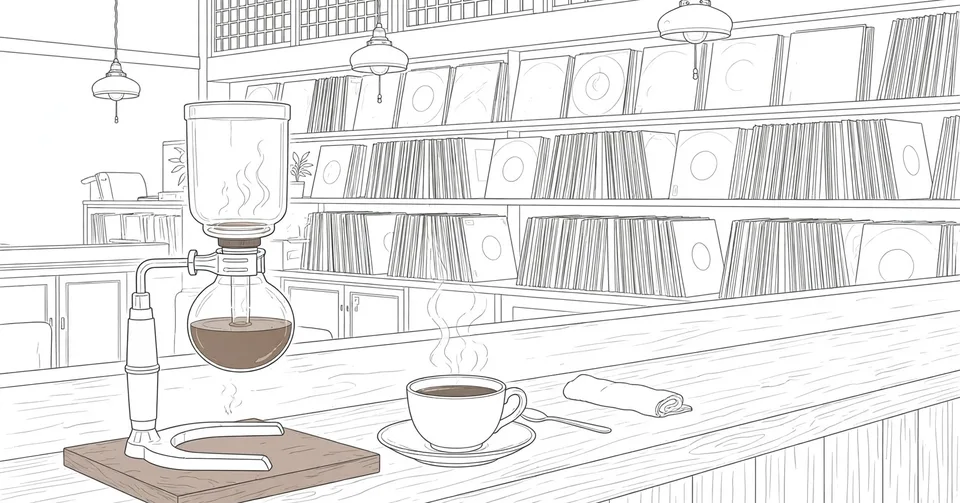
Step into a surviving kissaten and the first thing you notice is the pace. Nothing is rushed, and nothing is loud. The master works behind the counter with tools that look like laboratory glassware, a siphon brewer with two glass chambers and a flame underneath, or a nel drip, a pour over made through a cloth flannel filter that gives the cup a soft, round body. The coffee is usually a dark roast, smooth rather than sharp, served black in a thick porcelain cup, often with a small glass of water on the side. The cup costs more than a can from a machine, and nobody in the room thinks that is strange.
The food is part of the ritual too. The menu of a Japanese coffee shop is short and stubbornly old fashioned: thick toast, often cut an inch thick and buttered generously, purin, a firm custard pudding with caramel, napolitan spaghetti, and coffee jelly, cubes of dark coffee set in jelly and served with cream. These are not side dishes. They are the reason some customers come, and the reason the shops survive when cheaper coffee is everywhere.
Some kissaten went further and became jazz kissa, listening rooms built around a serious sound system. In an age when imported records were prohibitively expensive, a jazz kissa let you sit in near silence and hear music you could never afford to own. Talking was discouraged, and in the strictest rooms it was forbidden. The idea sounds severe until you sit in one, and then it feels like the point. Japanese coffee at its slowest is not about caffeine. It is about giving one sense, taste or hearing, your full attention for an hour.
That slowness is also why the kissaten nearly died. Chains arrived, convenience stores started selling counter coffee, and the old masters retired without successors. The number of kissaten fell sharply from its 1970s peak. Yet the survivors are now finding a new audience. Young Japanese customers, raised on fast coffee, are rediscovering the kissaten as a quiet room in a loud city, and visitors from abroad seek them out as deliberately as they seek out temples. The slow life of Japanese coffee, written off as a relic, turned out to be the one people missed.
The can that set Japanese coffee free
The second life of Japanese coffee began with a missed train. In 1969, Tadao Ueshima, founder of UCC Ueshima Coffee in Kobe, bought a bottle of milk coffee at a station kiosk and had to abandon it half finished because his train was leaving and the bottle had to be returned. He wondered why coffee could not travel with you. The answer was a can. UCC Coffee with Milk, launched in 1969, became the world's first mass produced canned coffee, and a year later Expo 70 in Osaka put the cans in front of the whole country. Sales took off, and a new habit was born. A guide to Japanese coffee culture describes how the kissaten and the can grew up side by side, one slow and one instant.
Canned coffee had a quieter predecessor. In 1965, Miura Yoshitake of Miller Coffee had developed a canned coffee in Hamada, where canning technology was advancing fast. Ueshima's version was the one that reached the whole country, and the UCC can is now recognized by Guinness World Records as the longest selling ready to drink canned coffee brand. The detail matters less than the pattern. Japanese coffee kept producing the same idea twice, once as craft and once as convenience, and the convenient version always won the crowd.
The vending machine finished the job. In 1973, Pokka introduced machines that could serve both hot and cold drinks from the same box, a technology rare anywhere in the world. A can of coffee that is warm in winter and chilled in summer, available on every platform and street corner, turned coffee from a destination into a reflex. The machines are so common that Japanese coffee and vending machines are really one story told twice, and the red button for hot and the blue button for cold are a small piece of design every visitor learns in a day.
The brands piled up fast. Suntory launched Boss Coffee in 1992, with its pipe smoking salaryman on the can, and Coca-Cola's Georgia brand followed. Doutor, founded in 1980, brought Western style cafe chains to Japan at prices ordinary people could afford, and Starbucks opened its first Japanese store in Ginza in 1996, introducing a third kind of coffee shop to a country that already had two. The convenience store finished the circle in the 2010s, when Seven-Eleven launched its Seven Cafe counter coffee and put a fresh cup in the hands of anyone with 100 yen and thirty seconds. If the kissaten is Japanese coffee at its slowest, the can is Japanese coffee at its fastest, and both sell millions of cups a day.
Why Japanese coffee tastes the way it does
Ask what makes Japanese coffee different and the answer is not the bean, it is the handling. The classic kissaten roast is dark, the grind is fine, and the pour is slow. A nel drip master rinses the flannel filter, blooms the grounds, and pours in thin circles, watching the coffee fall drop by drop. A siphon brewer uses vapor pressure to push hot water up into the grounds and then lets gravity pull the brewed coffee back down, a small piece of theater that also makes a clean, aromatic cup. The result is coffee that tastes smooth and deep rather than bright and acidic, the kind of cup that suits a quiet room.
The craft did not stop with the old masters. Japan helped invent the modern pour over, and its third wave coffee bars in Tokyo and Kyoto are among the most exacting in the world. The specialty shop % Arabica, a Japanese coffee export in its own right, opened its first Kyoto store in 2014 and now has shops from London to Jakarta, proof that the Japanese way of brewing travels as well as the can did. The same country that drinks sweet canned coffee from a machine also weighs its beans to the gram and times its pours to the second. The two lives of Japanese coffee are not a contradiction. They are a division of labor. One life is for pleasure, the other is for the day.
My own view, after years of living here, is that the split is the honest part. Coffee in Japan never pretended to be one thing. The kissaten says coffee is worth an hour of your day, and the vending machine says coffee is worth thirty seconds of it, and both are right on different days. I drink the slow cup when I want to think, and I drink the can when I am running for a train, and I have never felt the second choice betrayed the first. A food culture that makes room for both is a food culture that understands real life.
A country that imports nearly everything it drinks
The numbers behind Japanese coffee are large and slightly odd. Japan grows almost no coffee, yet it is the world's fourth largest coffee consuming country. In the year to September 2026, Japan drank about 6.25 million 60 kilogram bags, behind the United States at 24.6 million, Brazil at 23.5 million, and Germany at 9.59 million. Green coffee bean imports in 2024 were about 360,000 tons, roughly 6 million bags, and the top three origins, Brazil at about 40 percent, Vietnam at about 28 percent, and Colombia at about 13 percent, supply about 80 percent of it.
The history of that appetite is short. Coffee imports were halted during the Second World War, when kissaten closed and beans vanished, and resumed in 1950. The postwar boom turned coffee from a luxury into a daily drink, and instant coffee helped. Satori Kato, a Japanese born chemist working in the United States, is credited with developing a soluble instant coffee process and filing his patent around 1901, which means Japan had a hand in instant coffee long before it had a coffee habit of its own. By the turn of the millennium, Japan had passed France to become the world's third largest coffee importing nation by volume, and it has stayed near the top ever since.
There is a small irony in the trade. Indonesia, my home country, is the world's fourth largest coffee producer, and its beans are part of the flow that fills Japanese cups. The kopi tubruk I grew up with in Magelang, coarse grounds and hot water in a glass, could not look more different from a siphon brewer in a Tokyo kissaten. Yet both are the same idea: hot water, ground beans, and a few quiet minutes. Japanese coffee did not invent coffee. It invented two new ways to meet it, and then it kept both.
How to drink Japanese coffee like a local
The best way to understand Japanese coffee is to drink it in both lives, in one day. Start in the morning at a kissaten. Order the house blend, black, and sit at the counter if there is one. Watch the master work. Do not rush the cup, and do not ask for the Wi-Fi password first. The toast and the purin are worth ordering, and the coffee jelly with cream is the most Japanese dessert a coffee drinker can meet. A good kissaten is easy to recognize: the sign is old, the curtains are heavy, the coffee smells like toast and chocolate, and the master has been there longer than you have been alive.
Then, in the afternoon, buy a can from a vending machine. In winter, press the red button and hold the warm can in both hands, the way everyone does. In summer, press the blue one. Try the black first, then the milky sweet one that Ueshima invented, and notice how different they taste when they come from the same machine. The can costs about 130 to 150 yen, and it is the cheapest souvenir in Japan that you will actually use.
If you want a third stop, buy a cup at a convenience store, where the machine grinds the beans in front of you, or visit a vending machine at a train station at midnight, when the row of glowing machines is the brightest thing on the platform. The tea ceremony and matcha will always be Japan's older drink, and Japanese beer will always be its louder one. But coffee is the drink that learned to be two things at once, and that is why it fits this country so well.
The two lives of Japanese coffee will keep going side by side. The kissaten will keep brewing one cup at a time for the people who want an hour of quiet, and the vending machine will keep humming on every corner for the people who want thirty seconds of warmth. One is an art, the other is a habit, and Japan refused to choose between them. That refusal is the whole story, and it tastes very good.
More in Food & Travel
- Toshikoshi Soba Is the Long Noodle Japan Eats at Midnight
- Izakaya, the After-Work Pubs Where Japan Unwinds
- Japanese Street Food, From Takoyaki Stalls to Festival Yatai
- Namasu Turns Daikon and Carrot Into a Red and White Wish
- Ebi Bends Like an Old Back and Wishes You a Long Life
- Kobumaki Rolls Joy Into a Strip of Kelp
Latest posts
- Chihayafuru Made a Card Game Feel Like a Sport
- Oshi-e Hagoita Turns Silk Into a Picture You Can Touch
- Hyakunin Isshu Gave Karuta Its Hundred Poems
- Hagoita Is the Paddle Japan Turns Into New Year Art
- Takoage Sends New Year Wishes Up on a Paper Kite
- Hanetsuki Keeps New Year in the Air With a Wooden Paddle
- Japanese Stationery and the Small Tools Japan Takes Seriously
- Karuta Turns a Hundred Poems Into Japan's Fastest Card Game
- Hatsuyume Is the First Dream Japan Reads Like a Fortune
- Japanese Manga and How It Became the World's Most Read Comics
- Hatsu-Hinode Is the First Sunrise Japan Wakes Up For
- Matsunouchi Is the Week Japan Keeps the Pine Up for Its Guest
- Osouji Is the Cleaning Japan Does Before the Gods Arrive
- Japanese Anime and How a Niche Hobby Conquered the World
- Toshigami Is the Guest Japan Prepares the Whole House For