Japanese Manga and How It Became the World's Most Read Comics
· 12 min read
Japanese manga grew from postwar children's magazines into a 704 billion yen industry read around the world. This is how one man's robot boy started it all.
Ride a train anywhere in Japan and you will see it. A salaryman in a suit, a schoolgirl in uniform, an old man with a newspaper folded away, all of them reading the same thing, a small black and white book held open with one hand. That book is Japanese manga, and it is the most widely read form of comics on the planet.
Japanese manga did not conquer the world by accident. It grew out of one artist's cinematic way of telling stories, a ruthless weekly magazine system that let readers vote with their attention, and a digital shift that put entire libraries in everyone's pocket. Today the Japanese manga market is worth more than 700 billion yen a year, and its most famous series has passed 600 million copies in circulation.
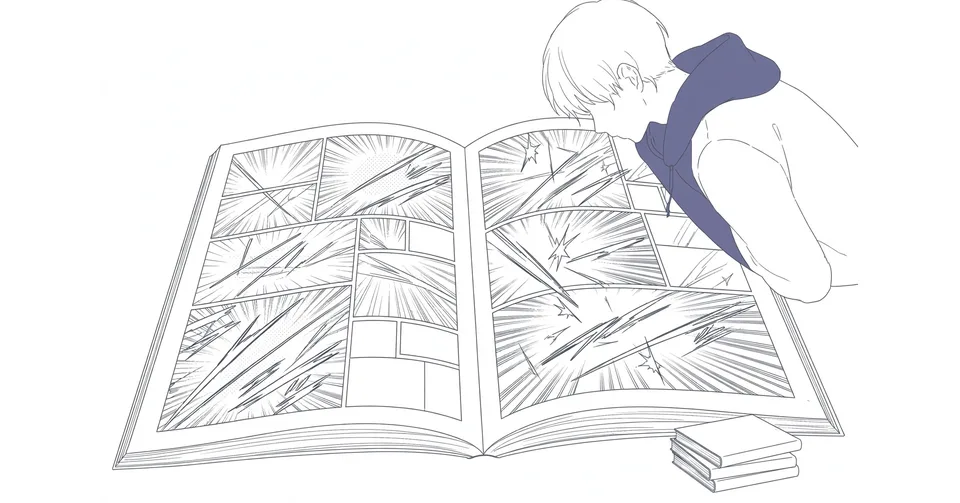
This is the story of how Japanese manga went from cheap children's entertainment to a medium that adults read openly, on trains, in offices, and in parliaments, and why it still has no real rival.
What Japanese manga actually is
The word manga simply means comics in Japanese, but outside Japan it has come to mean something more specific. Japanese manga is a whole publishing system, not a single style. It covers romance, horror, cooking, sports, history, science fiction, and quiet stories about nothing much happening at all. A manga can be a 20 page gag strip or a 100 volume epic that runs for 25 years.
Most Japanese manga starts life in a weekly or monthly magazine, printed on cheap paper and read once before being thrown away. The popular series are then collected into small paperback volumes called tankobon, which is where the money is made. A single hit can support an anime adaptation, films, games, merchandise, and a theme park, but everything starts with the magazine chapter.
Reading Japanese manga feels different from reading a Western comic. The pages run right to left, the panels vary wildly in size, and a single page can hold a silent close-up of a face for a full beat before the action explodes across the next spread. That rhythm, borrowed from film, is the single most important thing one man gave to the medium.
The man who made manga modern
Osamu Tezuka is known in Japan as the God of Manga, and the title is not an exaggeration. Born in 1928, Tezuka was a trained doctor who chose drawing over medicine, and in a career of about 42 years he produced roughly 150,000 pages of art and more than 700 titles.
His revolution began in 1947 with New Treasure Island, a long adventure story that sold around 400,000 copies and showed publishers that comics could carry a real plot. Then came the character that changed everything. Tetsuwan Atom, known in English as Astro Boy, began serialization in 1952. The story of a robot boy with a human heart ran until 1968, and in 1963 it became the first Japanese animated television series, drawing a peak viewing rate of 40.7 percent. You can read more about that leap from page to screen in the story of Japanese anime.
Tezuka borrowed his paneling from cinema. He used close-ups, long shots, and silent pauses the way a film director would, and he gave his characters large, expressive eyes that could carry an emotion without a single word. Before him, Japanese comics were mostly short gags for children. After him, they could be anything.
What strikes me most about Tezuka is that he never treated comics as a lesser art. He drew adult stories about medicine, religion, and war alongside children's adventures, and he did it at a pace that would break most people. He proved that Japanese manga could be serious literature and popular entertainment at the same time, and the industry has been living in the space he opened ever since.
The weekly magazine machine
If Tezuka gave Japanese manga its language, the weekly magazines gave it its engine. The most famous of them, Weekly Shonen Jump, launched in 1968 and became the best-selling manga magazine in history, with more than 7.5 billion copies sold since its first issue.
Jump ran on a brutally simple idea. Every week, readers voted for their favorite series by mailing in a survey card. Series at the bottom of the rankings were cancelled, sometimes after only a few weeks. Series at the top got color pages, covers, and eventually anime adaptations. The system was cruel to creators, but it was honest with readers, and it produced an astonishing hit rate.
At its peak, the numbers were almost absurd. The combined New Year issue for 1995 sold 6.53 million copies in a single week, with a total readership estimated at 18 million people in Japan. That was in a country of about 125 million people, which means roughly one in seven Japanese residents was reading the same magazine. By the middle of 2026, the magazine's average print circulation had fallen below one million copies for the first time, a reminder that even giants age. But the series it built, from Dragon Ball to One Piece, still define what the world thinks Japanese manga is.
The magazine system also explains why Japanese manga feels so different from comics elsewhere. A creator in Japan does not pitch a finished graphic novel to a publisher and wait a year. A creator draws 19 pages a week, every week, for years, while readers judge each chapter in real time. The storytelling is fast, the cliffhangers are constant, and the characters grow up alongside their audience.
Shonen, shojo, seinen, and everything between
One of the first things a new reader learns is that Japanese manga is organized by audience, not by genre. The labels on the magazine tell you who it is for, and within each label you can find almost any kind of story.
| Label | Audience | Typical tone | Famous examples |
|---|---|---|---|
| Shonen | Boys and young men | Action, friendship, competition | One Piece, Naruto, Demon Slayer |
| Shojo | Girls and young women | Romance, emotion, relationships | Sailor Moon, Fruits Basket |
| Seinen | Adult men | Darker, slower, more complex | Berserk, Vagabond, Monster |
| Josei | Adult women | Realistic adult life and romance | Nana, Paradise Kiss |
| Kodomo | Children | Simple, funny, educational | Doraemon, Pokemon Adventures |
These are starting points, not fences. Plenty of adults read shonen, plenty of men read shojo, and some of the most popular series in history crossed every line. The labels matter because they shape the magazine, the pacing, and the art style, but the best Japanese manga always finds readers far outside its intended audience.
That breadth is part of why the medium survived while comics industries in other countries shrank. When a reader outgrows shonen, there is seinen waiting. When a reader wants romance without action, there is shojo and josei. Japanese manga does not ask its audience to grow out of it. It grows with them.
One Piece and the numbers that stopped making sense
No story about Japanese manga is complete without One Piece. Eiichiro Oda's pirate adventure began in Weekly Shonen Jump in 1997, and it has been running ever since. In March 2026, with the release of volume 114, the publisher Shueisha announced that the series had passed 600 million copies in circulation worldwide, about 450 million in Japan and 150 million overseas.
That figure makes One Piece the best-selling comic series by a single author in history, a fact recognized by Guinness World Records. It has topped the Oricon yearly manga chart 14 times, most recently in 2024. For comparison, the entire Harry Potter book series has sold around 600 million copies, and it took seven books and a global film franchise to get there. One Piece did it with a single manga.
The number is a circulation figure, not a count of copies actually bought, which is the standard publishing metric in Japan. Even so, it tells you something real about the scale of Japanese manga. A story about a rubber boy who wants to be king of the pirates is read by more people than most of the world's great novels, and it is still going.
How Japanese manga went digital
The biggest change in Japanese manga in the last decade has nothing to do with drawing. It is about where people read. In 2024, the Japanese manga market reached a record 704.3 billion yen, and digital sales made up 72.7 percent of it, about 512.2 billion yen. Print volumes fell 8.6 percent to 147.2 billion yen, and magazines fell 9.7 percent to 44.9 billion yen. The market dipped 1.7 percent in 2025 to 692.5 billion yen, its first decline after seven years of growth, but the direction is clear. The future of Japanese manga is on a phone screen.
Publishers saw this coming. Shueisha's MANGA Plus app now offers the latest chapters of major series in English and other languages on the same day they appear in Japan, legally and free. That matters more than it sounds. For decades, the only way to read Japanese manga outside Japan was to wait months for a translation or read an illegal scan. Same-day legal access changed the relationship between Japanese creators and the rest of the world.
Digital also changed who can make manga. A creator no longer needs a magazine contract to find readers. Web platforms let new artists publish directly, build an audience, and get picked up by a publisher later. The weekly magazine system is still powerful, but it is no longer the only door into the industry.
Reading Japanese manga without getting lost
If you have never read Japanese manga, the first five minutes are the hardest. Here is the short version. Start at what looks like the back of the book, because that is the front in Japanese. Read panels right to left, top to bottom. Speech bubbles follow the same order. Sound effects are often left in Japanese, drawn into the art itself, which is why a punch can look like it shouts across the page.
Do not worry about understanding every cultural reference on the first read. A good series explains itself through its characters. If you want a place to start, One Piece is the obvious landmark, but it is more than 110 volumes long. A shorter first read might be a completed classic like Death Note, or a quiet masterpiece like the works of the Studio Ghibli films, which share manga's DNA even when they were made for the screen. The brushwork tradition behind all of this, from ink to paper, is the same one explored in Japanese calligraphy.
The other thing to know is that Japanese manga is meant to be read fast. The panels are designed to pull your eye forward, and a whole volume can disappear in an hour. That speed is a feature, not a flaw. It is why people read manga on trains, between classes, and during lunch breaks. It fits into the gaps of a day in a way that a film or a novel cannot.
Why Japanese manga travels so well
People often ask why Japanese manga succeeded where other comics stayed local. I think the answer has three parts, and none of them is about Japan being exotic.
First, the stories are long. A manga series can spend years on a single character's growth, so readers form attachments that a two hour film cannot match. When a character you have followed for a decade finally achieves their dream, it feels like watching a friend succeed.
Second, the medium is honest about feelings. Japanese manga lets its heroes cry, fail, and look foolish, and it treats those moments as the point rather than as embarrassment. That emotional directness travels across languages better than jokes or wordplay ever could.
Third, the industry never stopped making manga for everyone. There is manga about cooking, about office life, about historical Japan, about space, about grief. When a medium covers that much ground, almost anyone can find a doorway in. The global market has noticed. Analysts value the worldwide manga market at about 10.2 billion dollars in 2025, with forecasts of much larger growth by 2033, and France alone sold 36 million manga copies in 2024. You can check the latest market figures in the manga industry statistics compiled from Japanese publishing data.
None of this means Japanese manga is perfect. The weekly schedule burns out creators, the pay for newcomers is often poor, and the industry has been slow to change working conditions that would be unacceptable in other fields. But the work itself, the pages, the characters, the stories, keeps finding readers, and that is the hardest thing in publishing to fake.
The quiet power of a small black and white book
Japanese manga started as cheap entertainment for children in a country rebuilding from war. It became a 704 billion yen industry, a global export, and a medium that adults read without apology. It did that by taking storytelling seriously, by letting readers decide what survived, and by never forgetting that a comic can be both popular and art.
The next time you see someone on a train, holding a small black and white book with one hand and smiling at a page, you will know what they are reading. It is probably Japanese manga. And if you borrow a volume, read it right to left, and give it twenty pages, you will probably understand why they are smiling.
More in Culture & Society
- Takoage Sends New Year Wishes Up on a Paper Kite
- Hanetsuki Keeps New Year in the Air With a Wooden Paddle
- Karuta Turns a Hundred Poems Into Japan's Fastest Card Game
- Hatsuyume Is the First Dream Japan Reads Like a Fortune
- Hatsu-Hinode Is the First Sunrise Japan Wakes Up For
- Matsunouchi Is the Week Japan Keeps the Pine Up for Its Guest
Latest posts
- Japanese Stationery and the Small Tools Japan Takes Seriously
- Toshikoshi Soba Is the Long Noodle Japan Eats at Midnight
- Osouji Is the Cleaning Japan Does Before the Gods Arrive
- Japanese Anime and How a Niche Hobby Conquered the World
- Toshigami Is the Guest Japan Prepares the Whole House For
- Urajiro Is the Fern That Wishes a Family Twice Over
- A Shimekazari Hangs the New Year Over the Front Door
- Make-Koshi Is the Eight Loss Line That Sends a Sumo Wrestler Down
- Japanese Arcades and the Game Centers That Refuse to Die
- Danpatsu-Shiki Is the Haircut That Ends a Sumo Career
- Kachi-Koshi Is the Eight Win Line That Moves a Sumo Wrestler Up
- Tachiai Is the One Second That Decides a Sumo Bout
- A Gunbai Points at the Winner and Nobody Argues
- Izakaya, the After-Work Pubs Where Japan Unwinds
- Dondo-Yaki Is the Fire That Closes the Japanese New Year