Toshigami Is the Guest Japan Prepares the Whole House For
· 25 min read
Toshigami is the deity of the new year in Japan, and every December cleaning, pine gate, straw rope, and rice cake is part of getting the house ready for the visit.
Every December, Japanese households begin a project that has no deadline on a calendar app and no invoice at the end of it. They scrub floors that are already clean, hang pine at the gate, twist straw over the front door, and stack two round rice cakes in the best room of the house. The work is done for a guest who has never been photographed and never signs a guest book. The guest is Toshigami, the deity of the new year, and the whole country prepares as if royalty were coming to stay.
The belief is simple enough to state in one sentence. Toshigami visits each home at the turn of the year, bringing the power of life, health, and a good harvest for the year ahead. What makes the belief interesting is everything that follows from it. If a god is coming to your house, the house must be clean, the door must be marked, and food must be ready. The decorations of the Japanese New Year are not ornaments. They are the furniture of a visit.
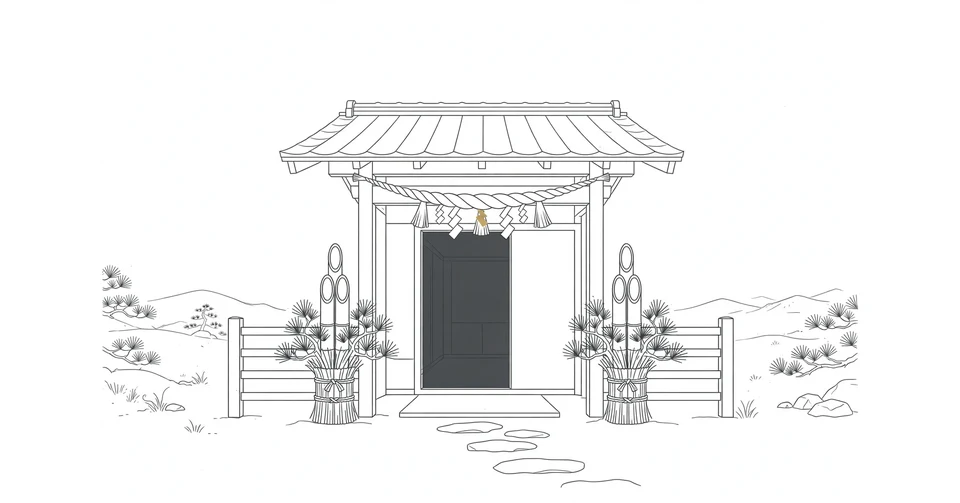
This article follows that visit from start to finish. It looks at who Toshigami is, where the belief comes from, how a household prepares, what the deity is offered, and how the visit ends in fire in the middle of January. Along the way it also draws a line that is easy to miss. Toshigami is not a shrine god in the ordinary sense. Toshigami is a guest god, and the difference changes everything about how the New Year is kept.
Who toshigami is
Toshigami, written with the characters for year and deity and often spoken of with the honorific as Toshigami-sama, is the kami of the new year. The name is also given as Otoshi-no-kami, the great year god, and the deity belongs to the Shinto pantheon. Yet the name on its own tells only half the story. To understand Toshigami, it helps to know that the belief is a folk one, handed down through households rather than handed down from a single shrine or a single priesthood.
In that folk belief, Toshigami gathers several beings into one visitor. The deity is the god of good fortune, the spirits of the ancestors, and the god of grains, arriving together as a single welcome guest. The idea is old. In ancient Japan, people believed that ancestral spirits and harvest deities came down from the mountains to each household at the start of the year, and the visiting deity they welcomed was Toshigami. The god was understood to deliver life energy and blessings for the coming year, and the blessings were practical ones. Health for the family, a rich harvest, success in business, and happiness in the home were all part of the visit.
That practical character is worth noticing. Toshigami is not a god of thunder or war, and the deity does not appear in a famous battle or a great quest. Toshigami is a god of the year turning, and the year turning is something every household experiences, whether it farms rice or works in an office. A god who brings health and a good harvest speaks to everyone, because everyone eats and everyone gets sick. I find that honesty appealing. A religion that gives its most important visitor the job of keeping a family healthy and fed has its priorities in the right place.
There is also an old story about the family of Toshigami. According to the Kojiki, the oldest surviving chronicle of Japan, Toshigami was the son of Susanoo, the storm god, and Kamuo Ichihime, and the older brother of Ukanomitama, the deity of food and agriculture. The family connection is fitting. A god of the harvest who is the brother of the god of food belongs to a family that feeds people. It also places Toshigami inside the great myths of Japan, not outside them. The deity is not a minor local spirit invented for a single village. Toshigami has a place in the old stories, even if the stories do not linger on the visit itself.
The name that began as a harvest
The word Toshigami carries its history inside it. The character for year, nen, originally meant harvest. The harvest came once a year, so the word for the harvest slowly became the word for the year itself. Toshigami was therefore first of all the god of abundant harvests, and specifically of grain or rice. The character for kami means god or deity, so the full name can be read as the god of the year, the god of the harvest, or both at once. The two readings are not in conflict. In a farming country, the year is the harvest, and the harvest is the year.
That old meaning explains why so much of the New Year in Japan still smells of rice. The straw of the decorations is rice straw. The cakes offered to the deity are rice cakes. The wine poured out is rice wine. The whole season is built from the crop that fed the country for centuries, and the guest at the centre of it is the god of that crop. Even today, when most Japanese people buy their rice in a supermarket and have never stood in a paddy field, the New Year still runs on rice. The symbols have outlived the farming life that made them, and they carry the old meaning with them.
It is a useful reminder that words keep their past. When a family today says that Toshigami is coming, it is using a word that once meant the harvest coming in. The year is new, the rice is in, and the god who watched over the fields is now expected at the front door. The seasons of farming and the seasons of the calendar have folded into each other, and the name of the deity is the fold.
There is a home given for Toshigami in the old belief, and it is a real place. The deity's home is said to be on Shimokoshiki-shima, an island off the coast of Kagoshima Prefecture in Kyushu. The detail is a small one, but it matters. A god with a home somewhere is a god who travels, and a god who travels is a god who can visit. Toshigami is not imagined as sitting permanently in one shrine, waiting for worshippers to come. Toshigami is imagined as setting out from an island in the south and arriving at every front door in the country.
A god who visits instead of waiting
Most gods in Japan are visited. A person goes to a shrine, walks under the torii gate, washes hands and mouth at the basin, and stands before the hall to pray. The god stays where the god is, and the worshipper does the travelling. Toshigami reverses the arrangement. At the New Year, the god does the travelling, and the household does the waiting. That single reversal explains the entire season.
Because Toshigami is coming to the house, the house must be made ready in a way a shrine never has to be made ready by its visitors. A shrine is cleaned by its priests. A home is cleaned by the family that lives in it. The welcome is not a matter of walking to a holy place. It is a matter of turning an ordinary place into a holy place for a week or so, and then turning it back again. The home borrows the language of the shrine, the rope and the pine and the offering, and speaks it over its own rooms.
This is why the preparations for Toshigami feel so personal. Nobody else can clean your house for you in the way that matters. A cleaning service could scrub the floors, but the ritual cleaning of the year end is not about dirt. It is about the household saying, with its own hands, that it is ready. Toshigami notices the difference between a house that has been prepared and a house that has been decorated. The first is a welcome. The second is a display.
I think there is something quietly democratic about a visiting god. A shrine god can be far away, up a mountain or across a prefecture, and a poor person may never make the journey. A visiting god comes to every door, rich or poor, and the welcome costs little more than effort and attention. Straw is cheap. Rice cakes are cheap. A clean floor costs nothing but time. Toshigami is a god for households, and households are where most of life actually happens.
How a house prepares for toshigami
The preparations begin long before the decorations go up. Traditionally they start on December 13, a day known as Shogatsu Kotohajime, the start of New Year preparations. Today many families begin after Christmas, when the shops fill with pine and straw and the television starts counting down. Whenever it starts, the first job is always the same. The house is cleaned.
The great year end cleaning is called osouji, and in its older form it is known as susuharai, the sweeping away of soot. It is not ordinary housework. It is a ritual to purify the house and welcome Toshigami into a clean and fresh environment. Every room is cleaned, the high shelves are dusted, the corners that are ignored all year are finally reached, and the house is put in order from top to bottom. The cleaning is the real offering, and the decorations that follow are only the sign that the cleaning is done.
There is a practical reason for the order, and it is also a moral one. A rope hung over a dirty doorway would be a decoration without the work behind it. Clean first, then decorate. The sequence teaches something that applies far beyond the New Year. Preparation is the gift, and the visible sign is only the wrapping. Anyone can buy a decoration. Not everyone will scrub the floor beneath it, and the god, if the god is paying attention, will know the difference.
Once the house is clean, the decorations go up, and each one has a job in the welcome of Toshigami. A kadomatsu stands at the gate as a marker. A shimekazari hangs over the door as a boundary. A kagami mochi sits in the best room as a seat and an offering. Osechi is cooked as a meal to share. Together they form a complete system, and each piece only makes full sense when the god it serves is understood.
Timing matters too. The decorations are best put up by December 28, and two days are avoided. December 29 is avoided because the number nine sounds like the word for suffering. December 31 is avoided because hanging a decoration on the last night is called a one night decoration, and it is considered rude to the deity, as if the welcome had been left to the last minute. A guest who is welcomed properly is welcomed early, and a god is no different.
Kadomatsu, the signpost at the gate
The first thing Toshigami needs, according to the custom, is a way to find the house. A kadomatsu is a pair of pine and bamboo decorations placed at the entrance, and it serves as a guidepost so that the deity can find the way. Pine represents longevity, bamboo symbolizes strength and growth, and plum blossom, when it is added, stands for resilience. The kadomatsu is a signpost written in plants, and its message is simple. This house is expecting someone. This is the door.
The kadomatsu is also a yorishiro, an object into which a deity can descend, and it was originally an offering to Toshigami. The distinction between a signpost and a seat is a fine one, and the kadomatsu is a little of both. It marks the place, and it holds the place. A full account of the decoration, its pine and bamboo and the way it stands at the gate, is given in an article on this site about the kadomatsu, and it is worth reading alongside this one. The kadomatsu stays standing through the days when the deity is believed to be in residence, a period called matsunouchi, which runs to around January 7 in the Kanto region around Tokyo and to around January 15 in Kansai, around Kyoto and Osaka.
I have always liked the idea of a signpost for a god. It suggests that even a deity might need directions, and that a household can be helpful rather than merely obedient. The family does not only pray. It puts up a sign, the way a person waiting for a friend at an airport holds up a name card. The welcome is active. The house goes out to meet the guest, starting at the gate.
The rope over the door
Above the front door hangs the shimekazari, the small decorated straw rope that marks the entrance as clean and protected. The rope is a household version of the great shimenawa of the shrines, shrunk to the size of a doorway and dressed with fern, pine, paper streamers, and a bitter orange. Its purpose is to prepare the home to receive Toshigami and to keep the fresh purity of the new year intact, and it works in two directions at once. It keeps bad luck and impure things out of the house, and it keeps the purity of the new year in.
The rope is the clearest sign that the house has been set apart. The white zigzag paper strips on it, called shide, are the same paper that hangs at shrines, and wherever shide appears it says that a space has been marked as sacred. The straw itself is rice straw, twisted to the left, and it carries the harvest into the doorway. A detailed account of the rope, its parts, and the story of the sun goddess that lies behind it is given in an article on this site about the shimekazari. Read together, the rope and the pine gate describe a single threshold. The kadomatsu says where the god should enter. The shimekazari says that the entrance is clean enough to enter through.
The rope also tells us something about the nature of the visit. Toshigami does not enter through a window or a back door. The deity enters through the front, under the rope, the way an honoured guest enters a house. The household does not hide the welcome. It hangs it where the street can see it, so that the neighbours know a preparation has been made, and so that Toshigami knows which door is ready. There is a social side to the custom as well as a religious one. A street where every door carries a rope is a street that has agreed, together, that the year is worth welcoming properly.
Kagami mochi, the seat at the table
Inside the house, in the best room, sits the kagami mochi. It is a stack of two round rice cakes, the lower one larger than the upper one, topped with a daidai, a bitter orange whose name sounds like the phrase for generation after generation. The name means mirror rice cake, because the round cakes resemble the old bronze mirrors of Japan. The kagami mochi is the offering at the centre of the welcome, and it is also the seat of Toshigami. Toshigami is believed to rest in it during the days of matsunouchi, the period when the pine decorations stand.
That idea, that a god would sit in a rice cake, can sound strange until it is placed beside the other objects in the house. The kadomatsu is a seat at the gate. The kagami mochi is a seat in the room. The house is full of places prepared for the guest, and the guest is expected to be present in them. The offering is not food left on a table for a god who eats elsewhere. It is a place made for a god who is here.
The two round cakes are often read as a symbol of harmony, and of the layering of years, one year laid upon another. The daidai on top carries the wish that the family line will continue from generation to generation. The rice cake is also a practical object. It is food, and food is what a guest is offered. To offer Toshigami a rice cake is to offer the god the best of the harvest, in the form the harvest takes when it is pounded, shaped, and set out with care.
The visit has an ending built into it, and the rice cake is part of that ending. On January 11, families perform kagamibiraki, the ceremony of opening the mirror, in which the kagami mochi is broken apart with the hands or a hammer, never cut with a knife, and eaten in soup or in sweet red bean porridge. Eating the rice cake is understood as receiving a share of the power and luck of the deity, and as a prayer for health in the year ahead. The god is not only welcomed and honoured. The god is shared, and the blessing is taken into the body. A guest who has been fed leaves something behind, and the household eats it.
For a fuller account of the deity whose visit the rice cake serves, including the old name Otoshi-no-kami and the story of the harvest behind it, the encyclopaedia entry on Toshigami is a useful place to start. It sets out the etymology, the mythology, and the belief that the decorations of the New Year were originally offerings to this one god.
Osechi, the meal shared with a god
The rice cake is not the only food prepared for the visit. Osechi ryori, the traditional New Year food, is a collection of dishes packed into tiered lacquered boxes called jubako and eaten during the first days of January. Each dish carries a wish, for health, longevity, prosperity, or family happiness. Black beans are eaten for health and hard work. Herring roe is eaten for many children. Sweet chestnuts, golden yellow, are eaten for wealth. Rolled kelp is eaten because its name sounds like the word for joy. The boxes are a catalogue of wishes, written in food.
The origin of osechi lies in offering. The dishes began as an offering to Toshigami, placed on a tray and set before the deity, and the family then shared the food to receive the blessing. The custom has been traced back to the Nara period, and its logic has not changed. To eat with a god is to share in the god's good fortune, and to prepare food for a god is to prepare the best food the household can manage. The meal is not a feast for its own sake. It is a meal with a guest, and the guest is the reason the food is special.
There is also a practical reason the food is cooked in advance, and it belongs to the same logic. The dishes are prepared to last for days, so that the household can rest during the New Year and the god of the kitchen can be allowed a break from the stove. A family that has cooked for days before the year turns can spend the first days of the year eating, resting, and being together. The work is done early so that the welcome itself can be unhurried. I value that part of the custom. A celebration that leaves the hosts exhausted has missed its own point.
What happens while toshigami stays
The days when Toshigami is believed to be in residence are called matsunouchi, the days of the pine. The name comes from the kadomatsu that stands at the gate for the whole period, and the length of the period depends on the region. In most of Japan, including Tokyo and the Kanto region, it runs to around January 7. In Kansai, around Kyoto and Osaka, it runs to around January 15. The difference is old, going back to a time when an order about the end of the New Year period reached the east but not the west, and the two regions kept different calendars ever after.
During matsunouchi, the house is in a particular state. The decorations are up, the rice cake is in place, and Toshigami is understood to be present. It is a time for visiting shrines, for greeting neighbours, for eating the prepared food, and for letting the year begin slowly. The first days of the year are not a rush. They are a stay, and the guest is the reason for the slowness. A household that hurries through the first week of the year has treated the guest as an interruption. A household that takes its time has treated the guest as the point.
The period also has a quiet discipline to it. The decorations are not left up forever. The pine comes down, the rope comes down, and the rice cake is eaten. A visit has a shape, and the shape includes an end. The custom does not pretend that the New Year lasts all year. It gives the New Year a week or two of ceremony, and then it lets ordinary life return. There is wisdom in that limit. A welcome that never ends stops being a welcome and becomes clutter.
Dondo-yaki sends toshigami home
The end of the visit is marked by fire. Dondo-yaki is the mid-January fire festival in which communities burn their New Year decorations, and it is the ceremony that sends Toshigami home. Around January 14 and 15, in fields, shrine precincts, and riverbeds across the country, tall bundles of bamboo, straw, pine, and reeds are built up, and residents bring their kadomatsu, their shimekazari, their old charms, and their first calligraphy of the year to add to the pile. The structure is set alight in a ceremony that is festive and sacred at once, and the flames are understood to send Toshigami back to the heavens, to purify the impurities of the past year, and to usher in health and good fortune for the year ahead.
The fire is not treated as disposal. The decorations are not rubbish, and they are not thrown away. They are returned, respectfully, to the elements, and the smoke is understood to carry thanks upward. In some places, mochi is roasted over the flames and eaten, in the belief that it will bring good health for the year. Children in some towns collect the decorations from each house and carry them to the fire themselves. A full account of the festival, its history back to the Heian period court ritual of sagicho, and its many regional names is given in a guide to dondo-yaki. It is the clearest single account of how the season closes.
The fire completes the story that the cleaning began. The house was purified to receive the guest, and the decorations are purified by fire to send the guest away. The welcome and the farewell are mirror images of each other. One is done with water and a broom. The other is done with flame. Both are acts of care, and both say the same thing. The visit mattered, and it is over, and the year can now begin in earnest.
There is a detail in the custom that I keep coming back to. The decorations are burned, not kept. A family could keep a shimekazari on a shelf as a souvenir, but the custom says to let it go. The blessing is not in the object. The blessing is in the visit, and the object has done its work. Letting the straw burn is a way of saying that the year does not live in things. It lives in the people who prepared for it, and they are still standing there, watching the smoke rise.
Toshigami and the kami of the shrines
It is worth drawing the line clearly now, because the difference between Toshigami and the kami of the shrines is the key to the whole custom. Most kami have a shrine, a place where they reside and where worshippers come to them. Amaterasu has Ise. Hachiman has thousands of shrines across the country. The ujigami, the local guardian deity, has a shrine in the neighbourhood, and the family goes to it. The relationship is stable, fixed in place, and built around visits made by people.
Toshigami has no shrine of that kind. The deity is not enshrined in one place waiting for worshippers. Toshigami is a folk deity of the household, and the household is the shrine for a week or two each year. The god arrives, stays in the rice cake and by the pine at the gate, and leaves in the smoke of the fire. The shrine is temporary, the residence is temporary, and the worship is temporary. Then ordinary life returns, and the god returns to the island in the south until the next year.
That difference also explains why the belief feels so personal. A shrine is public, shared by a whole community, and its rituals are performed by priests. A household welcome is private, performed by the family, and shaped by the family's own habits. A household that hangs a small rope on an apartment door and a household that stands a great kadomatsu at a farmhouse gate are doing the same thing at different scales, and neither needs a priest to do it. The custom belongs to the people who keep it.
There is a further difference, and it is a theological one. The kami of the shrines are distinct beings with their own stories, and they are worshipped as themselves. Toshigami gathers several beings into one visitor, the god of good fortune, the ancestral spirits, and the god of grains. The deity is less a single person and more a meeting, a moment in the year when the powers a household depends on arrive together. That is why the welcome is so broad. It is not a prayer to one god for one thing. It is a prayer to everything that keeps a family alive, arriving at the door at once.
I do not think the distinction makes Toshigami a lesser god. If anything, it makes the deity a more honest one. A god who lives in a shrine can be admired from a distance. A god who comes to dinner has to be reckoned with. The household must clean, cook, decorate, and make room, and in doing so it discovers what it actually believes. Belief that costs nothing is easy to hold. Belief that costs a week of cleaning and cooking is a belief that has been tested, and the test is the point.
Why a guest god still matters
The New Year in Japan today is full of things that have nothing to do with Toshigami. There are countdown parties, television specials, sales, travel, and fireworks. Many households hang a shimekazari because their parents did, or because the neighbours do, or because the shops sell them in December and the street looks bare without them. Not everyone who prepares for the New Year believes in Toshigami in a literal sense. The custom survives on habit as much as on belief, and that does not make it empty.
What survives in the habit is the structure of the welcome. A family still cleans its house together. It still marks its door. It still cooks food in advance and eats it together. It still gathers at a fire in January to let the old things go. The deity may be doubted, but the acts Toshigami inspired are still performed, and the acts still do their work. A house that has been cleaned feels different to live in. A meal that has been cooked with care tastes different. A fire watched together in winter is a memory that lasts.
That is the deeper reason the custom has lasted. It is not only a belief about a god. It is a schedule for doing the things a household needs to do anyway, given a sacred reason to do them. Clean the house. Mark the door. Cook for the people you love. Let go of what is finished. Toshigami is the reason, but the acts are the reward, and the reward arrives whether or not the guest is real.
The idea of the guest also gives the New Year a shape that a mere date on a calendar cannot give it. A year that simply turns is an abstraction. A year that arrives as a guest, is welcomed, fed, honoured, and sent home with thanks, is an event. It has a beginning, a middle, and an end, and the household is a participant in all three. The family is not watching the year change. It is hosting it.
So the pine stands at the gate, the rope hangs over the door, and the rice cakes wait in the best room, and all of it is done for Toshigami, the guest Japan prepares the whole house for. The preparations are the belief, made visible. A clean house, a marked door, and a shared meal are not the decorations of a welcome. They are the welcome itself, and they are enough. When the fire takes the decorations in January and the smoke rises, the house stands ready for whatever the year brings, its doorway clean, its people together, and its guest already on the way home, carrying the thanks of the household with the smoke into the winter sky.
More in Culture & Society
- Matsunouchi Is the Week Japan Keeps the Pine Up for Its Guest
- Urajiro Is the Fern That Wishes a Family Twice Over
- A Shimekazari Hangs the New Year Over the Front Door
- Make-Koshi Is the Eight Loss Line That Sends a Sumo Wrestler Down
- Japanese Arcades and the Game Centers That Refuse to Die
- Danpatsu-Shiki Is the Haircut That Ends a Sumo Career
Latest posts
- Osouji Is the Cleaning Japan Does Before the Gods Arrive
- Japanese Anime and How a Niche Hobby Conquered the World
- Kachi-Koshi Is the Eight Win Line That Moves a Sumo Wrestler Up
- Tachiai Is the One Second That Decides a Sumo Bout
- A Gunbai Points at the Winner and Nobody Argues
- Izakaya, the After-Work Pubs Where Japan Unwinds
- Dondo-Yaki Is the Fire That Closes the Japanese New Year
- Hakkeyoi Is the Word That Starts a Sumo Bout
- A Yobidashi Calls the Wrestlers and Sweeps the Ring
- A Dohyo Is Sacred Ground Long Before the First Bout
- A Kadomatsu Guards the Door Until the New Year Fire
- A Shikona Gives a Wrestler His Second Name
- Japanese Street Food, From Takoyaki Stalls to Festival Yatai
- Komusubi Is the Smallest Chair at Sumo's Top Table
- A Sekiwake Waits One Win From Sumo's Highest Door